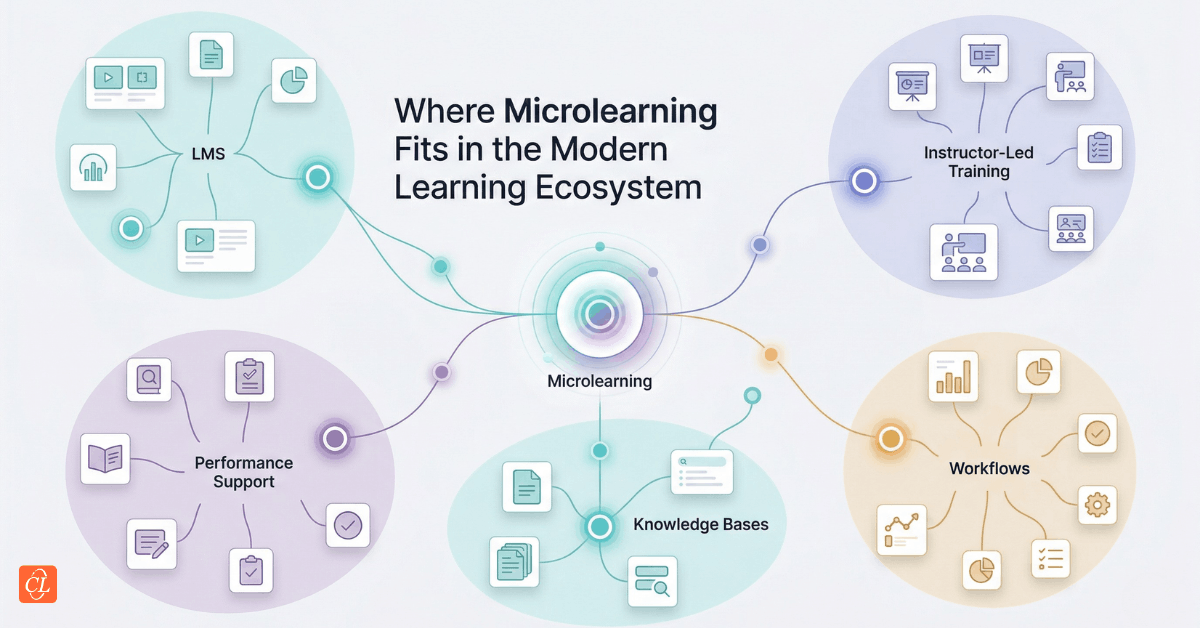
Microlearning becomes far more valuable when it is treated as part of a learning ecosystem rather than as a standalone content format.
That distinction matters because many organizations still approach microlearning too narrowly. They view it as a way to shorten courses, create quick videos, or modernize a few aging training assets. While those uses can be helpful, they do not capture the full strategic potential of microlearning. Its real strength lies in how well it can connect with broader learning models and help L&D teams redesign the overall learning experience around relevance, accessibility, reinforcement, and performance.
This is where the conversation around microlearning needs to mature.
This article explores how microlearning fits into blended and mobile learning models, how it supports social and on-demand learning, how it enables better analytics and reinforcement, how it can be used to convert legacy training assets, and how it should be positioned in future-state L&D strategy.
Download Now: Microlearning — Where Does It Fit in Your Learning Strategy?
Table of Contents
- Why Microlearning Matters More at the Ecosystem Level
- Microlearning as a Layer in the Modern Learning Architecture
- Where Microlearning Fits in Blended Learning
- Microlearning, Mobile Learning, and On-Demand Access
- Microlearning and Social Learning in Practice
- Using Microlearning to Counter Forgetting and Improve Reinforcement
- What Learning Analytics Reveal About Microlearning Value
- Converting Courses, ILT, and VILT Assets into Microlearning
- Microlearning in the Flow of Work and Future-State Learning Strategy
- Building a Smarter Learning Ecosystem with Microlearning at the Center
- FAQs
Why Microlearning Matters More at the Ecosystem Level
Microlearning is often introduced as a format improvement, but its bigger value appears at the systems level.
That is because most enterprise learning problems are not simply content problems. They are architecture problems. Employees forget what they learned because reinforcement is weak. Training feels disconnected because it sits too far from work. Long courses struggle because they attempt to carry the entire burden of capability-building on their own. Learning libraries grow, but usefulness does not always grow with them. These are not issues of length alone. They are issues of how learning is structured, sequenced, supported, and connected.
This is exactly where microlearning becomes strategically important.
What changes when microlearning is viewed at the ecosystem level
- Learning becomes more distributed across time
Instead of expecting one training event to do everything, organizations can support learning before, during, and after formal instruction. - Content becomes easier to maintain and reuse
Smaller, modular assets can often be updated and reorganized more efficiently than large single-purpose courses. - Learner access becomes more flexible
Employees can engage with relevant support in shorter windows and across more contexts. - Reinforcement becomes easier to design
Critical ideas can be revisited intentionally instead of being left to chance.
This broader lens matters because the future of enterprise learning will not be built on longer libraries of standalone content. It will be built on better-integrated learning systems. Microlearning can play a major role in that transition.
Microlearning as a Layer in the Modern Learning Architecture
To understand microlearning strategically, it helps to stop treating it as a separate training category and start seeing it as a layer within the wider learning architecture.
This layer can serve different purposes depending on where it is placed. It can prepare learners before a program begins, break complexity into manageable parts during learning, reinforce key ideas after instruction, support application in the workflow, or help employees retrieve knowledge at moments of need.
That flexibility is what makes microlearning so useful in modern L&D.
Rather than replacing other learning forms, microlearning often strengthens them by filling the gaps they leave behind. Instructor-led learning can provide discussion, alignment, and guided exploration. Longer digital modules can establish broader conceptual understanding. Coaching can support behavior change over time. Microlearning adds focus, repetition, and accessibility around these experiences.
A practical view of microlearning inside the learning architecture
| Learning Layer | Role of Microlearning | Strategic Value |
| Before formal learning | Priming, readiness, orientation | Reduces ramp-up and improves preparedness |
| During structured learning | Chunking, recap, quick practice | Improves clarity and reduces overload |
| After training | Reinforcement, recall, refreshers | Supports retention and transfer |
| During work | Job support, reminders, decision help | Improves execution and consistency |
| During change | Updates, launch communication, new feature support | Speeds adoption and lowers confusion |
This view is particularly useful because it keeps microlearning from being overclaimed. It does not need to do everything. It only needs to do the things it is particularly well suited to do. When learning teams accept that, they can design more coherently and avoid using microlearning as a fashionable substitute for stronger instructional design.
In other words, microlearning works best not when it is isolated, but when it is orchestrated.
Where Microlearning Fits in Blended Learning
Blended learning is one of the most natural homes for microlearning because it depends on orchestration rather than uniform delivery.
A strong blended learning experience is not simply a mix of instructor-led and digital content. It is a deliberately sequenced journey in which each learning element plays a distinct role. Some parts build awareness. Some deepen understanding. Some enable discussion and practice. Some support application and follow-through. Microlearning fits well into this structure because it can strengthen multiple stages without demanding long stretches of learner time.
This is particularly useful in enterprise settings where blended learning must support busy employees, distributed teams, and varied training needs.
Where microlearning adds value inside blended learning
Before a live session, microlearning can build readiness. Learners can arrive with baseline knowledge, shared vocabulary, or early exposure to the topic, which allows the live experience to focus on discussion and application rather than basic transmission.
During a blended program, microlearning can reinforce key concepts between larger learning moments. It can also be used to break up complexity and help learners process ideas in smaller units.
After workshops, virtual sessions, or structured digital learning, microlearning becomes especially valuable as a follow-through mechanism. Instead of allowing learning momentum to disappear once the formal event ends, L&D teams can use short assets to refresh, reinforce, and reactivate key concepts over time.
Typical blended learning roles for microlearning
- pre-session primers
- post-session recaps
- scenario-based practice between live events
- manager reinforcement prompts
- spaced recall activities after structured learning
- short performance support assets tied to application tasks
This makes microlearning particularly effective in flipped classroom models as well. When baseline knowledge is delivered in smaller pre-work assets, live sessions can focus on higher-value interaction, reflection, and problem-solving. That usually results in better use of facilitator time and stronger learner engagement.
The larger point is this: blended learning works best when each component is designed for a specific purpose. Microlearning helps make that purpose more precise.
Microlearning, Mobile Learning, and On-Demand Access
Microlearning and mobile learning are often discussed together, but they are not identical concepts. That distinction is important.
Microlearning refers to the instructional design approach: focused, short-form learning built around a narrow objective or support need. Mobile learning refers to the delivery environment: learning accessed through mobile devices and often shaped by on-the-go use conditions. These two often work well together, but one does not automatically guarantee the other.
That said, mobile access has significantly strengthened the value of microlearning in workplace settings.
When learning is designed for small windows of time and immediate relevance, mobile delivery often becomes a natural fit. Employees in the field, on the move, between meetings, or working across distributed environments benefit from learning they can access quickly without sitting down for a full training event.
But good mobile microlearning requires more than shrinking content to fit a smaller screen. It requires design decisions that respect mobile use conditions:
- clear interfaces
- concise structure
- rapid relevance
- low navigation burden
- formats suited to short engagement windows
The same logic applies to on-demand learning more broadly. Employees increasingly expect support that is searchable, accessible, and available when needed rather than tied only to scheduled training. Microlearning strengthens this model because it turns learning into something that can be retrieved as needed instead of only attended in advance.
Microlearning and Social Learning in Practice
Social learning is another area where microlearning can add value, though often in more subtle ways than teams initially expect.
At first glance, microlearning may seem highly individual while social learning seems collaborative. But in practice, the two can complement each other well. Social learning depends on shared interpretation, observation, dialogue, peer exchange, and collective reflection. Microlearning can support these activities by giving people smaller, more focused prompts or shared artifacts around which interaction happens.
Ways microlearning can support social learning
- short discussion starters before team conversations
- peer-shared examples of good practice
- short scenarios used in manager-led debriefs
- quick video prompts that spark reflection
- reinforcement assets circulated through communities of practice
- role-based prompts used in collaborative problem-solving
This is especially useful because many organizations want social learning, but struggle to make it concrete. Conversations remain vague unless there is something focused to anchor them. Microlearning can provide that anchor.
It also works well in digital collaboration environments. Learning teams can use short assets inside enterprise social platforms, team channels, or community spaces to create recurring moments of engagement that feel lighter and more sustainable than formal programs.
That said, social learning still requires intentional facilitation. Microlearning can prompt the exchange, but it does not guarantee it. The real value appears when short assets are woven into manager coaching, peer discussion, team reflection, and knowledge-sharing routines.
Using Microlearning to Counter Forgetting and Improve Reinforcement
One of the most strategically important roles microlearning plays in the modern learning ecosystem is helping organizations deal with forgetting.
This matters because many learning investments lose value not during the event, but after it. Employees attend sessions, complete courses, and even perform well in assessments, only to lose recall over time because nothing meaningfully brings the learning back into view. The forgetting problem is not new, but in fast-changing business environments it becomes even more costly. When knowledge decays quickly, organizations must retrain more often, performance gaps reopen, and capability-building becomes less efficient.
Microlearning is especially effective here because reinforcement is one of its natural strengths.
Instead of relying on one large review session long after the original learning event, L&D teams can use small, spaced interventions to reactivate knowledge and support retrieval over time. These can take the form of short quizzes, scenario reminders, key-point videos, prompt cards, or decision-based refreshers.
Where reinforcement microlearning is especially valuable
- post-training retention
- compliance follow-ups
- onboarding continuation
- sales and product refreshers
- software adoption after rollout
- manager capability reinforcement
- safety reminders in operational settings
This role is critical because it changes how training effectiveness is understood. Instead of assuming that learning ends when delivery ends, reinforcement-oriented microlearning recognizes that capability often depends on what happens after the formal event.
That makes microlearning not only a design tactic, but a durability strategy for learning.
What Learning Analytics Reveal About Microlearning Value
Microlearning can also improve the quality of learning analytics, though not simply because it produces more data points.
The more meaningful advantage is that modular learning assets often create clearer signals about learner behavior. When content is shorter, more focused, and deployed at specific moments in a learning journey or workflow, teams can often see more precisely what is being used, when it is being used, and where value may or may not be emerging.
That visibility can be helpful, but only if analytics are interpreted intelligently.
Completion rates alone rarely tell the full story. A learner may complete a short asset because it is quick, not because it was useful. Similarly, repeated access may signal value, confusion, or both. The real strength of microlearning analytics lies in combining usage patterns with context.
What teams should look for in microlearning analytics
- which assets are accessed repeatedly
- where learners return after formal programs
- what support is used close to work moments
- which reinforcement assets sustain engagement over time
- which topics attract use but still correlate with performance gaps
- where learners stop engaging, ignore, or bypass content
This kind of analysis can help L&D teams answer better questions:
- Are learners actually using the support that was designed for the flow of work?
- Which parts of a blended program need stronger reinforcement?
- What content is functioning as reference rather than instruction?
- Which assets are proving valuable enough to replicate elsewhere?
Analytics become more meaningful when they are tied to the role microlearning is supposed to play. A quick-reference asset should not be judged in the same way as a short explainer module. A reinforcement quiz should not be interpreted the same way as a video watched before a live workshop. The more clearly asset purpose is defined, the more useful the analytics become.
That is why microlearning can strengthen not only learning delivery, but also learning insight.
Converting Courses, ILT, and VILT Assets into Microlearning
One of the most practical strategic opportunities for microlearning lies in content conversion.
Many organizations already possess large amounts of learning content in the form of legacy eLearning, instructor-led training materials, virtual session recordings, slide decks, process documentation, and product training resources. The challenge is not always lack of content. It is that much of this content was created for a different learning model: longer sessions, event-based delivery, and less flexible access.
Microlearning offers a way to rethink these assets, but conversion should be approached carefully.
Simply cutting a long course into smaller pieces does not automatically create effective microlearning. Nor does uploading clips from a virtual session guarantee learner usefulness. Strong conversion depends on redesign, not just resizing.
What smart conversion involves
A strong conversion process begins by identifying the most valuable learning moments, concepts, decisions, or process steps within the original material. These are then reorganized into focused units aligned to specific learner needs.
For example:
- an ILT workshop may yield short primers, recap assets, and post-session reinforcement pieces
- a long eLearning course may be restructured into task-based learning units and reference assets
- a VILT recording may be repurposed into targeted concept explainers or scenario discussions
- a curriculum may be redesigned into a sequence of modular assets tied to stages of performance
What not to do during conversion
- preserve the original structure when it no longer serves the learner
- keep unnecessary introductions, transitions, or facilitator language
- assume every part of a course deserves conversion
- substitute fragmentation for instructional design
The best conversion work is not about salvaging everything. It is about extracting what still matters and redesigning it for better usability, relevance, and reinforcement.
This is one of the clearest ways microlearning can help organizations modernize training without starting from zero.
Microlearning in the Flow of Work and Future-State Learning Strategy
Perhaps the most forward-looking role of microlearning is how well it supports the broader shift toward learning in the flow of work.
This shift reflects a basic reality: employees increasingly need learning that is not fully separated from performance. They still need structured programs for foundational development, but they also need support that appears closer to the moments where decisions, tasks, and interactions unfold. This does not eliminate formal training. It changes how formal training is complemented.
Microlearning is particularly valuable here because it can sit closer to execution than many other learning forms. It can appear through searchable libraries, platform prompts, team systems, workflow tools, manager support, product environments, or performance enablement channels. In that role, it becomes less about attendance and more about readiness, recall, and action.
Why microlearning aligns with future-state learning strategy
- it supports continuous learning rather than single-event dependency
- it fits hybrid, distributed, and fast-changing work contexts
- it helps connect formal and informal learning
- it supports just-in-time performance enablement
- it makes modular learning design more scalable
- it works well alongside AI-assisted content operations and dynamic learning delivery
This does not mean every future trend should be attached to microlearning. It means microlearning is well positioned to support several of the core shifts already reshaping L&D such as greater modularity, stronger workflow integration, more targeted reinforcement, more flexible content reuse, and better alignment between training and performance.
For learning leaders, this is the important strategic takeaway: microlearning should not be treated only as a content format to deploy. It should be treated as part of how the learning function evolves.
That evolution is not toward smaller learning for its own sake. It is toward more usable learning ecosystems.
Building a Smarter Learning Ecosystem with Microlearning at the Center
When microlearning is positioned well, it does not sit on the edge of the learning strategy. It helps connect multiple parts of it.
It can support the design of blended programs, strengthen mobile and on-demand access, enable social learning moments, improve reinforcement, make analytics more meaningful, modernize old content, and extend support into the workflow. Few learning approaches can play across that many dimensions while still remaining focused and practical.
That is why this cluster matters. It moves the conversation from “Should we use microlearning?” to a much more strategic question:
How should microlearning help reshape the overall learning ecosystem?
A smart answer usually includes several commitments:
- treating microlearning as modular infrastructure, not just asset production
- using it to strengthen journeys before, during, and after formal learning
- designing for reinforcement and point-of-need support, not just consumption
- converting older content through redesign rather than mechanical compression
- integrating microlearning into broader learning, workflow, and analytics systems
This approach helps L&D teams avoid two common errors. The first is underestimating microlearning and using it only for quick wins. The second is overestimating it and expecting it to replace every other form of learning. The strongest strategy sits between those extremes.
Microlearning is most powerful when it is given a clear role in a larger learning architecture and used to improve how that architecture functions as a whole.
That is not a small contribution. It is a structural one.
FAQs
1. Where does microlearning fit in a learning strategy?
Microlearning fits best as a supporting layer within the broader learning strategy. It can prepare learners before formal training, reinforce learning afterward, support blended learning journeys, provide point-of-need performance support, and strengthen continuous learning across the employee experience.
2. How does microlearning support blended learning?
Microlearning supports blended learning by building readiness before live sessions, reinforcing concepts between learning events, and sustaining retention after formal instruction ends. It helps make blended programs more focused, flexible, and effective over time.
3. Is microlearning the same as mobile learning?
No. Microlearning is an instructional design approach based on focused, short learning experiences, while mobile learning refers to access through mobile devices. The two often work well together, but mobile delivery alone does not make content effective microlearning.
4. Can eLearning be converted into microlearning?
Yes, but effective conversion requires redesign, not just cutting longer courses into smaller parts. Strong conversion identifies key learning moments, narrows objectives, removes unnecessary content, and reorganizes material into focused assets that are easier to use and reinforce.
5. How does microlearning help with social learning?
Microlearning can support social learning by providing short videos, scenarios, prompts, or cases that spark discussion, reflection, and peer exchange. It works especially well when integrated into team conversations, manager coaching, or collaborative digital spaces.
6. What role does microlearning play in learning analytics?
Microlearning can improve analytics by creating clearer signals around content use, repeat access, timing of engagement, and reinforcement behavior. These insights help L&D teams understand which assets are truly useful and where learning support is most needed.
7. Why is microlearning important for future-state learning strategy?
Microlearning is important because it supports modular learning design, workflow integration, on-demand access, reinforcement, and flexible content reuse. These qualities align well with how enterprise learning is evolving toward more continuous and performance-connected models.
Conclusion
Microlearning reaches its full value when it is no longer treated as just a shorter way to deliver training. Its real contribution is broader than format. It helps blended learning become more coherent, mobile learning become more usable, social learning become more concrete, reinforcement become more intentional, analytics become more revealing, and legacy training become more adaptable.
Most importantly, it helps learning move closer to work without abandoning the value of structured development.
For enterprise L&D teams, that is the real opportunity. Microlearning is not simply a content trend to adopt. It is a design and delivery capability that can help reshape the learning ecosystem around relevance, modularity, accessibility, and performance support. Used this way, microlearning does not compete with the larger strategy. It strengthens it. And that is exactly where its long-term strategic importance lie