Training the Last Mile: What Enterprise L&D Can Learn from Selling Technical Products to Farmers
Know Who’s Talking
Fabrício Peres
Fabrício Peres is the Founder of Faperes, where he helps AgInput and AgTech companies sell in Brazil by building commercial models that work in the field. His expertise spans farmer economics, value proposition design, go-to-market strategy, and field adoption, helping companies translate technical innovation into solutions farmers choose to buy.
Before founding Faperes, Fabrício spent 14 years at Syngenta in Brazil, across Latin America, and in global roles, working on the commercial side of agriculture. He approved and led Syngenta's sustainable innovation program and built Reverte, one of the largest regenerative agriculture programs in Brazil, restoring degraded soil across hundreds of thousands of hectares.
Today, he advises input manufacturers, carbon platforms, MRV companies, and AgTech founders whose success depends on farmer adoption, helping them align their products with the realities of the Brazilian field.
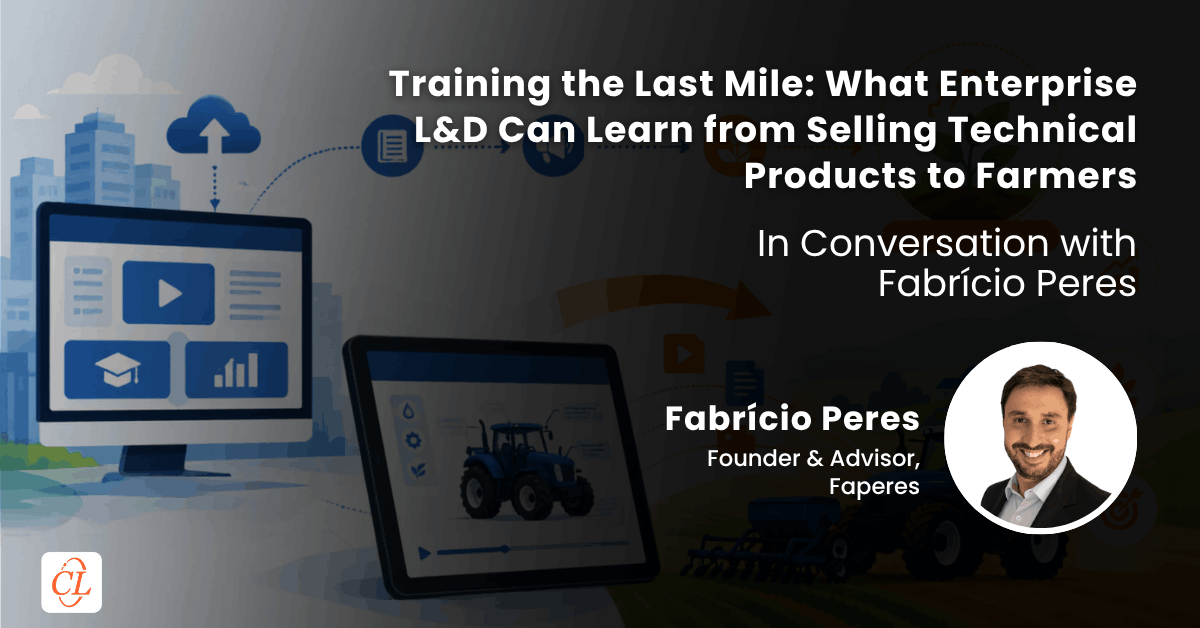
Welcome to CommLab India's eLearning Champions Podcast featuring Fabrício Peres, Founder of Faperes and an agribusiness advisor who helps organizations accelerate the adoption of new technologies and practices across farming communities.
In this episode, RK Prasad and Fabrício explore what enterprise Learning & Development can learn from helping farmers adopt change. Their conversation examines why knowledge alone rarely changes behavior, how risks and incentives shape decision-making, why listening matters more than telling, and how organizations can design solutions that people are willing to adopt.
Click Here To Read Transcript
00:00:01 Fabricio Peres
I'm Fabricio and I have about 20 years experience in agriculture.
00:00:12 Fabricio Peres
I work for almost the entire time in a leader of the sector.
00:00:14 Fabricio Peres
And my roles during this period have been about working with farmers, changing behaviours of farmers in the most diverse ways.
00:00:25 Fabricio Peres
from a commercial point of view, but also from a sustainability point of view, improving practices, safety practices, and so on.
00:00:33 Fabricio Peres
And that's where L&D learning and development have been very important to my role.
00:00:39 Fabricio Peres
I'm not an expert on the topic, but this particular agenda has been very, very relevant for my performance and for my agenda in the company, because it was about working with farmers, engaging with farmers, changing behaviour, right?
00:00:54 Fabricio Peres
Today I work as an advisor and consultant for companies, agribusiness companies that want to sell in Brazil.
00:01:02 Fabricio Peres
So international companies that have clearly Brazil as a next geography to enter and to operate.
00:01:09 Fabricio Peres
But it's a very complex geography.
00:01:12 Fabricio Peres
That's where I support them in order to understand the market, understand the possibilities, design the strategies and operate.
00:01:22 Fabricio Peres
Once they enter into the market and start to sell.
00:01:25 Fabricio Peres
And of course, working with farmers is the most relevant part of that because it's about these farmers getting to know these new organization, the products, the solutions that this company has to offer, and then yeah, adopting those technologies.
00:01:43 RK Prasad
So that was before that is after.
00:01:49 RK Prasad
Syngenta's experience, right?
00:01:52 Fabricio Peres
Yeah.
00:01:52 Fabricio Peres
So this work I have been doing in the past one and a half years, that's the time that I left Syngenta.
00:02:00 Fabricio Peres
Yeah, that's it.
00:02:02 Fabricio Peres
But also within Syngenta, there was very much my responsibility.
00:02:08 Fabricio Peres
Of course, when you are in the country, because I joined the company, the organization in the country, in Brazil.
00:02:15 Fabricio Peres
So I took local leadership roles.
00:02:19 Fabricio Peres
And then that evolved to regional roles for Latin America as a whole.
00:02:24 Fabricio Peres
And then in the past, so like 8 years ago, I moved to Basel with the company to take a global responsibility.
00:02:32 Fabricio Peres
So, and of course, I mean, when it comes to working with farmers, changing behaviors, as you change the geography and the scope of that, the approach needs also to adapt.
00:02:44 RK Prasad
Absolutely, absolutely.
00:02:47 RK Prasad
So I suppose you are currently in Brazil?
00:02:53 Fabricio Peres
No, I am still in Brazil.
00:02:54 Fabricio Peres
I am still in Switzerland.
00:02:56 RK Prasad
OK, you are still in Brazil.
00:02:57 RK Prasad
OK, so in your experience, have you worked with farmers outside Switzerland in your global role?
00:03:08 Fabricio Peres
I mean, not just Switzerland, I mean Brazil, of course, but the whole Latin America.
00:03:14 Fabricio Peres
With Argentinian farmers, Colombian farmers, Mexican farmers, Chilean farmers, Paraguayan farmers, then also with African farmers at my global role with that company, farmers in Asia, Thailand, India as well, China.
00:03:36 Fabricio Peres
So yeah, I mean, I had the opportunity and the privilege.
00:03:40 Fabricio Peres
To experience different geographies, different environments, different completely different farming contexts and challenges.
00:03:50 RK Prasad
Right.
00:03:50 RK Prasad
And also how much for like countries like China and India, how closely the farming community is woven into the society and the ancient practices.
00:04:08 RK Prasad
Which still go on in some parts of the country.
00:04:11 RK Prasad
I think that must have been very, very interesting when you work with not just there.
00:04:17 Fabricio Peres
I mean, Africa is also very interesting as well in that sense because the community, the cooperatives, the associations, they have a very important role in those environments, not just to better organize the farmers, right, but also to strengthen their voices.
00:04:37 Fabricio Peres
when it comes to negotiation of terms, bringing their products to the market.
00:04:43 Fabricio Peres
And that's where you're about bringing that closer to the society, right?
00:04:50 RK Prasad
So you have market yards where the middlemen will auction by their staff, at least in India, it happens.
00:05:01 RK Prasad
I find this personally very interesting because I started my career in it.
00:05:05 RK Prasad
In an agro firm and yeah, it was a government organization and it used to sell urea and phosphate and some kind of micro nutrient.
00:05:25 RK Prasad
And then after that, after a very long gap again, I went back to the agro industry.
00:05:30 RK Prasad
This time it was a private firm.
00:05:34 RK Prasad
And they were also selling more or less that, but they were also selling what was called named Farm Boone, which is more like a mixture which was customised to the farmers land depending on the soil testing.
00:05:49 RK Prasad
Yeah, and also organic fertilizer called, I think Flower Power or something like that.
00:06:00 RK Prasad
They used to make it out of the bagasse from the sugar plants.
00:06:05 RK Prasad
So that is very and I was the training manager there.
00:06:10 RK Prasad
So I can completely relate to the challenges when it comes to behavioral changes at the farmers level.
00:06:18 Fabricio Peres
Very good.
00:06:19 RK Prasad
Most of them are hereditary, you know, their great grandfather, grandfather, you know.
00:06:27 RK Prasad
Anyway, that is very interesting.
00:06:28 RK Prasad
So I again, once again, I think that you are a trained agronomist.
00:06:36 Fabricio Peres
No, my academic background is business, business management and business economics.
00:06:43 Fabricio Peres
But I learned agronomy during this 20 years, right?
00:06:48 RK Prasad
My God, that is that is a business management professional getting into such a technical thing.
00:06:56 RK Prasad
Yeah, I mean people study for 1010 years to understand agronomy and genetics and plant biology, all the pests and herb herbs and all these things.
00:07:11 RK Prasad
So how did you, how did you come into agriculture of all things?
00:07:19 Fabricio Peres
So before joining the company I was.
00:07:24 Fabricio Peres
I was a management consultant.
00:07:25 Fabricio Peres
So I started my career in consulting.
00:07:29 Fabricio Peres
I worked in consulting for like almost a decade.
00:07:33 Fabricio Peres
And I mean, as a consultant, I was working for a big, big for company, right?
00:07:39 RK Prasad
Okay.
00:07:40 Fabricio Peres
And then I joined a boutique management consulting firm.
00:07:45 Fabricio Peres
And as a consultant, I mean, that was the beauty.
00:07:47 Fabricio Peres
I mean, especially in the beginning of of the career, you you you are exposed to so many different topics.
00:07:53 Fabricio Peres
so many different industries.
00:07:55 Fabricio Peres
So just to give some examples, in the beginning of my career in consulting, I worked with mostly with telecommunication in the telecommunication industry, but also banking, retail, consumer goods, and this in terms of industries.
00:08:10 Fabricio Peres
And then in terms of topics, I had the chance to work with finance, so Sarbanes Oxley and this kind of things.
00:08:20 Fabricio Peres
So IT.
00:08:21 Fabricio Peres
Engineering in the telecommunication to understand all the engineering aspects of the communication, right?
00:08:28 Fabricio Peres
Commercial marketing, human resources as well, not learning and development, but it was more in terms of organizational setup, right?
00:08:40 RK Prasad
And design and performance management.
00:08:43 RK Prasad
Yeah.
00:08:44 Fabricio Peres
One of my first projects was a consolidation of a telecom company in Brazil.
00:08:50 Fabricio Peres
So they were entering in Brazil and they were acquiring different small companies in Brazil.
00:08:56 Fabricio Peres
It was a new regulation about the licensing of the telecommunications in Brazil.
00:09:01 Fabricio Peres
So this company, international company, was entering and buying these different operators.
00:09:07 Fabricio Peres
And the project was about.
00:09:09 Fabricio Peres
Consolidating all of that in terms of organizational setup, but also infrastructure.
00:09:16 Fabricio Peres
And then you went through all the process of capabilities, mapping, understanding where the company would go.
00:09:22 Fabricio Peres
So connecting that to the strategic plan of the company.
00:09:25 Fabricio Peres
It was a very nice project, but super challenging because we had to do all the design and start implementation with HR actually in like 6 months.
00:09:35 Fabricio Peres
So it was really tough.
00:09:37 Fabricio Peres
But you know.
00:09:39 Fabricio Peres
That's the beauty because when you have experience with different industries, you understand also the timing because for me it was a shock.
00:09:45 Fabricio Peres
I was in telecommunication.
00:09:47 Fabricio Peres
It was really short term.
00:09:49 Fabricio Peres
For example, strategic plan in that industry was a 3 years plan.
00:09:54 Fabricio Peres
Then I moved to agriculture, right?
00:09:56 Fabricio Peres
And then in agriculture, the long term plan was 15 years and the short term plan was 3 years.
00:10:05 RK Prasad
You know, not 3 months.
00:10:08 Fabricio Peres
Wow.
00:10:08 RK Prasad
So, but I think as you rightly said, I totally agree because you have, you know, tasted or rather experienced so many different industries, different priorities, different customers, different technologies.
00:10:25 RK Prasad
When you entered agriculture, probably you must have got some very creative ideas.
00:10:33 RK Prasad
As compared to a person who has always been in agriculture.
00:10:38 Fabricio Peres
Yeah, that's true.
00:10:39 Fabricio Peres
So just to conclude, and then one of the projects, project partner that I was working, the consulting, moved to the company that I was invited to join later and then he invited me to take the role.
00:10:50 Fabricio Peres
So RK, that's true because when I joined the company, there was a huge transformation process happening.
00:10:58 Fabricio Peres
They were changing the whole strategy of the company.
00:11:02 Fabricio Peres
to integrate different business units like crop protection, seeds, trying to become a solutions company, right?
00:11:10 Fabricio Peres
Integrated crop solutions.
00:11:12 Fabricio Peres
And then they were also developing services to incorporate all of that.
00:11:18 Fabricio Peres
So it was an integrated strategy approach.
00:11:22 Fabricio Peres
And in the company it was before, in the telecommunication company, they were in the convergence stage.
00:11:30 Fabricio Peres
What is that?
00:11:31 Fabricio Peres
So
00:11:32 Fabricio Peres
I don't know if, I mean, you recall that.
00:11:34 Fabricio Peres
So in the telecommunication, you first started with the voice, right?
00:11:39 Fabricio Peres
Then they incorporated the text.
00:11:41 Fabricio Peres
Yeah, right.
00:11:42 RK Prasad
And then the pictures.
00:11:43 Fabricio Peres
Part messages and then came the Internet.
00:11:46 Fabricio Peres
So all this convergence.
00:11:47 Fabricio Peres
So you could make lots of parallels in that.
00:11:50 RK Prasad
Right?
00:11:52 RK Prasad
Correct.
00:11:53 RK Prasad
So I'm sure you saw agriculture with a different set of eyes.
00:12:00 RK Prasad
And you could see bring in similarities, synergies, and synthesise all that knowledge you had, which is, I think, great.
00:12:13 RK Prasad
It also shows that you are a fantastically fast learner.
00:12:21 Fabricio Peres
Well, I mean, I had to develop that, right?
00:12:24 Fabricio Peres
I mean, when you move from topic to topic in such a short term.
00:12:28 RK Prasad
Yeah.
00:12:30 Fabricio Peres
Such a short term, you can't of develop that, right?
00:12:33 RK Prasad
Right.
00:12:34 RK Prasad
Okay, now you have worked with different economies and different agricultural environments.
00:12:43 RK Prasad
So your focus of bringing better practices would always meet with some challenges of adoption.
00:12:53 RK Prasad
Yeah, both at the practitioner level, that is at the farmer.
00:13:00 RK Prasad
And maybe even at the dealer level, the other associates in the supply chain, yeah, as well as the marketing representatives or agronomists who are a part of the system.
00:13:18 RK Prasad
Yeah.
00:13:20 RK Prasad
So there is always a very big challenge for something new, something better.
00:13:27 RK Prasad
And you get that resistance.
00:13:28 RK Prasad
So can you talk a little bit about the challenges and misconceptions of this, especially in the rural setup or the farming community setup?
00:13:40 Fabricio Peres
Yeah.
00:13:43 Fabricio Peres
So in my currently, as I said, I have been working with international companies to enter Brazil, right?
00:13:50 Fabricio Peres
And the.
00:13:52 Fabricio Peres
And I think that's very applicable to learning and development at all because the biggest misconception I see is about assuming that the farmers, they don't know, right?
00:14:02 Fabricio Peres
They don't know.
00:14:03 Fabricio Peres
And then and then these companies, organizations, some of them, they entering the market or it doesn't need to be an international company, can also be a local one.
00:14:13 Fabricio Peres
They enter in the market, trying to push all the knowledge, hey, this is how you need to do, this is why it's better and so on and so forth.
00:14:22 Fabricio Peres
But the farmer, when he's listening to that in a fraction of minutes, he already mapped the whole thing and he understood because he experienced that on a daily basis.
00:14:34 Fabricio Peres
And then it's not about and then the conversation needs to shift.
00:14:38 Fabricio Peres
If the company needs to be successful in that interaction, in that behavioral change objective,
00:14:46 Fabricio Peres
It needs to shift from a pushing to a learning, to a hearing point of view.
00:14:51 Fabricio Peres
So what are your challenges?
00:14:52 Fabricio Peres
How do you see that?
00:14:53 Fabricio Peres
Have you ever experienced that?
00:14:55 Fabricio Peres
How can we make difference?
00:14:56 Fabricio Peres
What are the trade offs that you face?
00:14:58 Fabricio Peres
How can we address those trade offs in order to minimise your risks?
00:15:03 Fabricio Peres
So this is very important because it's not about knowledge, it's about the risks, it's about the changes, the trade offs.
00:15:11 Fabricio Peres
So there are many other elements well beyond the knowledge itself.
00:15:17 Fabricio Peres
And actually, companies, they need to focus on the knowledge, but the bottleneck is not there.
00:15:22 Fabricio Peres
Actually, that is given, they know.
00:15:24 Fabricio Peres
I'm going to give you another example.
00:15:26 Fabricio Peres
I was also responsible for stewardship, okay, stewardship of crop protection products.
00:15:32 Fabricio Peres
So crop protection products, they are very sensitive product products because they require special conditions in order to....
00:15:44 Fabricio Peres
Be safe in order to be effective, right?
00:15:47 Fabricio Peres
So for example, a farmer or an operator they need to wear PPE, correct?
00:15:53 Fabricio Peres
Right?
00:15:54 Fabricio Peres
Because if you get if the product gets in contact with the eyes, if they inhalate and so on, it might have problems depending on the product, right?
00:16:04 Fabricio Peres
Correct.
00:16:05 Fabricio Peres
Even you have all the.
00:16:07 Fabricio Peres
The safety requirements in terms of reducing the dose rates and all of that, I mean, that's not objective of the product, right?
00:16:15 Fabricio Peres
And farmers, they know they need to wear PPE.
00:16:18 Fabricio Peres
So then for a long time, the company was focusing on the trainings, right?
00:16:24 Fabricio Peres
Hey, let's explain, let's raise the awareness of the importance of wearing PPEs because it can be harmful for you.
00:16:35 Fabricio Peres
In the short term, in the long run and all of that, and you need to read the label like this and so on and so forth.
00:16:43 Fabricio Peres
So the focus was entirely on the knowledge, but it was not that when you ask the farmer why you don't use, do you know?
00:16:49 Fabricio Peres
Yeah, of course I need, I know, of course I know.
00:16:53 Fabricio Peres
But why don't you use?
00:16:55 Fabricio Peres
Come on 40 degrees, all these helmets here.
00:16:59 Fabricio Peres
I mean, come on.
00:17:01 RK Prasad
I will be sweating my sweating to death inside and we.
00:17:04 Fabricio Peres
Need to be in the field for the whole day.
00:17:06 Fabricio Peres
So it is not, it is not practical.
00:17:09 Fabricio Peres
So then the whole industry was focusing on the knowledge when the problem was elsewhere.
00:17:18 Fabricio Peres
And you could go deeper.
00:17:21 Fabricio Peres
There were other situations that it was because of the neighbors because I mean if my neighbors they see me dressed like that.
00:17:28 Fabricio Peres
Yes, they will be scared.
00:17:30 Fabricio Peres
They will be scared.
00:17:32 Fabricio Peres
And then my whole community will start to blame me because of any kind of problem that might happen in the field.
00:17:38 Fabricio Peres
So then I don't wear it because if I wear that, they will say, hey, they are spraying.
00:17:44 Fabricio Peres
This is the guy.
00:17:46 Fabricio Peres
So there are many different aspects in all the geographies was about access, for instance.
00:17:53 Fabricio Peres
So the farmer.
00:17:55 Fabricio Peres
Wanted to use the PPE but could not afford it, so didn't have enough money to buy that or would have a very old one that was completely, you know, not in the good conditions to wear and to protect.
00:18:11 Fabricio Peres
Or he could not find the PPE in the shops.
00:18:15 Fabricio Peres
I mean, when we had the COVID, we could find the masks, remember.
00:18:22 Fabricio Peres
It was.
00:18:23 Fabricio Peres
He went on shortage of masks because everybody wanted to buy the masks.
00:18:28 Fabricio Peres
And then all of a sudden you had masks everywhere, customised masks and so on and so forth.
00:18:33 Fabricio Peres
So that's the point, you know, focusing too much on the knowledge when the knowledge many, many times is not a bottleneck.
00:18:44 RK Prasad
I mean, I'm being very, very honest with you.
00:18:48 RK Prasad
Most of my career I was in learning.
00:18:52 RK Prasad
And most of the time we focus on knowledge.
00:18:57 RK Prasad
This is the first time I heard a totally different kind of perspective.
00:19:02 RK Prasad
So let us go a little deeper if you don't mind.
00:19:05 RK Prasad
So you will find out a that do they have the knowledge?
00:19:11 RK Prasad
Most of the time they do have knowledge or at least they know that they don't know that knowledge but they know that there is a knowledge.
00:19:20 RK Prasad
Why don't they use it for other reasons?
00:19:25 RK Prasad
Okay, let us say you found out the other reasons.
00:19:30 RK Prasad
What would be your next step?
00:19:34 Fabricio Peres
That's a very good point as well.
00:19:37 Fabricio Peres
The technology or knowledge or product, I even say the product is not a solution, is not an offer.
00:19:49 Fabricio Peres
What do I mean by that?
00:19:51 Fabricio Peres
If you take a technology, let's take a software.
00:19:55 Fabricio Peres
If you just say, hey, use this software, that's not enough.
00:20:02 Fabricio Peres
You need to explain me how I use it.
00:20:04 Fabricio Peres
You need to, you need to pack that in a subscription mode.
00:20:09 Fabricio Peres
You need to all the terms they make part of this offer.
00:20:15 Fabricio Peres
Right.
00:20:15 Fabricio Peres
So the technology and the product alone is not enough.
00:20:19 Fabricio Peres
So in the case of PPE, for example, we had to work with the technology, with the clothes and PPEs themselves to develop that.
00:20:31 Fabricio Peres
We also had to do behavioural work with the farmer, with their families, you know.
00:20:39 Fabricio Peres
So for example, there was one program that we were working with the kids of the farmer.
00:20:45 Fabricio Peres
So then the kids would go to the parents and say, hey, you must wear PPE because that is dangerous.
00:20:50 Fabricio Peres
I learned that this is hard.
00:20:53 Fabricio Peres
This can be harmful for you.
00:20:54 Fabricio Peres
If you hear that from your kids, you will accept you change behaviour because you want to be perceived as an example.
00:21:02 Fabricio Peres
So you change behaviour, right?
00:21:05 Fabricio Peres
So if you hear from a company is different than.
00:21:09 Fabricio Peres
Hearing from your closed ones, even neighbors, in the case of the farmers, the neighbors, they play a very important role.
00:21:15 Fabricio Peres
So all of that needs to be incorporated into what I call the solution.
00:21:21 Fabricio Peres
So right approach, how you approach the terms, how you get access to that, you know, so understanding all these bottlenecks, you need to find solutions for each one of them and encapsulate them all together.
00:21:35 Fabricio Peres
And that becomes a solution.
00:21:37 Fabricio Peres
Not approaching that is yes.
00:21:41 RK Prasad
Wow.
00:21:44 RK Prasad
But when you when I heard this, it is the long but effective way of doing it.
00:21:52 RK Prasad
So people choose the short conduct a training program.
00:21:58 Fabricio Peres
Yeah.
00:21:59 RK Prasad
So you are first establishing credibility.
00:22:05 RK Prasad
You are really finding out what are the other issues and problems around this particular requirement, and then you are also identifying who should be the voice to tell this person.
00:22:23 RK Prasad
As you said, maybe his children, who knows, maybe his wife who has neighbors and then.
00:22:34 RK Prasad
You identify all these issues, come up with solutions, then bundle them together and present it to the farmer.
00:22:44 RK Prasad
Yeah, I'm sure it must have been very, very effective.
00:22:47 Fabricio Peres
Yeah, you know, you mentioned something about the short term, right?
00:22:51 Fabricio Peres
That's true.
00:22:52 Fabricio Peres
When you design the solution, you need to design in a way that is a long term solution, not a short term.
00:23:00 Fabricio Peres
That will bring next step that is an even bigger problem.
00:23:05 Fabricio Peres
However, you need when you put yourself in the shoe of the target, right of the farmer, of the employees, you need to fear short term issues.
00:23:22 Fabricio Peres
Because farmers, they care on what's going to happen on Monday.
00:23:28 Fabricio Peres
Correct.
00:23:29 RK Prasad
Yeah.
00:23:31 Fabricio Peres
And if you design your solution thinking on the problem for the next year, you will not be effective.
00:23:38 RK Prasad
So lose him.
00:23:40 Fabricio Peres
Solution needs to be designed that is effective in the long run.
00:23:44 Fabricio Peres
But the problem you are addressing is a short term problem for the farmer.
00:23:49 Fabricio Peres
Yes, otherwise it will not, it will not be sustainable in the long run.
00:23:54 RK Prasad
So yeah, go ahead, go ahead.
00:23:58 Fabricio Peres
Back to the example of the product and technology is not about saving the planet, right?
00:24:05 Fabricio Peres
It is not about saving the planet.
00:24:08 Fabricio Peres
It is about how can I reduce your cost of fertilizers today?
00:24:15 Fabricio Peres
With the war, with everything that's happening, the prices, they are super high.
00:24:20 Fabricio Peres
So it's not about saving the planet and reducing the emissions and fertilizer.
00:24:24 Fabricio Peres
No, it's about reducing your costs today.
00:24:27 Fabricio Peres
You see that.
00:24:28 Fabricio Peres
So at the end of the day, you want to reduce emissions.
00:24:32 Fabricio Peres
Fertilizers, they are a big part of that.
00:24:36 Fabricio Peres
But the way you present that, the solution, the value proposition is based on the short term economics of the farmer.
00:24:45 Fabricio Peres
If you talk about planet, he will not be, he will not be effective.
00:24:49 RK Prasad
He will be lost.
00:24:50 RK Prasad
I mean, he'll just not take you seriously in the first place.
00:24:55 RK Prasad
But tell me, is it not sometimes difficult to align the short term benefit which you are going to present to him with the long term solution?
00:25:08 RK Prasad
For example, let us take the same example.
00:25:10 RK Prasad
Let us say our long term solution is.
00:25:14 RK Prasad
You know, as you were saying, stewardship of the farmer, the soil, the climate, the economies.
00:25:24 RK Prasad
OK, now you are looking at that.
00:25:27 RK Prasad
But today he wants a cheaper fertilizer.
00:25:33 RK Prasad
Sometimes, don't you think that it will be very difficult for you to align them as the first steps to go into the long term?
00:25:42 Fabricio Peres
Absolutely.
00:25:43 Fabricio Peres
You need to think on the 2 dimensions.
00:25:46 Fabricio Peres
You can either improve the outputs and the outcomes or you can reduce the risks.
00:25:52 Fabricio Peres
So in some cases, the benefits they are misaligned.
00:25:58 Fabricio Peres
So you have the long term, you have the long term benefits, but you don't have the short term benefits.
00:26:06 Fabricio Peres
in the example I just gave, right?
00:26:07 Fabricio Peres
The long term is about saving the planet, but you also have the short term because the prices of the fertilizers, they are high and so on and so far.
00:26:15 Fabricio Peres
Imagine that the fertilizers prices, they are down and they are super cheap.
00:26:19 Fabricio Peres
So you have a misalignment of benefits because that is not present in the short term, right?
00:26:26 Fabricio Peres
But then you need to think on this is not the main.
00:26:31 Fabricio Peres
This is not the only reason you might have other reasons.
00:26:35 Fabricio Peres
You might also have the risks of the change.
00:26:39 Fabricio Peres
So if I do the change that you are telling me to do and it fails, who takes the blame?
00:26:46 Fabricio Peres
Who takes the full risk?
00:26:49 Fabricio Peres
If it's the farmer, he will not take that.
00:26:52 Fabricio Peres
If it's an employee that needs to change a behavior and then that new behavior brings him to a bad situation in the short term.
00:27:03 Fabricio Peres
Is he going to be blamed by that or that will be absorbed by the organization, by the manager, by the L&D, by somebody else, by the leadership?
00:27:14 Fabricio Peres
If that risk are shared, it's a different thing.
00:27:18 Fabricio Peres
So all in all, to say that benefit in long term, short term is one variable, but you have other variables, the risks if it fails, the terms.
00:27:28 Fabricio Peres
So how you pack all the different elements.
00:27:32 Fabricio Peres
Are you providing the right tools for the farmer to change that behaviour?
00:27:37 Fabricio Peres
Can he have access to credit if he needs to buy a different machinery to do that, to do direct seeding seeding, right?
00:27:47 Fabricio Peres
So are you thinking about the whole structure?
00:27:50 Fabricio Peres
So there are different elements.
00:27:51 Fabricio Peres
Benefit is one, but they also have the risk sharing risk.
00:27:54 RK Prasad
Term cost cost accessibility.
00:27:59 RK Prasad
There's so many things.
00:28:01 RK Prasad
Yeah.
00:28:01 RK Prasad
So it is more a holistic solution than just selling some product.
00:28:07 Fabricio Peres
Yeah.
00:28:09 Fabricio Peres
Sorry.
00:28:09 RK Prasad
Yeah.
00:28:09 RK Prasad
You were saying something.
00:28:10 RK Prasad
Sorry.
00:28:11 Fabricio Peres
Yeah.
00:28:11 Fabricio Peres
And also the incentives, right?
00:28:13 Fabricio Peres
I mean, when you think about L&D in an organization, what are the incentives for that particular behavioral change, right?
00:28:23 Fabricio Peres
If you don't have the right incentives, the right KPIs for the employee.
00:28:30 Fabricio Peres
And again.
00:28:31 Fabricio Peres
What happens on Monday is the most important thing because the employee or the farmer do not take the decision on the same day, right?
00:28:42 Fabricio Peres
I mean, an employee that is doing a training will not be expected, will not make the decision on the behavior during the training.
00:28:50 Fabricio Peres
We'll do that in the next week when he faces an issue in the work that he needs to take some of the tools and some of the learnings to apply that.
00:29:00 Fabricio Peres
So the decision, there is a timing misalignment on the moment that you provide that and the moment that the decision needs to be made.
00:29:10 Fabricio Peres
And this misalignment is very, very clear in the farmer with the farmer.
00:29:15 Fabricio Peres
Right.
00:29:17 RK Prasad
Now, that brings me to a kind of situation like if you take the employee now we.
00:29:29 RK Prasad
Don't find, how should I put it?
00:29:33 RK Prasad
If you train the employee or help him learn in the short term and long term, can we do it in isolation and expect him to go into the system as compared to the same thing as a farmer, his wife, his neighbor, his kids?
00:29:57 RK Prasad
How do you do that?
00:29:59 Fabricio Peres
Absolutely not.
00:30:00 Fabricio Peres
I mean, this reminds me of the pilots, right?
00:30:04 Fabricio Peres
The pilot.
00:30:05 Fabricio Peres
Yeah.
00:30:06 Fabricio Peres
Because the pilot for me is exactly what you're saying.
00:30:08 Fabricio Peres
I mean, what is a pilot?
00:30:11 Fabricio Peres
You put the product or the technology or the training in the most favorable conditions.
00:30:18 Fabricio Peres
So you want to you, your intention is to test if the product works or not.
00:30:26 Fabricio Peres
Right.
00:30:26 Fabricio Peres
If the training is effective or not.
00:30:28 Fabricio Peres
So then you isolate all the other variables, you put in the best scenario, right?
00:30:34 Fabricio Peres
Leaders promoting the training or right budget allocated for that, right?
00:30:41 Fabricio Peres
For this new product, this new technology in the hands of the farmer.
00:30:45 Fabricio Peres
Now you're gonna do regenerative agriculture, you're gonna do cover cropping.
00:30:50 Fabricio Peres
Here are the seeds.
00:30:51 Fabricio Peres
Plant the seeds.
00:30:52 Fabricio Peres
I provide you the seeds.
00:30:54 Fabricio Peres
Let's organize a plot in your field and you do that.
00:30:58 Fabricio Peres
So you make everything perfect and then you say, hey, it worked.
00:31:04 Fabricio Peres
The cover crops, they improved the soil health a lot.
00:31:08 Fabricio Peres
That's great.
00:31:09 Fabricio Peres
We can go commercial.
00:31:10 Fabricio Peres
And then in the first season, you break because it's not like that in the real world.
00:31:16 Fabricio Peres
So all the other people, they are not, they are not perfect.
00:31:21 Fabricio Peres
Exactly.
00:31:22 Fabricio Peres
And they and they sometimes.
00:31:25 Fabricio Peres
Other so that's what you're saying, and then you say so then you fail because you isolate everything and then you think in one part of right.
00:31:34 RK Prasad
It is like in science, in lets say in chemistry, we say laboratory conditions, okay, we say pressure and temperature being constant.
00:31:48 Fabricio Peres
Yes, right.
00:31:49 Fabricio Peres
In Portuguese, yeah.
00:31:53 Fabricio Peres
Normal conditions of temperature and pressure.
00:31:56 RK Prasad
Pressure or when you go to buy an automobile, a car and you ask him what is the mileage per litre per gallon, he will say 40 kilometres under test conditions.
00:32:13 Fabricio Peres
And then you buy the car and then you go for 50.
00:32:19 RK Prasad
That's the whole thing.
00:32:20 RK Prasad
Now how do we?
00:32:22 RK Prasad
How do we solve this problem?
00:32:24 RK Prasad
Because I train a guy, he goes there, his boss will tell him, don't tell me all this new nonsense.
00:32:32 RK Prasad
This is how it works.
00:32:33 RK Prasad
You better work that.
00:32:36 Fabricio Peres
You know, you should not design your solution based on the promoters, right?
00:32:51 Fabricio Peres
So.
00:32:52 Fabricio Peres
In this case, you should not design when everything is right.
00:32:56 Fabricio Peres
You should design in the real conditions, right?
00:33:03 Fabricio Peres
So you should make sure that it resonates with the more skeptical ones, because if they buy into that, if the solution works in that context, the promoters will come for free.
00:33:20 Fabricio Peres
No.
00:33:20 Fabricio Peres
So designing the solution for training for a product going into the market, you know, you need to think about all of that.
00:33:31 Fabricio Peres
Recently, I've been working with a company that is going to Brazil.
00:33:35 Fabricio Peres
They have a software and then they were saying, you know, I mean, this software, we are already deploying this software.
00:33:44 Fabricio Peres
In Asia, in North America, in Europe.
00:33:46 Fabricio Peres
So let's just go to Brazil.
00:33:49 Fabricio Peres
We present that to the farmers and then it's clear.
00:33:53 Fabricio Peres
So it's a it's a it's a software that measures the carbon emissions, right?
00:34:01 Fabricio Peres
The footprint of the farm.
00:34:04 Fabricio Peres
And by measuring that, you can identify if there was a carbon reduction emission reduction.
00:34:11 Fabricio Peres
And then the company can trade that for credits, right?
00:34:15 Fabricio Peres
So that's right.
00:34:16 Fabricio Peres
So I measure and the improvements I can sell that.
00:34:21 Fabricio Peres
That's clear, right?
00:34:22 RK Prasad
But then we sounds straight.
00:34:24 Fabricio Peres
But then we went to Brazil and then we were talking and then I told the company, hey, look, let's hear, let's listen to the guys.
00:34:35 Fabricio Peres
Let's not just present.
00:34:36 Fabricio Peres
Hey, that's it.
00:34:37 Fabricio Peres
And so on.
00:34:38 Fabricio Peres
That's the benefit.
00:34:39 Fabricio Peres
No.
00:34:40 Fabricio Peres
Let's explain the objective.
00:34:43 Fabricio Peres
What do we want to achieve?
00:34:44 Fabricio Peres
So we want a solution that can help the farmer to capture more value out of the improvement of the practices that they are doing.
00:34:52 Fabricio Peres
So and so far, right?
00:34:53 Fabricio Peres
That's the outcome that we want to achieve together.
00:34:56 Fabricio Peres
Don't present the solution yet.
00:35:00 Fabricio Peres
Let's validate.
00:35:01 Fabricio Peres
Let's it, let's listen to them.
00:35:03 Fabricio Peres
And then we had a few meetings with different farmers, distributors, agronomists.
00:35:09 Fabricio Peres
And then at the end of the day, we said, we need to redesign the whole thing because the market is in a completely different level.
00:35:17 Fabricio Peres
The complexities there, they are very different than in other places.
00:35:21 Fabricio Peres
The practices that they are doing, they are different.
00:35:23 Fabricio Peres
They are thinking in the system.
00:35:24 Fabricio Peres
They are not thinking in the planting activity, you know.
00:35:30 Fabricio Peres
So that was a very good example in that sense, you know.
00:35:36 RK Prasad
Wonderful.
00:35:36 RK Prasad
So let us let us shift to an organizational environment where we need to train the sales team.
00:35:52 RK Prasad
Let's say we want to equip them to sell better, give better value to the farmers.
00:35:59 RK Prasad
Now these are homogeneous group of people.
00:36:05 RK Prasad
Maybe a little senior, maybe a little junior, but more or less the same responsibilities.
00:36:10 RK Prasad
And do you recommend that we also bring in the managers?
00:36:17 Fabricio Peres
I think that's not the right question.
00:36:20 Fabricio Peres
The right question should be ask them, ask the ones that are gonna get that and ask them.
00:36:32 Fabricio Peres
Because you might need to rethink on the whole structure of the training.
00:36:36 Fabricio Peres
They know.
00:36:37 Fabricio Peres
They know.
00:36:38 Fabricio Peres
I've been working with sales reps for a long time in the company.
00:36:41 Fabricio Peres
I mean, when I was responsible for stewardship, for sustainability, I had to do all these trainings with them and so on.
00:36:49 Fabricio Peres
And it was a really, really interesting, especially in my journey because I was coming from the country and then going to global and designing global trainings.
00:37:00 Fabricio Peres
You know, when I was in local, the global was saying, hey, this is the training.
00:37:05 Fabricio Peres
I would look at the training and say, nice, but nobody will understand at the end of the day what they need to do on tomorrow.
00:37:16 Fabricio Peres
And then I would go to the guys and say, look, this is the objective, the company, we have this agenda, we need to improve this outcome.
00:37:27 Fabricio Peres
What's the best way to do that?
00:37:29 Fabricio Peres
What do you need for that to happen?
00:37:32 Fabricio Peres
Are you lacking knowledge, any specific knowledge or knowledge is not the issue, is the incentive and so on.
00:37:41 Fabricio Peres
And then the guys, they have the answers, they knew the answers.
00:37:45 Fabricio Peres
That's their job.
00:37:46 Fabricio Peres
They are on a daily basis doing these things, you know.
00:37:49 Fabricio Peres
So of course, in some cases they didn't have the knowledge.
00:37:54 Fabricio Peres
I mean, in the case that I experienced, they didn't have the knowledge.
00:38:00 Fabricio Peres
As I mean, they thought they didn't have the knowledge, but the time we started to explain what was that, they said, okay, that's so just connecting the dots, it was enough to for them to realize that they knew that they had the knowledge.
00:38:13 RK Prasad
Wow.
00:38:14 Fabricio Peres
So typically these guys they know.
00:38:17 Fabricio Peres
So I think it's more about going and asking the why and how to these guys.
00:38:24 Fabricio Peres
The managers, of course, they are important because at the end of the day, they are the ones who need to give the incentives and share the risks.
00:38:32 Fabricio Peres
I was saying before, if that fails, if the guy changes behaviour and doesn't deliver the objectives that the manager set up, who is going to take the blame?
00:38:42 Fabricio Peres
Right.
00:38:42 Fabricio Peres
If there's is backing up, fine.
00:38:46 Fabricio Peres
So of course, the managers, they need to be involved, but you need to be very clear on.
00:38:53 Fabricio Peres
What's their role in the process, right?
00:38:57 Fabricio Peres
So it's not just, it's not about, hey, you need to do this training because then it becomes a compliance thing, correct?
00:39:05 RK Prasad
They will do it, but nothing happens and they will curse you for it, you know, exactly.
00:39:13 Fabricio Peres
And the other thing is, I'm gonna repeat that for the 3rd time.
00:39:16 Fabricio Peres
Please fix the Monday, fix the Monday on Monday.
00:39:22 Fabricio Peres
If it fails, is the manager going to blame the guy?
00:39:28 RK Prasad
Wow, I want to describe to you a very live problem which one of my customers is facing.
00:39:36 RK Prasad
OK, this is a company which is into water purification.
00:39:43 RK Prasad
So they sell their equipment and software and products to.
00:39:51 RK Prasad
Factories which use water.
00:39:54 RK Prasad
Now this particular vice president, he is in charge of digital products.
00:40:01 RK Prasad
Basically, they collect information of the processes from the customers, process it and sells it back as some kind of service.
00:40:12 RK Prasad
OK, that is a high level thing.
00:40:15 RK Prasad
Now he has, I mean the company has a large number of sales people who are highly qualified and fairly senior people.
00:40:26 RK Prasad
Now when this guy who is in charge of revenues from the software, these guys don't bother, OK.
00:40:39 RK Prasad
They don't try to go and educate the customer to say that he the customer will benefit from the software.
00:40:47 RK Prasad
So the whole chain is jammed and this person is highly frustrated.
00:40:53 RK Prasad
So if you were in my position, what will you tell him?
00:40:58 Fabricio Peres
As the customer, I mean, I don't know.
00:41:03 Fabricio Peres
I mean, that's a very high level description, right?
00:41:06 RK Prasad
But I know.
00:41:08 Fabricio Peres
Typically, what I see in this kind of situations that solution is not getting traction, and then the whole organization starts to be frustrated because targets are not being met.
00:41:22 Fabricio Peres
And then who to blame?
00:41:23 Fabricio Peres
Is that is the sales director, is the sales team, or is the strategic?
00:41:32 Fabricio Peres
I mean, at the end of the day.
00:41:35 Fabricio Peres
You need to ask the customer and companies tend to focus so much internally and not externally.
00:41:42 Fabricio Peres
And are they, are they addressing an issue, a challenge that their customer is facing?
00:41:49 Fabricio Peres
If they are, how they are packing the solution?
00:41:52 Fabricio Peres
So people tend to think about the sales process when the problem is might not be the process, the problem might be the solution.
00:42:05 Fabricio Peres
How they are packing everything and not the technology.
00:42:09 Fabricio Peres
Technology is one element of the solution, as I described in the video.
00:42:13 RK Prasad
Yes.
00:42:14 Fabricio Peres
So how they are packing all of that, right?
00:42:18 Fabricio Peres
And very often the bottleneck is there.
00:42:23 Fabricio Peres
I mean, with highly senior team and so on.
00:42:27 Fabricio Peres
I mean, I would, I would challenge if the sales process is the issue, maybe they have a solution issue.
00:42:35 Fabricio Peres
They are not packing the technology in a way that the clients.
00:42:40 Fabricio Peres
I'm not saying the product is bad.
00:42:42 Fabricio Peres
That's not what I'm saying.
00:42:43 Fabricio Peres
The product is one element, the conditions, the terms.
00:42:47 Fabricio Peres
I'm going to give an.
00:42:48 Fabricio Peres
Yeah, the risks.
00:42:50 Fabricio Peres
I'm going to give an example.
00:42:51 Fabricio Peres
I mean, we, there was a very good product in the portfolio, right?
00:42:59 Fabricio Peres
And it was doing everything that competitors were doing and more.
00:43:05 Fabricio Peres
And we were presenting to the farmer the more, right?
00:43:09 Fabricio Peres
It was a huge vigor.
00:43:11 Fabricio Peres
So your plant will be, will have an increased vigor.
00:43:15 Fabricio Peres
The farmer turned to us and said, I understand that nobody's doing that.
00:43:21 Fabricio Peres
But is this killing the pest that I have in soil?
00:43:25 Fabricio Peres
It was, but we were selling something different, something else, what they had, what they wanted or another situation.
00:43:35 Fabricio Peres
We had the best portfolio, the best coverage.
00:43:38 Fabricio Peres
We had every but the terms that we were asking the farmer to pay was you don't need to pay now in the beginning of the season.
00:43:47 Fabricio Peres
You can because it was for coffee.
00:43:50 Fabricio Peres
It's a different cycle than soybean and so on.
00:43:54 Fabricio Peres
You can pay us in October.
00:43:58 Fabricio Peres
So beginning of the year, you can pay in October for us was hey look we are giving.
00:44:04 Fabricio Peres
a big time for them to pay.
00:44:08 Fabricio Peres
They were not paying.
00:44:10 Fabricio Peres
They were not paying.
00:44:10 Fabricio Peres
And then we were saying, hey, we are failing.
00:44:13 Fabricio Peres
I mean, and then our market share was going down and everything else.
00:44:16 Fabricio Peres
Why is that?
00:44:17 Fabricio Peres
October was the worst month for the farmers to pay.
00:44:21 Fabricio Peres
Why?
00:44:21 Fabricio Peres
Because it was right after harvest, the prices, they were super low.
00:44:26 Fabricio Peres
They didn't have the cash because they were they were not selling the crops because they knew we was in the valley.
00:44:34 Fabricio Peres
So they were holding that to sell in a better price conditions.
00:44:38 Fabricio Peres
So then they were not capitalised, right?
00:44:40 Fabricio Peres
We were getting the money.
00:44:44 Fabricio Peres
OK, so we were asking them cash.
00:44:48 Fabricio Peres
In a very bad moment, we traded that.
00:44:53 Fabricio Peres
Lets get your crop, we trade your crop.
00:44:59 Fabricio Peres
So it was a benefit for the farmer because instead of paying cash.
00:45:03 Fabricio Peres
could give part of their production, we could capture the whole premium price.
00:45:10 Fabricio Peres
Then you unlock the whole thing from a 3rd or 4th player.
00:45:16 Fabricio Peres
We became the leaders.
00:45:19 RK Prasad
I can imagine.
00:45:20 RK Prasad
I can imagine because you went straight for the win win kind of solution.
00:45:26 RK Prasad
But that you can....
00:45:27 Fabricio Peres
Then the problem, not the product.
00:45:30 Fabricio Peres
The product was exactly the same.
00:45:33 Fabricio Peres
of selling, the engagement with the farmer, all the selling process was exactly the same.
00:45:40 Fabricio Peres
What changed was the offer, the solution that we were bringing to the farmer, the whole pack, right?
00:45:49 Fabricio Peres
Thinking, as you said, not in individual parts, but the whole system behind.
00:45:53 Fabricio Peres
So it's the crop is the terms, if the is the issue, is the past.
00:45:59 Fabricio Peres
So it's the whole thing.
00:46:02 Fabricio Peres
And then let's try to address that.
00:46:04 Fabricio Peres
And then we unlock.
00:46:06 RK Prasad
Wow, this is really, really valuable, Fabricio, really valuable, even for me personally, because we also sell our services to customers.
00:46:20 RK Prasad
And this is highly educative.
00:46:21 RK Prasad
And I would really encourage our sales and marketing people to really, you know, and even our operations people to listen to what you have said.
00:46:31 RK Prasad
So yeah, it is a wonderful podcast, one of my best I have done.
00:46:35 RK Prasad
I really, really enjoyed speaking with you.
00:46:38 Fabricio Peres
No, it was very nice from my side.
00:46:40 Fabricio Peres
Thank you very much for that.
00:46:42 RK Prasad
Thank you.
00:46:42 RK Prasad
Thank you.
Here are some takeaways from the interview.
Why Doesn't Knowledge Alone Change Behavior?
A common assumption is that people resist change because they don't know enough. The conversation challenges this idea by suggesting that, in many situations, people already understand what needs to be done. The real challenge lies elsewhere.
Instead of pushing more information, organizations should spend more time understanding the realities people face. Questions about everyday challenges, trade-offs, risks, and incentives reveal why desired behaviors are often difficult to adopt. As discussed in the episode, the conversation needs to shift from explaining solutions to listening first.
Why Should Listening Come Before Presenting Solutions?
One example highlights the importance of understanding the problem before proposing an answer.
Instead of immediately presenting a finished solution, the discussion first focused on the outcome everyone wanted to achieve. Farmers, distributors, and agronomists were then invited to share how they viewed that objective and the challenges they faced in reaching it. Those conversations revealed that the market operated very differently than expected, making it necessary to redesign the solution before moving forward.
The discussion emphasizes that listening is not simply gathering feedback. It is a critical part of designing solutions that reflect the realities people experience every day.
What's Really Preventing People from Changing?
The episode illustrates this through an example involving personal protective equipment.
People already knew why protective equipment was important. Awareness wasn't the problem. When asked why they weren't using it, they pointed to practical realities such as discomfort while working long hours in high temperatures. Other barriers included concerns about how neighbors would react, limited access to protective equipment, and affordability.
The discussion shows that behavior is influenced by much more than knowledge. Risks, trade-offs, incentives, accessibility, and confidence all shape whether people decide to change. Understanding these factors is often more valuable than providing additional information.
Why Do Timing and Manager Support Matter?
The conversation explains that learning is only the beginning. The real decision happens later, when people return to work and must decide whether to apply what they learned.
This is why the episode repeatedly emphasizes the importance of "fixing Monday." Learning should help people solve the problems they face immediately after training, not just communicate long-term goals.
Managers also play an essential role in reducing the perceived risk of change. When employees know they will be supported if a new approach doesn't work as expected, they are far more willing to try it. Behavior change becomes much more likely when organizations create an environment where people can experiment, learn, and apply new skills with confidence.
Are Organizations Solving the Right Problem?
Toward the end of the conversation, the focus shifts to customer value.
Organizations often assume that poor adoption is caused by the sales process or by a lack of training. The discussion suggests looking more closely at whether the overall solution addresses the customer's biggest challenge. Technology or product features are only one part of the solution. Conditions, timing, payment terms, incentives, and perceived risk can be equally important.
One example illustrates this clearly. A product remained exactly the same, but changing the payment model to better fit farmers' circumstances transformed adoption. The lesson was simple: solving the customer's problem mattered more than changing the product itself.
Final Thoughts
Across every example in this episode, one principle remains consistent: lasting behavior change begins with understanding people.
Rather than assuming knowledge is the missing piece, organizations should first uncover the risks, trade-offs, incentives, and everyday realities that shape people's decisions. Only then can they design solutions that make change practical, achievable, and worthwhile.
Whether you're introducing a new technology, redesigning a learning program, or leading organizational change, this episode offers a valuable reminder that successful adoption depends on more than training. It requires designing solutions that support people not only while they're learning, but also when they return to work and decide whether—or not—to change their behavior.
"It's not about knowledge, it's about the risks, it's about the changes, the trade-offs."
WorkLearning.AI Interim Research Report
A Joint Research Initiative by Lancaster University, UK and CommLab India