How to Choose the Right Learning Partner for Scale and Speed
Know Who’s Talking
Stuart Moriens
Stuart Moriens is a strategic leader with 25+ years of experience driving measurable business impact through innovation, technology, performance improvement, and team leadership. He has led teams of up to 30 people, managed suppliers and outsourcing partnerships, and worked across life sciences and sales training.
His achievements include improving learning outcomes, streamlining sales certifications, and transforming compliance programs to increase completion rates and reduce support requirements. He is a committed people leader who advocates for team development, work-life balance, and a culture that values high-quality work.
Outside work, he is a second-degree black-belt martial artist and certified martial arts instructor.
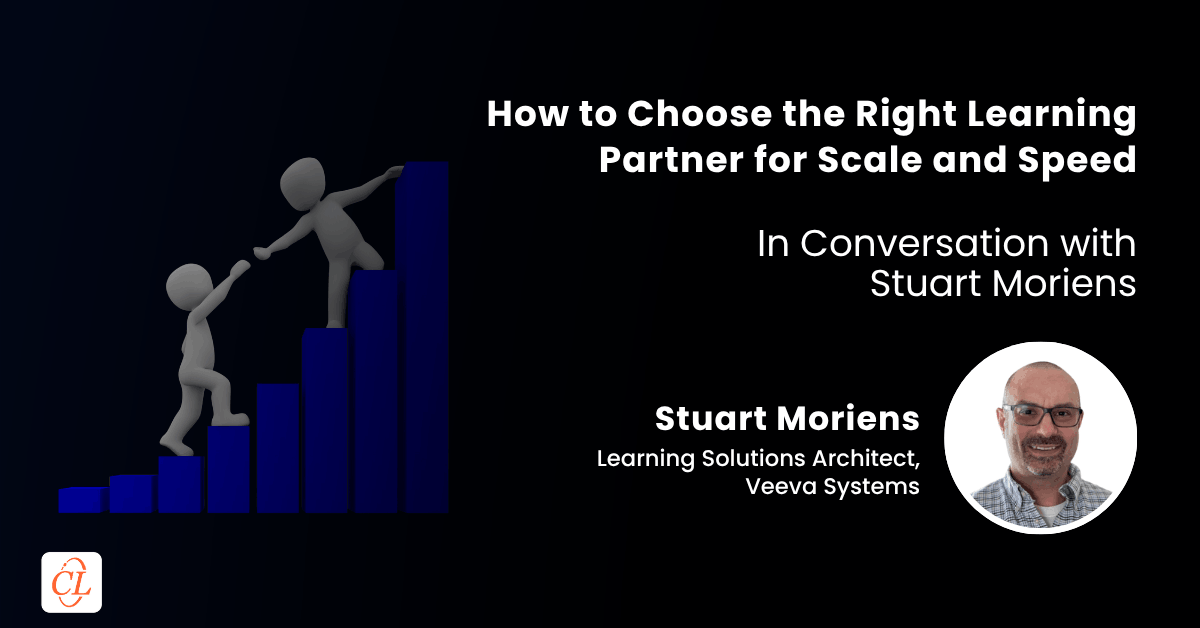
Welcome to CommLab India's eLearning Champion Podcast featuring Stuart Moriens, Learning Solutions Architect at Veeva Systems and a 25-year veteran of building and scaling outsourcing partnerships for enterprise learning teams.
In this episode, RK Prasad, CEO and Co-founder of CommLab India and Stuart explore what enterprise Learning & Development can learn from a quarter-century of scaling training programs across markets and technologies. Their conversation examines why the right outsourcing partner has less to do with size than with subject matter depth, how AI is taking over the first draft without replacing expert review, why protecting customer content matters as much as producing it, and how organizations can design training that fits a market's culture instead of fighting it.
Click Here To Read Transcript
00:00:00 RK Prasad
So Stu, welcome to this e Learning champion podcast of CommLab India.
00:00:06 RK Prasad
For the last 25 plus years, you have been in this field and you have been managing internal teams, external partners, sometimes both and 25 years is not a small time.
00:00:21 RK Prasad
And if I may recall, then it is about the same time that e learning as a methodology has come into the industry.
00:00:30 RK Prasad
And CommLab also has been, you know, in that industry for the last 25 years.
00:00:38 RK Prasad
So I would like to listen to you, Stu, and as well as my audience.
00:00:45 RK Prasad
How did you start in this?
00:00:47 RK Prasad
And can you give me some interesting milestones of these 25 years?
00:00:54 Stuart Moriens
Sure.
00:00:55 Stuart Moriens
So.
00:00:58 Stuart Moriens
Actually, my degree is in communications.
00:01:00 Stuart Moriens
And one of the things that's really interesting is I went to Syracuse University, very well known for communications, and I took like photography as a minor and I really liked it.
00:01:13 Stuart Moriens
And one of the first groups of people who were digitizing things were photographers.
00:01:21 Stuart Moriens
And so I learned multimedia almost as an side.
00:01:26 Stuart Moriens
topic, you know, as a minor in when I was at university and I liked it so much.
00:01:32 Stuart Moriens
When I graduated, I looked for a career in multimedia and found a small vendor that was looking for a multimedia partner.
00:01:41 Stuart Moriens
They were not, you know, large, which was to my benefit because the my manager and the owner of the company were experienced learning people and instructional designers.
00:01:53 Stuart Moriens
And so I got seven years.
00:01:55 Stuart Moriens
I was there seven years and got a seven year education on how to be a learning professional to the point where I outgrew that company, moved on to another company where I led the everything except for essentially sales and project management.
00:02:10 Stuart Moriens
Was there for a while, again, got a lot more exposure.
00:02:13 Stuart Moriens
And I had a realization, which is that a lot of our customers were looking to buy our knowledge.
00:02:21 Stuart Moriens
our consultancy more than they were looking to buy courses or equal to that.
00:02:26 Stuart Moriens
And it just wasn't the business model where I was working.
00:02:30 Stuart Moriens
And I really wanted to continue to add value, deliver what customers wanted.
00:02:35 Stuart Moriens
So, you know, I decided to apply to go work for a life sciences company and I was successful there in applying.
00:02:45 Stuart Moriens
My first role was I was brought into sales training to
00:02:49 Stuart Moriens
essentially develop these training managers into instructional designers to help them build their own things, to do it internally, to be honest, to reduce our vendor spend.
00:03:00 Stuart Moriens
And one thing we figured out very quickly was that those people didn't have time to be instructional designers.
00:03:06 Stuart Moriens
So I was there, not that they didn't want to, and I'll be completely transparent here.
00:03:11 Stuart Moriens
There are a few people that really wanted it.
00:03:15 Stuart Moriens
And so they have now become some of the best learning professionals I know.
00:03:20 Stuart Moriens
And we built an instructional design curriculum internally.
00:03:23 Stuart Moriens
So we did give them education, but the reality was they didn't have the time to be builders, to be developers, to be, you know, writers, things, everything that goes into e learning, right?
00:03:34 Stuart Moriens
And so what we ended up doing was quickl outsourcing, offshoring, you know those kinds of things to really create a partnership between the training managers
00:03:47 Stuart Moriens
and our vendors to deliver on that promise of, you know, developing those sales trainers, but then creating the capacity, right, where they didn't have to do everything to build that e-learning.
00:04:00 RK Prasad
So when was this, which year was this?
00:04:05 Stuart Moriens
That was about 2008.
00:04:06 Stuart Moriens
So I had already been, you know, we're talking you know, 10, 11 years after after the 25 years you're talking about.
00:04:14 Stuart Moriens
But I think the nice thing for me was I kind of grew up.
00:04:17 Stuart Moriens
So going backwards a bit, I kind of grew up with e-learning, right?
00:04:20 Stuart Moriens
So as I mentioned earlier, I was a multimedia developer.
00:04:24 Stuart Moriens
We were building things on CD ROMs and floppy disks.
00:04:28 Stuart Moriens
That makes me feel old to say that, you know, started this before even Flash was a thing.
00:04:34 Stuart Moriens
And I remember championing, like how do we develop in Flash and having to it was because we could make
00:04:41 Stuart Moriens
you know, interactive buttons in Flash and you couldn't like in Netscape Navigator 3.
00:04:45 Stuart Moriens
So, you know, you get to the point where now Flash is dominant in the market.
00:04:51 Stuart Moriens
And then fast forward a few more years, now everybody's replacing Flash.
00:04:54 Stuart Moriens
So part of, you know, going backwards, like you asked, like it's really for me, it was about agility and not being married to a technology bit.
00:05:03 Stuart Moriens
And we'll talk about this I'm sure throughout the podcast, but it was understanding like.
00:05:08 Stuart Moriens
How do we deliver technically in a way that keeps learners engaged, that we can develop quickly, you know, that doesn't cost a ton of money?
00:05:17 Stuart Moriens
So, you know, to be honest, you know, going back to your original question, I feel like I've evolved with e-learning to the point when I was working at a life sciences company, my role eventually expanded, and I was trying to influence people that were not only talking about e-learning anymore, we were talking about digital learning.
00:05:36 Stuart Moriens
You know, we're talking about video, podcasts, you know, digital job aids, adaptive learning.
00:05:44 Stuart Moriens
So, you know, I think it's interesting.
00:05:47 Stuart Moriens
During my 25 year journey, the word e-learning has evolved.
00:05:51 Stuart Moriens
And I almost feel like calling it only e-learning sells it short because now we have like AI and digital avatars, like is that e-learning?
00:06:00 Stuart Moriens
I don't know, but it is a way you can learn digitally, right?
00:06:03 Stuart Moriens
So it is.
00:06:05 RK Prasad
So I wanted to go a little deep there.
00:06:09 RK Prasad
So when you realise that most of these guys don't have time or some of them don't have interest to sit and do the stuff.
00:06:18 RK Prasad
And when you started looking at external partners, I assume that you first searched for people or companies in the US, correct?
00:06:29 Stuart Moriens
Actually, no.
00:06:31 Stuart Moriens
And the reason for that again.
00:06:34 Stuart Moriens
So in my second role where I led all of the courseware, we could kind of use a different word now, courseware.
00:06:42 Stuart Moriens
I haven't heard that word in a while, but we were building it, calling it courseware.
00:06:46 Stuart Moriens
We had moved away from CD roms and floppy disks finally in, you know, into learning management systems.
00:06:51 Stuart Moriens
And I had experience, though offshoring.
00:06:54 Stuart Moriens
So one of the things that I did is we had one of the initiatives I had on the vendor side was to create scale for us without increasing our costs.
00:07:03 Stuart Moriens
Right.
00:07:04 Stuart Moriens
And so
00:07:05 Stuart Moriens
In that experience, on the vendor side, I did try to outsource in the US to use contractors and things like that.
00:07:15 Stuart Moriens
But what I learned, having then that not worked the way I wanted, was we went to India and I actually traveled to India and set up the offshore development center for my partner.
00:07:28 Stuart Moriens
Now, it wasn't all me, but I was there.
00:07:30 Stuart Moriens
So I had a very hands on experience.
00:07:34 Stuart Moriens
partnering with them.
00:07:35 Stuart Moriens
And what we found was we initially did it to save money, right, but we created scale.
00:07:43 Stuart Moriens
And what I mean by that is a couple different things.
00:07:47 Stuart Moriens
One is we now had around the clock development.
00:07:49 Stuart Moriens
So I had a team of, you know, 10 ish people internally doing the work.
00:07:55 Stuart Moriens
And what was happening with our scale is, you know, we would work many times, 10, 11 hour days, right?
00:08:01 Stuart Moriens
But then people will go to sleep and work stopped.
00:08:04 Stuart Moriens
With our partner in India, we were able to say, okay, we're done for the day, here's the work, hand it back off in the morning.
00:08:11 Stuart Moriens
So it was the very first time I was, people weren't calling it this, but we were doing daily stand ups.
00:08:17 Stuart Moriens
We would.
00:08:18 Stuart Moriens
So this is, you know, now I'm thinking 20, 20, 15, 20 years ago before Agile was even a thing.
00:08:26 Stuart Moriens
Every morning, we would sit down with our project team, our extension of our team from India would join that call.
00:08:33 Stuart Moriens
Right.
00:08:34 Stuart Moriens
And we would essentially have a daily handoff and we were able to increase our scale and speed without induce increasing our costs, which then we were able to pass on those benefits to our customers.
00:08:48 RK Prasad
Wow.
00:08:49 RK Prasad
So you took quite a leap, leap of faith, but you did do you did your due diligence, I understand, but what were your criteria of selecting?
00:09:02 RK Prasad
these partners, what did you see in them?
00:09:05 RK Prasad
Because nobody knew much at that time, right?
00:09:09 Stuart Moriens
Yeah.
00:09:10 Stuart Moriens
I think there's a few things, right?
00:09:11 Stuart Moriens
So first and foremost, you have to really understand what are you asking your partner to do, right?
00:09:18 Stuart Moriens
So there are some companies that can do everything, right?
00:09:21 Stuart Moriens
For example, I know CommLab can, right?
00:09:23 Stuart Moriens
And you guys do a great job with that.
00:09:26 Stuart Moriens
My partner in India, I was very specific, like I need them to be e learning developers, right?
00:09:34 Stuart Moriens
We kept, we had on staff, subject matter experts and instructional designers, right?
00:09:40 Stuart Moriens
We'll probably talk about this, but that's one of the things I look for in partners.
00:09:44 Stuart Moriens
They're not the same thing.
00:09:45 Stuart Moriens
So if I have a partner that tells me they're instructional designers or subject matter experts.
00:09:52 Stuart Moriens
I asked to see resumes.
00:09:53 Stuart Moriens
I asked to understand how they know about life sciences because they're supposed to be learning experts.
00:09:58 Stuart Moriens
So the first thing I would say is based on a lot of my other experience working with contractors and consultants in the US, when I decided to offshore and outsource, it was really very much, okay, what am I offshoring and outsourcing and being very specific about it.
00:10:13 Stuart Moriens
And so it was development and testing, right?
00:10:17 Stuart Moriens
It was not.
00:10:19 Stuart Moriens
medical writing, it was not, you know, content development and it was not instructional design.
00:10:24 Stuart Moriens
And it doesn't mean you can't outsource those things or offshore them.
00:10:29 Stuart Moriens
It was just a calculated choice we made to keep that internal and mostly due to time zones, because we wanted our subject matter experts to be able to talk to our customers, our instructional designers to be able to talk to our customers and they were all in the US.
00:10:44 Stuart Moriens
So it was factoring a lot of that in.
00:10:48 Stuart Moriens
The other thing I'll share with this, and this is really important to me.
00:10:52 Stuart Moriens
Scale doesn't equal size, right?
00:10:55 Stuart Moriens
What do I mean by that?
00:10:56 Stuart Moriens
You could have the biggest partner in the world, but they may have 1,000,000 customers, right?
00:11:02 Stuart Moriens
And so do they have the capacity to increase their scale and the size of their team, right quickly?
00:11:10 Stuart Moriens
Just because they're big doesn't mean they can do that.
00:11:13 Stuart Moriens
And.
00:11:14 Stuart Moriens
What I found in with my partner that I'm telling you about in India is they were not huge, but what they had is a network of people they had vetted.
00:11:26 Stuart Moriens
And then what we agreed is we train that network on our ways of working and we paid them for it.
00:11:31 Stuart Moriens
It wasn't like we expected them to, you know, just figure this out on their own, just do it, do whatever.
00:11:37 Stuart Moriens
So we invested.
00:11:39 Stuart Moriens
So a couple things.
00:11:40 Stuart Moriens
We found a partner that had that kind of network.
00:11:44 Stuart Moriens
that did good work, that essentially was willing to scale with us as we grew as a company and train their network.
00:11:52 Stuart Moriens
And we wanted to make sure again, we paid them to do it so they could pay their contractors.
00:11:56 Stuart Moriens
So they took it seriously.
00:11:59 Stuart Moriens
Just and to be completely honest, you know, that company I worked for at the time, they were sold.
00:12:04 Stuart Moriens
They're no longer in the industry, but my partner is still aroun and what's amazing amazing is their core team is still intact.
00:12:13 Stuart Moriens
Wow.
00:12:14 Stuart Moriens
So I am still working with the same people in India today that I worked with 25 years ago, or maybe 20 years ago.
00:12:21 Stuart Moriens
Now, again, they know me, I know them.
00:12:25 Stuart Moriens
So we don't produce the same stuff we did when we first started, but it's the same model.
00:12:29 Stuart Moriens
So the example I'll give you is I lead translation services for our Learn GXP content at Veeva.
00:12:36 Stuart Moriens
This morning, somebody asked, could we translate something as quickly as possible?
00:12:39 Stuart Moriens
Normally, it takes us 4 to 6 weeks.
00:12:42 Stuart Moriens
We're going to get it done in about a week because my partner, I have 2 partners, the 1i mentioned in India that can scale quickly.
00:12:50 Stuart Moriens
They literally already started the work this morning again, you know, they were able to start it early because I was on early and they've already completed their pre work.
00:12:59 Stuart Moriens
And then our translation partner has a network of linguists that scales quickly too.
00:13:04 Stuart Moriens
So we can get something to a linguist and have it turned around in a day.
00:13:08 Stuart Moriens
So again, that was really important to me when picking bot partners, right?
00:13:12 Stuart Moriens
You know, neither one is huge, but they can scale because they have their own networks, and I vetted that.
00:13:19 Stuart Moriens
And even with our linguists, I'm giving them a test.
00:13:22 Stuart Moriens
Do they know life sciences?
00:13:24 Stuart Moriens
Do they know the subject matter we work in knowing the language not enough.
00:13:29 RK Prasad
Correct.
00:13:30 RK Prasad
They have have to know the industry.............................................................!
00:13:41 RK Prasad
You also wanted them to know, have a grip on the subject as well as something to something on learning.
00:13:48 RK Prasad
Yeah, I did understand that.
00:13:50 RK Prasad
And am I right to assume that model continues for the last so many years with you?
00:13:56 Stuart Moriens
I mean, yes and no.
00:13:59 Stuart Moriens
So I think part of what I worked at a life sciences company.
00:14:04 Stuart Moriens
We had big initiatives like launch training when I worked in sales training, right?
00:14:09 Stuart Moriens
And.
00:14:10 Stuart Moriens
To me, that's harder to not give to one supplier, right?
00:14:13 Stuart Moriens
So, and also, you know, going back again to sales training, those trainers, you know, at a launch, you know what it's like, right?
00:14:22 Stuart Moriens
It's up to the last minute craziness to get that product launched on time.
00:14:26 Stuart Moriens
Every day a rep isn't selling, it's costing millions of dollars, right?
00:14:29 Stuart Moriens
So we made the decision there that we needed a source providers for launch training.
00:14:38 Stuart Moriens
And the difference there then becomes, does that vendor not only doing good work, but I think it's really important.
00:14:46 Stuart Moriens
They have to, so now they have to be able to, like they have to have subject matter experts.
00:14:52 Stuart Moriens
We can't rely on their instructional designers to be subject matter experts, right?
00:14:58 Stuart Moriens
Because it's got to be right the first time, right?
00:15:01 Stuart Moriens
And also that launch team.
00:15:05 Stuart Moriens
on the customer side, they're very busy, right?
00:15:08 Stuart Moriens
So, you know, we really needed a partner that could it iterate with us and work autonomously.
00:15:16 Stuart Moriens
But then you have to.
00:15:17 Stuart Moriens
So that now becomes understanding the subject matter, whether it's science, sales, IT, whatever it is, that partner has to understand it.
00:15:26 Stuart Moriens
And in my experience, that's one of the biggest challenges when you find some of these generic, for lack of a better word,
00:15:33 Stuart Moriens
vendors that don't have that subject matter expertise, that can be a challenge.
00:15:40 Stuart Moriens
So for me, there's 2 things.
00:15:42 Stuart Moriens
One is they have to understand the subject matter, right?
00:15:45 Stuart Moriens
And they have to, you have to be able to vet that.
00:15:47 Stuart Moriens
It just can't be a learning company.
00:15:49 Stuart Moriens
They have to be for life sciences.
00:15:50 Stuart Moriens
They should have life sciences, subject matter experts separate from their instructional designers.
00:15:55 Stuart Moriens
And I'm sorry to say I work with a lot of companies or talk to them where where they don'tt invest in in internal subject matter expert expertise.
00:16:02 Stuart Moriens
And then what happens happens
00:16:03 Stuart Moriens
is it delays the launch and it frustrates the customer because, you know, those vendors have gone and saying, yeah, we know your subject matter, and then you get into it and they don't.
00:16:16 RK Prasad
Correct.
00:16:17 Stuart Moriens
And so just, I think what I look at is 2 different models then, right?
00:16:21 Stuart Moriens
And it really depends on, you know, how much agility, how much speed, how much work work you have.
00:16:27 Stuart Moriens
So I've done both.
00:16:28 Stuart Moriens
I've done complete outsourcing when it makes sense.
00:16:31 Stuart Moriens
And then I've
00:16:33 Stuart Moriens
done a more specialized outsourcing when that makes sense.
00:16:36 Stuart Moriens
So like for the translations things I talked about, it just makes sense.
00:16:43 Stuart Moriens
Once the content's translated, having a linguist or a translation vendor with expensive resources, integrate that content back or clean it up just doesn't make sense.
00:16:53 RK Prasad
Correct.
00:16:54 Stuart Moriens
So I give it to a company that's very strong at articulate storyline, our authoring tool, right.
00:17:01 Stuart Moriens
Hopefully, does that so it really depends on the situation.
00:17:05 Stuart Moriens
And in those cases for translations, the linguist needs to understand the subject, but they don't need to be a SME.
00:17:13 Stuart Moriens
Like does that correct?
00:17:14 RK Prasad
Yeah, absolutely.
00:17:17 RK Prasad
Let me let me just retreat what you said.
00:17:20 RK Prasad
So when it comes to a subject like life sciences, you would insist that the partner also has
00:17:29 RK Prasad
Internal subject matter experts, not just instructional designers or learning experts, but there are cases when you may not need such kind of expertise or you provide that at your end.
00:17:43 RK Prasad
On the same topic, can you throw some light on the other software issues like language, cultural differences?
00:17:56 RK Prasad
Different perceptions of time and quality and stuff like that.
00:18:02 Stuart Moriens
Yeah, so.
00:18:02 Stuart Moriens
A couple of different thoughts come to mind here, so.
00:18:07 Stuart Moriens
A couple of different things.
00:18:10 Stuart Moriens
As you use AI, particularly like AI voices for narration, when we do our translation to keep our timelines short and our costs as low as possible, we use AI narration.
00:18:24 Stuart Moriens
What's interesting is we're finding, you know, there are some cultures that accept that and they accept that it doesn't sound perfect.
00:18:32 Stuart Moriens
And, you know, they accept that it can sometimes not sound perfectly human, even though the technology is advancing faster than you know, you can even imagine.
00:18:42 Stuart Moriens
But there are some cultures that that no matter what you do, they expect perfection when someone speaks their language, and I understand that that.
00:18:50 Stuart Moriens
So it'sssss.
00:18:53 Stuart Moriens
What's interesting is I used to have my partner in India produce the AI voiceover.
00:18:59 Stuart Moriens
They don't speak all the languages.
00:19:01 Stuart Moriens
So there's a missed opportunity there, which is doing your very best and not just trusting the AI.
00:19:08 Stuart Moriens
So this is a common theme.
00:19:10 Stuart Moriens
You're going to hear like human in the loop, right?
00:19:13 Stuart Moriens
A lot of what that means is is a human reviewing AI's work.
00:19:17 Stuart Moriens
Right.
00:19:17 Stuart Moriens
And that's not only about content.
00:19:19 Stuart Moriens
To me now now it's about the narration too.
00:19:22 Stuart Moriens
So I worked with my translation partner to set up a workflow where the linguist can actually produce the AI narration and they can tweak it so that it sounds more like a native speaker, right?
00:19:37 Stuart Moriens
So in those cases, what I've been able to do is, you know, shift and we do it now for not just the countries that have, you know,
00:19:47 Stuart Moriens
that don't accept AI narration.
00:19:49 Stuart Moriens
We do it for everybody.
00:19:50 Stuart Moriens
We just, we're just piloting it now.
00:19:52 Stuart Moriens
It's likely to be rolled out more globally.
00:19:54 Stuart Moriens
But in that case, it was a matter of, you know, understanding some cultures will accept the inexactness of AI narration, some won't.
00:20:06 Stuart Moriens
So it became my responsibility to figure out, okay, how do I shift the work, not increase my cost, not increase my timelines and then.
00:20:17 Stuart Moriens
get the voices as good as they can possibly be.
00:20:20 Stuart Moriens
It's and I, one of my favorite phrases is progress over perfection.
00:20:25 Stuart Moriens
So I feel very confident to go back to those customers now and say, we are making progress on your feedback.
00:20:33 Stuart Moriens
It's not going to be perfect, but the AI is increasing in quality every day.
00:20:38 Stuart Moriens
And so we will get better with the AI, but we're going to do our best to make sure it's as close to perfect as it can be.
00:20:46 RK Prasad
Okay, understood.
00:20:48 RK Prasad
The other angle of language, what I was wanting to find out was the language proficiency of your partners in India when they interact with your teams.
00:20:59 Stuart Moriens
Yeah, so I joke around a lot with them.
00:21:03 Stuart Moriens
You know, I live in a city where I don't necessarily, you know, I hear some people don't speak English language and what we would call the Queen's English, you know and
00:21:14 Stuart Moriens
I tell my partners in India, sometimes they speak better English than native people that I'm around.
00:21:21 Stuart Moriens
So I haven't really ever had any issues with working when I offshore.
00:21:28 Stuart Moriens
You know, I'm probably doing it now.
00:21:30 Stuart Moriens
I tend to talk fast, so I try to slow myself down, but that's.
00:21:34 Stuart Moriens
I haven't really had any language issues issues in that way.
00:21:38 Stuart Moriens
Now I I I have had had
00:21:41 Stuart Moriens
Again, I'll go back to my role managing vendors or suppliers at a large life sciences company.
00:21:47 Stuart Moriens
We did have some countries and markets that wanted the work to stay in their country or market.
00:21:52 RK Prasad
Right.
00:21:53 Stuart Moriens
Because they felt like they understood language better, the market better.
00:21:57 Stuart Moriens
And so in those cases, I worked with those people people to find a solution that met their need.
00:22:04 Stuart Moriens
So again, I don't think it's really necessarily an issue of the people I work with in India having language issues, but there are some customers that have a preference or native speakers or there, you know, could be nationalistic.
00:22:17 Stuart Moriens
They want their vendor to be in their market.
00:22:19 Stuart Moriens
So when that happens, I did work with them to address that.
00:22:23 RK Prasad
Okay, so have you ever tried companies in South Africa or Ireland which are native speakers of English?
00:22:31 RK Prasad
There were some of our prospective customers or even customers who tried companies in these countries.
00:22:38 RK Prasad
Have you have you had any experience in that?
00:22:41 Stuart Moriens
I've worked with companies like in Eastern Europe, not necessarily, you know, in South Africa, I think he said, or some of the other markets.
00:22:55 Stuart Moriens
To me, again, it's it's about
00:23:00 Stuart Moriens
those markets tend to be less costly for labor than the US.
00:23:04 Stuart Moriens
And everyone who outsources offshores are looking to save money.
00:23:10 Stuart Moriens
To me, though, it's about scale, right?
00:23:12 Stuart Moriens
So essentially, a lot of times it's not just about, you know, where you are, but I'm looking for a partner that potentially going to be able to do that around the clock development with me.
00:23:23 Stuart Moriens
So one of the reasons India works well for me is is the
00:23:29 Stuart Moriens
You know, we're like, what, 11 hours closest to difference, sometimes 10 hours, whatever.
00:23:33 Stuart Moriens
So it it makes that makes a big difference.
00:23:36 Stuart Moriens
So my only comment would be if I was going to offshore and outsource.
00:23:41 Stuart Moriens
It's it's less about the savings and language to me.
00:23:43 Stuart Moriens
Like I have to be able to communicate, but they need to add that scale because that's how we can then improve our quality and speed.
00:23:53 Stuart Moriens
So Veeva one of our one of our, you know our.
00:23:58 Stuart Moriens
our values is speed, right?
00:24:00 Stuart Moriens
So I'm always looking at that.
00:24:01 Stuart Moriens
And for me, then it's about.
00:24:06 Stuart Moriens
You know, how do we pick a partner that's going to help us save money, right?
00:24:11 Stuart Moriens
Help us, you know, with our processes, but also increase our speed.
00:24:15 Stuart Moriens
And that's where India is a really sweet spot for that.
00:24:19 RK Prasad
Okay, so.
00:24:22 RK Prasad
You started outsourcing the development work, keeping the instructional design and, you know, subject matter expertise with you.
00:24:34 RK Prasad
Has that changed now over these years, developing deeper relationships with your Indian partners?
00:24:40 RK Prasad
Have you been?
00:24:42 RK Prasad
Did you try giving out instructional design or subject matter expertise?
00:24:49 Stuart Moriens
Yeah, so.
00:24:51 Stuart Moriens
When I worked for, like I said, a large life sciences company, one of our big initiatives we had was really reducing our supplier footprint and we went through a big initiative.
00:25:03 Stuart Moriens
The goal was to get to less than 5 suppliers globally.
00:25:07 Stuart Moriens
That is a huge challenge for a giant life sciences company, especially when I talk about subject matter expertise, right?
00:25:16 Stuart Moriens
I've really.
00:25:17 Stuart Moriens
not found a lot of potential partners that could cover every single one of the subjects we would need and have those people.
00:25:25 Stuart Moriens
That said, we did get to 3 to 4 suppliers.
00:25:31 Stuart Moriens
And in some cases, then we also, just this is a bit of an aside, we vetted a subject matter expertise network that they could partner with if we needed them too.
00:25:42 Stuart Moriens
But one of those partners was in India.
00:25:45 Stuart Moriens
They had offices in the US, that's who I interacted with, but the work was all done in India.
00:25:51 Stuart Moriens
And so we did do that and we did it for a number of years.
00:25:56 Stuart Moriens
It was all still in place until I left that life sciences company.
00:26:00 Stuart Moriens
I don't think that's still in place, but it worked very well.
00:26:04 Stuart Moriens
Again, it was but in order to make it work, I feel like we had to help that supplier.
00:26:11 Stuart Moriens
understand where to get the subject matter expertise when they didn't have it through people we had vetted.
00:26:16 Stuart Moriens
And I think that's the difference there.
00:26:18 Stuart Moriens
So in order to make that small supply base work, it's not about India.
00:26:21 Stuart Moriens
It's about making us if your target is five or less suppliers for an entire organization, right?
00:26:28 Stuart Moriens
My thought was the only way this is going to work is if I work with them to make sure when they do need subject matter expertise they don't have.
00:26:37 Stuart Moriens
That we could partner to find that and we were sure that was not going to derail a project.
00:26:44 RK Prasad
OK, but that was for the large company life sciences company you had mentioned.
00:26:50 RK Prasad
But now, currently, what exactly do you outsource to your learning partners?
00:26:57 Stuart Moriens
Yeah, so it's it really depends on what we're building.
00:27:00 Stuart Moriens
Like I said, for translation, you know, it's it's everything.
00:27:04 Stuart Moriens
If we're building courses, a lot of times it comes down to, you know, I have internal, I have my own network of subject matter experts.
00:27:13 Stuart Moriens
So a lot of times I will kind of build my own team, right?
00:27:19 Stuart Moriens
And so.
00:27:21 Stuart Moriens
I don't do the work, but I manage the people.
00:27:23 Stuart Moriens
So I haven't in my current role outsourced everything yet.
00:27:28 Stuart Moriens
That said, the more and more we rely on AI, right, and we have a human in the loop.
00:27:34 Stuart Moriens
I feel like we could shift that model.
00:27:37 Stuart Moriens
And what I mean by that is, you know, we use tools that will take like an SOP and create role based training with AI, right?
00:27:46 Stuart Moriens
My partner can do all of that.
00:27:48 Stuart Moriens
And now the SME becomes the human in the reviewer.
00:27:52 Stuart Moriens
So essentially that reviewer reviews.
00:27:58 Stuart Moriens
It's not a finished product, but it might be a beta, right?
00:28:01 Stuart Moriens
And it's very simple to adjust the content based on their feedback.
00:28:05 Stuart Moriens
When we're using AI, a customer has to approve that though.
00:28:08 Stuart Moriens
If we're going to use AI, the customer's got to be open to that, approve the use of AI.
00:28:13 Stuart Moriens
But so to me, the use of AI has enabled me to.
00:28:18 Stuart Moriens
Partner, go use this tool.
00:28:19 Stuart Moriens
Here's how we use it.
00:28:20 Stuart Moriens
It's been vetted and now they're doing everything but the SME review.
00:28:26 RK Prasad
So you mean to say that your partners are now using AI tools to further reduce time?
00:28:33 Stuart Moriens
Yeah, I would say that we so we get in my current role.
00:28:38 Stuart Moriens
I get a lot of requests for SOP training.
00:28:42 Stuart Moriens
We've cut our time, I would say by about 25% using AI.
00:28:48 Stuart Moriens
The biggest challenge is AI works really well upstream, you know, for like needs analysis, some content development, some storyboarding.
00:29:00 Stuart Moriens
The real opportunity is in the tools that then do the media development, you know, using AI, like you want it to look, if you're talking about a scientist in a lab, they need to be in the right lab setting, wearing the right things.
00:29:12 Stuart Moriens
You know, the equipment around them needs to be correct and it's really hard.
00:29:16 Stuart Moriens
to get AI to generate a lot of those things.
00:29:20 Stuart Moriens
That said, we do use some tools that are made for life sciences.
00:29:24 Stuart Moriens
And again, everyday they get better at generating the media that is life sciences specific.
00:29:32 Stuart Moriens
So my from I would say it saved us about 25% of our time, but there's still a real opportunity and the tools are catching up faster than you can imagine, which is.
00:29:44 Stuart Moriens
You know, that 25% is because we have sped up.
00:29:48 Stuart Moriens
Essentially, content development needs it all, you know, if you talk about in terms of ADDIE analysis and design, right?
00:29:57 Stuart Moriens
The opportunity to get fat more than 25% faster is coming with some tools that do a better job of the media development.
00:30:06 Stuart Moriens
And then the nice thing for us is we can do do things much faster for our customers and we can do things less expensively for our customers.
00:30:14 RK Prasad
Right.
00:30:14 Stuart Moriens
So for example, I think our prices for SOP training, if we use AI, have, you know, they've significantly dropped in our timelines too.
00:30:24 RK Prasad
So what are some other tools you use or what are your favorites?
00:30:32 Stuart Moriens
Yeah, so there's still a place for tools like Articulate Storyline.
00:30:37 Stuart Moriens
It's it's very good at, you know, we try to create our learning today.
00:30:43 Stuart Moriens
Using storytelling.
00:30:45 RK Prasad
OK, right.
00:30:46 Stuart Moriens
And so I like to think of our courses almost as like learning documentaries, right?
00:30:52 Stuart Moriens
So we are using like stock footage and video to reinforce the content in the narration, right and putting just key bullet points on the screen.
00:31:04 Stuart Moriens
And So what I.
00:31:06 Stuart Moriens
My thought is when I use those tools, you know, there's a couple of ways to look at it.
00:31:11 Stuart Moriens
They have new AI coming all the time, but let's just say their image generation isn't as good as an image generation tool I have.
00:31:20 Stuart Moriens
That's when I'll go find a specialized tool, right?
00:31:22 Stuart Moriens
So the traditional tools like Rise and Storyline have their place, right?
00:31:28 Stuart Moriens
But I often find too those tools had AI bolted on.
00:31:33 Stuart Moriens
So it's not like natively part of the workflow.
00:31:38 Stuart Moriens
So while those work.
00:31:40 Stuart Moriens
There are new tools that I really like that what I'll call our AI native, right, that support workflows like the one I'm talking about, which so the tool that we're using to create SOP training is called Speach.
00:31:55 Stuart Moriens
And what we can do is we can load any controlled document into it.
00:32:01 Stuart Moriens
We can even have a video of somebody performing a procedure, load that in.
00:32:07 Stuart Moriens
And it will create, it'll even ask you if you want to create role based training.
00:32:11 Stuart Moriens
So you, it will look at the SOP, identify the roles in the SOP.
00:32:16 Stuart Moriens
You can say, OK, yes, these are the roles that I want to create separate courses for, or I want to create one course for this role, right?
00:32:23 Stuart Moriens
And we can input all of that, give it the input.
00:32:26 Stuart Moriens
It's not just also giving it the document.
00:32:28 Stuart Moriens
Sometimes you can only give a tool a document, or you can only give it a prompt.
00:32:32 Stuart Moriens
We can give it a document and we can give it a prompt.
00:32:35 Stuart Moriens
So we can say, here's an SOP.
00:32:37 Stuart Moriens
I want you to focus on these roles, specifically these things, right?
00:32:41 Stuart Moriens
So in the event of like a CAPA, if a customer's gotten a warning letter, anything like that, we can train specifically to that to address that CAPA or address that issue.
00:32:55 Stuart Moriens
So that tool is flipped to the point where, you know, we can get a lot of work done by saying, okay, here's the document.
00:33:03 Stuart Moriens
Here's what we're trying to achieve.
00:33:05 Stuart Moriens
Here's who we're trying to train.
00:33:08 Stuart Moriens
Push a button.
00:33:09 Stuart Moriens
It spits out all the content.
00:33:11 Stuart Moriens
But the reality is then we have the SME, they have to go in and click a button.
00:33:15 Stuart Moriens
Yes, I read this.
00:33:16 Stuart Moriens
It's validated.
00:33:17 Stuart Moriens
Yes, I read this.
00:33:18 Stuart Moriens
It's validated.
00:33:19 Stuart Moriens
And so that SME can come from our customer.
00:33:21 Stuart Moriens
It can come internally for us, right?
00:33:24 Stuart Moriens
But that's a totally different.
00:33:26 Stuart Moriens
model, righ?
00:33:27 Stuart Moriens
We're not even starting...
00:33:28 Stuart Moriens
like when when I talk about using Rise and Storyline, we're.
00:33:32 Stuart Moriens
The content essentially comes first and the development comes second.
00:33:37 Stuart Moriens
With a tool like Speach, and I wouldn't do this for everything.
00:33:40 Stuart Moriens
It's right for SOP training, right?
00:33:42 Stuart Moriens
You can say, here's my document.
00:33:45 Stuart Moriens
I did my needs analysis, and maybe you did that in Gemini or some other tool outside of.
00:33:51 Stuart Moriens
We just still have to do that.
00:33:52 Stuart Moriens
I'm not so when I said like, you know, somebody got a kappa or something.
00:33:56 Stuart Moriens
Well, why what what happened?
00:33:58 Stuart Moriens
You know what was the real issue?
00:34:00 Stuart Moriens
Retraining everybody on everything about that SOP might not solve that one specific issue.
00:34:05 Stuart Moriens
You want it to be targeted to address that issue.
00:34:07 Stuart Moriens
So we might do our needs analysis in a tool like Gemini, right, feed it into a tool like Speach with the SOP and the results of the needs analysis and the target of the training.
00:34:25 Stuart Moriens
And then you push a button, essentially walk away for a few minutes, and your SME can then validate that.
00:34:32 RK Prasad
That's an interesting thing which you just mentioned.
00:34:34 RK Prasad
You were talking about the SME validating.
00:34:40 RK Prasad
This is regarding Speach you're talking about or some other tool.
00:34:44 Stuart Moriens
Well, it doesn't.
00:34:45 Stuart Moriens
So the reality is the tool Speach is an enabler, right?
00:34:49 Stuart Moriens
You have to look at authoring tools in that way.
00:34:50 Stuart Moriens
Like if you, you know, you probably have heard the saying if the only tool you have is a hammer, everything looks like a nail, right?
00:34:57 Stuart Moriens
So if you only use.
00:35:00 Stuart Moriens
storyline, then you essentially my thought is you have to, it's really, you have to know like with a, you have to have content to start with.
00:35:07 Stuart Moriens
Something has to go into storyline.
00:35:08 Stuart Moriens
It's not now they do have tools that would produce, you can give it a document.
00:35:12 Stuart Moriens
It would draft training and rise and other tools, but they're not specifically tuned for life sciences.
00:35:19 Stuart Moriens
Beach was built for life sciences.
00:35:22 Stuart Moriens
It even has a lot of, it's validated.
00:35:24 Stuart Moriens
It's got a lot of GXP kind of controls in it.
00:35:27 Stuart Moriens
If they're one of our partners at Veeva, you can go into one of our vaults.
00:35:30 Stuart Moriens
If you have Speach in our integration, say, I want to create training on this, and it then will create something for your SME to review.
00:35:38 Stuart Moriens
We also use it as an authoring tool ourselves.
00:35:41 Stuart Moriens
But the reality is whether it was Speach or whether it was some brand new tool that came out tomorrow, you can't just hit a button and walk away and deliver it to a customer.
00:35:51 Stuart Moriens
Even if you work for that customer.
00:35:54 Stuart Moriens
So my thought is it's not about Speach, it's about the use of AI, which requires that SME.
00:36:00 Stuart Moriens
So, you know, another tool come to market tomorrow that's better than Speach.
00:36:04 Stuart Moriens
It wouldn't change the whole point that if you're using AI, whatever that's produced, it has to be reviewed by molt.
00:36:11 Stuart Moriens
So it's reviewed by the SME, but also by an instructional designer, right?
00:36:15 Stuart Moriens
Because to make sure that it's still good learning, right?
00:36:21 Stuart Moriens
So.
00:36:22 Stuart Moriens
You're what I try to do, I'm going to take a step back here.
00:36:27 Stuart Moriens
When I used to work on projects, I would hire a junior instructional designer and a senior instructional designer.
00:36:33 Stuart Moriens
And a lot of times I'd have the junior instructional designer do a lot of the heavy lifting because, you know, they could do it less extensively and have the senior person then coach and review them, especially if I was building an internal team, right?
00:36:47 Stuart Moriens
I'm now treating A I like the junior instructional designer.
00:36:52 Stuart Moriens
I'm treating it like a junior medical writer, right?
00:36:54 Stuart Moriens
And that's then what that does is it saves me from having to hire and pay those resources, but it doesn't change the need for senior level review.
00:37:06 RK Prasad
Correct.
00:37:08 RK Prasad
Very interesting.
00:37:10 RK Prasad
So one question here is to how was the end user end customer responding to the use of AI on their proprietary content?
00:37:22 Stuart Moriens
So like I said, first and foremost, and I can't stress this strongly enough, you need to ask your vendors, are, you know, are they using AI, right?
00:37:33 Stuart Moriens
The customer needs to approve the use of that, right?
00:37:37 Stuart Moriens
And we make sure any AI we use doesn't train the large language model, right?
00:37:44 Stuart Moriens
So every single, again, any vendor I work with at Veeva, any AI provider,
00:37:51 Stuart Moriens
We have it in writing that they're not using any content we put in to train the model, right?
00:37:56 Stuart Moriens
So that protects our customers' content.
00:38:00 Stuart Moriens
So it starts with customer consent, right?
00:38:03 Stuart Moriens
And then it comes to using the right tools that, you know, and making sure they're configured properly so that content doesn't ever leave like that one development cycle essentially, that one project.
00:38:18 Stuart Moriens
And so that is very important to us, and I would suggest that should be important to anybody in life sciences.
00:38:24 Stuart Moriens
It's for your content.
00:38:25 Stuart Moriens
You need to be 100% aware aware of where it's going.
00:38:29 Stuart Moriens
And so you should be asking your vendors, what AI do you use?
00:38:34 Stuart Moriens
Does it as my content being used to train the model?
00:38:38 Stuart Moriens
How do you firewall my content from your another customer's content so that they're not gonna be commingled?
00:38:46 Stuart Moriens
Right.
00:38:47 Stuart Moriens
So for example, when we use Speach, I have a workspace for every single customer.
00:38:52 Stuart Moriens
OK, we don't commingle their content at all.
00:38:56 Stuart Moriens
So any like risk of even subconsciously them saying it as a human, you're not in your environments are separate.
00:39:06 Stuart Moriens
So I think it starts with consent from the customer and then it, you know, then the customer really should be asking all the right questions.
00:39:14 Stuart Moriens
And so.
00:39:15 Stuart Moriens
I would say if your partner, your vendor's using AI and you don't understand all that, that's a real time to bring IT in to help you understand that.
00:39:25 RK Prasad
How do you, how do you reassure the customer that look, your content is safe with us?
00:39:33 RK Prasad
Okay, we do sign a, you know, a piece of paper, but do you ask for certain certifications or?
00:39:41 RK Prasad
certain software checks and balances which their servers have.
00:39:47 RK Prasad
How do you do that?
00:39:49 RK Prasad
I mean, I can always say that, yeah, I use this.
00:39:52 RK Prasad
I don't, you know.
00:39:55 Stuart Moriens
So I think, you know, Veeva as a software company and the industry we work in, we are very thoughtful, right, about how we use A I, correct.
00:40:08 Stuart Moriens
So.
00:40:10 Stuart Moriens
if I want to go purchase an authoring tool, work with a partner, just like a life sciences company, you know, we fully vet that partner.
00:40:20 Stuart Moriens
So we make sure we have in writing from them.
00:40:24 Stuart Moriens
You know, what do they do with our information?
00:40:26 Stuart Moriens
So if I'm going to work with a new piece of software, it goes through an A AI review.
00:40:31 Stuart Moriens
Our Chief Information officer has to to approve the use of of the tool, right?
00:40:35 Stuart Moriens
So we'''''''''''''' a rel.
00:40:38 Stuart Moriens
I can't use an AI enabled tool without my CIO signing off.
00:40:43 Stuart Moriens
IT also does a security risk assessment where they are looking for things like, you know, proof from that customer that it's not just lip service and it's not just words on a piece of paper, right?
00:40:58 Stuart Moriens
And so I've never been asked for this.
00:41:00 Stuart Moriens
So I think it's, I feel very honored to be trusted by my customers.
00:41:05 RK Prasad
Right.
00:41:05 Stuart Moriens
But if they ever did ask, we could produce a paper trail that show how we protect our content.
00:41:10 RK Prasad
Correct.
00:41:12 RK Prasad
Yeah, I think that's that's that answers the question.
00:41:15 RK Prasad
But let us move to the most interesting and probably towards the end of our discussion, that as a learning expert, having been into the integrity of all these kind of changes and evolution in technology and the way we learn and.
00:41:36 RK Prasad
You know, they have been tremendous upheavals like from Flash to authoring tools to mobile learning to now with A I.
00:41:48 RK Prasad
How do you think how if you have to do some crystal gazing, how do you see this space, this learning L and D space in the next 5 years?
00:42:01 Stuart Moriens
So.
00:42:02 Stuart Moriens
Like you mentioned earlier, I've been doing this for about 25 years, and we've been talking things about things like personalized learning.
00:42:11 Stuart Moriens
We've been talking about role specific training, adaptive learning, basic core instructional design principles like respecting a learner's existing knowledge, right?
00:42:22 Stuart Moriens
A lot of those things were just hard to do in the past.
00:42:27 Stuart Moriens
It was, you know.
00:42:30 Stuart Moriens
The so a couple different things, right?
00:42:32 Stuart Moriens
You had SCORM and AICC as your way of communicating with an LMS, and they were very limited, right?
00:42:38 Stuart Moriens
Now with XAPI and CMI5, there is the way to talk to an LMS or really any platform that you couldn't before, that enables things things like like role specific traininging, adaptive learning.
00:42:57 Stuart Moriens
In life sciences,
00:42:58 Stuart Moriens
There's a tremendous amount of risk.
00:43:00 Stuart Moriens
You know, if you're audited, they'll often ask, what kind of training did you provide your people?
00:43:06 Stuart Moriens
And so we are finally kind of at a place where we can robustly even report on some of that.
00:43:12 Stuart Moriens
Like in the past, with SCORM 12, you only had like completion progress.
00:43:17 Stuart Moriens
With SCORM 2004, you had a lot more interaction data, but not many LMS's could report on it.
00:43:23 Stuart Moriens
But now even if you're putting the data in as a vendor, you can't always get it out as a company.
00:43:29 Stuart Moriens
But today with things like CMI 5 and XAPI and learning record stores, I'm not at the mercy of the LMS.
00:43:39 Stuart Moriens
I'm not at the mercy of the experience occurring in the LMS.
00:43:43 Stuart Moriens
So I think the technology has finally caught up to the promises and things we've been, you know, knowing we need to do forever.
00:43:52 Stuart Moriens
And I think the next 5 years is the realization of that.
00:43:56 Stuart Moriens
It's.
00:43:57 Stuart Moriens
more adaptive learning, more role-based training, better reporting to know like, so it's not just about individualizing for the learner, but imagine I'm a manager and I have a dashboard about each of my employees that tells me their strengths and weaknesses based on their performance and learning.
00:44:17 Stuart Moriens
And potentially that information goes into a data lake that also uses other performance information about them.
00:44:24 Stuart Moriens
It can give you a picture of your employee, right?
00:44:27 Stuart Moriens
That was almost impossible, but I started doing this.
00:44:30 Stuart Moriens
It probably actually almost, it was impossible when I started doing this.
00:44:34 Stuart Moriens
Now, you know, with companies that are mature with data that, you know, allow you to do these things, you can do the things we've been needing to do for a long time.
00:44:45 Stuart Moriens
So I feel like the technology has finally caught up to where we need to be.
00:44:50 Stuart Moriens
And in fact, it's accelerating it.
00:44:52 Stuart Moriens
Does that answer your question?
00:44:54 RK Prasad
Yeah, absolutely.
00:44:55 RK Prasad
Actually it kindled another question.
00:45:00 RK Prasad
With the latest generation, you know, digital natives or Gen Z or Alpha and all these guys, these young people, they learn differently.
00:45:13 RK Prasad
So do you think that slowly this structured courses of 25 minutes, 30 minutes?
00:45:21 RK Prasad
These kind of courses will dissolve into just in time, just enough, you know, at the point of need kind of thing with AI.
00:45:33 Stuart Moriens
Yeah, I think it will.
00:45:35 Stuart Moriens
But again, I think it's a lot of it also comes down to our customers enabling that.
00:45:41 Stuart Moriens
So what I mean by that is like if you want to do learning in the flow of work, you've got to have a, it's very hard for.
00:45:49 Stuart Moriens
What works best is to have a single way to do that, right?
00:45:52 Stuart Moriens
And so if you bring in 10 vendors that do it 10 different ways, now you're just creating friction for the learner.
00:45:59 Stuart Moriens
So if I was, you know, trying to do these things, I would own that as the life sciences company or find one partner that could come up with a way to do it globally, regardless of the person creating the training.
00:46:14 Stuart Moriens
So for me, it's really.
00:46:19 Stuart Moriens
I think one of the enabling things is the customer has to be mature enough to help you execute that.
00:46:24 Stuart Moriens
As a vendor, you can't do everything.
00:46:27 Stuart Moriens
And that's why it's really important to have good partners on both sides of the table there.
00:46:32 Stuart Moriens
And to really, you know, your customer might be, I'll go back to my sales training days, your customer might be a training manager, but it doesn't mean you shouldn't be talking to IT.
00:46:43 Stuart Moriens
You shouldn't be talking to business leaders at that company.
00:46:47 Stuart Moriens
So one thing I'll say is.
00:46:50 Stuart Moriens
It's interesting.
00:46:51 Stuart Moriens
Different people look for different things like the business owner a lot of times is looking for does this supplier understand my subject matter, right?
00:47:01 Stuart Moriens
But I think it's more than that.
00:47:03 Stuart Moriens
Do they understand my business and how I execute?
00:47:07 Stuart Moriens
Because lots of suppliers understand the subject matter.
00:47:12 Stuart Moriens
But the ones that do best can sit across the table from the entire team of the customer stakeholders.
00:47:19 Stuart Moriens
I have the conversation like seamlessly with the training manager, a medical science liaison.
00:47:28 Stuart Moriens
IT.
00:47:29 Stuart Moriens
So I'm not saying one person for your vendor needs to be able to do that.
00:47:31 Stuart Moriens
But I'm saying that they need to have the people within the team that you can have a real conversation with everybody there so that you're delivering.
00:47:40 Stuart Moriens
It's not just about your content.
00:47:41 Stuart Moriens
It's about your delivery.
00:47:43 Stuart Moriens
So that and that needs to be frictionless for the customer.
00:47:47 Stuart Moriens
So
00:47:48 Stuart Moriens
The sales training manager doesn't want to get involved in how do I deploy the flow of work?
00:47:53 Stuart Moriens
They want to be involved in, is this going to train my salespeople to be prepared to sell?
00:47:58 Stuart Moriens
It's my job as the vendor then to seek out the person that I can work with at the customer to deliver in the flow of work.
00:48:06 Stuart Moriens
And how do they do that there or help them build that, whatever that means.
00:48:10 Stuart Moriens
Does that does that make sense?
00:48:11 RK Prasad
Absolutely, absolutely.
00:48:12 RK Prasad
So again, a follow up question would be that there are so many AI tools running around and there will be more and companies will use in different degrees and then the flow of work is not just the domain of the training and LED people, there are other stakeholders.
00:48:31 RK Prasad
So it is not as simple as I just mentioned that everything will become like that.
00:48:37 RK Prasad
Saying that, do you think there is a need?
00:48:40 RK Prasad
For a new set of standards to come out for training in the view of a I how we are using it no earlier times as you mentioned a ICC SCOM these were all like evolved by the a ICC by the aeronautical you know industry SCOM was US military.
00:49:09 RK Prasad
Those are all technical standards.
00:49:11 RK Prasad
So do you think that there we need a standard where these kind of interventions can be like measured and whether they, you know, come up to the standard or can they talk to each other?
00:49:28 Stuart Moriens
Yeah, I think the standard is there.
00:49:33 Stuart Moriens
It's just the adoption needs to be accelerated.
00:49:36 Stuart Moriens
So for example,
00:49:38 Stuart Moriens
I still see LMSs that don't work with XAPI or CMI 5, right?
00:49:43 Stuart Moriens
Those standards enable that.
00:49:45 Stuart Moriens
But a lot of large companies have older LMSs that they, you know, most things have moved to the cloud.
00:49:52 Stuart Moriens
So the days of like hosted LMSs and like being behind in upgrades is a little is kind of past us, right?
00:49:59 Stuart Moriens
But I think the standard is there.
00:50:02 Stuart Moriens
I think what we need is more adoption of the standard and more tools that are
00:50:08 Stuart Moriens
less of this stuff, but more tools that are less proprietary.
00:50:12 Stuart Moriens
So tools.
00:50:13 Stuart Moriens
So tools that rely on CMI 5 experience API to deliver in the flow of work.
00:50:20 Stuart Moriens
So they CMI 5 and XAPI allow us to track anything, right?
00:50:25 Stuart Moriens
So you know, if your supplier is building something, is it using CMI 5 to put that record in?
00:50:32 Stuart Moriens
And then if you're trying to get them.
00:50:34 Stuart Moriens
Learn about them, build that dashboard I talked about earlier, hit them with the flow of work, whatever those tools are, are they able to also use CMI5 to get that information back?
00:50:43 Stuart Moriens
And so this is, I've been hearing about experience API for like 8 years now, and there's still many tools that don't support it.
00:50:51 Stuart Moriens
And I don't know if is that your experience, too.
00:50:55 RK Prasad
Yes.
00:50:57 RK Prasad
Exactly the same experience.
00:50:59 RK Prasad
So we have, I mean, even after 2530 years of digital learning and e learning, what you may say, there are companies who have still not following I or introduced e learning.
00:51:13 RK Prasad
I mean, it amazes me, there are very large companies in Europe who ha who come to us and say that look, we don't know anything, you should help us.
00:51:22 RK Prasad
So from there to the.
00:51:25 RK Prasad
market leaders, you know, the normal curve kind of thing, early adopters, and you know, you have all these guys there.
00:51:32 RK Prasad
So probably it'll take some more time for this to get accepted by the industry.
00:51:38 Stuart Moriens
And it's also very cultural, like we were talking about earlier with language.
00:51:42 Stuart Moriens
So I see the same thing.
00:51:43 Stuart Moriens
There are some companies in Europe that still want to do live training, whether it's their country's culture or their company's culture like like.
00:51:51 Stuart Moriens
It's not my job to judge somebody's culture, right?
00:51:54 Stuart Moriens
What it is to deliver something that lands for their culture.
00:52:00 Stuart Moriens
So the reality for me is like, I, you know, when I work with Speach, for example, one of the things I've talked to them about is producing eLearning is great.
00:52:11 Stuart Moriens
Can we produce a PowerPoint?
00:52:13 Stuart Moriens
Can we produce a job aid?
00:52:14 Stuart Moriens
You know?
00:52:15 Stuart Moriens
So I also feel like it's my responsibility as a vendor.
00:52:20 Stuart Moriens
to influence the tool makers.
00:52:24 Stuart Moriens
And, to me, if I find that those tool makers, it's not just about me, I'm not like a genius, it's an industry thing.
00:52:32 Stuart Moriens
And so if I am going to pick a new tool, I'll often talk to other people using that tool.
00:52:38 Stuart Moriens
And it's not only about the technical aspect, but it's about the customer service.
00:52:42 Stuart Moriens
It's about the responsiveness, it's about how they take feedbackback.
00:52:45 Stuart Moriens
And unfortunately, some of the bigger tool vendors as they get bigger, take less and less feedback.
00:52:49 Stuart Moriens
It's just the reality.
00:52:51 Stuart Moriens
But I think a lot of that is on the vendor, like you're suggesting to educate their customers.
00:53:00 Stuart Moriens
But at the same time, you know, changing culture is hard.
00:53:04 Stuart Moriens
And I'm not saying we should shy away from hard work.
00:53:07 Stuart Moriens
But the question is, you know, why not meet the learner where they are?
00:53:11 Stuart Moriens
If you can produce the same learning outcome.
00:53:15 Stuart Moriens
Does it matter if it's PowerPoint or relearning?
00:53:16 Stuart Moriens
And we're in a place now where you could track that PowerPoint if you wanted to.
00:53:21 RK Prasad
I think that is the most brilliant observation you bet, Stu, that it is not our job to change culture, but it is our job to design a training which sits in their culture.
00:53:32 RK Prasad
I think that's a quotable quote from you, Stu.
00:53:35 RK Prasad
Thank you very much.
00:53:36 RK Prasad
I really enjoyed the conversation.
Here are some takeaways.
What Turned India into a Strategic Outsourcing Choice Rather Than a Low-Cost Option?
When Stuart needed to expand beyond the capacity of his internal team, he initially experimented with contractors in the US. He later traveled to India to help establish an offshore development center, at a time when this model was still relatively unfamiliar within L&D.
What stood out was not simply the potential for savings. It was the ability to create continuity across time zones. When the US team finished for the day, the India-based team could continue working and return progress the next morning. This effectively created a continuous production cycle, helping the organization increase both speed and capacity without proportionately increasing costs.
Those efficiencies could then be passed on to customers. In many ways, the teams were practicing frequent communication and daily work handoffs years before Agile became a familiar concept in learning and development.
However, Stuart believes sustainable outsourcing depends on more than having access to a large workforce. The real advantage comes from having a reliable ecosystem of skilled professionals who can be trained, supported, and compensated fairly.
For him, scale is not the same as organizational size. A large provider may still struggle to respond quickly when demand suddenly spikes. A well-established network, however, can be activated almost immediately. He recalls a recent translation assignment that would ordinarily require four to six weeks but was completed in approximately one week because the partner could quickly mobilize the right resources.
How Should Outsourcing Decisions Change When the Business Stakes Increase?
Not every learning project carries the same level of risk, so Stuart believes sourcing strategies should reflect the potential business impact.
Product launch training is a good example. If sales representatives are not prepared when a product enters the market, the financial consequences can be significant. Such initiatives therefore require greater internal involvement and closer oversight.
The biggest differentiator is often subject matter expertise.
For repetitive, high-volume work, a provider's instructional design capabilities may be enough. But specialized or business-critical programs require access to people who genuinely understand the subject. Instructional designers cannot always be expected to fill the role of a subject matter expert, particularly when accuracy directly affects business outcomes.
Stuart encountered this issue when a former employer sought to reduce its global supplier base to fewer than five providers. To prevent consolidation from compromising expertise, the organization created a vetted network of subject matter experts that suppliers could access whenever their internal capabilities were insufficient.
The result was a more manageable supplier ecosystem without sacrificing specialist knowledge.
Is AI Replacing Instructional Designers or Making Their Work Faster?
Stuart approaches generative AI much like an inexperienced member of an instructional design team: capable of completing substantial work, but requiring experienced people to review the output.
His team uses a life-sciences-focused AI solution called Speach. It can work from standard operating procedures and, in some cases, recordings of people performing procedures to create initial training content. The resulting material can then be focused on a particular role or learning requirement rather than creating broad retraining for an entire workforce.
This allows AI to take on much of the early-stage work, particularly drafting and structuring content.
But human expertise remains essential. AI-generated material is reviewed by both an instructional designer and a subject matter expert before it reaches the customer. The technology reduces production effort; it does not remove accountability.
Stuart estimates that AI has reduced the time needed for SOP-related training by roughly 25%, with the biggest gains occurring during initial content development.
However, generating accurate visuals remains more challenging. Creating media that correctly depicts a specific professional environment—for example, a scientist working in the appropriate laboratory setting, still requires careful oversight.
The takeaway is not that AI eliminates instructional design. Rather, it allows skilled professionals to spend less time on repetitive drafting and more time on judgment, refinement, and quality.
What Should L&D Buyers Ask About Customer Data and AI?
For Stuart, responsible AI adoption begins with governance and customer consent.
An AI solution cannot simply be introduced and used with customer material. It must first go through a formal evaluation, including approval from the Chief Information Officer and an IT security review.
External AI providers are held to similarly strict expectations. Vendors must provide written assurances that customer information will not be used to train their models. Customer environments are also separated to prevent information from one organization from being mixed with another's content.
This creates an important checklist for L&D teams evaluating AI-enabled vendors.
Organizations should understand what AI tools a provider uses, where customer information goes, whether that information contributes to model training, and what controls prevent data from being exposed across customers.
Stuart notes that customers have not yet asked him to provide evidence of these safeguards. Nevertheless, the processes are documented so that a clear audit trail can be produced if a customer ever requires proof.
For enterprise buyers, that distinction is important. Trust in AI should be supported by documented processes, not verbal assurances alone.
Why Are Learning Standards Still Struggling to Keep Pace With Technology?
Stuart believes many capabilities that L&D professionals have discussed for years are now technically possible.
Adaptive learning, personalized experiences, and role-specific training can be supported by today's technology. Learning standards have also evolved. SCORM largely focused on basic information such as course completion, often keeping learning data within the LMS.
xAPI and CMI5 expanded that possibility by allowing learning activity to be captured across different environments. This can provide organizations with a broader understanding of employee capabilities, learning behavior, strengths, and development gaps.
The challenge, however, is adoption.
Stuart points out that he has been hearing about Experience API for years, yet many learning tools still do not support it. Technology may be available, but organizations and vendors do not always adopt it at the same pace.
Culture creates another consideration. Some learners continue to prefer instructor-led formats, while certain markets expect voiceovers to sound distinctly local. Even when AI can technically produce these experiences, learner expectations still matter.
Stuart's approach is therefore pragmatic: use technology according to the audience and business requirement.
A solution might combine an eLearning course with a PowerPoint presentation and job aid. AI narration might be used but refined by a linguist to ensure it sounds natural to the target audience.
The most advanced technology is not automatically the best learning solution. What matters is whether it works for the people who will actually use it.
What Should Enterprise L&D Leaders Look for in a Long-Term Partner?
Across decades of outsourcing and technological change, Stuart's central principle has remained consistent: the best partner is not necessarily the biggest, cheapest, or most technologically advanced.
What matters is the combination of scale, speed, subject matter expertise, quality, security, and the ability to mobilize trusted resources when needed.
The same principle applies to AI.
Technology can accelerate content creation, localization, personalization, and delivery, but organizations still need partners capable of applying business judgment and maintaining quality.
For enterprise L&D leaders, the more useful question is not simply, How large is this provider? or What AI tools does it use?
It is: Does this partner understand our business and subject matter well enough to be trusted with work we cannot personally oversee at every stage?
That is ultimately what separates a transactional supplier from a strategic learning partner.
And as Stuart's experience demonstrates, effective global learning is not about imposing the same solution everywhere. It is about understanding the audience and creating something that works within its context.
WorkLearning.AI Interim Research Report
A Joint Research Initiative by Lancaster University, UK and CommLab India