Execution Capacity, the Truth Nobody Budgets For | Ep 1: We Have More Learning Work Than We Can Execute
Know Who’s Talking
Sushmitha Kolagani
Sushmitha Kolagani is the Content Strategist at CommLab India. Sushmitha's journey started with a simple love: reading and writing. That love led her into instructional design, business writing, and along the way, she picked up the technical side of the craft too — SEO, AEO, and everything in between. Equal parts creative and imaginative, she's spent over 13 years finding new ways to make content that people actually want to engage with.
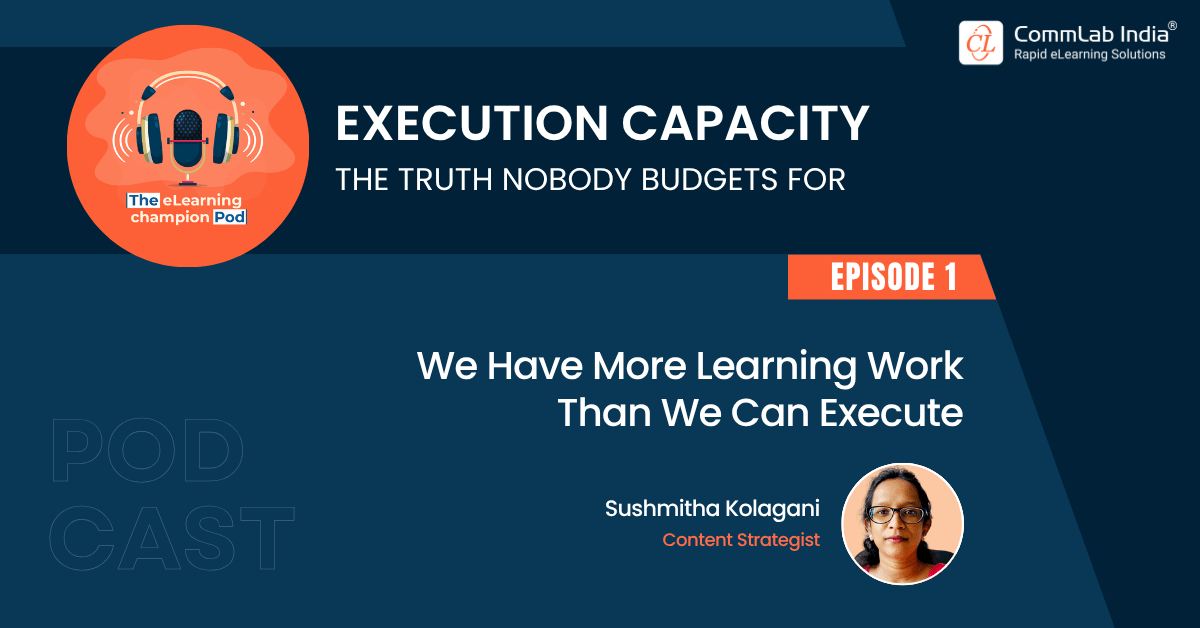
"We have more learning work than we can execute." If you have said this in a leadership meeting, or thought it quietly while staring at a backlog that never seems to shrink, this episode is for you.
In Episode 1 of Execution Capacity, the Truth Nobody Budgets For, Sushmitha Kolagani names the problem that sits underneath almost every training frustration in corporate organizations today, and explains why it is so often misdiagnosed.
Click Here To Read Transcript
00:00:05 Sushmitha
Here's a sentence I want you to sit with for a moment.
00:00:14 Sushmitha
We have more learning work than we can execute.
00:00:18 Sushmitha
Have you said that recently or heard it in a leadership meeting?
00:00:22 Sushmitha
Maybe or thought it quietly while looking at a backlog that somehow never gets shorter.
00:00:29 Sushmitha
If you have this podcast is for you, not for L&D purists debating instructional design theory for you.
00:00:37 Sushmitha
The sales VP whose team still doesn't know the new product properly.
00:00:43 Sushmitha
The compliance head who's watching regulatory deadlines approach with half the training still in development.
00:00:49 Sushmitha
The HR leader trying to onboard 500 new hires while reskilling another 1000 for roles that didn't exist 2 years ago.
00:00:59 Sushmitha
Welcome to the e Learning Champion podcast by Commlab India.
00:01:03 Sushmitha
I am Sushmita, and today we are starting at the beginning with the problem that's sitting underneath almost every training frustration in corporate organizations today.
00:01:14 Sushmitha
Thank you for being here.
00:01:15 Sushmitha
Whether this is your first time joining us or you found your way here through our channels on LinkedIn, Spotify, or YouTube, genuinely glad you're listening.
00:01:26 Sushmitha
This podcast exists because there's a conversation happening in boardrooms, in functional leadership meetings, and in quiet one on ones between heads of sales, compliance, HR and marketing.
00:01:40 Sushmitha
And that conversation is about training, specifically about why training almost never keeps pace with the speed at which our organizations are actually moving.
00:01:52 Sushmitha
Over the next 30 minutes, I want to dig into something that I think gets misdiagnosed constantly, and when you misdiagnose a problem, you spend money, time, and energy on the wrong fix.
00:02:06 Sushmitha
So let's get the diagnosis right.
00:02:08 Sushmitha
Here's what we are covering today.
00:02:10 Sushmitha
First, I want to name the actual problem, what learning execution capacity means and why it's the thing most organizations are really struggling with, even if they're calling it something else.
00:02:23 Sushmitha
Second, how this problem shows us shows up differently depending on which function you lead.
00:02:30 Sushmitha
And 3rd, 5 questions you can ask of your own function this week that will tell you exactly where your execution capacity ceiling is.
00:02:40 Sushmitha
So let's get into it.
00:02:42 Sushmitha
I want to start the first section with the definition because this term learning execution capacity sounds technical, but it actually describes something very human and very familiar.
00:02:54 Sushmitha
Learning execution capacity is the dependable ability to turn learning priorities into finished governed outputs at the required speed and scale.
00:03:06 Sushmitha
Let me break it down.
00:03:07 Sushmitha
Dependable meaning it works not just when things are calm but when demand spikes.
00:03:15 Sushmitha
Finished outputs are the courses, programs, job aids and simulations assessments we needed yesterday.
00:03:23 Sushmitha
Things that actually reach our workforce.
00:03:27 Sushmitha
Governed means they are accurate, approved, compliant, and on brand, and at the required scale of business means on time across all your markets, languages, and business units.
00:03:42 Sushmitha
The last part is where most organizations quietly fall down.
00:03:46 Sushmitha
Not on the quality when they have time, on the ability to maintain quality when they don't have time.
00:03:54 Sushmitha
And here's the data that stops people when I share it.
00:03:58 Sushmitha
According to Talent LMS's 2026 Learn in Debt report, 41% of employees said their role has evolved faster than their company's ability to train them for it.
00:04:11 Sushmitha
Read that again.
00:04:12 Sushmitha
Nearly half of employees across industries are working in roles they haven't been fully trained for.
00:04:19 Sushmitha
Not because the organization doesn't want to train them, but because the training function cannot keep up with the speed of change.
00:04:28 Sushmitha
And a TDS 2025 state of industry report adds another data point worth noting.
00:04:34 Sushmitha
The average number of formal learning hours per employee fell from 17.4 in 2023 to 13.7 in 2024.
00:04:44 Sushmitha
Now a TD acknowledges that informal learning may partly explain the drop, but even if we accept that.
00:04:52 Sushmitha
In an environment where a I adoption, compliance demands, product launches and work for transformation are all accelerating simultaneously, a meaningful drop in formal learning hours per person should raise a question for every leader.
00:05:07 Sushmitha
Is your training function keeping pace?
00:05:10 Sushmitha
Most of the time when I ask that question to functional leaders, sales, marketing, compliance, HR, the honest answer is no.
00:05:20 Sushmitha
And the follow up answer is usually we know it, but we don't know exactly what to do about it.
00:05:27 Sushmitha
And that's what I want to address today.
00:05:29 Sushmitha
Here's what I have seen consistently.
00:05:32 Sushmitha
The problem is in strategy.
00:05:34 Sushmitha
Most organizations have a reasonable learning strategy.
00:05:37 Sushmitha
They know what capabilities they need.
00:05:40 Sushmitha
They know which populations need training.
00:05:42 Sushmitha
They have a road map.
00:05:44 Sushmitha
The gap is between the road map and what actually gets built, deployed and reaches people on time, and that gap is an execution capacity problem.
00:05:54 Sushmitha
Think about any other function in your organization that runs at scale.
00:05:58 Sushmitha
Finance, supply chain, marketing, operations, manufacturing.
00:06:03 Sushmitha
All of them have something that L&D rarely has a clear understanding of throughput.
00:06:09 Sushmitha
How much can we process?
00:06:11 Sushmitha
Where are the bottlenecks?
00:06:13 Sushmitha
What happens when demand spikes?
00:06:15 Sushmitha
How do we flex capacity up or down without losing quality or control?
00:06:21 Sushmitha
L&D almost never talks this way.
00:06:24 Sushmitha
And it's not because L&D leaders aren't smart.
00:06:27 Sushmitha
It's because the function evolved from a training as an event mindset where you design a program, run it and move on, rather than a production at scale mindset where demand is continuous.
00:06:39 Sushmitha
Recurring and unpredictable in its volume.
00:06:42 Sushmitha
So the organizations that have cracked this are the ones that stopped treating L&D as a creative function that produces training when asked and started treating it as a production operation with a throughput ceiling that needs to be actively managed.
00:06:57 Sushmitha
Now in the second section on how the execution gap shows up in each function, I want to make this concrete.
00:07:04 Sushmitha
The execution capacity problem doesn't feel the same if you are a sales VP versus a head of compliance versus a chief HR officer.
00:07:12 Sushmitha
The symptoms are different, the urgency is different and the downstream consequences are different, but the root cause is the same.
00:07:21 Sushmitha
Lets start with sales.
00:07:22 Sushmitha
If you lead a sales function, the execution gap usually shows up around product launches.
00:07:28 Sushmitha
Your company announces a new product or a new version of an existing product.
00:07:32 Sushmitha
Your sales team has a quota attached to it and the training, the thing that explains how to position it, how to handle the objections that will come up in the first 90 days, how to demonstrate value in a technical sale.
00:07:46 Sushmitha
This knowledge arrives late or incomplete or so compressed.
00:07:50 Sushmitha
It was delivered in a 2 hour session the week before launch.
00:07:55 Sushmitha
The result is that your reps go into the field improvising.
00:07:59 Sushmitha
They lean on what they already know, they oversimplify, they lose deals they should have won in the first quarter while your team is still trying to build the training they needed 6 weeks ago.
00:08:12 Sushmitha
I recently spoke with a sales operation leader at a large technology company who said something I found remarkable in its honesty.
00:08:20 Sushmitha
We budget 10s of millions of product development and launch marketing.
00:08:25 Sushmitha
We budget almost nothing for the training that turns our sales team into effective sellers.
00:08:30 Sushmitha
And then we wonder why adoption is slow.
00:08:34 Sushmitha
That's the execution gap in sales.
00:08:37 Sushmitha
Now lets look at compliance.
00:08:39 Sushmitha
If you lead a compliance function, the execution gap is even more visceral because your deadlines are not soft.
00:08:45 Sushmitha
Regulatory deadlines are real, they have consequences, and they arrive whether your training is ready or not.
00:08:52 Sushmitha
The compliance training execution problem is often a volume and urgency problem simultaneously.
00:08:58 Sushmitha
Volume because compliance training programs typically cover large populations across multiple geographies.
00:09:05 Sushmitha
Often in multiple languages, often with different regulatory requirements and Regency, because the content has to be accurate at the moment of deployment.
00:09:15 Sushmitha
When you combine a large audience, a hard deadline, content that can't be finalised until late in the cycle, and a need for localization across multiple languages, you have a production challenge that most internal L&D teams simply cannot absorb without something breaking.
00:09:31 Sushmitha
And what breaks is usually the timeline, the quality or the reach.
00:09:36 Sushmitha
The downstream consequence in compliance isn't just a missed deadline, its regulatory exposure, its audit findings, and in some industries, its financial penalties.
00:09:48 Sushmitha
Now HR, if you lead HR or people operations, the execution gap tends to show up in 2 places: onboarding and reskilling.
00:09:57 Sushmitha
Onboarding because when organizations are growing, the volume of new employees can overwhelm whatever onboarding program exists, and reskilling simply because the pace of organizational change is generating training needs faster than more HR teams can build to meet them.
00:10:15 Sushmitha
And finally, marketing.
00:10:17 Sushmitha
If you lead marketing, the execution gap shows up in brand and product knowledge degradation.
00:10:22 Sushmitha
Your commercial teams need to represent your brand and products accurately and compellingly.
00:10:27 Sushmitha
So when products change, campaigns launch, messaging shifts.
00:10:32 Sushmitha
The training that keeps your commercial team aligned needs to change with it.
00:10:36 Sushmitha
Most marketing leaders invest in brand guidelines and campaign toolkits.
00:10:41 Sushmitha
But the training that ensures people can actually articulate the message is either lagging or incomplete.
00:10:47 Sushmitha
So across all 4 functions, the execution gap manifests differently on the surface, but underneath it's the same.
00:10:55 Sushmitha
The production system can't keep pace with what the business needs.
00:11:00 Sushmitha
So now I want to address the 3 fixes organizations reach for most often and why each of them addresses a symptom rather than the underlying cause.
00:11:10 Sushmitha
Fix number one hire more instructional designers.
00:11:13 Sushmitha
This is intuitive.
00:11:14 Sushmitha
We have too much training to build and not enough people building it.
00:11:17 Sushmitha
So the answer is more builders.
00:11:21 Sushmitha
But here's why it fails in practice.
00:11:23 Sushmitha
First, hiring takes time, typically 12 to 16 weeks from decision to a new hire reaching full productivity.
00:11:31 Sushmitha
If your problem is a current backlog or an upcoming deadline, you won't see relief in time.
00:11:36 Sushmitha
Second, if your production system has bottlenecks that aren't in the development phase and most of the time they aren't, adding more developers just moves the bottlenecks somewhere else.
00:11:47 Sushmitha
If the problem is that every course spends 2 weeks waiting for a subject matter expert to review it, another instruction designer produces more drafts that sit in the same review queue.
00:12:00 Sushmitha
So much for that.
00:12:01 Sushmitha
Now fix number 2, buy more technology.
00:12:05 Sushmitha
Every year there are new authoring tools, new a I content generators, new learning management systems, and the pitch is always the same.
00:12:13 Sushmitha
Do more with less, faster at scale.
00:12:16 Sushmitha
But the reality is that tools help when your bottleneck is development speed.
00:12:21 Sushmitha
They don't help when your bottleneck is review cycle, subject matter, expert availability, localization, or organizational alignment.
00:12:30 Sushmitha
I have worked with organizations that spent 6 figures on new platforms and saw zero change in cycle time because the platform was excellent but the process around it was still broken.
00:12:44 Sushmitha
Now fix number 3 prioritise differently.
00:12:49 Sushmitha
When you can't do everything, you do the most important things first.
00:12:52 Sushmitha
The problem is that this is a zero sum response to a throughput problem.
00:12:58 Sushmitha
You are not increasing your capacity to deliver.
00:13:01 Sushmitha
You are deciding which items in the backlog don't get done.
00:13:04 Sushmitha
Every item in that backlog exists because someone identified a training need that serves a business objective.
00:13:12 Sushmitha
So when you deprioritise something, you are not eliminating the need, you are accepting that it won't be met.
00:13:20 Sushmitha
So the organizations that have genuinely solved the execution capacity problem did something different.
00:13:26 Sushmitha
They redesigned the production model.
00:13:29 Sushmitha
They looked at their training function the way a supply chain consultant looks at a manufacturing operation, mapping the flow of work from intake to deployment, identifying where it waits, where it breaks, where quality gates are placed too late to catch errors cheaply, and where hands off between teams create invisible delays.
00:13:50 Sushmitha
Then they made structural changes.
00:13:52 Sushmitha
They separated the work that requires deep internal expertise.
00:13:57 Sushmitha
From the work that requires dependable execution capacity and they built different sourcing models for each.
00:14:05 Sushmitha
That's what learning execution capacity looks like when it's built deliberately.
00:14:10 Sushmitha
And now for a real world scenario.
00:14:12 Sushmitha
This scenario illustrates what this looks like in practice.
00:14:16 Sushmitha
Not going to name the organization, but the situation is one I've encountered in variations many times.
00:14:23 Sushmitha
A global manufacturing company, roughly 40,000 employees across 12 countries, decides to roll out a new enterprise wide safety and compliance program.
00:14:33 Sushmitha
The driver is a combination of regulatory change in 3 of their major markets and a push from the board following some near miss incidents the previous year.
00:14:43 Sushmitha
The program needs to reach every employee.
00:14:46 Sushmitha
It needs to be in 6 languages, its need to be completed within a 6 month window, and it needs to be accurate.
00:14:53 Sushmitha
The regulatory content has to reflect the specific requirements in each location.
00:14:58 Sushmitha
The internal L&D team has 8 people.
00:15:01 Sushmitha
They are good at their jobs, but they are currently running 14 other active projects.
00:15:05 Sushmitha
At the same time, this request arrives.
00:15:08 Sushmitha
They have one external translation vendor who can handle 3 of the 6 languages.
00:15:13 Sushmitha
The other 3 languages will require finding new vendors, onboarding them, and managing the quality of unfamiliar translation partners under time pressure.
00:15:23 Sushmitha
Now the subject matter experts, safety engineers and compliance specialists who need to review and approve the content are distributed across 12 countries and have day jobs that don't include reviewing training content.
00:15:38 Sushmitha
6 months sounds like enough time, but it isn't.
00:15:42 Sushmitha
Not with this existing production model.
00:15:45 Sushmitha
The program launched late in some markets, had a compress rollout in others, and the quality checks were shortened under deadline pressure in ways that created a revision cycle.
00:15:55 Sushmitha
The following quarter, the organization met the letter of the regulatory requirement in most jurisdictions, but at the cost of rework, team burnout, and a CLO who spent 6 months managing a crisis rather than building a function.
00:16:11 Sushmitha
The redesign that followed wasn't about hiring more people or buying a better authoring tool.
00:16:17 Sushmitha
It was about building a production model that could handle this kind of spike without those consequences.
00:16:23 Sushmitha
Reserved external development capacity, a structured localization pipeline, defined review protocols that pull subject matter experts in earlier and more efficiently.
00:16:34 Sushmitha
A governance model that separated what had to be done internally from what could be executed externally without loss of control.
00:16:42 Sushmitha
The next time a program of similar scope arrived 18 months later, it ran differently.
00:16:47 Sushmitha
Not perfectly, but differently.
00:16:50 Sushmitha
The timeline was realistic from the start.
00:16:53 Sushmitha
The team wasn't managing a crisis.
00:16:55 Sushmitha
The CLO was leading, not firefighting.
00:16:58 Sushmitha
That's the difference between an organization that has built learning execution capacity.
00:17:03 Sushmitha
And one that's still assuming it.
00:17:05 Sushmitha
So before I close, I want to give you something concrete.
00:17:09 Sushmitha
5 questions you can ask of your own function before your next planning conversation.
00:17:14 Sushmitha
First, if training demand double next quarter, a new regulation, a merger, a system migration, could your function deliver without quality quietly eroding?
00:17:25 Sushmitha
Answer with what you know your current production model can handle and not what you hope for.
00:17:32 Sushmitha
The second question, where does work actually wait in your training production process, not where it gets built, but where does it sit in between the stages?
00:17:43 Sushmitha
Intake to design, design to development, development to review, review to localization.
00:17:49 Sushmitha
Each of these transitions is a potential delay.
00:17:53 Sushmitha
Thirdly, which metrics currently reveal your constraints?
00:17:57 Sushmitha
Most organizations measure training completion rates.
00:18:00 Sushmitha
Almost none of them measure QH cycle time, review delays or release reliability.
00:18:06 Sushmitha
If you can't see the bottleneck in your data, you're managing by intuition.
00:18:11 Sushmitha
4th, is your training demand recurring and continuous deadline bound spikes or a defined role gap that needs a specific capability built?
00:18:21 Sushmitha
These 3 demand patterns need different capacity models.
00:18:25 Sushmitha
Finally, which work in your training pipeline genuinely requires internal expertise and judgment, and which work requires dependable execution capacity that could be structured differently?
00:18:36 Sushmitha
That answer is the foundation of a production model that scales.
00:18:41 Sushmitha
So that's our first episode in the e Learning Champion podcast.
00:18:46 Sushmitha
If what we talked about today resonated, if you recognise your organization in any of those scenarios.
00:18:52 Sushmitha
Visit us at comlabindia.com.
00:18:55 Sushmitha
Next episode we are going deeper on one specific function compliance, because the stakes are different when training isn't just a business performance issue, but a regulatory and legal one.
00:19:07 Sushmitha
And if you found this episode valuable, please share it with your colleagues.
00:19:10 Sushmitha
Subscribe on Spotify, Apple Podcasts or wherever you listen.
00:19:15 Sushmitha
And if you are watching on YouTube or LinkedIn, leave a comment.
00:19:18 Sushmitha
I will genuinely read them.
00:19:20 Sushmitha
Thank you for listening to the e Learning Champions podcast.
00:19:23 Sushmitha
Until next time.
Here are some takeaways.
What Is Learning Execution Capacity, and Why Does It Matter?
Learning execution capacity is the dependable ability to turn learning priorities into finished, governed outputs at the required speed and scale. That definition has four parts worth unpacking:
- Dependable, meaning it works not just when things are calm, but when demand spikes.
- Finished outputs, meaning courses, programs, job aids, simulations, and assessments that actually reach the workforce.
- Governed, meaning the content is accurate, approved, compliant, and on brand.
- At the required speed and scale, meaning on time, across every market, language, and business unit.
That last point is where most organizations quietly fall down. The issue is rarely quality when there is enough time. It is maintaining quality when there is not.
What Does the Data Actually Show?
Two data points anchor this episode. According to TalentLMS's 2026 Learning Debt Report, 41% of employees say their role has evolved faster than their company's ability to train them for it. Nearly half the workforce is operating in roles they have not been fully trained for, not because organizations do not want to train them, but because the training function cannot keep pace with the speed of change.
ATD's 2025 State of the Industry report adds a second signal: average formal learning hours per employee fell from 17.4 in 2023 to 13.7 in 2024. ATD notes informal learning may explain part of that drop. Even so, in an environment where AI adoption, compliance demands, product launches, and workforce transformation are all accelerating at once, a meaningful drop in formal training hours should prompt every leader to ask whether their training function is keeping pace.
If Strategy isn't the Problem, What is?
Most organizations already have a reasonable learning strategy and a roadmap. The gap sits between that roadmap and what actually gets built and delivered on time — an execution capacity problem, not a strategy problem. Functions like finance and supply chain understand their throughput and know where bottlenecks sit. L&D rarely thinks this way, not for lack of skill, but because it grew up around a training-as-event mindset rather than a production-at-scale one.
How Does the Execution Gap Show Up in Your Function?
The gap does not feel the same across functions. Symptoms and consequences differ, but the root cause is identical: the production system cannot keep pace with what the business needs.
Sales
The gap usually shows up around product launches. Training on positioning and objection handling arrives late or compressed into a two-hour session the week before launch, and reps go into the field improvising and losing winnable deals. As one Sales Operations leader put it: companies budget tens of millions for launch marketing and almost nothing for the training that turns sellers effective, then wonder why adoption is slow.
Compliance
Here the gap is more visceral because regulatory deadlines are not soft. Compliance training combines high volume across populations, geographies, and languages with recency, since content must be accurate the moment it deploys — a challenge most internal teams cannot absorb without something breaking. The consequence isn't just a missed deadline; it can mean regulatory exposure, audit findings, and financial penalties.
HR
For HR leaders, the gap surfaces in onboarding, when hiring volume overwhelms the program, and in reskilling, when organizational change outpaces the ability to build training for it.
Marketing
The gap shows up as brand and product knowledge degradation: most marketing leaders invest in brand guidelines and campaign toolkits, but the training that helps people articulate the message lags behind.
Why Don't the Common Fixes Actually Work?
Organizations typically reach for three fixes. Each addresses a symptom rather than the underlying cause.
1. Why doesn't hiring more instructional designers solve it?
Hiring takes time, typically twelve to sixteen weeks from decision to a new hire reaching full productivity, which offers no relief for a current backlog or an approaching deadline. And if the production system's real bottleneck is not development, more developers simply move the backlog somewhere else. If every course spends two weeks waiting on a subject matter expert for review, another instructional designer just produces more drafts that sit in the same queue.
2. Why doesn't buying more technology solve it?
New authoring tools, AI content generators, and learning management systems promise to help teams do more with less, faster, at scale. Tools genuinely help when the bottleneck is development speed. They do not help when the bottleneck is review cycles, subject matter expert availability, localization, or organizational alignment. Some organizations have spent six figures on new platforms and seen zero change in cycle time, because the platform was excellent but the process around it was still broken.
3. Why doesn't reprioritizing solve it?
Reprioritizing is a zero-sum response to a throughput problem. It does not increase capacity to deliver; it decides which items in the backlog do not get done. Every item in that backlog exists because someone identified a real training need tied to a business objective. Deprioritizing a need does not eliminate it. It simply accepts that the need will not be met.
What Actually Works?
Organizations that have genuinely solved the execution capacity problem redesigned their production model. They mapped the flow of work from intake to deployment the way a supply chain consultant maps a manufacturing operation, looking for where work waits, where it breaks, where quality gates sit too late to catch errors cheaply, and where handoffs between teams create invisible delays. They then separated work that requires deep internal expertise from work that requires dependable execution capacity, and built different sourcing models for each.
What Does This Look Like in a Real Organization?
Picture a global manufacturer — 40,000 employees, 12 countries rolling out a safety and compliance training program after regulatory change and board pressure from prior near-misses. Six languages, six months, zero room for jurisdictional error.
The internal L&D team: eight people, already juggling fourteen other projects, with subject matter experts scattered across those 12 countries for whom reviewing training is a side task. Six months sounds workable. Under the old model, it isn't; rollouts slip in some markets, quality checks get rushed, and the company technically meets the regulation, but pays for it in rework, burnout, and a CLO firefighting instead of leading.
The fix isn't more headcount or a shinier tool. It's reserved external capacity, a real localization pipeline, earlier expert reviews, and clear lines between what stays internal and what doesn't. Eighteen months later, the next program like it runs on time and the CLO is finally leading, not scrambling.
What 5 Questions Should You Ask Your Own Function?
Before your next planning conversation, Sushmitha suggests testing your function against five questions:
- If demand doubled tomorrow, would quality hold — or quietly erode?
- Where does work actually sit and wait, not just where it gets built?
- Are you tracking queue age and cycle time, or just completion rates?
- Is your demand steady, spiky, or a one-time gap? Each needs a different model.
- What truly needs internal judgment — and what just needs reliable execution?
Next Step
Execution capacity isn't a nice-to-have metric — it's the difference between a strategy that lives on paper and one that actually reaches your workforce. Ask these five questions before your next planning cycle, and you'll know exactly where your function stands. Ready to go deeper? Tune in to Episode 2 of Execution Capacity, the Truth Nobody Budgets For.


WorkLearning.AI Interim Research Report
A Joint Research Initiative by Lancaster University, UK and CommLab India