
AI in L&D is having a moment, but much of the conversation still feels too narrow. The focus is still heavily on faster content creation—quicker scripts, instant outlines, auto-generated quizzes. Useful, certainly. But in corporate training, content creation is rarely the stage that determines overall speed. It is simply the most visible part of the process. The real pressure lies elsewhere: in how quickly existing materials can be repurposed, how efficiently learning can be rolled out across languages and regions, and how well training is reinforced after delivery. In most organizations, the slowdown is not in creating the first draft. It is in everything that has to happen for learning to scale and stick.
That is why the more important question for L&D leaders today is not, “How can AI help us create content faster?” but “Where can AI help us move learning faster?” In a business environment shaped by constant change—new tools, new expectations, new compliance needs, and new skill gaps—learning has to keep up without becoming an operational bottleneck. This is where AI starts becoming strategically relevant.
This blog explores where AI improves speed and throughput in corporate training by helping L&D teams repurpose existing content, scale learning across languages and regions, and reinforce training beyond delivery.
Table Of Content
- Why “AI Just for Content Creation” Is a Low-Leverage Use Case
- Where AI Improves Speed and Throughput (The Real Levers)
- Turning AI into Real L&D Impact: What to Do Next
Why “AI Just for Content Creation” Is a Low-Leverage Use Case
In corporate training, content creation is rarely the stage that determines overall speed. It is simply the most visible part of the process. The real drag on execution usually comes from what happens around content—how quickly existing materials can be repurposed, how efficiently learning can be rolled out across languages and regions, and how well training is reinforced after delivery.
That is why AI for content creation, by itself, is a low-leverage use case. It improves one task, but leaves some of the most important execution bottlenecks untouched.
In practice, an L&D team may now be able to generate a first draft faster, but still struggle with the issues that actually delay scale and impact:
- Existing knowledge is trapped in static formats instead of being activated for wider, faster use
- Multilingual rollout slows down because translation and localization across formats require significant coordination
- Learning delivery speeds up at the front end, but performance support after training remains weak
For AI to improve speed and throughput in a meaningful way, it has to help L&D teams do more than generate content. It has to help them transform what already exists, scale learning across markets, and sustain learning beyond the point of delivery.
An organization can now create more learning content than ever before and still fail to improve responsiveness, business alignment, or learner performance. In some cases, the problem becomes worse. AI makes it easier to produce content at scale, but if the surrounding workflow is inefficient, it simply introduces more volume into an already constrained system. AI helps shift time from low-value tasks to higher-value strategic work, but that shift creates real value only when the saved time is redirected toward better prioritization, faster decision-making, stronger alignment with business needs, and more effective learning delivery.
Where AI Improves Speed and Throughput (The Real Levers)
To improve speed and throughput in a meaningful way, AI has to reduce friction across the broader learning process, not just accelerate first drafts. And with 75% of organizations plan to increase AI spending in learning and talent development, the bigger question is where AI can remove the bottlenecks that actually slow learning down.
1. Rapid Transformation of Existing Content
One of the biggest misconceptions in L&D is that every new training need requires building something from scratch. In reality, most organizations are sitting on a vast library of underutilized content—PowerPoint decks, instructor-led training materials, PDFs, SOPs, webinar recordings, and legacy eLearning courses. The problem is not a lack of content. It’s that this content is often static, scattered, or not designed for digital consumption. This is not a content creation use case. It is a throughput lever, helping L&D teams move faster by working with what already exists instead of starting from scratch.
Preserve Expertise. Scale Learning.
Join 60+ global organizations that trust CommLab India to turn classroom training materials into immersive eLearning.

Instead of starting with a blank screen, L&D teams can now take existing assets and rapidly transform them into structured, engaging learning experiences. AI here becomes a high-impact enabler of speed and throughput. Classroom training programs, for example, can be converted into eLearning by using AI to analyze slide decks, instructor notes, and supporting materials. AI can help identify key concepts, reorganize content into logical learning flows, and even suggest interactions or assessments. What previously required weeks of manual instructional design effort can now be accelerated significantly without compromising quality.
Watch this video to learn why enterprise organizations are shifting from ILT to eLearning.
The same applies to webinar recordings, which are often a goldmine of expert knowledge but rarely reused effectively. Traditionally, converting a 60-minute webinar into a structured course meant manually reviewing the recording, extracting insights, scripting content, and designing modules. With AI, this process becomes far more efficient. Key segments can be identified automatically, important concepts extracted, and content chunked into shorter, learner-friendly formats such as microlearning modules or scenario-based learning.
AI supports transformation by:
- extracting key insights from raw materials
- breaking down long-form content into digestible learning units
- tagging content with metadata for easier retrieval and reuse
- aligning content with learning objectives and outcomes
This allows L&D teams to move from content creation to content activation—unlocking value from what already exists.
Modern authoring tools combined with GenAI further accelerate this process by enabling rapid development of interactive elements, voiceovers, and assessments. Instead of rebuilding courses manually, teams can focus on refining and contextualizing content for specific audiences, roles, or regions.
Give Your Webinars a Longer Life
CommLab India converts webinar recordings into structured, self-paced eLearning, so your content continues to deliver value long after the live session ends.

2. Scalable Translation and Multilingual Rollouts
For global organizations, training is not complete when the English version is ready. That is only the beginning. The real challenge is rolling learning out across languages, regions, and business contexts without slowing launch timelines or creating inconsistency. This is where many L&D teams lose momentum. eLearning translation is one of the biggest challenges in global learning delivery, where speed, consistency, and context all have to come together across regions.
AI improves this process when it is used within a well-planned localization workflow. Its value is not limited to translating text faster. It helps create a more efficient multilingual rollout process that is faster, more scalable, and more cost-effective. When AI tools and translation memory tools are used well, they enhance speed and efficiency while reducing costs. But that advantage becomes much stronger when the master course in English is designed from the start with translation and localization best practices in mind.
Discover how AI can make eLearning translations faster, smarter, and easier to scale across global learners.
Layouts, visuals, narration, and on-screen text all need to be developed in a way that supports smooth translation and localization, rather than forcing rework at every stage. This is especially important because modern learning content is rarely limited to one format.
To maintain consistency, all of these assets need to be translated together, not in isolation. This is where AI can make a measurable difference. It can speed up first-pass translation, identify repeated language for reuse, and support consistency across formats.
Popular translation tools are often used to make multilingual workflows faster and more efficient, especially when large volumes of content need to be translated at scale. These include:
- DeepL
- Smartcat
At the same time, enterprise learning cannot depend on automation alone. Accuracy, context, and business relevance matter too much. A compliance course, a technical training module, and a sales enablement program all demand different language sensitivity and domain understanding. That is why AI works best when paired with qualified native translators who bring subject matter expertise across industries and topics.
This is what makes translation a real throughput lever. It is not just about translating faster. It is about building a multilingual learning operation that can scale without becoming a bottleneck.
3. Stronger Reinforcement After Training Delivery
A major reason training underperforms is not poor design, but weak reinforcement. Learning is launched, completed, and then forgotten. Managers are often not equipped to reinforce it, and L&D teams rarely have the bandwidth to build extensive post-training support manually.
AI can help generate reinforcement assets quickly: follow-up nudges, microlearning refreshers, manager discussion prompts, scenario practice, FAQs, and search-friendly support content. This extends learning beyond the event and improves the chances of transfer to the job.
It also improves throughput in a less obvious way: by increasing the value of what has already been delivered.
AI supports this by:
- creating post-training nudges and reminders
- generating manager coaching prompts
- building refresher content from core modules
- turning formal training into continuous reinforcement
This helps L&D move beyond delivery toward sustained performance support.
Turning AI into Real L&D Impact: What to Do Next
Start small, but start where it matters. Choose one bottleneck—such as converting existing content, speeding up localization, or strengthening post-training reinforcement—and apply AI with a clear objective: reduce friction and improve flow.
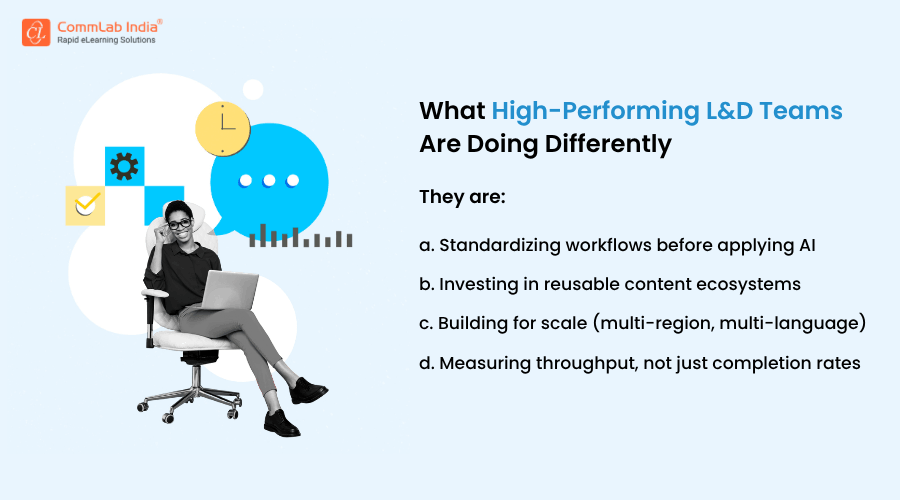
The next step is to build repeatable systems, not one-off experiments. Standardize how content is transformed, how translation is managed, and how reinforcement is delivered. Combine AI tools with human expertise to maintain quality while improving speed. Measure success not by how fast content is created, but by how quickly learning reaches the learners and drives performance. Over time, this approach shifts L&D from a reactive function to a scalable, high-impact learning operation.
Want to take this further? Explore our eBook to learn how AI streamlines reskilling for a future-proof workforce, the challenges to consider with AI implementation, and more!
![Have You Adopted these eLearning Trends? [SlideShare]](https://www.commlabindia.com/hubfs/Imported_Blog_Media/elearning-trends-evergreen-slideshare.jpg)