
If AI can analyze a business problem, suggest a strategy, prepare a proposal, and even question its own recommendations, what exactly is left for the manager to do? Approve the output? Surely, we do not need an expensive executive merely to click “Approve”.
The question sounds new. But managers have been dealing with a version of it for a long time. A CEO may know less about finance than the finance head, less about technology than the technology head, and less about a customer than the salesperson handling the account. Yet, the CEO is expected to get results from all of them.
So, how does someone manage people who know more than he or she does? And what changes when some of that expertise comes from a machine?
Let’s examine this a little more closely.
For those responsible for leadership development, this raises a practical question. If AI can increasingly perform the analysis and preparation that once formed part of a manager’s work, what should management development programs now teach? And how should organizations help managers acquire the judgment needed to use such assistance responsibly?
Knowledge and the Responsibility for Results
We often mix up knowing the most with being responsible for the result. They are connected, of course, but they are different responsibilities.
Consider an architect designing your house. The architect knows more about design than you do. The structural engineer understands loads and foundations that you would probably prefer not to understand. Does that mean you leave everything to them?
You still need to explain how you want to live, what you can afford, and which compromises you are willing to make. A beautiful house that does not suit your family is hardly a successful project.
Your responsibility is not discharged merely because you hired excellent professionals.
Something similar happens in a business. Specialists contribute their expertise. The manager must ensure that their combined effort serves the purpose for which the work was undertaken. When cost, quality, speed, and customer expectations pull in different directions, someone has to decide what takes precedence.
AI gives us another source of expertise. It does not, by itself, settle these choices.
The Peculiar Problem with an Agreeable Expert
Managing human experts comes with its own difficulties. They have opinions, professional pride, competing priorities, and sometimes a rather low opinion of the brief you have given them.
AI can appear refreshingly accommodating. Ask for a strategy and you get one. Ask for another and you get that too. You can keep improving the presentation until it looks quite impressive.
But have you improved the decision?
A polished answer can make it difficult to notice that the question was poorly framed. Worse, the system may work diligently towards an objective whose consequences you have not thought through.
Suppose you ask it to reduce customer service costs. It recommends fewer human interactions and more automated responses. The arithmetic looks attractive. But what if the customers who need those interactions are the very customers you cannot afford to lose?
The recommendation may satisfy the brief and still damage the business.
A good human expert may challenge you before proceeding. We can ask AI to challenge us too, and we should. But we cannot assume that it will discover every missing fact or question every unwise instruction.
This brings us back to the manager. How do we get useful work from such a capable and obliging assistant?
Start with What You Actually Want
“Improve our sales.” “Reduce our costs.” “Make this course engaging.”
These are wishes. They need a little more work before they become useful assignments.
Anyone who has managed the development of an e-learning course will recognize the problem. The stakeholder wants the course to be engaging, interactive, short, comprehensive, and inexpensive. All at the same time. The development team is then left to discover which of these requirements really matters.
AI does not remove this ambiguity. It can produce an answer before we have even noticed it.
A useful brief should explain the outcome, the constraints, and what we are unwilling to sacrifice. For example:
“Suggest how we can shorten course development time using the resources we already have. Identify the delays we can remove but retain the necessary checks for content accuracy. Recommend one project on which we can test the approach.”
Now we have something to work with.
Before proceeding, ask the system to examine the brief itself. What have we left out? What information does it need? Could the proposed objective create another problem elsewhere?
The objective can change as we learn. But it should change because we have discovered something important, not because the latest answer sounds more interesting.
Is Learning to Prompt Enough?
Naturally, much of the training around AI concentrates on prompting. We are taught to give the system a role, provide context, specify the format, and refine the instructions. All useful. But does learning to ask a question properly mean that we know which question is worth asking?
Consider a manager who asks AI to design a training program to improve sales. A well-written prompt may produce learning objectives, modules, exercises, and even an assessment. The output could be excellent. But what if the salespeople already know how to sell, and the real problem is poor leads or delayed quotations? We would have designed a very good program for the wrong problem.
The difficulty here is not the wording of the prompt. It is the diagnosis that should have preceded it.
Nor does a good prompt relieve us of the need to examine the answer. We still need to distinguish facts from assumptions, test whether the recommendation is practical, and decide what evidence would justify acting on it. Asking the system to “be accurate” is an instruction, not a verification.
So, by all means, teach people to prompt. But let them practice on a real problem, explain why they framed it that way, check the output, and follow the work through to its result. Otherwise, we may produce people who are very good at obtaining impressive answers and not quite so good at deciding what to do with them.
Know Enough to Question the Answer
Does this mean managers no longer need subject knowledge? I would be very careful with that conclusion.
You may not need to perform every calculation or prepare every analysis. But you need enough understanding to recognize when an answer does not fit the way the work actually happens. Where the decision calls for specialist knowledge, that may mean involving someone qualified to challenge the recommendation.
A production schedule may look perfectly feasible until you discover that three activities depend on the same person. An attractive sales forecast may depend on inquiries that have not progressed beyond an initial conversation. A training solution may be technically sound but impossible for the intended learners to use during their working day.
These are not always failures of analysis. Often, they are failures to understand the situation.
So, spend time with the people doing the work. Speak to customers. Examine where things get delayed and why. AI can help us interpret operational information, but someone must ensure that the information reflects reality.
Otherwise, we risk becoming very well informed about a business that exists only in the report.
Find the Assumption on Which the Recommendation Depends
A ten-page proposal can contain an impressive amount of detail and still depend on one doubtful assumption.
An AI-assisted production proposal, for instance, may promise substantial time savings. But does it include the time spent checking and correcting the output? Does it account for the senior person whose review is necessary before the work can go to the customer?
If these activities are excluded, the saving may be smaller than it first appears.
Ask what must be true for the recommendation to work. Then check those few important claims against actual records, relevant experience, or a small pilot.
You can ask another AI system to review the proposal. That may reveal weaknesses. But two systems agreeing with each other is not the same as evidence from the operation.
The more consequential the decision, the stronger the checking should be.
Decide What Can Be Delegated
Should every AI-assisted action come back to the CEO for approval? That would be a rather expensive way to introduce a bottleneck.
We already delegate work to people within limits. We can apply the same discipline here.
Preparing a draft is different from sending it to a customer. Suggesting a price is different from committing to it. Testing a change is different from introducing it into a live operation.
Decide what can proceed independently, what requires review, and who is authorized to approve it. Consider the consequences of an error and how easily it can be corrected. For AI-assisted actions, those limits should also cover access to sensitive information and when a human reviewer must intervene.
There is little point in having a fast system if every minor action waits for the senior-most person. Equally, speed is a poor excuse for allowing a consequential decision to slip through without anyone accepting responsibility.
Write Down Why You Decided
Once a decision is made, record the reasons briefly. What did we choose? What did we reject? Which risk did we accept? What result would make us reconsider?
This need not become another elaborate reporting exercise. A few clear sentences may be enough.
The purpose is to preserve our reasoning while we still remember it honestly. When a decision goes wrong, it is remarkably easy to believe that we had anticipated everything except the outcome!
A decision record helps us examine whether the problem lay in our assumptions, our execution, or a change in circumstances. It also prevents every new recommendation from taking us back to the beginning.
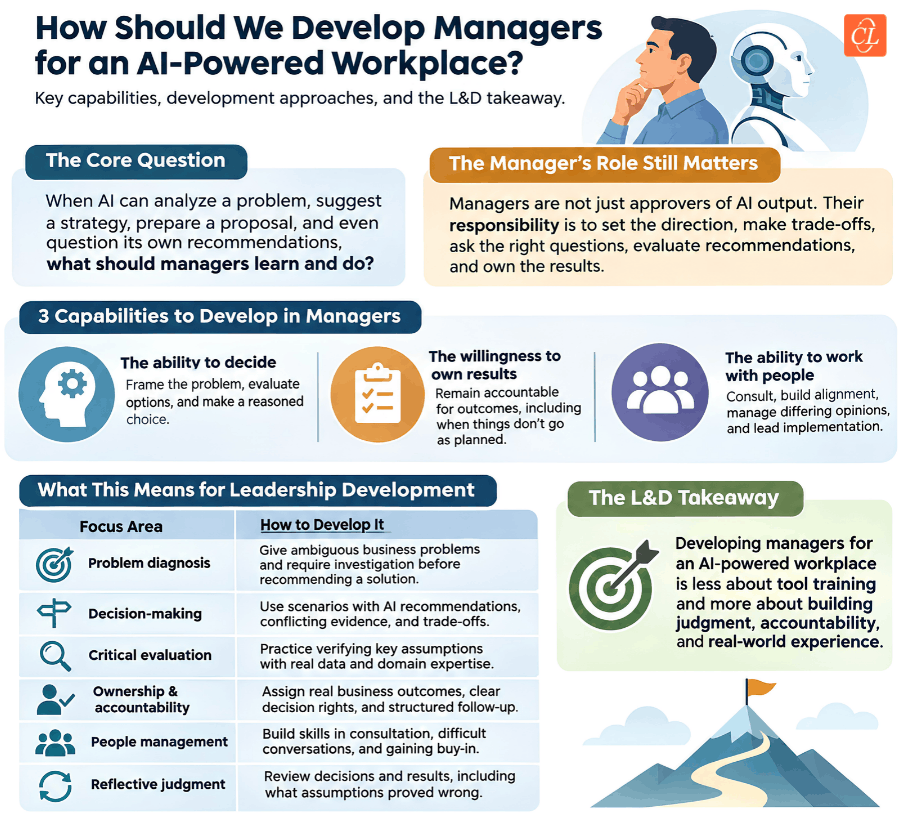
What, Then, Should We Develop in Managers?
If learning to prompt is not enough, what else should managers learn? There is a tendency to prescribe creativity, emotional intelligence, ethics, and critical thinking. All worthwhile. But what would a manager actually do differently after such training? Let’s make the requirements a little more concrete.
The Ability to Decide
We often assume that a person who has been given the authority to decide also knows how to decide well. That is quite an assumption! A designation gives a manager authority. It does not automatically confer judgment.
Decision-making requires us to identify the real problem, examine the evidence, weigh the alternatives, and accept certain disadvantages in pursuit of a worthwhile result. It also requires knowing when to stop analyzing and act, and when a small experiment would be wiser than a large commitment.
AI can assist at each stage. To use that assistance well, managers need practice in making decisions and examining their consequences. Otherwise, we may simply replace dependence on the most persuasive person in the room with dependence on the most convincing answer on the screen.
The Willingness to Own the Result
But is the ability to decide enough? We have all seen situations where everyone has an opinion, but nobody quite wants to take responsibility for what happens next.
Ownership means seeing the work through, including dealing with obstacles. Accountability means explaining our decisions and results honestly, acknowledging our contribution when something goes wrong, and taking corrective action. A person may be a good analyst and still hesitate to accept either responsibility.
Can we develop these qualities? I would approach this as a matter of practice and working conditions, as well as personal disposition. Some people take initiative more readily than others. But what appears to be an innate quality may also reflect their upbringing, experience, and what happened the last time they took a risk.
Give someone a meaningful outcome to own, along with the authority and resources to influence it. Make clear what they can decide and when they should seek help. Review how they handle delays, report bad news, and put mistakes right. Ownership does not mean struggling alone until the problem becomes impossible to hide.
The boss has some work to do here too. If we routinely override delegated decisions, humiliate people for reasonable mistakes, or claim the credit while passing down the blame, our speeches about ownership are unlikely to achieve much.
None of this guarantees that everyone will develop the same willingness or reliability. Persistent avoidance, despite clear expectations and adequate support, may require us to reconsider the responsibilities entrusted to that person. But we should first examine whether we have made genuine ownership possible.
The Ability to Work with People
And what about people skills? Were they not important anyway? Of course. AI gives us another reason to examine what they achieve in the work.
Suppose AI helps a manager prepare a sound plan to improve productivity. The numbers make sense and the workflow looks feasible. But the employees expected to implement it believe that the real purpose is to reduce their jobs. Others know of a practical difficulty but hesitate to mention it. How far will our excellent plan travel?
The manager must listen to these concerns, discover what the analysis missed, and explain the decision honestly. Where interests conflict, the manager must work through the disagreement. Where capability is missing, the manager must coach or arrange support. A recommendation does not implement itself merely because its reasoning is sound.
Listening, asking useful questions, explaining trade-offs, handling disagreement, and giving constructive feedback are therefore part of getting results. Understanding another person’s perspective does not require agreeing with every objection. It helps us decide which objections reveal a real problem, and which require a difficult but necessary conversation.
There is a connection with ownership here. We cannot reasonably expect people to take ownership if they cannot question an instruction, discuss an unrealistic deadline, or bring bad news to their manager. Employees need the skills to have these conversations, and managers need the maturity to receive them.
Development Needs a Real Assignment
How do we develop this combination of judgment, responsibility, and people skills? A classroom program can introduce useful ideas. The workplace must provide opportunities to apply them.
Give managers a real problem. Ask them to frame it, use AI to explore it, check the important claims, consult the people affected, and make a decision within agreed limits. Let them carry the work through and review both the result and how they arrived at it.
Make the feedback specific. Did they listen before proposing a solution? Did they surface an uncomfortable fact? Did they explain a trade-off clearly? Did they seek help in time and honor their commitments? “Be more accountable” is difficult to act upon. Discussing a missed commitment and agreeing how to put it right is much more useful.
We must also think about younger professionals. If AI prepares the first analysis every time, where will they acquire the experience needed to question it? They need supervised opportunities to investigate problems themselves, work alongside experienced colleagues, and see what happens after a recommendation is implemented.
AI fluency helps managers obtain useful assistance. Domain knowledge and decision-making help them judge what to do. Ownership and accountability help them follow through responsibly. People skills help them turn a decision into coordinated action. Our development programs should give them practice in all four.
What This Means for Leadership Development
For L&D teams, the implication is to build these abilities into assignments, rather than treating them only as topics to be covered. A manager could be asked to diagnose a real performance problem, use AI to explore options, identify the assumptions behind a recommendation, and consult the people whose work would change. The exercise should end with a decision, a clear record of why it was made, and a review of what happened in practice.
The assessment should look beyond the quality of the AI-generated answer. Did the manager identify the right problem? Check the evidence? Explain the trade-offs? Listen to objections and take responsibility for the result? Coaching, feedback, and opportunities to make decisions within sensible limits will matter as much as the formal learning experience.
The Manager Still Has Work to Do
The ability to obtain sophisticated analysis is valuable. But it can also tempt us to confuse the availability of an answer with the resolution of a problem.
The manager still has to decide what is worth doing, explain the requirements, question the evidence, resolve competing interests, and follow through on the result.
None of this requires being the most knowledgeable person in the room. It does require knowing enough to ask sensible questions and being willing to accept responsibility for the answers acted upon.
We may be able to delegate more of the thinking. We still have to answer for what we do with it.
Does this mean we must become more human? In a sense, yes. But being human also includes defending poor decisions and finding someone else to blame! What we need to develop are the more demanding qualities: humility to question our understanding, courage to make difficult decisions, empathy for those affected, and integrity to accept responsibility for the results. These take us into the territory of ethics, fairness, and human virtues.
Can we develop these through training programs? A program can provide a beginning. But these qualities need to be practiced in real decisions, examined through honest reflection, and demonstrated by those who lead us. We cannot teach fairness and reward favoritism or ask for honesty and punish every admission of error. Preparing managers for AI therefore requires us to look beyond their ability to use the technology. We must also examine how we develop their judgment and character, and what our organizations encourage them to become.