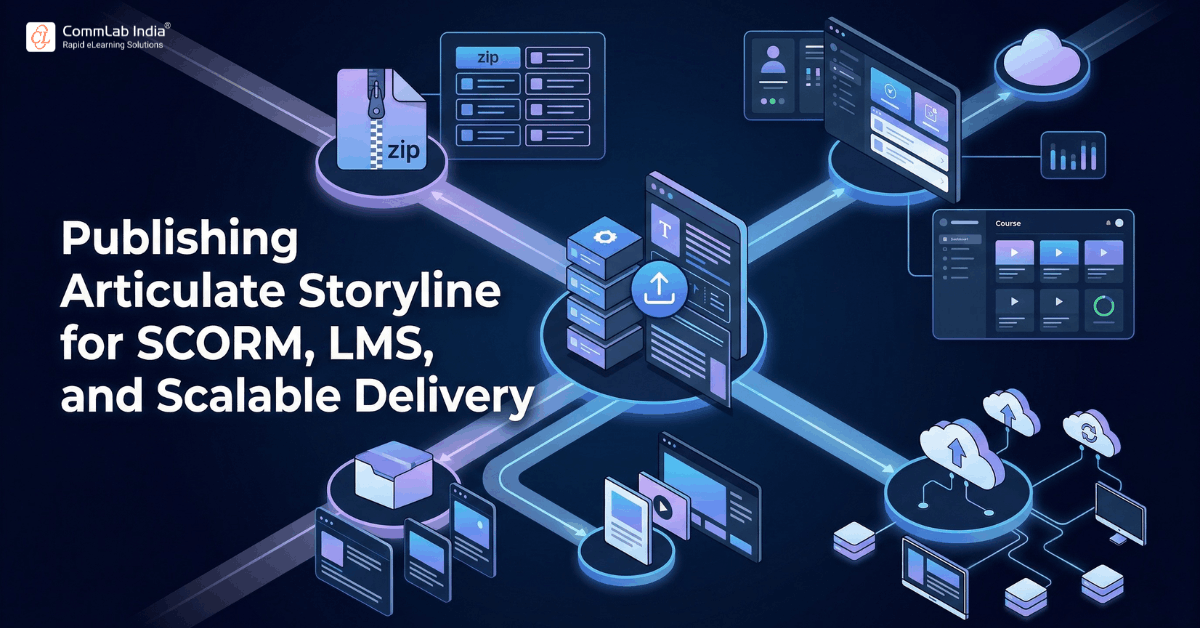
In Articulate Storyline, publishing is not a final button-click exercise. It is the stage where instructional design, learner experience, LMS behavior, technical compatibility, reporting needs, and operational realities all converge. The decisions made here affect whether a course launches smoothly, tracks completion accurately, supports localization workflows, handles restricted navigation correctly, and works as expected inside the organization’s learning infrastructure.
This matters even more in enterprise environments, where courses are rarely deployed in isolation. They sit inside broader training ecosystems with LMS rules, reporting expectations, learner compliance requirements, time-tracking needs, access conditions, localization demands, and varying degrees of technical governance. In such settings, publishing is not merely about output. It is about readiness.
Articulate Storyline gives teams several ways to publish and implement courses, but the real value lies in understanding how those options map to actual business and learning requirements. A course intended for a public web environment raises different decisions than one built for a compliance LMS. A translated course needs different preparation than a single-language release. A self-directed learning module calls for a different navigation model than a tightly controlled certification path.
This article explores how to approach Articulate Storyline publishing, LMS deployment, SCORM preparation, technical controls, and implementation choices more strategically. Rather than treating publishing, navigation restriction, markers, scripting, localization export, and learner-time calculation as disconnected technical tasks, it brings them together into one enterprise-level view of Storyline readiness. The goal is not just to get a course out the door, but to ensure it performs well where it matters most: in the real learning environment.
Download eBook Now: Rapid eLearning Authoring Tools
Table of Contents
- Publishing Is Where Learning Design Meets Technical Reality
- Choosing the Right Storyline Publishing Path for the Delivery Context
- SCORM and LMS Publishing as Business-Critical Decisions
- Technical Readiness Goes Beyond File Output
- Navigation Restriction and Learner Control in Storyline
- Designing Interactive Control with Markers, Triggers, and Script-Enabled Behavior
- Preparing Storyline Courses for Translation and Global Deployment
- Estimating Learner Time and Managing Completion Expectations
- FAQ
Publishing Is Where Learning Design Meets Technical Reality
Storyline development often receives most of the creative attention because it is where teams build screens, interactions, media, and assessments. But publishing is the point at which all those design decisions are tested against operational reality. It is where the course stops being a draft and starts becoming a deployable learning product.
That transition matters more than many teams assume.
A course may look polished during internal review and still fail in deployment because its output settings do not align with the LMS, its reporting logic does not reflect the completion requirement, its navigation model does not match the learning objective, or its technical assumptions were never validated in the target environment. When these problems appear after launch, they create confusion for learners, support teams, LMS administrators, and L&D stakeholders alike.
This is why publishing should be treated as part of learning design, not as an isolated technical handoff.
The publishing stage translates course intent into delivery behavior. If the course is meant to support self-paced exploration, publishing decisions should not accidentally impose restrictive logic. If the course is part of compliance training, the reporting setup should support the required completion evidence. If learners are expected to complete the module across multiple sessions, tracking and resume behavior need to be dependable. In other words, publishing should faithfully implement the learning experience the course was designed to create.
Why implementation deserves earlier attention
Publishing problems are often discovered too late because teams wait until the end of development to think about them. A better approach is to consider implementation needs much earlier, especially when the course involves:
- LMS reporting requirements
- restricted navigation
- time-based compliance expectations
- multi-language rollout
- special interaction behaviors
- advanced learner controls
- deployment across different technical environments
When those realities are accounted for earlier, the final publishing stage becomes more predictable and far less risky.
Choosing the Right Storyline Publishing Path for the Delivery Context
Articulate Storyline offers multiple publishing options, and that flexibility is useful only when teams understand that different output paths serve different delivery goals. The best publishing decision is not the one that seems most common. It is the one that aligns with how and where the course will actually be used.
That alignment is critical because the same course can behave very differently depending on whether it is published for an LMS, a web environment, internal review, or another distribution context. What works for one use case may create friction in another.
The first question is not “How do we publish this course?”
It is, “What environment is this course entering, and what does that environment require?”
This question shifts the team’s attention from output mechanics to implementation purpose. Once that purpose is clear, publishing choices become easier to evaluate.
Common publishing contexts and what they imply
| Delivery context | What matters most |
| LMS deployment | Tracking accuracy, completion logic, learner resume behavior, reporting compatibility |
| Web delivery | Accessibility, straightforward launch behavior, less dependence on LMS data |
| Internal stakeholder review | Easy sharing, stable preview behavior, quick feedback cycles |
| Translation workflow support | Clean content extraction, reusable source management, version discipline |
| Controlled certification or compliance rollout | Accurate restrictions, completion reliability, audit-readiness |
Each of these contexts creates different priorities. A course meant for external access may need simplicity and low friction. A course meant for formal internal tracking must behave consistently within the LMS and record completion the way the business expects. A course under review may not yet need full LMS packaging, but it still needs predictable playback for feedback and sign-off.
Publishing should reflect learner and administrator needs together
One of the most common mistakes teams make is optimizing only for one side of the equation. They either focus too much on the learner-facing experience and ignore reporting behavior, or they optimize for reporting and create unnecessary learner friction.
A stronger implementation balances both:
- what learners need to access and complete the course smoothly
- what the organization needs to track, manage, and scale it effectively
That balance is where good Storyline publishing decisions begin.
SCORM and LMS Publishing as Business-Critical Decisions
For many organizations, SCORM publishing is treated as a technical requirement that must be satisfied before launch. That is true, but it is only part of the story. In enterprise learning, SCORM and LMS settings shape how training is recognized, reported, audited, and operationally trusted. That makes them business-critical, not merely technical.
A Storyline course delivered through an LMS is doing more than presenting content. It is participating in a larger system of compliance management, learner tracking, progress visibility, certification records, and program accountability. If its SCORM setup does not align with those needs, even a well-designed course can become unreliable in the eyes of the organization.
Why SCORM decisions carry strategic weight
Publishing a Storyline course for SCORM affects questions such as:
- When is a learner considered complete?
- What score or status is reported back?
- Can learners resume where they left off?
- Will progress appear correctly in the LMS?
- Does the course support required compliance evidence?
- How will administrators interpret the completion data?
These are not trivial details. They affect stakeholder confidence, reporting accuracy, and operational readiness across the learning program.
The most important mindset shift
Teams should stop thinking of SCORM as a file format issue alone and start thinking of it as a reporting contract between the course and the LMS.
That contract needs to reflect the real expectations of the business. If a course requires passing an assessment, the completion logic should support that. If the course is meant only to track completion after full review, the status settings should reflect that structure. If learners need flexibility to exit and resume, that behavior must be dependable.
A practical way to think about SCORM readiness
Before publishing a Storyline course to an LMS, teams should be able to answer four questions clearly:
- What defines completion for this course?
- What learner behavior should be reported?
- What does the LMS administrator need to see?
- What could go wrong if the course is launched without testing?
When those questions are answered early, SCORM publishing becomes a design-aligned implementation choice rather than a last-minute technical guess.
Technical Readiness Goes Beyond File Output
Publishing a course successfully does not automatically mean the course is technically ready. Storyline can generate the output package, but readiness depends on whether the published course behaves reliably in the actual environment where learners will use it.
This distinction is important because many implementation issues emerge not from publishing failure, but from environmental mismatch. A course may publish correctly and still show inconsistent behavior once it interacts with the LMS, browser conditions, access settings, restricted navigation logic, device expectations, or specific interface elements embedded within the course.
Technical readiness is about dependable behavior
A technically ready Storyline course should do the following consistently:
- launch without confusion
- display correctly across intended environments
- track completion as expected
- handle resume behavior reliably
- preserve navigation logic accurately
- maintain interaction integrity
- support the reporting and access assumptions of the program
This requires more than checking whether the output folder exists. It requires thinking through how the course will operate after deployment.
Areas that deserve implementation attention
Several elements often need closer review before release:
- launch behavior
Learners should not struggle with how or where the course opens. - tracking and resume logic
Progress should be saved and restored in a way that matches the intended experience. - interaction controls
Restricted screens, rollover logic, markers, or script-enabled actions should behave predictably. - time expectations
If the business needs duration estimates or time-on-task assumptions, they should be reasonable and defendable. - translation or localization dependencies
If the course is part of a multilingual rollout, content extraction and update flow should already be planned.
A simple but useful rule
If the deployment environment matters, testing matters just as much as publishing.
This sounds obvious, yet many avoidable LMS issues come from assuming the course will behave the same way in production as it did in development preview. The stronger practice is to validate the course where it will actually live.
Navigation Restriction and Learner Control in Storyline
Navigation is one of the most important learner experience decisions in any eLearning course, and it becomes even more significant when implementation requirements enter the picture. In Storyline, navigation can be left open, lightly guided, or tightly restricted. Each approach changes not only how the course feels to the learner, but also how it supports completion, compliance, and instructional intent.
This is why navigation restriction should never be treated as a purely technical control.
It is a design decision with operational consequences.
A compliance module may require learners to move in sequence and fully review required content before proceeding. A performance support resource, by contrast, may need open access so learners can jump directly to what they need. A certification course may require controlled assessment logic, while a product training module may benefit from guided exploration. The correct restriction level depends on the learning purpose.
Restriction should serve intent, not distrust
One of the most common mistakes in course implementation is over-restricting navigation simply because it seems safer from an administrative point of view. The result is often a more frustrating learner experience without a corresponding gain in learning quality.
A better question is this:
What degree of learner control best supports the purpose of this course?
That question encourages a more balanced approach.
When navigation restriction makes sense
Restriction can be appropriate when the course needs to:
- ensure exposure to mandatory content
- preserve a carefully sequenced instructional flow
- prevent learners from skipping required decision points
- support regulated or audited learning requirements
- maintain assessment integrity
When greater learner freedom works better
More flexible navigation is often preferable when the course is meant to support:
- self-directed review
- just-in-time reference use
- experienced learners revisiting known material
- exploration-based product or process learning
- multi-topic resources with non-linear value
Good restriction is invisible, not punitive
The strongest navigation logic feels purposeful rather than authoritarian. Learners may not love every restriction, but they should still understand why the course is structured the way it is. When restriction is confusing, inconsistent, or excessive, it can undermine both usability and motivation.
That is why implementation decisions around navigation must be closely aligned with instructional design, not layered on afterward as administrative control.
Designing Interactive Control with Markers, Triggers, and Script-Enabled Behavior
Storyline implementation is not only about publishing formats and tracking packages. It is also about how the course controls learner interaction inside the experience itself. Features such as markers, trigger logic, rollover restrictions, and script-enabled behavior can all shape how information is revealed, how actions are sequenced, and how the course responds to learner choices.
These controls become most valuable when they are used with intent.
Markers are more than visual helpers
Markers in Storyline can serve as compact interaction points that allow learners to reveal supporting information without overcrowding the main screen. They are particularly useful when a course needs to preserve visual clarity while still offering optional depth.
In the right context, markers can help teams:
- reduce on-screen clutter
- support exploratory learning
- surface definitions, notes, or examples on demand
- create layered content without overwhelming the primary view
The key is moderation. When markers are used thoughtfully, they improve discoverability and screen cleanliness. When overused, they can make the learning experience feel fragmented or overly dependent on hidden interaction.
Trigger logic shapes behavior more than many teams realize
A large part of Storyline’s implementation strength comes from its ability to control what learners can do and when they can do it. Trigger logic helps teams define sequence, unlock progression, control object visibility, and support interaction rules that align with course intent.
This matters especially when the course includes:
- required viewing logic
- restricted progress rules
- staged content reveal
- decision-based movement
- multi-step interaction completion
Script-enabled actions should be purposeful
The ability to enable script-based behavior can be useful in certain advanced scenarios, especially when teams need more customized control. But it should be approached carefully. Script-related choices should solve a real interaction or technical need, not introduce complexity merely because the feature exists.
A good rule here is simple: the more advanced the behavior, the stronger the justification and testing discipline should be.
Markers, triggers, and script-enabled behavior are most effective when they create clearer, more intentional learner interaction rather than technical novelty.
That principle keeps implementation aligned with learner value.
Preparing Storyline Courses for Translation and Global Deployment
In many enterprise environments, a course is not finished once it works in one language. It may need to be translated, localized, reviewed by regional stakeholders, and redeployed across multiple markets. This means publishing and implementation decisions often sit inside a broader multilingual workflow.
Storyline supports this process, but successful translation readiness requires planning. It is not enough to finish the source course and then think about export as a separate administrative step. If the course is likely to be translated, that possibility should shape how content is structured, reviewed, and managed from the start.
Translation readiness begins with cleaner source design
Courses that are easier to translate usually share certain characteristics:
- clearly separated text layers
- disciplined version control
- consistent terminology
- fewer unnecessary text variations
- structured review and update workflows
- early consideration of expansion and localization needs
Exporting translation templates to Word or other review-friendly formats becomes much smoother when the source content has already been managed carefully.
Why this matters operationally
Translation is not just about language replacement. It affects timelines, review cycles, publishing schedules, LMS rollout coordination, and update management. If the original course is not prepared well, even simple multilingual expansion can become slower and more error-prone than expected.
This is why translation support belongs inside the broader implementation conversation. A course intended for global deployment should not be published as though it were a one-time local asset. It should be developed and packaged with reusability and language adaptation in mind.
In global learning programs, Storyline publishing should support not just launch, but sustained deployment across versions, languages, and release cycles. That makes translation export and localization readiness part of technical strategy, not merely content administration.
Estimating Learner Time and Managing Completion Expectations
Time is one of the most misunderstood variables in digital learning. Stakeholders want to know how long a course will take because duration affects scheduling, compliance assignment, workload planning, and learner expectations. Yet the time learners actually spend in a Storyline course can vary depending on reading speed, interaction design, audio use, navigation flexibility, reflection depth, and review behavior.
That does not mean time estimation is unimportant. It means it must be handled carefully.
Why learner-time calculation matters
In enterprise settings, estimated duration often influences:
- course assignment planning
- manager communication
- learning path design
- compliance reporting expectations
- learner willingness to begin the course
- rollout scheduling across teams
If estimated duration is unrealistic, it creates problems in both directions. When a course is presented as shorter than it feels, learners and managers may view it as misleading. When it is estimated too generously, the training may appear heavier than it really is.
A better approach to time estimation
Instead of treating duration as a single fixed number, teams should think of it as a reasoned expectation based on course design. Factors that affect learner time include:
- volume and complexity of content
- number of interactions
- audio duration
- pace restrictions
- navigation freedom
- assessment structure
- optional exploration elements
A course with open review and layered markers will behave differently from a tightly controlled linear compliance module. Implementation decisions influence not just learner flow, but time perception and actual completion experience.
Time and trust
Estimated learner time is not merely administrative. It is part of how the organization communicates respect for learner workload. When course timing feels credible, the training is more likely to be accepted as well-planned rather than burdensome.
That is why duration calculation belongs inside the broader publishing and implementation conversation.
FAQ
1. How do you publish an Articulate Storyline course for an LMS?
To publish a Storyline course for an LMS, teams need to package it in a format that supports the organization’s reporting and completion needs, then test the course in the target environment. The key is not just publishing the file, but ensuring tracking, resume behavior, and learner flow work correctly after deployment.
2. Why is SCORM important in Storyline publishing?
SCORM matters because it controls how the course communicates progress, completion, and sometimes scores to the LMS. In enterprise learning, this affects compliance visibility, administrator trust, learner status reporting, and the reliability of the overall deployment.
3. What should teams consider before publishing a Storyline course?
Teams should consider delivery environment, learner access conditions, completion logic, navigation rules, resume behavior, reporting requirements, time expectations, and whether the course may later need translation or global rollout. Publishing choices should reflect the course’s real operational context.
4. When should navigation be restricted in Storyline?
Navigation should be restricted when the instructional sequence or business requirement genuinely depends on it, such as compliance training, controlled certification, or mandatory exposure to specific content. Restriction should support course purpose, not simply limit learner freedom by default.
5. What are markers used for in Articulate Storyline?
Markers are useful for revealing additional information without overcrowding the main screen. They work well for definitions, examples, clarifications, and optional exploration points, especially when teams want to maintain clean screen design while still offering content depth.
6. How does Storyline support translation workflows?
Storyline supports translation readiness by allowing content extraction into review-friendly formats that can be used in localization workflows. For multilingual projects, success depends on planning content structure, version control, and update processes early rather than after development is complete.
7. Why is learner-time estimation important in Storyline courses?
Learner-time estimation matters because it affects rollout planning, course assignment expectations, and perceived training burden. A credible estimate helps learners and managers plan realistically and improves trust in the overall learning experience.
Conclusion
Publishing a Storyline course is not the moment when development ends. It is the moment when the course proves whether it is truly ready for the environment in which learners will encounter it. That is why publishing, LMS setup, SCORM logic, navigation control, translation readiness, and technical implementation all deserve far more strategic attention than they often receive.
When handled well, these choices create more than smooth deployment. They create trust. Learners trust that the course will work, administrators trust that completion data is meaningful, managers trust that timing expectations are realistic, and L&D teams gain confidence that their learning design will survive contact with the real world.
Articulate Storyline offers strong flexibility at this stage, but flexibility alone is not enough. It must be guided by a clear understanding of delivery context, instructional purpose, reporting needs, and operational scale. The most effective teams are not the ones that simply know where the publish button is. They are the ones that treat publishing as a disciplined implementation process linked directly to learner experience and business readiness.
In the end, a course is not truly finished when it looks complete in Storyline. It is finished when it launches cleanly, behaves reliably, tracks accurately, and supports the learning experience it was meant to deliver.