Somewhere between our first job and our tenth, we all experience the same moment:
We walk into workplaces carrying degrees, certificates, and confidence… and then reality hits.
The real rules—how to collaborate, solve problems, adapt to change, communicate value, delight customers, or make decisions under pressure—aren’t written anywhere. Yet we’re expected to master them instantly.
And that’s the strange part.
Work shapes our identity, our routine, our future… but no one really teaches us how to work. The expectations are high, the pace is fast, and the margin for error keeps shrinking, especially now with AI transforming roles faster than job descriptions can keep up.
Business training steps into this gap—not as a “training program,” but as the missing manual for modern work. It helps employees make sense of complexity, build confidence in ambiguity, and turn everyday tasks into meaningful contributions to the business.
Download Now: The Training Alignment Checklist
Table Of Content
- What Is the Role of Business Training in L&D Today?
- What Are the Types of Business Training — and the Formats That Make Them Work Today?
- What Kinds of Skills Does Business Training Actually Build?
- What Business Outcomes Does Effective Business Training Actually Drive?
What Is the Role of Business Training in L&D Today?
Business training is the bridge between what organizations expect and what employees are realistically prepared for.
It translates abstract business goals into everyday behaviors people can actually execute.
1. It exposes the “black box” of how the organization actually works.
Most employees understand their tasks, not busFiness models. Training makes the business visible — how value is created, how decisions ripple, and what really drives performance.
2. It prevents silent performance breakdowns before they become visible failures.
Teams rarely fail loudly; they fail quietly through misunderstandings, unclear expectations, and unspoken assumptions. Business training is early intervention.
3. It standardizes judgment in situations where there are no rules.
Processes can be documented, but judgment cannot — unless training teaches how to think, not just what to do.
4. It upgrades “internal communication bandwidth.”
Companies slow down not because employees lack skills, but because teams don’t speak the same operational language. Training synchronizes how people interpret urgency, quality, ownership, and priority.
5. It reduces the cognitive load of work.
When people aren’t guessing, improvising, or mentally firefighting, they perform better with less stress. Training removes friction from daily work.
6. It creates strategic consistency in a world of unpredictable change.
When markets shift or new tech arrives, corporate training helps teams adjust their mental models faster than competitors.
7. It turns managers into multipliers instead of bottlenecks.
Instead of being the single point of answers, trained managers empower teams with capability, confidence, and clarity.
What Are the Types of Business Training — and the Formats That Make Them Work Today?
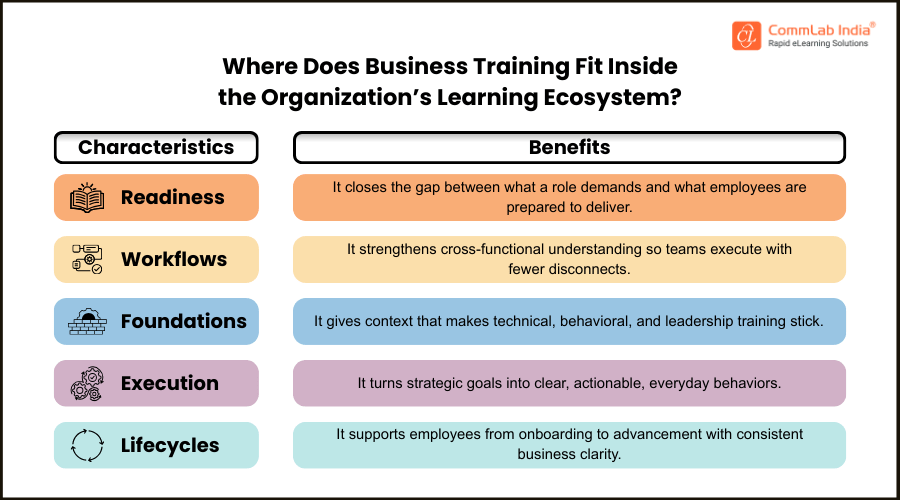
Business training isn’t just a set of topics. It’s a system — a combination of the capabilities you build and the formats you use to embed those capabilities into daily work.
Modern L&D teams succeed when they match the right skill outcome with the right learning experience.
And according to a 2025 Harvard report summarizing industry research, targeted training can lead to a 17% increase in productivity and a 21% boost in profitability—a clear reminder that well-designed business training isn’t just helpful, it’s financially strategic.
Below is the integrated view — what today’s organizations need employees to learn, and how that learning actually sticks.
1. Business Acumen — Powered by Microlearning & Explainer Videos
Employees need a clear grasp of how the business runs: customers, value chains, markets, margins, and metrics.
This capability is best delivered through:
- Microlearning that breaks complex concepts (like revenue levers or customer lifetime value) into digestible bursts
- Short explainer videos that clarify business models, processes, and financial logic without jargon
This combination ensures business literacy is not a one-time workshop but a steady, practical upgrade.

2. Operational Decision-Making — Strengthened Through Scenarios & Blended Learning
Teams need to solve problems early, make decisions without hesitation, and keep workflows moving.
This comes to life through:
- Scenario-based eLearning that recreates real operational dilemmas
- Blended learning journeys that mix theory with practice, reflection, and coaching
This helps employees build judgment — not just follow steps.
3. Customer & Market Readiness — Delivered Through Video, Role Plays & On-the-Job Practice
Employees must understand customers, anticipate needs, and respond consistently.
This capability strengthens through:
- Video-based modules that show real customer situations
- VILT or live role plays to practice conversations in a safe space
- Guided on-the-job assignments where employees apply new approaches immediately
This builds the emotional intelligence and responsiveness customers feel instantly.
4. Cross-Functional Collaboration — Enabled by Workshops & Workflow-Based Learning
Organizations run on handoffs, not heroics. Employees need to understand how their decisions impact upstream and downstream teams.
This is best supported through:
- Interactive workshops (virtual or in-person) that surface misunderstandings and build shared language.
- Workflow-based practice where employees solve cross-functional problems as a group.
Gamified challenges that turn collaboration and problem-solving into engaging, real-world skill practice.
Watch How Gamification Can Transform Employee Training
5. Leadership & Team Performance — Developed Through Coaching, Blended Journeys & Real-Time Nudges
Managers must lead with clarity, coach effectively, and guide teams through complexity.
This capability builds through:
- Blended leadership programs combining workshops, reflection, simulations, and peer exchange
- Coaching sessions that help managers apply concepts to real team challenges
- AI nudges and performance prompts that reinforce behaviors at the moment of need
This doesn’t just create better leaders — it creates better everyday decisions.
Explore CommLab India’s blended learning solutions engineered for clarity, consistency, and capability at scale

6. Change & Digital Transformation — Powered by Adaptive Learning & Hands-On Practice
Employees must adopt new systems, tools, and processes quickly without overwhelming support channels.
The most effective formats include:
- AI-powered adaptive modules that personalize learning to each user’s gaps
- Hands-on guided practice using walkthroughs, sandboxes, and checklists
This speeds up adoption, reduces frustration, and minimizes productivity dips.
7. Behavioral & Performance Habits — Reinforced Through Spaced Learning & Micro-Coaching
Accountability, ownership, resilience, and communication shape how work feels every day.
These behaviors take hold through:
- Spaced microlearning that reinforces one habit at a time
- Micro-coaching through managers or AI that prompts reflection and action
This transforms behavior from intention to habit — the real ROI of L&D.
What Kinds of Skills Does Business Training Actually Build?
What Hidden Gaps Does Business Training Actually Fix?
Problems leaders notice too late and employees feel every day:
- Unclear expectations that create hesitation, duplicated effort, and inconsistent decisions.
- Invisible silos where teams know their tasks but not how their work connects to the whole.
- Slow decision loops driven by uncertainty and missing context — not lack of capability.
- Rework and friction caused by processes being followed without understanding the “why.”
Business training strengthens the skills people rely on every single day—the ones that don’t appear in job descriptions but determine whether work feels smooth or constantly uphill.
For L&D, these are the skills that quietly change how teams think, act, and show up at work.
1. The Ability to Read What’s Really Happening
People learn to interpret situations instead of reacting to them—spotting early signs of a problem, reading the room in a meeting, or understanding what a customer actually means, not just what they say.
2. Knowing What Truly Matters Right Now
Instead of treating every task like a fire, employees start recognizing which actions will move work forward and which ones are just noise. It helps them work with intention, not exhaustion.
3. Understanding How Their Work Connects to Others
Teams finally see how their decisions ripple across functions. They stop working in bubbles and start asking, “Who does this impact, and how can we make this easier for them?”
4. Staying Steady When Things Shift (Because They Always Do)
Whether it’s new tools, changing priorities, or unexpected roadblocks, employees develop the confidence to navigate uncertainty without freezing or constantly seeking reassurance.
5. Communicating in a Way That Actually Moves Work Forward
Not just talking, but influencing—explaining ideas clearly, asking for what they need, pushing back respectfully, and aligning people around decisions.

The Training Alignment Checklist
Aligned Training that Boosts Engagement, Skills, and ROI!
- 15 expert-crafted questions to assess alignment
- Built-in framework to spot gaps
- Quick, actionable tool to catch misalignment
- And more!
What Business Outcomes Does Effective Business Training Actually Drive?
When business training works, its impact shows up not in “learner satisfaction scores” but in the hard numbers leaders track in boardrooms.
It shifts performance levers that directly influence revenue, cost, speed, and customer value.
1. Faster Time-to-Performance in Critical Roles
Employees reach proficiency sooner because they understand not just how to do the job, but why certain decisions matter.
This reduces ramp-up costs, speeds execution, and makes teams productive weeks—sometimes months—earlier.
2. Higher Operational Efficiency with Lower Rework and Waste
When people grasp the logic behind processes, errors drop.
Less rework means fewer delays, tighter cycles, and cleaner handoffs—translating to measurable cost savings across operations.
3. Stronger Revenue Impact Through Better Customer Decisions
Training improves situational judgment: knowing when to escalate, when to negotiate, and when to hold firm.
The result? Higher conversions, better retention, improved upsells, and fewer value leaks in customer interactions.
4. Reduced Managerial Load and Better Utilization of Leadership Time
Managers spend far less time firefighting and correcting misunderstandings.
Instead of being bottlenecks, they become force multipliers—freeing leadership time for strategy, innovation, and team development.
5. Higher Change Adoption Rates and Lower Transition Costs
Whether it’s a new system, process, or strategic shift, business training reduces resistance and confusion Organizations move through change faster, with fewer dips in productivity and fewer support escalations.
Conclusion
The real impact of business training shows up when everything is aligned — the problem you’re solving, the skills you’re building, and the way success is measured. When those pieces connect, training stops being an activity and becomes a driver of performance. When they don’t, even well-designed programs struggle to make a dent in outcomes.
If you want a quick way to check whether your training is built on that kind of alignment, we’ve created a free eBook that walks you through the essentials. It helps you evaluate whether your objectives, content, and assessments actually support the results you’re aiming for, and gives you a clear sense of whether your program is ready for rollout.
Download now.