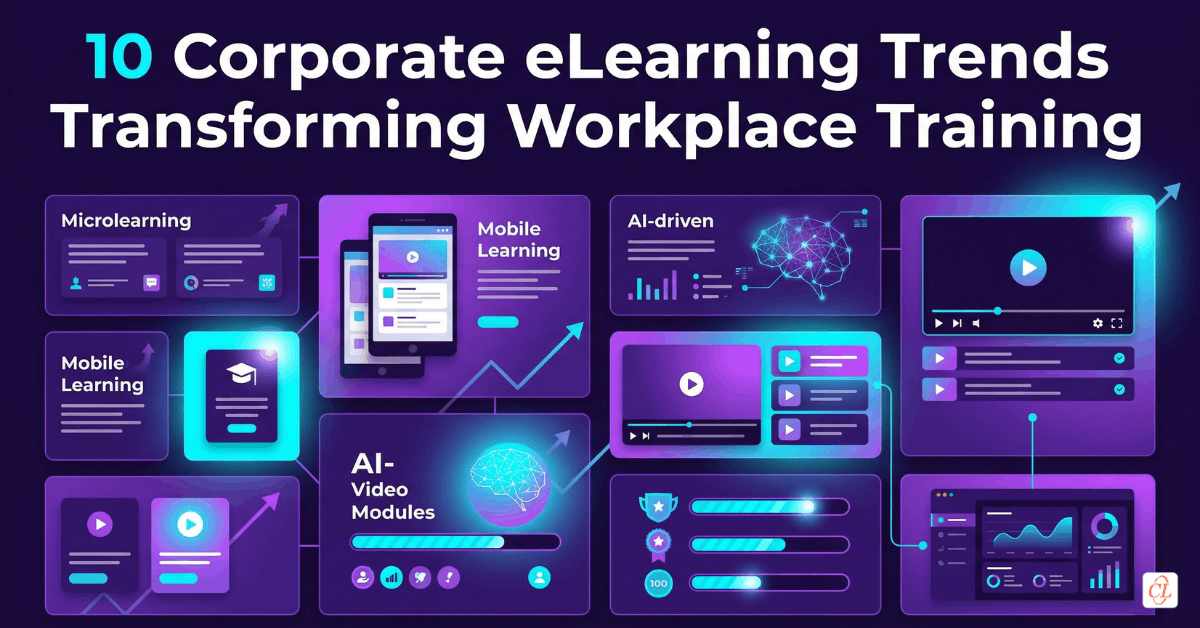
Corporate training is being reshaped by forces that go far beyond content delivery. Employees now expect learning to be faster, more relevant, easier to access, and more closely connected to the work they do every day. At the same time, organizations are under pressure to close skill gaps quickly, support changing business models, and build learning systems that can scale without losing impact.
This is why eLearning trends matter more than ever. They do not simply reflect new tools or formats. They reveal how corporate learning is evolving from a training function into a strategic capability that supports performance, agility, and workforce readiness.
Download eBook: AI-Powered L&D Trends 2026
In practical terms, eLearning trends refer to the technologies, design approaches, and learning models that are changing how organizations train employees. These trends shape how learning is created, delivered, personalized, measured, and embedded into work.
In this article, we examine the 10 corporate eLearning trends transforming workplace training, and more importantly, what they mean for learning leaders building modern, future-ready training strategies.
Why eLearning Trends Matter in Corporate Training
For many years, workplace training was built around scheduled programs, formal courses, and fixed learning paths. That model still has value, but it no longer reflects how employees work, how skills evolve, or how organizations compete.
Today, training must respond to a faster business environment. Employees need support not just during onboarding or annual compliance cycles, but continuously, as roles change, tools evolve, and expectations rise.
That is why modern eLearning trends in corporate training are not simply about making learning more digital. They are about making learning more useful, timely, scalable, and connected to performance.
The strongest learning strategies now focus on a different set of questions:
- How quickly can employees access the knowledge they need?
- How relevant is the training to their role and context?
- Can learning adapt to different needs and proficiency levels?
- Does training help people perform better, not just complete modules?
The trends below represent the most important shifts shaping modern workplace learning.
Trend #1: Microlearning for Faster Skill Application
One of the most influential developments in corporate training is the move toward microlearning.
Microlearning breaks larger topics into short, focused learning units designed around a single concept, task, or skill. Instead of asking employees to complete long training modules in one sitting, organizations deliver learning in smaller, easier-to-consume moments.
This matters because most employees do not struggle with access to information. They struggle with time, attention, and overload.
Microlearning works particularly well when organizations need to:
- reinforce key concepts after formal training
- support task-based performance
- train distributed or time-constrained teams
- improve retention through spaced learning
Why microlearning is effective
Microlearning aligns more closely with how people consume information at work. It reduces friction, increases accessibility, and makes it easier to revisit important concepts when needed.
Strategic implication
Microlearning should not be treated as “shorter content.” It works best when it is intentionally designed around real workplace moments where knowledge needs to be applied quickly.
Trend #2: Mobile Learning for Work-Anywhere Training
As work has become more distributed, flexible, and device-driven, mobile learning has become a foundational part of corporate training strategy.
Employees increasingly expect to access learning from wherever they are, whether they are in the office, in the field, on the move, or working remotely.
Mobile learning supports this shift by making training available across smartphones, tablets, and other devices, allowing employees to engage with content in more flexible ways.
This trend has pushed organizations to rethink course design itself.
Mobile-first learning design includes:
- responsive course layouts
- shorter modules and cleaner navigation
- touch-friendly interactions
- quick-access learning assets
Why this trend matters
Mobile learning is not only about convenience. It expands access, improves continuity, and helps organizations reach learners who may not sit at desks or have uninterrupted training time.
Strategic implication
If a training experience only works well on a desktop inside a formal learning portal, it is already too narrow for many modern work environments.
Trend #3: Personalized Learning Pathways
Traditional training programs often assume that all learners need the same content in the same sequence. In reality, employees vary widely in role, experience, skill level, and learning goals.
That is why personalized learning has become one of the most important eLearning trends in workplace training.
Personalized learning pathways allow organizations to move away from one-size-fits-all training and create more relevant, role-specific learning experiences.
Personalization can include:
- role-based learning journeys
- recommended content based on skill gaps
- learner-selected pathways
- adaptive reinforcement and follow-up resources
Why personalization matters
When learning feels relevant, employees are more likely to engage with it and apply it. Relevance reduces unnecessary training time and increases the practical value of learning.
Strategic implication
Personalization does not always require advanced AI. Even structured role-based pathways and curated learning journeys can significantly improve learner experience and impact.
Trend #4: AI-Powered Learning Experiences
Artificial intelligence is quickly changing what corporate learning systems can do.
Among the most important eLearning trends transforming corporate training, AI stands out because it affects not just content creation, but the entire learning experience.
AI can now support:
- personalized content recommendations
- conversational learning support
- automated assessment and feedback
- skill gap identification
- content summarization and adaptation
This creates new opportunities for L&D teams to scale learning more intelligently and efficiently.
Where AI adds real value
The strongest AI applications in workplace learning are not about replacing instructional thinking. They are about improving speed, relevance, discoverability, and support.
What organizations should avoid
AI should not be treated as a shortcut for poor learning design. Without governance, content review, and clear use cases, AI can create more noise than value.
Strategic implication
The real shift is not from “manual learning” to “automated learning.” It is from static training systems to more responsive, intelligent learning environments.
AI-Powered L&D Trends 2026
Your L&D Playbook
- The need for AI fluency at work
- Skill-based learning 2.0
- Top AI tools for L&D
- Real stories from L&D teams
- And more
Trend #5: Learning in the Flow of Work
One of the clearest shifts in modern L&D strategy is the move away from separating learning from work.
Employees increasingly need support while performing tasks, not only before or after them. This has led to a growing focus on learning in the flow of work.
Instead of relying solely on formal courses, organizations are embedding learning into the tools, systems, and moments where employees need help most.
Examples include:
- embedded job aids
- in-platform walkthroughs
- searchable knowledge resources
- short learning nudges within work tools
Why this trend matters
Training becomes more effective when it is available at the moment of need. This reduces friction between learning and performance and makes knowledge more usable.
Strategic implication
High-performing learning teams are increasingly designing not just courses, but performance support ecosystems.
Trend #6: Immersive Learning Through Simulations and Scenarios
As organizations seek stronger application and retention, immersive learning is gaining momentum.
This does not always mean high-cost virtual reality. In many cases, immersive learning is delivered through realistic scenarios, branching simulations, decision-making exercises, and interactive practice environments.
This trend reflects a larger shift: learners need to do more than understand content. They need to practice judgment, decision making, and task execution.
Immersive learning is especially useful for:
- compliance and risk-based training
- customer-facing roles
- technical processes
- leadership and communication skills
- software and systems training
Why this trend matters
Practice improves transfer. Employees are more likely to retain and apply what they learn when they experience it in context rather than only reading or watching it.
Strategic implication
Organizations should prioritize immersive design where consequences, complexity, or real-world judgment matter most.
Trend #7: Social and Collaborative Learning
Learning in organizations rarely happens in isolation. Employees learn continuously through conversations, shared problem solving, peer observation, and collaborative work.
This is why social learning continues to be a critical part of workplace learning strategy.
Modern digital learning environments increasingly support:
- peer discussion spaces
- expert-led knowledge sharing
- cohort-based learning experiences
- collaborative reflection and problem solving
Why collaborative learning matters
Some of the most valuable knowledge in organizations is not found in formal courses. It lives in people, teams, and day-to-day experience.
Strategic implication
The goal of social learning is not simply to “add discussion boards.” It is to create structured opportunities for knowledge exchange that improve learning depth and transfer.
Trend #8: Data-Driven Learning and Analytics
As digital learning ecosystems mature, organizations are gaining access to more learning data than ever before.
This has made learning analytics one of the most strategically important trends in modern corporate training.
Organizations are increasingly using data to understand:
- which content learners engage with
- where drop-off occurs
- how learners perform over time
- what skills are improving
- where interventions may be needed
Why analytics matter
Without meaningful measurement, training often defaults to surface-level success metrics such as completion rates. Analytics help organizations move beyond activity and toward insight.
What better measurement looks like
Stronger learning measurement connects training to capability development, performance support, and business relevance.
Strategic implication
The future of L&D is not just data-rich. It must become data-literate. Learning leaders need to interpret signals, not simply collect dashboards.
Trend #9: Video-First Learning for Modern Workforces
Video has become one of the most effective and widely used formats in workplace learning.
Its rise is driven by a simple reality: employees often prefer to watch, observe, and absorb information quickly rather than read dense training content.
This has made video-based learning a central part of modern eLearning strategy.
Video is especially effective for:
- process demonstrations
- software walkthroughs
- leadership communication
- onboarding
- just-in-time support
Why this trend matters
Video can simplify complex topics, humanize training, and improve accessibility when designed well. It also works particularly well in mobile and microlearning environments.
Strategic implication
The value of video is not in making training more visual for its own sake. It lies in choosing the right format for the right learning objective.
Trend #10: Continuous Learning Ecosystems
Perhaps the most important shift in all of corporate learning is this: organizations are moving away from isolated training events and toward continuous learning ecosystems.
In this model, learning is not confined to formal programs. It becomes an ongoing, integrated part of how employees build capability over time.
A continuous learning ecosystem typically includes:
- formal learning programs
- microlearning and reinforcement
- knowledge resources
- social learning opportunities
- performance support tools
- skill development pathways
Why this trend matters
Business environments now change too quickly for learning to happen only in periodic bursts. Employees need ongoing support to adapt, reskill, and grow.
Strategic implication
The future of workplace learning is not a larger course catalog. It is a connected system that helps employees learn continuously and apply knowledge effectively.
How to Prioritize the Right eLearning Trends for Your Organization
Not every trend should be adopted at once, and not every trend is equally relevant to every organization.
The most effective L&D teams do not chase trends for visibility. They evaluate them based on business need, learner context, operational readiness, and expected impact.
A practical way to prioritize is to ask:
1. What learning problem are we solving?
A trend is only valuable if it addresses a real challenge, such as low engagement, poor retention, slow onboarding, or lack of role relevance.
2. Where is learner friction highest?
Identify where employees struggle most, whether it is access, time, discoverability, relevance, or application.
3. What can scale sustainably?
The right solution is not always the most advanced one. It is the one your team can design, maintain, govern, and improve effectively.
4. What supports performance, not just participation?
The strongest learning investments improve how people work, not simply how many modules they complete.
When evaluated this way, eLearning trends become far more than design preferences or technology choices. They become strategic levers for building a stronger workforce.
FAQs
1. What are the most important eLearning trends in corporate training?
A. The most important eLearning trends include microlearning, mobile learning, personalized learning, AI-powered learning, immersive learning, social learning, video-based training, and learning analytics. Together, these trends help organizations create more relevant, flexible, and effective training experiences.
2. How are eLearning trends changing workplace learning?
A. eLearning trends are shifting workplace learning from static, course-based training toward more dynamic and performance-focused systems. Training is becoming shorter, more personalized, embedded into work, and increasingly supported by data and intelligent technologies.
3. Why is microlearning important in corporate training?
A. Microlearning is important because it aligns with how employees learn in real work environments. Short, focused learning experiences are easier to access, easier to retain, and more likely to be used when employees need quick support or reinforcement.
4. How is AI changing corporate eLearning?
A. AI is changing corporate eLearning by making learning more adaptive, responsive, and personalized. It can recommend content, identify skill gaps, support learners conversationally, and help L&D teams deliver training more efficiently.
5. What is the role of learning analytics in workplace training?
A. Learning analytics help organizations understand how training is being used and where it is creating value. Instead of relying only on completions, analytics can reveal learner engagement, performance trends, and opportunities to improve training effectiveness.
6. What is learning in the flow of work?
A. Learning in the flow of work refers to training and support that are available during actual work tasks. This includes job aids, embedded guidance, searchable resources, and other learning tools that help employees solve problems in real time.
7. How should organizations choose which eLearning trends to adopt?
A. Organizations should prioritize eLearning trends based on learner needs, business goals, and operational readiness. The best approach is to adopt trends that solve meaningful learning problems and improve performance in scalable, sustainable ways.
CONCLUSION
The most important eLearning trends are not simply changing how training looks. They are changing what workplace learning is expected to do.
Corporate training is becoming more personalized, embedded, data-informed, and performance-oriented. It is moving beyond the limits of traditional course delivery and toward systems that support employees continuously, in context, and at scale.
For L&D leaders, this creates both opportunity and responsibility. The opportunity lies in building learning experiences that are more relevant and impactful than ever before. The responsibility lies in choosing trends strategically, not reactively.
The organizations that benefit most will not be the ones adopting the most tools. They will be the ones building smarter, more connected learning ecosystems around the real needs of their workforce.