The year winds down with the soft glow of holiday lights, the hum of year-end conversations, and that familiar pause where teams finally catch their breath. It’s a season of reflection, what worked, what didn’t, and what we’d do differently if we had the chance. In workplaces everywhere, learning quietly shows up in those reflections. Not as courses completed or certificates earned but as moments when training helped someone make the right call, avoid a mistake, or step into a challenge with confidence.
As we look toward 2026, this season offers a gentle reminder. Just like the most meaningful gifts aren’t always the biggest ones, the most valuable training isn’t loud or overwhelming.
With that in mind, here are the 12 training gifts your workforce needs most in 2026.
Table Of Content
- Adaptive Learning
- Training That Mirrors Real Work
- Compliance That Builds Confidence
- Learning in the Flow of Work
- Microlearning
- Video-based Learning
- Continuous Learning, Not One-Time Events
- Immersive Learning
- Skill-based Learning
- Experiential Learning
- AI Learning Agents
- Social Learning Platforms
1. Adaptive Learning
No two roles or learners are the same. Yet training often assumes they are. Adaptive learning responds to this reality by adjusting content based on role, experience, and progress, helping people focus on what truly matters to their work.
It works best when learning:
- Adjusts depth based on prior knowledge
- Focuses on role-specific challenges
- Evolves as performance improves
2. Training That Mirrors Real Work
Learners are expected to make decisions, not recall content. When training is disconnected from real situations, people struggle to apply it at work.
Scenario-based learning can be an effective way to help learners practice decisions, assess consequences, and develop judgment before applying them at work.
This approach is especially effective when:
- Errors carry compliance, safety, or business risk
- Roles require consistent decision-making under pressure
- Teams must balance rules, speed, and outcomes
3. Compliance That Builds Confidence
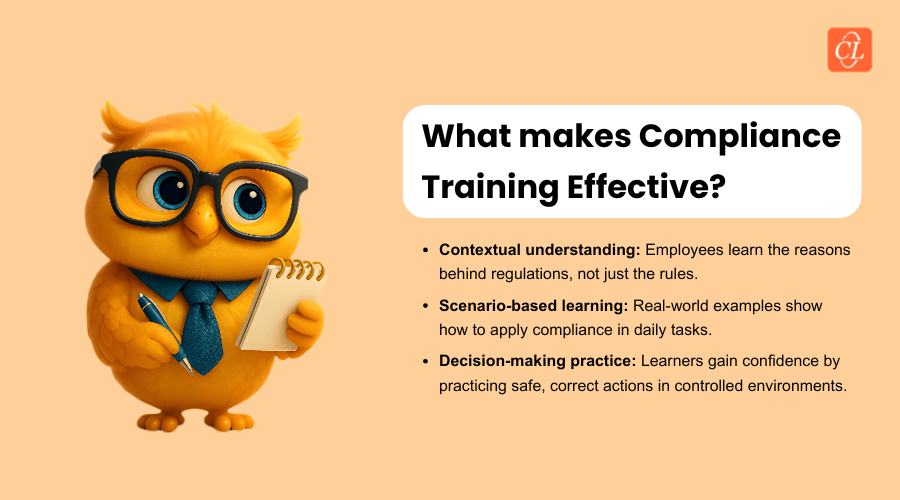
Compliance shouldn’t feel like something to get through. When training explains the why behind rules and shows what good decisions look like in real situations, people act with confidence instead of hesitation.
This is where compliance training stops being defensive and starts supporting better performance.
4. Learning in the Flow of Work
The most useful learning often happens while the work is happening. Performance support helps people apply knowledge without stepping away from their responsibilities.
Practical ways to support learning in the flow of work:
- Quick reference guides: Provide concise, role-specific instructions that employees can consult instantly.
- Job aids and checklists: Standardize processes and reduce mistakes in high-stakes environments like healthcare, manufacturing, or finance.
- Short, searchable refreshers: Offer microlearning snippets or on-demand videos to answer questions at the moment of need.
Related Read: Corporate Training Enhanced with Learning in the Flow of Work
5. Microlearning
Time is the most limited resource at work. Long training sessions are often delayed, rushed, or forgotten. Short, focused learning moments respect how people actually work.
Microlearning works because it:
- Delivers help at the moment of need
- Reduces cognitive overload
- Fits naturally into busy workdays
Delve into the nuances of microlearning and its transformative impact on corporate training.
6. Video-based Learning
In many industries, traditional slide-based training struggles to convey complex processes or procedures. Learners often forget critical steps or struggle to apply what they’ve seen in real work situations. Video-based learning solves this by making content visual, relatable, and easier to retain especially in high-stakes environments like healthcare and pharmaceuticals.
How video-based learning adds value:
- Visual clarity: Demonstrates complex tasks or procedures step by step, reducing errors in real-world application.
- Human connection: Showcases real people, scenarios, and environments, making content relatable and memorable.
- Flexible access: Learners can watch on-demand, pause, and revisit critical steps when needed.
|
Key Benefit Category |
Benefits for Learners (Video-Based Learning) |
Benefits for Organizations (Video Production with AI Tools) |
|
Clarity & Understanding |
Learners see complex tasks or procedures step by step, reducing errors in real-world application. |
Ensures standardized, high-quality content that clearly conveys processes across teams. |
|
Engagement & Relatability |
Learners engage with real people, scenarios, and environments, making learning memorable. |
Content can be customized for multiple roles or regions without recreating from scratch. |
|
Accessibility & Flexibility |
Learners can watch on-demand, pause, and revisit critical steps when needed. |
AI-assisted production allows rapid updates and consistent delivery across locations and departments. |
|
Efficiency & Scalability |
Saves time by providing focused, concise visual learning instead of lengthy manuals or presentations. |
Reduces production costs and turnaround time while enabling scalable training programs. |
With video production using AI tools, organizations can create training that is not only engaging but also adaptive and scalable, reducing production time while increasing learning effectiveness.
Hear Kevin Alster on AI avatars and video-based learning.
7. Continuous Learning, Not One-Time Events
Traditional training often assumes that one workshop or training course will be enough to equip someone for months or years of work. However, for training in industries such as healthcare, pharmaceuticals, manufacturing, IT, or finance, that model simply doesn’t hold up. Skills evolve, technologies change, and job demands shift so quickly that learning done once becomes outdated before it can be applied. And the result is Knowledge decay, performance gaps, and frustration for both learners and leaders.
There’s a reason 76% of employees say they’re more likely to stay with organizations that invest in continuous training. Ongoing learning isn’t just about building capability, it signals commitment to growth, keeps skills current, and helps people perform with confidence as roles evolve. When learning continues beyond a single event, it supports both stronger performance and long-term engagement.
AI-Powered L&D Trends 2026
Your L&D Playbook
- The need for AI fluency at work
- Skill-based learning 2.0
- Top AI tools for L&D
- Real stories from L&D teams
- And more
8. Immersive Learning
Learning by reading or watching can only take you so far. Immersive learning lets employees step into realistic, simulated environments where they can practice tasks, make mistakes safely, and build real confidence before applying skills on the job. It’s training that feels like the real thing, so learners are ready when it matters most.
Why immersive learning works for corporate training?
- Practice in realistic scenarios: Learn by doing, not just observing.
- Safe space for mistakes: Build confidence without risk to patients, products, or processes.
- Immediate application: Skills transfer faster from simulation to real-world tasks.
Immersive learning is a hands-on gift for your workforce, turning knowledge into practical, job-ready skills that stick.
Related Read: Instructional Design Strategies for Immersive Learning
9. Skill-based Learning
People finish a course, tick the box, pass the quiz, and then freeze when they face a real situation at work. Completion looks good on a dashboard, but it doesn’t always translate into confident action.
That’s why future-ready L&D has shifted its focus. It’s no longer about how many courses people complete, but about whether they can apply skills when it actually matters. Skills that hold up during audits, customer conversations, production issues, system failures, or compliance reviews.
Understanding Skill-based Learning Better with Examples
|
a)In healthcare and pharmaceuticals, skill-based learning goes beyond knowing regulations. What matters is whether professionals can apply them correctly and consistently in practice.
This approach reduces errors and strengthens compliance by ensuring people can act—not just recall information. |
b) In IT and software, skill gaps surface most clearly in technical sales roles. Completing a product training course doesn’t ensure a salesperson can diagnose customer needs, position solutions or handle complex objections.
This skill-based learning approach shifts the focus from course completion to sales performance, helping technical sales teams in high-stakes customer conversations. |
10. Experiential Learning
One of the most valuable gifts learning can offer is safe practice before it really matters. Experiential learning is all about “learning by doing.” It’s based on David Kolb's experiential learning model.
What’s shaping the future of experiential learning:
- Immersive tech: VR and AR simulations for complex, high-stakes tasks.
- AI-driven scenarios: Adaptive challenges that respond to learner choices.
- Cross-industry inspiration: Proven learning models shared across sectors.
- Global reach: Localized, accessible experiences for diverse teams.
See 5 approaches in action, which work best for experiential learning.
11. AI Learning Agents
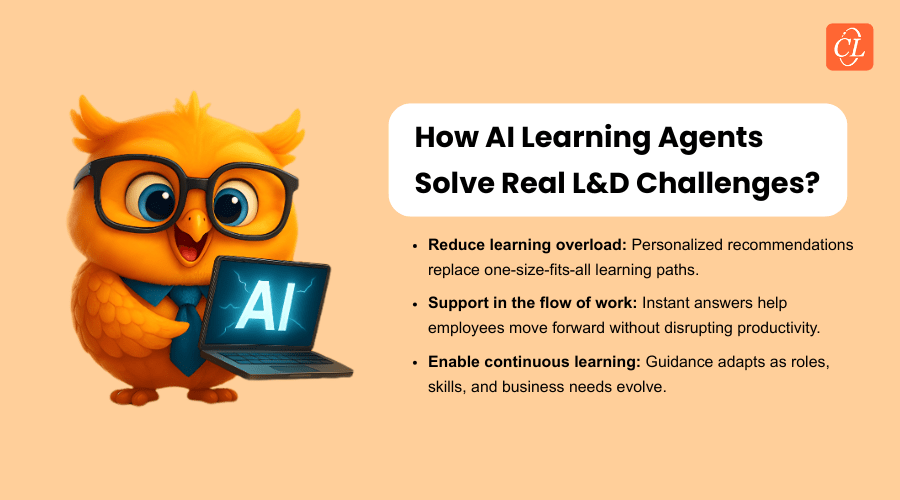
AI learning agents act like personal learning guides, helping employees navigate complex learning ecosystems without feeling overwhelmed or lost. Instead of forcing learners to search through catalogs, AI agents recommend what to learn next, answer questions in real time, and step in when learners are stuck—keeping learning continuous and relevant.
12. Social Learning Platforms
People learn best from people. Social learning platforms tap into everyday expertise by enabling employees to share experiences, ask questions, and learn from peers across roles and locations. Instead of knowledge staying locked in individuals or departments, social learning creates an environment where insights flow freely.
Why social learning matters in L&D:
- Capture tacit knowledge: Real-world tips and lessons get shared before they’re lost.
- Encourage peer-led learning: Employees learn from colleagues who face the same challenges.
- Build learning communities: Conversations reinforce learning long after formal training ends.
Social learning platforms turn learning into a shared experience, making development continuous, collaborative, and deeply human.
Gift your Team the Future of Learning
As we unwrap the possibilities of 2026, the greatest gift an organization can give its people is learning that truly empowers them. Training is all about helping employees perform with confidence, grow continuously, and adapt to change. From adaptive learning to experiential approaches, the focus is on practical relevance, real-world application, and long-term impact. By embracing these training gifts, organizations can nurture a workforce that’s capable, resilient, and ready for whatever comes next.
And this holiday season, we have a special gift for you, our NEW eBook: AI-Powered L&D Trends 2026. Discover why AI fluency will be critical at work, how skill-based L&D 2.0 is transforming learning, explore the top AI tools for L&D, and get insights from real stories of high-impact L&D teams.