An ERP implementation can transform how an organization operates, but only if employees are able to work confidently within the new system from day one.
That is where many implementations begin to struggle.
Organizations often invest heavily in software selection, system configuration, integration, data migration, and testing. Yet one of the most decisive factors in ERP success is still underestimated: whether end users are truly prepared to adopt the new way of working. When employees do not understand how the new system affects their daily responsibilities, the result is often confusion, resistance, delays, workarounds, and a frustrating gap between implementation and actual business value.
ERP systems do not simply replace old software. They reshape workflows, approvals, reporting structures, process ownership, and operational visibility across functions. For employees, that means the change is not just technical. It is practical, behavioral, and organizational.
ERP end-user training is the structured process of preparing employees to use a new ERP system effectively in the context of their actual roles, responsibilities, and business workflows. At its best, it does far more than explain system screens or navigation. It helps users understand what is changing, why it matters, how their work will be affected, and what they need to do differently to succeed.
This is why ERP training should not be treated as a final rollout activity. It should be built into the implementation strategy itself.
In this article, we explore how organizations can design an ERP end-user training strategy that supports implementation readiness, reduces resistance, accelerates adoption, and helps enterprise teams realize the full value of ERP transformation.
Download eBook: Classroom to eLearning Conversion
Table of Contents
- Why ERP End-User Training Is a Strategic Priority
- Why ERP Training Often Fails to Deliver Adoption
- The Three Phases of an Effective ERP Training Strategy
- How to Plan ERP Training Around Roles, Workflows, and Business Risk
- Designing ERP Training That Drives Real Performance
- Why Communication and Reinforcement Are Essential for Adoption
- Common ERP Training Mistakes That Undermine Implementation
- What a Scalable ERP Training Model Looks Like
- FAQs
Why ERP End-User Training Is a Strategic Priority
ERP implementations are often described as technology initiatives, but in reality, they are enterprise-wide behavior change programs. A new ERP system alters how employees complete transactions, approve requests, access information, collaborate across functions, and make operational decisions. That is why implementation success depends just as much on user readiness as it does on technical readiness.
When organizations underestimate this reality, training becomes a late-stage task designed to “show users the system” shortly before go-live. But by that point, the damage may already be done. Employees may feel uncertain about what is changing, unclear about what is expected of them, or skeptical about whether the new system will actually help them do their jobs better.
That is precisely why ERP end-user training must be positioned as a strategic implementation lever, not a support function.
A well-designed ERP training strategy helps organizations:
- Reduce user anxiety before rollout
Employees are more likely to engage with change when they know what is coming and how it affects them. - Align people with new workflows and responsibilities
Training creates clarity around process changes, decision points, and role expectations. - Improve accuracy and consistency in system use
Better training reduces avoidable mistakes, rework, and process deviations. - Accelerate confidence after go-live
Users become productive faster when they have practiced in a safe environment before launch. - Support broader ERP adoption and change readiness
Training helps move employees from awareness to capability to sustained usage.
In short, ERP training is not simply about helping employees use software. It is about enabling the organization to operate effectively inside a transformed business environment.
In simple terms
ERP end-user training matters because ERP implementation changes how people work, not just the tools they use. The better prepared users are, the more likely the implementation is to succeed.
Why ERP Training Often Fails to Deliver Adoption
Many ERP training programs are built with good intentions, yet they still fall short when it comes to real-world adoption. The reason is rarely a lack of effort. More often, it is a mismatch between what training delivers and what users actually need in order to perform confidently in the new system.
Too often, ERP training is designed as a content delivery exercise rather than a performance enablement strategy.
Employees are shown system functionality, but not the business context behind it. They are exposed to screens and click paths, but not the practical decisions they will need to make in their day-to-day work. They complete learning modules, but still feel unprepared when the system goes live.
That disconnect usually stems from a few recurring issues.
Where ERP training typically breaks down
- It starts too late in the implementation journey
By the time formal training begins, users may already feel overwhelmed or resistant. Early orientation is often missing. - It is too system-centric and not role-centric
Employees are taught how the software works, but not how their work will change within it. - It treats all users as if they need the same learning
Different roles require different workflows, decisions, and levels of depth. Generic training rarely sticks. - It assumes completion equals readiness
Finishing a course does not automatically mean a user can perform effectively under real business conditions. - It ends at go-live
The most important learning often begins after users enter the live environment and encounter unfamiliar scenarios.
This is why organizations must rethink ERP training as an ongoing adoption architecture, not a one-time instructional event. If the goal is business continuity and user confidence, then training must be designed around actual performance, not just information transfer.
The Three Phases of an Effective ERP Training Strategy
The strongest ERP training programs are not compressed into a single pre-launch window. They evolve in parallel with the implementation itself, supporting employees at the moments when they need different types of learning and reassurance.
A useful way to think about ERP end-user training is through three connected phases: readiness, performance, and reinforcement.
Phase 1: Build Readiness Before Users Ever Touch the System
Long before employees need to complete a transaction in the new ERP, they need to understand what is changing and why. This early stage is often overlooked, yet it has a profound impact on adoption.
At this point, employees are asking practical questions:
- Why are we changing systems now?
- What problem is this solving?
- How will this affect my role?
- Will my current process still work?
- What should I expect over the coming weeks or months?
If these questions go unanswered, uncertainty grows. And uncertainty is one of the biggest drivers of resistance.
This first phase should focus on orientation and readiness, not deep task training. It should help employees make sense of the transition before they are expected to perform within it.
Useful assets at this stage may include:
- short awareness modules introducing the ERP initiative
- role-based impact communication
- process overview explainers
- implementation journey updates
- manager talking points
- early system previews
The goal is not to teach everything upfront. It is to create familiarity, reduce fear, and establish that the change is being managed thoughtfully.
Phase 2: Build Role-Based Capability Before Go-Live
Once the system and workflows are ready enough to support learning, the focus should shift from awareness to task proficiency.
This is the phase where many organizations finally “begin training,” but the most effective teams treat it as the second stage of a much broader enablement journey.
Here, users need to learn how to complete the tasks they will actually perform in the live system, including the right sequence, the right decisions, and the consequences of getting something wrong.
That means ERP training should be structured around real work, not system menus.
Instead of generic modules such as:
- ERP overview
- system navigation
- dashboard features
The training should be framed around actual performance needs such as:
- creating purchase requisitions
- processing invoices
- managing employee data
- submitting approvals
- validating inventory entries
- running required reports
This shift makes training more relevant, more memorable, and far more actionable.
What this phase should include
- Role-based learning paths
Each audience should only receive the training required for their job responsibilities. - Task-based walkthroughs
Training should be built around common workflows rather than generic feature tours. - Practice opportunities
Users need safe environments where they can rehearse before live use. - Scenario-based examples
Realistic business situations make abstract processes easier to understand and retain.
This is the stage where users move from “I know this change is happening” to “I can do what my role requires in the new system.”
Phase 3: Reinforce Learning After Go-Live
Go-live is often treated as the endpoint of training. In reality, it is the point where learning becomes real.
Before launch, users are practicing in controlled environments. After launch, they begin navigating real deadlines, unusual exceptions, unfamiliar edge cases, and the pressure of live business operations. That is when confidence can dip, even among users who completed training successfully.
This is why the final phase of ERP training must focus on reinforcement and adoption support.
Organizations that do this well understand that post-go-live support is not “extra.” It is a core part of training strategy.
Post-go-live reinforcement should include
- searchable job aids
Quick references help users complete tasks without unnecessary delays. - short refresher modules
Ideal for reinforcing high-risk or infrequently used workflows. - FAQs and troubleshooting guides
Useful for recurring pain points and process confusion. - manager and super-user support
Human reinforcement is often as important as formal learning. - office hours or support channels
These give users a safe place to ask practical questions as they work.
When reinforcement is available in the flow of work, users are far less likely to abandon the new process, improvise workarounds, or depend excessively on a few internal experts.
ERP Training Strategy at a Glance
| Training Phase | Primary Objective | What Users Need Most |
| Readiness & Orientation | Reduce uncertainty and build awareness | Why the ERP is changing, what will be different, how roles are affected |
| Role-Based Performance Training | Build task-level capability before launch | Workflow practice, process understanding, transaction confidence |
| Go-Live Reinforcement | Sustain adoption and reduce friction | Job aids, support, refreshers, troubleshooting help |
How to Plan ERP Training Around Roles, Workflows, and Business Risk
A successful ERP training strategy begins long before course development. It starts with planning. And the most important shift organizations can make is this: Do not plan ERP training around content. Plan it around work.
That means the planning process should begin with a close examination of how work will change across functions, not simply what the system can do.
Start by asking the right questions
A strong ERP training plan usually begins with five practical questions:
1. Which roles are affected, and how?
Not every employee needs the same level of learning. Some roles will be deeply involved in daily system use, while others may only interact occasionally or in an approval capacity.
2. Which workflows are most critical to business continuity?
Some tasks have a higher operational or compliance impact than others. Those tasks should receive greater instructional depth and reinforcement.
3. What do users need to do on day one?
Trying to teach every possible workflow before launch often overwhelms learners. Prioritize what users must be able to do immediately.
4. Which mistakes would be most costly?
High-risk tasks should be supported with more practice, clearer guidance, and stronger post-launch support.
5. What support will exist after formal training ends?
If users are left without practical support after launch, training effectiveness will drop quickly.
What ERP training planning should account for
A more strategic planning process typically includes:
- Audience segmentation: Group users by role, function, and level of system dependence.
- Workflow mapping: Identify which tasks are changing and how those changes affect performance.
- Criticality analysis: Prioritize high-impact workflows that must be done correctly from the start.
- Change impact review: Understand where users may experience confusion, resistance, or disruption.
- Timeline alignment: Ensure training is sequenced realistically against implementation milestones.
- Support ecosystem planning: Define what users will rely on during and after go-live.
This planning work creates the foundation for training that feels practical, targeted, and implementation-ready rather than broad, generic, or disconnected from reality.
A Practical ERP Training Planning Lens
| Planning Area | Key Question | Why It Matters |
| Audience | Who needs what kind of training? | Prevents overtraining and ensures relevance |
| Workflow | What tasks are changing? | Keeps learning tied to real performance |
| Business Risk | Which mistakes matter most? | Helps prioritize training effort and reinforcement |
| Timing | When do users need what? | Prevents overload and supports retention |
| Support | What happens after training? | Sustains adoption when real work begins |
Designing ERP Training That Drives Real Performance
Once planning is complete, the next challenge is design. And this is where many ERP training efforts either become powerful or become forgettable. The difference usually comes down to whether the training was built to inform users or to enable performance.
The most effective ERP training experiences are designed around the idea that users do not need to become system experts. They need to become confident performers in the workflows that matter to their roles. That distinction changes everything.
What effective ERP training design should prioritize
1. Role specificity: Users engage better when the learning is clearly relevant to their actual responsibilities. Training should be tightly aligned to role, process ownership, and decision points.
2. Workflow realism: The closer the learning experience feels to real work, the easier it becomes for users to transfer what they learned into the live environment.
3. Practice before pressure: ERP systems often carry operational, financial, or compliance consequences. Users need opportunities to practice safely before they are expected to perform in production.
4. Reinforcement in the flow of work: The best training is not always the longest. It is often the easiest to access when someone needs help in the moment.
What high-impact ERP training can include
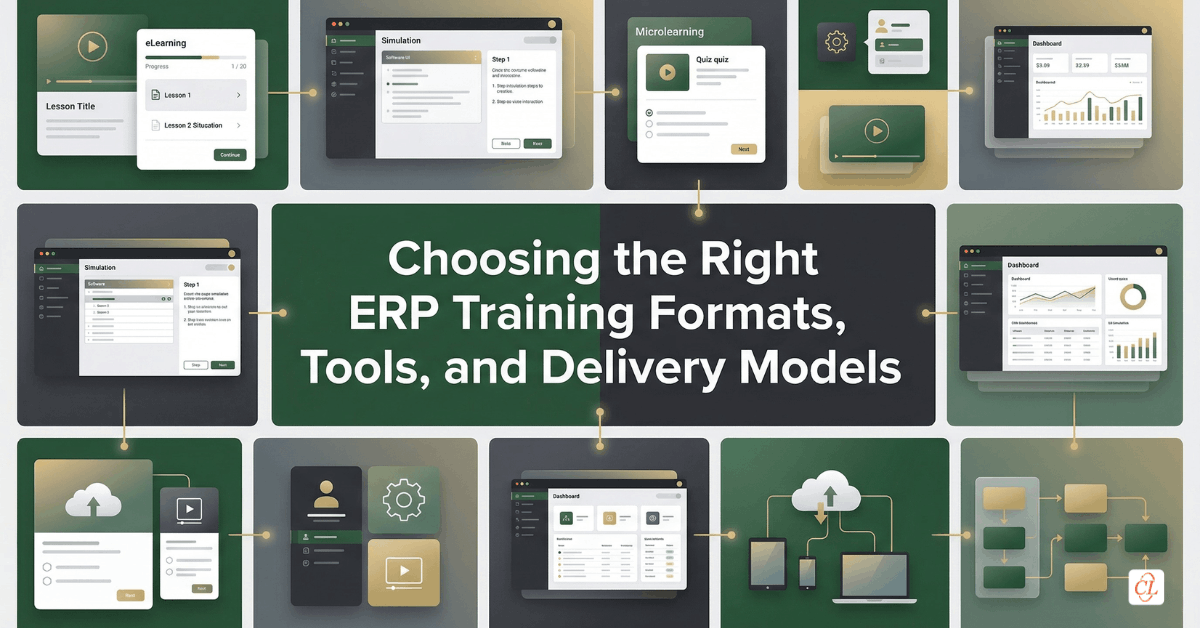
A modern ERP end-user training ecosystem often works best when it combines multiple formats rather than relying on a single delivery method.
Strong formats to include
- Short eLearning modules: Useful for foundational understanding and scalable delivery across locations.
- System simulations: Especially effective for helping users build confidence with workflows before go-live.
- Scenario-based practice: Helps users understand not just what to do, but when and why to do it.
- Quick-reference job aids: Ideal for supporting performance in the flow of work.
- Manager briefing resources: Managers can reinforce expectations and reduce user hesitation during transition.
- Microlearning refreshers
Useful for reinforcement after launch or for workflows used infrequently.
A well-designed ERP training program should feel less like a “course catalog” and more like a performance support ecosystem built around work.

Classroom to eLearning Conversion
Everything You Always Wanted to Know
- Converting classroom material to eLearning
- Leveraging authoring tools for conversion
- Understanding different avatars of eLearning
- And More!
Why Communication and Reinforcement Are Essential for Adoption
One of the most common misconceptions in ERP implementation is that if employees attend training, adoption will follow automatically.
It rarely works that way.
Employees adopt new systems when they understand the purpose of the change, feel supported through the transition, and believe they can succeed in the new environment. That is why training must work alongside communication, reinforcement, and manager support.
Training teaches people how. Communication reinforces why. And that distinction matters. Without communication, users may complete the training but still feel disconnected from the broader purpose of the implementation. Without reinforcement, even well-trained users can fall back into old habits once the pressure of live work sets in.
What stronger ERP adoption support looks like
Organizations can improve adoption by integrating training with:
- Leadership visibility
When leaders actively reinforce the importance of the ERP rollout, the initiative feels more credible and urgent. - Manager enablement
Managers are often the first point of reassurance for employees navigating change. - Role-based communication
Users need messages that connect the ERP rollout to their own workflows and responsibilities. - Internal launch campaigns
These can build familiarity, momentum, and engagement before training even begins. - Recognition and reinforcement
Celebrating early adoption behaviors can help normalize the new system faster.
This is where ERP training becomes more than instruction. It becomes a critical part of organizational transition management.
Common ERP Training Mistakes That Undermine Implementation
Even organizations with strong intentions can weaken ERP adoption through avoidable training decisions. These mistakes are common because they often emerge from time pressure, complexity, or the assumption that system training is inherently straightforward.
It is not.
ERP training sits at the intersection of learning, change management, business process transformation, and operational continuity. That means small design or planning mistakes can create outsized friction later.
Common mistakes to avoid
- Treating training as a final implementation task
This leaves too little time for readiness-building and creates avoidable user anxiety. - Teaching software without teaching workflow context
Users may know where to click but still not understand what they are doing or why. - Overloading learners with too much too soon
ERP systems are broad. Learners need prioritization, not information overload. - Ignoring role differences
Generic training reduces relevance and lowers retention. - Assuming completion means capability
Course completion is not the same as on-the-job readiness. - Failing to support users after go-live
Without reinforcement, confusion and workarounds tend to rise quickly. - Underestimating change resistance
Training cannot be effective if users are not psychologically or operationally ready for the shift.
Avoiding these mistakes does not require perfection. It requires a more deliberate, performance-centered approach from the start.
What a Scalable ERP Training Model Looks Like
Many organizations still build ERP training as if it were a one-time event tied to a single launch. But ERP environments continue to evolve. New users join. Processes change. Modules expand. Systems are updated. Business priorities shift.
That is why the most valuable ERP training strategies are built not as temporary rollout assets, but as scalable enablement systems.
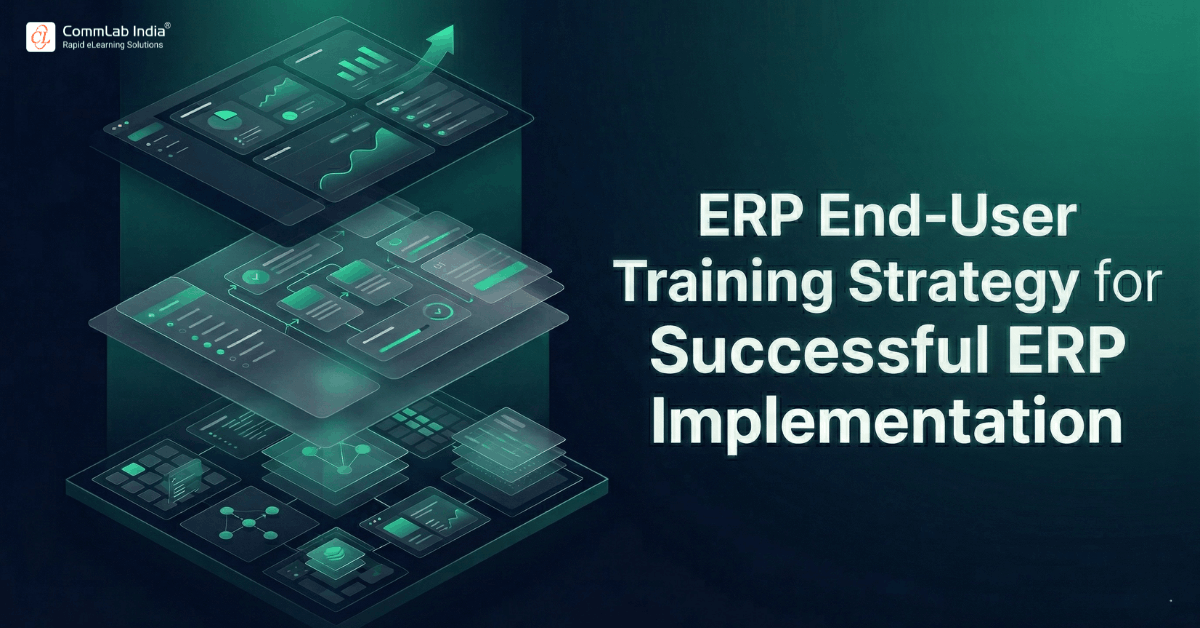
A scalable model usually includes three layers.
1. Core training layer
The core layer provides the foundational learning that applies broadly across the organization. Its role is to create a shared baseline of understanding so users are not entering the new system without context. This is where the organization explains the purpose of the ERP initiative, the business case behind the change, the broad process shifts users can expect, and the common principles that will shape system usage across functions.
This layer is especially important because it helps reduce confusion at the enterprise level. Even though employees perform different jobs, they still need a common understanding of why the organization is changing, what the ERP system is intended to improve, and how the transition will affect the broader operating model.
This layer may include:
- ERP purpose and implementation context
Explains why the system is being introduced and what business outcomes it is expected to support. - Common navigation principles
Familiarizes users with the general structure of the system so they can orient themselves more confidently. - Process overview content
Provides a high-level understanding of how workflows may change across departments. - Organization-wide transition messaging
Reinforces priorities, timelines, expectations, and the broader significance of the implementation.
The core layer creates consistency. It ensures that, regardless of function, users begin with the same organizational narrative and baseline understanding.
2. Role-specific training layer
If the core layer builds shared understanding, the role-specific layer builds actual job readiness. This is where most of the performance-critical learning lives, because this is the layer that connects ERP training directly to the tasks employees must perform in their day-to-day work.
No ERP implementation succeeds through generic training alone. Finance teams, procurement teams, HR teams, plant operations, customer service, and managers all interact with the ERP system differently. Their workflows, decisions, dependencies, and error risks vary significantly. A scalable training model recognizes this and creates focused learning experiences based on role, responsibility, and business impact.
This layer may include:
- Finance workflows
Such as invoicing, reconciliation, budgeting inputs, approvals, and period-close tasks. - Procurement processes
Including requisitions, purchase orders, vendor updates, and approval chains. - HR transactions
Such as employee data updates, leave workflows, payroll inputs, and reporting tasks. - Operations procedures
Including inventory entries, production updates, work order management, and supply chain tasks. - Reporting and approval tasks
Focused on the users who need to validate, review, or act on ERP-generated data.
This layer should be tightly aligned to actual workflows, not just system features. In other words, it should teach users how to do their work in the new environment, not merely how the software is organized. That distinction is what makes the training practical, relevant, and usable under real working conditions.
3. Performance support layer
The third layer is what sustains adoption after formal training is complete. This is often the difference between a training program that looks successful on paper and one that truly supports long-term performance.
Even well-trained users do not remember every step, every exception, or every rarely used process once they return to the pressures of day-to-day work. They need support that is easy to access in the moment of need. That is why performance support should not be treated as a nice-to-have addition. It should be designed as a permanent layer of the training ecosystem.
This layer may include:
- Job aids
Quick references that help users complete tasks accurately without having to revisit full courses. - Microlearning refreshers
Short learning assets that reinforce important workflows or address recurring pain points. - FAQs
Useful for answering common user questions quickly and consistently. - Searchable help resources
Makes it easier for employees to find relevant guidance without interrupting work unnecessarily. - Workflow checklists
Helps users follow critical steps correctly, especially for high-risk or less frequent tasks.
This layer is particularly valuable after go-live, during phased rollouts, and whenever new changes are introduced into the ERP environment. It reduces dependency on informal support networks and gives users a more reliable path to self-sufficiency.
The strength of a scalable ERP training model lies in the fact that it separates what is universal from what is role-specific, and what is formal learning from what is ongoing support. That makes the entire training system easier to maintain, easier to update, and far more useful over time.
FAQs
1. What is ERP end-user training?
A. ERP end-user training is the process of preparing employees to use a new ERP system effectively in their daily work. It includes system familiarity, role-specific workflows, process understanding, practice, and reinforcement to support successful adoption.
2. When should ERP training begin?
A. ERP training should begin before go-live, starting with awareness and readiness-building. Role-based task training should follow closer to launch, and reinforcement should continue after go-live to support real-world usage and adoption.
3. Why is ERP training important for implementation success?
A. ERP training is critical because implementation success depends on whether employees can use the new system accurately and confidently. Without effective training, organizations often face resistance, errors, low adoption, and slower realization of ERP value.
4. What should ERP end-user training include?
A. ERP end-user training should include role-based learning, workflow walkthroughs, simulations, scenario-based practice, job aids, and post-go-live support. The goal is to prepare users for real work, not just software navigation.
5. How do you improve ERP user adoption?
A. ERP user adoption improves when training is supported by communication, manager involvement, realistic practice, and easy access to help after launch. Adoption grows when employees understand both the reason for the change and how to succeed within it.
6. How do you measure ERP training effectiveness?
A. ERP training effectiveness should be measured using completion, readiness, confidence, task accuracy, support volume, and business impact metrics such as productivity and process consistency. Completion alone is not a strong enough indicator of success.
7. What is the best format for ERP training?
A. The best ERP training format is usually blended. It often includes eLearning, simulations, scenario-based learning, job aids, and microlearning refreshers, allowing organizations to combine scalability with practical performance support.
Conclusion
ERP implementation is often framed as a systems initiative. In practice, it is a people-powered transformation.
The technology may be new, but the real test of success lies in whether employees can navigate new workflows, make confident decisions, and perform effectively inside the new operational model. That is why ERP end-user training deserves far more strategic attention than it typically receives.
When training is treated as an essential part of implementation planning, rather than a final rollout task, it becomes a powerful enabler of readiness, adoption, and long-term business value. It helps organizations move beyond technical deployment and toward true transformation.
And ultimately, that is what successful ERP implementation requires.