Gamification is frequently positioned as a way to make learning more engaging. While this is true, it is also incomplete.
Engagement alone does not justify investment in corporate training. Organizations are ultimately concerned with outcomes such as faster onboarding, improved compliance adherence, stronger sales performance, and reduced operational risk. The real question, therefore, is not whether gamification works, but where it works and how it contributes to measurable business impact.
This is where many implementations fall short. Gamification is often applied as a uniform layer across different training programs, without considering the unique demands of each context. The same mechanics are used in onboarding, compliance, and sales training, despite the fact that each serves a fundamentally different purpose.
Effective gamification does not operate as a one-size-fits-all solution. It is a contextual design strategy that adapts to the nature of the training, the behavior it seeks to influence, and the outcomes it is expected to deliver.
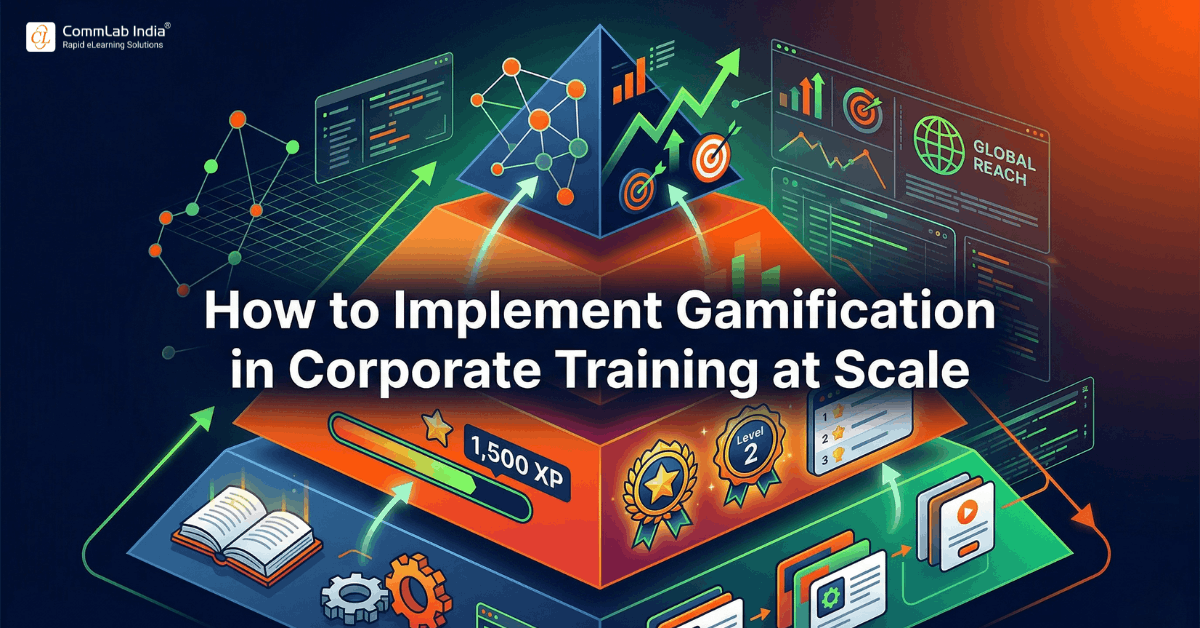
This article explores how gamification is applied across key corporate training scenarios. It examines how design choices differ by use case, how organizations can align mechanics with business goals, and how gamification can move from isolated initiatives to a scalable capability.
Download eBook Now: How AI Supercharges Gamification
TABLE OF CONTENTS
- Why Gamification Must Be Designed for Context
- Gamifying Onboarding: Building Confidence and Early Momentum
- Gamification in Sales Training: Driving Measurable Performance
- Gamifying Compliance Training: Making Risk Visible and Actionable
- Gamification in SOP and Healthcare Training: Ensuring Precision
- Cross-Functional Applications: Extending Gamification Across the Organization
- Scaling Gamification Beyond Individual Programs
- FAQs
Why Gamification Must Be Designed for Context
Gamification creates value only when it aligns with the specific intent of a training program. The same mechanics can produce entirely different outcomes depending on how they are applied and where they are used.
Each corporate training context carries its own expectations and constraints. Onboarding is designed to reduce uncertainty and accelerate readiness. Sales training is focused on performance and measurable results. Compliance training emphasizes accuracy and adherence to rules. SOP training, particularly in regulated industries, demands consistency and precision.
When gamification is applied without considering these differences, it often leads to misalignment. Mechanics that encourage competition may work well in sales environments but may undermine focus in compliance training. Similarly, fast-paced progression models that suit onboarding may not be appropriate for high-risk procedural training.
A more effective approach is to treat gamification as a flexible design system. The mechanics remain consistent in principle, but their implementation adapts to the context. This ensures that engagement is not just achieved, but directed toward meaningful outcomes.
Gamifying Onboarding: Building Confidence and Early Momentum
Onboarding represents a critical transition period where new hires must absorb information, understand expectations, and begin contributing effectively. Traditional onboarding approaches often overwhelm learners with content, leaving them uncertain about priorities and progress.
Gamification introduces structure and pacing, transforming onboarding into a guided journey rather than an information dump.
A well-designed gamified onboarding experience creates early momentum by breaking down learning into manageable stages. Each stage builds on the previous one, helping learners develop confidence as they progress.
Key design elements that enhance onboarding:
- Structured progression paths
Learning is organized into clear stages, allowing new hires to navigate content without feeling overwhelmed - Milestone-based achievements
Early accomplishments create a sense of progress and reinforce motivation - Scenario-based practice
Learners apply knowledge in realistic situations, bridging the gap between theory and practice
This approach shifts onboarding from passive orientation to active participation. Learners are not simply introduced to the organization; they begin to understand how to operate within it.
Gamification in Sales Training: Driving Measurable Performance
Sales training operates in a performance-driven environment where outcomes are visible and measurable. This makes it one of the most natural and effective applications of gamification.
However, the success of gamification in sales training depends on how well it aligns with actual performance metrics. Superficial competition can generate short-term excitement but may fail to build long-term capability.
Designing for Performance, Not Just Competition
| Training Focus | Gamification Approach | Resulting Impact |
| Product understanding | Scenario-based selling exercises | Improved confidence in conversations |
| Skill development | Role-play simulations with feedback | Better handling of objections |
| Performance tracking | Leaderboards tied to meaningful metrics | Increased accountability and motivation |
To be effective, gamification in sales training must reflect real-world dynamics.
- Simulations should mirror actual customer interactions, allowing learners to practice decision-making
- Rewards should be tied to meaningful performance indicators, not just participation
- Competition should be balanced, ensuring that it motivates without discouraging lower performers
When these elements are aligned, gamification transforms sales training into an ongoing performance system rather than a one-time intervention.
Gamifying Compliance Training: Making Risk Visible and Actionable
Compliance training is often viewed as a requirement rather than an opportunity. Learners engage with it reluctantly, focusing on completion rather than understanding.
Gamification offers a way to reframe compliance training by making it interactive and context-driven.
Instead of presenting policies as static information, gamified compliance training embeds them within decision-making scenarios. Learners are placed in situations where they must interpret rules and make choices, experiencing the consequences of their actions.
Effective gamification techniques in compliance training include:
- Branching scenarios
Learners explore different outcomes based on their decisions, making risks tangible - Immediate feedback loops
Correct and incorrect actions are explained in context, reinforcing understanding - Progress indicators
Learners track their improvement, which encourages continued engagement
This approach transforms compliance from a passive exercise into an active process of risk awareness and decision-making.
Winning the eLearning Engagement Game: How AI Supercharges Gamification
Experience the Future of eLearning Engagement with AI-enhanced Gamification!
- Games to Engage Modern Learners
- Practical Tips to Incorporate Gamification in eLearning
- AI-enhanced Gamification
- And More!
Gamification in SOP and Healthcare Training: Ensuring Precision
In high-stakes environments such as healthcare, SOP training must prioritize accuracy and consistency. Errors are not simply learning opportunities; they can have serious consequences.
Gamification in these contexts must be applied with discipline and intent. The goal is not to entertain but to reinforce correct behavior and eliminate variability.
Designing for Accuracy and Mastery
Gamified SOP training focuses on structured practice and validation of competence.
- Step-based simulations
Learners follow procedures in controlled environments, reinforcing correct sequences - Error-driven feedback
Mistakes are highlighted with clear explanations, helping learners understand implications - Mastery checkpoints
Progression is tied to demonstrated competence rather than completion
This ensures that learners do not just understand procedures, but can execute them reliably in real-world situations.
Cross-Functional Applications: Extending Gamification Across the Organization
While certain use cases are more prominent, gamification can extend across multiple areas within an organization when designed with flexibility.
Common Cross-Functional Applications
- Induction and cultural onboarding
Introducing organizational values and processes through interactive journeys - Product training across departments
Helping employees understand offerings through scenario-based learning - Continuous learning initiatives
Encouraging ongoing skill development through progression systems
These applications demonstrate that gamification is not limited to specific programs. When designed strategically, it can support a broader learning ecosystem.
Mapping Use Cases to Design Priorities
Each use case requires a distinct design approach because the underlying objectives differ.
Aligning Design with Outcomes
| Use Case | Primary Objective | Key Mechanics to Prioritize |
| Onboarding | Build confidence and clarity | Progression, milestones, guided paths |
| Sales training | Drive performance | Competition, simulations, feedback |
| Compliance | Increase risk awareness | Scenarios, repetition, feedback loops |
| SOP training | Ensure precision | Mastery checkpoints, simulations |
This alignment ensures that gamification supports the intended outcome rather than becoming a generic layer applied across all programs.
Scaling Gamification Beyond Individual Programs
Many organizations begin with isolated gamification initiatives. While these pilots can demonstrate value, they often remain confined to specific programs.
To achieve long-term impact, gamification must evolve into a scalable capability that spans the learning ecosystem.
Moving Toward Scalable Design
- Standardize core mechanics
Create consistency across programs while allowing contextual flexibility - Integrate with learning systems
Connect gamification with LMS platforms and analytics tools - Align with business strategy
Ensure that gamification supports organizational goals and performance metrics
This transition allows organizations to move from experimentation to sustained impact.
FAQs
1. What are common gamification use cases in corporate training?
A. Common use cases include onboarding, sales training, compliance programs, and SOP-based training. Each uses gamification differently to improve engagement and performance.
2. How is gamification used in onboarding training?
A. Gamification structures onboarding into progressive stages, uses milestones to track progress, and incorporates scenarios to help new hires apply knowledge in real-world contexts.
3. How does gamification improve sales training?
A. Gamification enhances sales training by introducing competition, simulations, and feedback systems that improve performance, motivation, and skill application.
4. Can gamification be used for compliance training?
A. Yes, gamification makes compliance training more engaging by using scenarios, feedback, and progression systems to help learners understand and apply policies.
5. Is gamification suitable for healthcare or SOP training?
A. Gamification can be effective in these areas when designed for accuracy and mastery, focusing on correct execution rather than entertainment.
6. How do organizations scale gamification effectively?
A. Organizations scale gamification by standardizing core mechanics, integrating with learning systems, and aligning design with business objectives.
CONCLUSION
Gamification delivers value not because it is engaging, but because it is adaptable.
When applied thoughtfully, it aligns with the unique demands of onboarding, sales, compliance, and high-stakes training environments. It transforms learning into an experience that is structured, relevant, and performance-driven.
For organizations seeking to improve training outcomes, the challenge is not to adopt gamification universally, but to apply it strategically where it matters most.
Gamification is not a layer to be added. It is a capability to be designed.