When a new enterprise platform is approaching go-live, the training challenge can look deceptively straightforward: understand the system, develop the courses, translate them, upload them to the LMS, and get employees ready.
At enterprise scale, that sequence breaks down quickly.
Different roles need different levels of learning. Regional teams work within different contexts. Frontline employees may have very different digital-learning habits from office-based learners. Source content may still be evolving. SMEs have limited review capacity. Localization can multiply production volume. And the implementation date is usually being driven by the business, not by L&D.
That changes the nature of the problem.
Enterprise technology training is not primarily a course-development problem. It is a rollout orchestration problem.
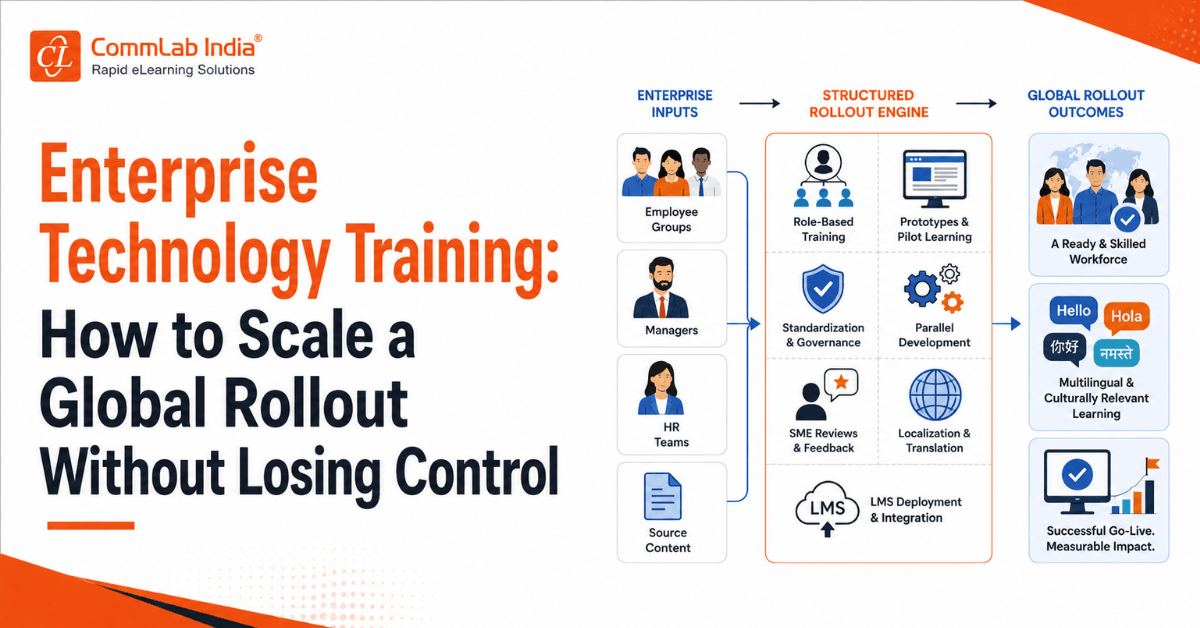
The organizations that scale it effectively reduce uncertainty before they add production capacity. They clarify learner roles, standardize the learning architecture, establish prototypes and review rules, plan localization early, and then use parallel development to increase throughput.
A recent global enterprise rollout illustrates why this matters. A large manufacturing organization with operations across the Americas, EMEA, and APAC was preparing to launch a new global people platform. A substantial part of its workforce was site-based, and its existing digital-learning culture was strongest around mandatory areas such as compliance, IT, and security.
The organization's own description was revealing: it was preparing the whole organization to "get ready." Self-driven learning was not yet deeply embedded, and some existing digital training was still heavily PowerPoint-based.
Getting ready, in that environment, meant much more than teaching people where to click. It meant building a learning production model capable of keeping pace with transformation.
See how this global manufacturer scaled role-based enterprise technology training in practice.
Table Of Content
- Why Enterprise Technology Training Becomes Difficult at Global Scale
- One Global Platform Should Not Mean One Global Course
- The Learner Experience Is Local Even When the Technology Is Global
- Why Sequential eLearning Development Becomes a Bottleneck
- Standardize Before You Scale
- Prototype the System, Not Just the Course
- Reviewer Capacity Can Become the Real Critical Path
- Rapid eLearning Is Not the Same as Rushing
- Localization Must Be Designed Into the Master Course
- A Better Enterprise Technology Training Rollout Model
- What Should Stay With the Internal L&D Team?
- How Do You Know the Rollout Is Ready to Scale?
- Enterprise Technology Training Rollout Control Framework
- FAQs About Scaling a Global Technology Training Rollout
- Scale the Rollout System, Not Just Course Production
Why Enterprise Technology Training Becomes Difficult at Global Scale
Enterprise technology training is structured learning that prepares different workforce groups to understand and use a new enterprise system, platform, or digitally enabled process.
In a global rollout, this typically involves some combination of:
- role-based learning
- system demonstrations and simulations
- assessments and practice
- stakeholder and SME reviews
- multilingual eLearning
- LMS deployment
- performance support
- post-launch maintenance
The difficulty is that these activities are interdependent.
A software implementation team may think in terms of configuration, testing, data migration, integrations, and go-live. L&D has to translate the same transformation into a different set of questions.
What will employees do differently? What will managers need to understand beyond the employee experience? What will HR or functional specialists be expected to support? Which parts of the learning are global, and which require regional context? How much learning can be produced before the platform itself is fully stable?
This is why a broader eLearning implementation strategy matters. Implementation is not simply publishing courses into an LMS. It involves aligning learning design, technology, rollout planning, learner adoption, and organizational readiness.
In this case, the three major learner groups emerged: employees, managers, and HR professionals.
That combination created three types of complexity at once:
- Audience complexity: different roles required different depth.
- Production complexity: the same launch could require multiple modules, media formats, assessments, and language versions.
- Governance complexity: SMEs, regional teams, technology stakeholders, reviewers, and L&D needed to make decisions against one shared timeline.
The mistake is to treat these as separate problems. They form one rollout system.
One Global Platform Should Not Mean One Global Course
One of the first decisions in enterprise technology training is how much learning should be shared across audiences.
The answer is rarely "all of it."
Employees may need to understand only the processes and tasks they will personally perform. Managers often need that same foundation plus additional knowledge about team workflows, approvals, responsibilities, and employee questions. HR professionals and system specialists may require deeper procedural knowledge.
This is the core logic behind role-based training, which aligns learning with distinct job responsibilities instead of giving every learner the same generic curriculum.
Start with what is common, then add the depth required by responsibility.
Consider a global people-platform implementation.
An employee may need to update personal details, complete a workflow, or locate information. A manager may need to perform those same employee functions plus approve requests, manage team processes, or complete manager-specific actions. An HR professional may need deeper knowledge of exceptions, administrative processes, or how the wider system works.
Giving all three audiences the HR-level curriculum creates unnecessary cognitive load. Creating three completely independent curricula creates unnecessary production and maintenance work.
Role-based architecture provides a middle path: reuse where the learning need is genuinely shared, differentiate where performance responsibilities diverge.
CommLab India has used similar principles in role-based software training, where different audiences receive simulations and performance support based on the tasks they actually perform.
The Learner Experience Is Local Even When the Technology Is Global
A global platform creates standardization at the system level. It does not automatically create standardization in learner readiness.
The enterprise behind this article already had an LMS and experience with eLearning, but much of that experience centered on mandatory compliance, IT, and security training. Self-driven learning was not strongly embedded, and some existing training was still PowerPoint-based rather than advanced digital learning.
For L&D, that should influence design decisions.
A workforce that routinely uses self-paced learning may be comfortable navigating modular content, simulations, searchable resources, and optional practice. A workforce that encounters digital learning mainly through mandatory annual courses may need a more deliberate transition.
Frontline populations introduce additional questions:
- Where and when will people learn?
- Do they regularly work at a computer?
- How long can they realistically spend in a learning session?
- Do they need formal simulation practice?
- What performance support will they require after training?
- How much manager reinforcement is necessary?
For software and systems training specifically, hands-on practice is often critical. Approaches such as Watch-Try-Do simulations can move the learner beyond simply watching a demonstration toward practicing the workflow. See more eLearning approaches for software training.
The technology may be standardized globally. The learning journey should still reflect how different people will encounter and use it.
Why Sequential eLearning Development Becomes a Bottleneck
Once the learning architecture is clear, volume becomes the next constraint.
A global technology rollout can require:
- multiple role-based modules
- demonstrations
- software simulations
- video
- assessments
- manager resources
- FAQs and performance support
- regional variants
- multilingual versions
- LMS packages
- technical testing
A traditional production model might move one course through analysis, design, development, review, revision, approval, and localization before the next course advances.
That creates safety through sequence. It also creates a throughput ceiling.
When the business launch date is fixed, waiting for course 1 to reach final approval before meaningful work begins on course 2 may simply not be viable.
The alternative is not uncontrolled parallel production. It is governed parallel production.
Standardize Before You Scale
One of the most important principles in rapid enterprise development is straightforward:
Do not multiply resources until you have reduced design ambiguity.
In the client discussion, the proposed approach included reviewing the source material, defining learning objectives for individual modules, agreeing those objectives, developing a small prototype, standardizing recurring elements, and then using multiple resources to scale development.
That sequence matters.
If five developers begin while questions remain about instructional style, simulation treatment, video use, feedback, visual conventions, or review expectations, five people can produce inconsistency faster.
If those variables are standardized first, the same five people can increase throughput without fragmenting the learner experience.
This principle aligns closely with rapid eLearning development, where templates, reusable components, streamlined workflows, existing content, and controlled reviews help reduce development cycle time.
What should be standardized before production scales?
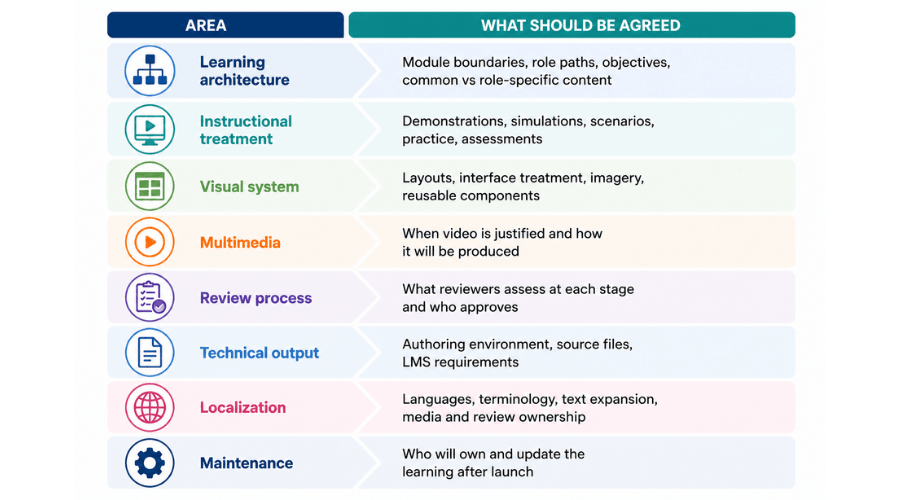
Standardization does not mean every course has to look identical. It means recurring decisions are made once instead of being rediscovered in every module.
Prototype the System, Not Just the Course
Prototypes are often treated primarily as visual-approval exercises.
For a large enterprise rollout, they should do more.
A prototype should validate the production model.
Can stakeholders agree on the level of interaction? Are simulations realistic? Is the visual treatment appropriate? Is the module structure suitable for the learner population? Will the design localize efficiently? Do reviewers understand what they are expected to evaluate?
The client discussion described the need to standardize recurring elements so learners would know what to expect, including consistent treatment of simulations and video. It also referred to an alpha, beta, and gold review progression.
A staged model allows each review point to serve a different purpose:
- Alpha: resolve substantive content, design, and functional issues.
- Beta: verify revisions and near-final functionality.
- Gold: confirm final release readiness.
When every review stage becomes another opportunity to reconsider the entire design, rapid development disappears.
Reviewer Capacity Can Become the Real Critical Path
One of the most underestimated risks in enterprise technology training is SME and stakeholder availability.
Organizations often increase development capacity when the schedule tightens. That only works if review capacity can keep pace.
Five development teams can still be blocked by two reviewers.
The manufacturing rollout exposed this issue clearly. Stakeholder vacations overlapped with the development schedule, so the teams discussed allowing production to continue while reviewers were away, leaving work ready for review when they returned.
The lesson is broader than vacation planning.
Review throughput must be planned with the same discipline as production throughput.
For every major workstream, determine:
- Who reviews it?
- What exactly are they reviewing?
- How quickly can they respond?
- What decisions are expected at each stage?
- Who resolves conflicting feedback?
- What happens when the reviewer is unavailable?
Rapid eLearning can also reduce avoidable SME involvement by defining expectations and touchpoints early, using reusable templates, and consolidating feedback rather than forcing SMEs through repeated review cycles. See the rapid eLearning development process for a related workflow.
A good rollout plan therefore has two capacity models: production capacity and decision capacity.
If either is insufficient, the schedule can slip.
Rapid eLearning Is Not the Same as Rushing
Rapid eLearning is frequently described as faster development using rapid authoring tools.
For enterprise rollouts, that is only part of the picture.
Rapid eLearning is a governed development approach that reduces avoidable cycle time through content readiness, reusable standards, focused instructional design, prototypes, parallel production, structured reviews, and efficient technology.
Rushing compresses activities without changing the operating model. Rapid development improves the operating model itself.
For example, if SMEs repeatedly review the same source material at storyboard, alpha, beta, localization, and deployment stages because decision rights were never clarified, faster authoring will not fix the bottleneck.
If each review stage has a specific purpose, the same project can move more smoothly.
This is also why custom eLearning development and rapid development should not be treated as opposites. Enterprise technology training may still require role-specific simulations, custom interactions, tailored assessments, and proprietary system workflows. The goal is to apply custom instructional design within a more scalable production model.
Localization Must Be Designed Into the Master Course
Localization is another area where late sequencing creates avoidable delay.
The common workflow is:
English development → English approval → translation → multilingual development → review → QA
For smaller projects, that may be appropriate.
For a large global rollout, localization should influence source-course design long before translation begins.
Decisions about screen density, navigation, graphics, interface screenshots, narration, subtitles, video, terminology, and editable text all affect how easily a course can move into other languages.
Translate stable content later. Design for translation from the beginning.
The organization may sensibly wait until the English master is stable before translating it. But the English master itself should already be designed to travel.
CommLab India's eLearning translation services likewise begin with a master course aligned to translation and localization requirements, followed by translation, asset adaptation, development, review, and QA across languages.
For a deeper look at what should change beyond language alone, see the eLearning localization strategy guide, which distinguishes translation from adapting the broader learning experience for regional learners.
Designing for localization early reduces rework and makes later maintenance much easier.
A Better Enterprise Technology Training Rollout Model
For a major implementation, the learning work can be organized into seven connected stages:
- Clarify the performance change. Define what employees, managers, specialists, and support teams need to do differently after go-live.
- Architect the role-based learning. Separate common knowledge from role-specific depth and identify where formal learning, simulation, video, or performance support is appropriate.
- Assess source-content readiness. Identify stable content, evolving content, SME dependencies, screenshots, policy inputs, and unresolved questions.
- Prototype and standardize. Validate templates, interactions, simulations, media treatment, technical requirements, and review expectations.
- Scale through parallel production. Add development capacity only after standards are sufficiently stable.
- Run controlled reviews and localization. Protect the critical path by planning reviewer availability, decision rights, translation readiness, and multilingual QA.
- Prepare for post-launch change. Preserve editable source files, establish maintenance ownership, and expect the platform and learning to continue evolving.
The important point is that development is only one stage. Scaling enterprise technology training requires the complete system.
What Should Stay With the Internal L&D Team?
Even when production is expanded through an external learning partner, not everything should move outside.
The internal enterprise team should usually retain ownership of:
- business priorities
- learner and organizational context
- stakeholder alignment
- system and policy interpretation
- SME decisions
- final approvals
- change-management integration
- deployment priorities
External capacity is particularly useful where it increases execution throughput:
- instructional structuring
- storyboarding
- eLearning development
- visual design
- simulations
- multimedia
- QA
- translation and localization
- project coordination
This is not a choice between internal expertise and external execution.
For many mature enterprise teams, the more useful model is internal strategic control plus scalable external execution capacity.
Where temporary or sustained workload exceeds internal bandwidth, L&D staff augmentation can add instructional designers, developers, project managers, visual designers, QA resources, and LMS specialists without requiring the organization to permanently increase headcount.
How Do You Know the Rollout Is Ready to Scale?
The right time to increase production is not simply when the deadline gets closer. It is when enough uncertainty has been removed.
Before adding multiple development resources, L&D leaders should be able to answer:
- Are learner groups and role differences clear?
- Are module objectives agreed?
- Is the prototype representative of the final experience?
- Are recurring interactions and visual standards defined?
- Do SMEs know what they are expected to review?
- Are content dependencies visible?
- Is reviewer availability mapped?
- Is the localization approach agreed?
- Are technical and source-file requirements settled?
- Is post-launch maintenance ownership clear?
If several of these remain unresolved, adding developers may increase work-in-progress rather than finished learning.
That is the operational difference between scaling activity and scaling throughput.
Enterprise Technology Training Rollout Control Framework
A useful way to assess readiness is to examine five control points.
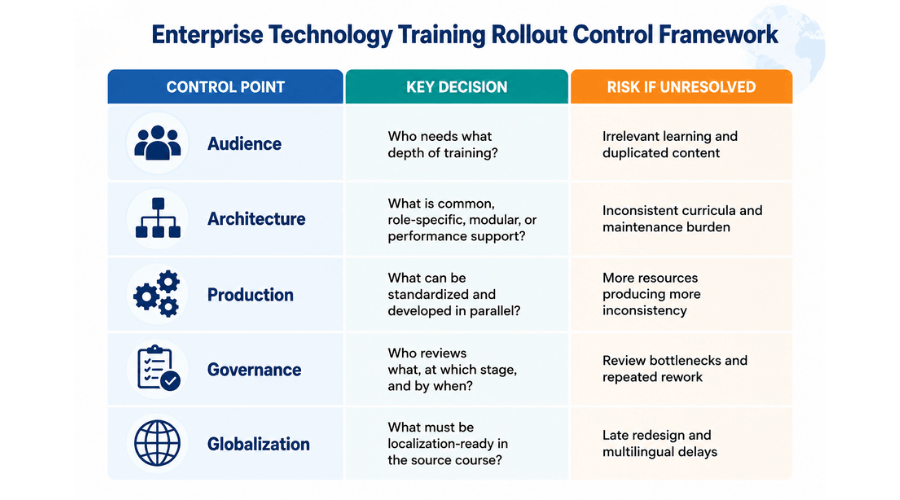
The central lesson is simple: do not solve a governance problem by adding developers, and do not solve a role-design problem by producing more courses. Diagnose the actual constraint first.
FAQs About Scaling a Global Technology Training Rollout
1. How far ahead of go-live should technology training development begin?
Technology training should begin as soon as the organization can clearly identify learner groups, role changes, source-content owners, and major process impacts. Development does not need to wait for every system detail to be final, but L&D should start early enough to allow time for architecture, prototyping, reviews, parallel production, localization, QA, and deployment before go-live.
2. What should be standardized before parallel eLearning development starts?
Before multiple development resources begin working in parallel, teams should agree on the learning architecture, module objectives, visual templates, interaction patterns, simulation treatment, assessment approach, review stages, technical specifications, and localization requirements. Standardizing these recurring decisions reduces inconsistency and rework as production scales.
3. How many courses can be developed in parallel during a global rollout?
There is no fixed number. The practical limit depends on how stable the source content is, how standardized the design is, how many qualified development resources are available, and whether SMEs and reviewers can keep pace. Parallel production should expand only when review capacity and decision-making capacity can support it.
4. How should SME review capacity be planned for a technology implementation?
Treat SME review capacity as part of the production plan. Identify who reviews each module, what they are expected to approve at alpha, beta, and final stages, expected turnaround times, known periods of unavailability, and who can resolve conflicting feedback. Adding developers will not accelerate the rollout if approved content cannot move through review.
5. When is an enterprise technology training rollout ready to scale?
A rollout is ready to scale when the major sources of design uncertainty have been reduced. Learner groups and role differences should be clear, learning objectives should be agreed, the prototype should be representative, recurring design standards should be established, reviewers should understand their responsibilities, and localization and technical requirements should be defined.
6. What is the biggest risk when scaling technology training too early?
The biggest risk is increasing work-in-progress without increasing completed learning. If objectives, templates, source content, review responsibilities, or localization requirements are still unstable, adding more developers can multiply inconsistencies and rework. The goal should be to scale throughput, not simply scale production activity.
Scale the Rollout System, Not Just Course Production
The most important shift for L&D leaders is to stop treating a global technology rollout as a collection of courses that need to be produced quickly.
It is a coordinated workforce-readiness system.
Role-based architecture creates relevance. Standardization creates consistency. Prototypes remove uncertainty. Parallel development creates scale. Review governance protects throughput. Localization planning makes global deployment manageable.
The authoring tool matters. But the authoring tool is not the operating model.
When the business launch date cannot move, the central question is not, "How fast can we build the courses?"
How do we create enough learning throughput, with enough control, to have the right people ready when the new way of working begins?
See How a Global Manufacturer Scaled Training for a Fixed Technology Launch
The principles here were applied in a real enterprise rollout involving employees, managers, and HR teams across the Americas, EMEA, and APAC.
See how the organization used role-based learning, standardized development, multilingual readiness, and scalable production to keep workforce preparation aligned with the business launch.
Read the Enterprise Technology Training Case Study →