A great deal of current GenAI use in instructional design is still built on a quiet assumption:
If the output looks good, the job is moving in the right direction.
That assumption is dangerous.
Because AI is very good at sounding coherent, confident, and complete. It can produce polished objectives, clean storyboards, credible scenarios, plausible assessments, and smooth narration in seconds. For a busy instructional designer, this can feel like relief. And often, in the short term, it is.
But relief is not the same as rigor.
That is the real issue.
If instructional designers only learn how to ask AI for help, but never learn how to challenge it, question it, or push back against it, then they are not really mastering AI-assisted work. They are becoming dependent on a fluent system whose weaknesses are easy to miss when the wording sounds strong.
That is why I believe every instructional designer now needs to develop a new professional habit:
The ability to argue with AI.
Not emotionally.
Not theatrically.
Not for the sake of showing resistance.
But professionally.
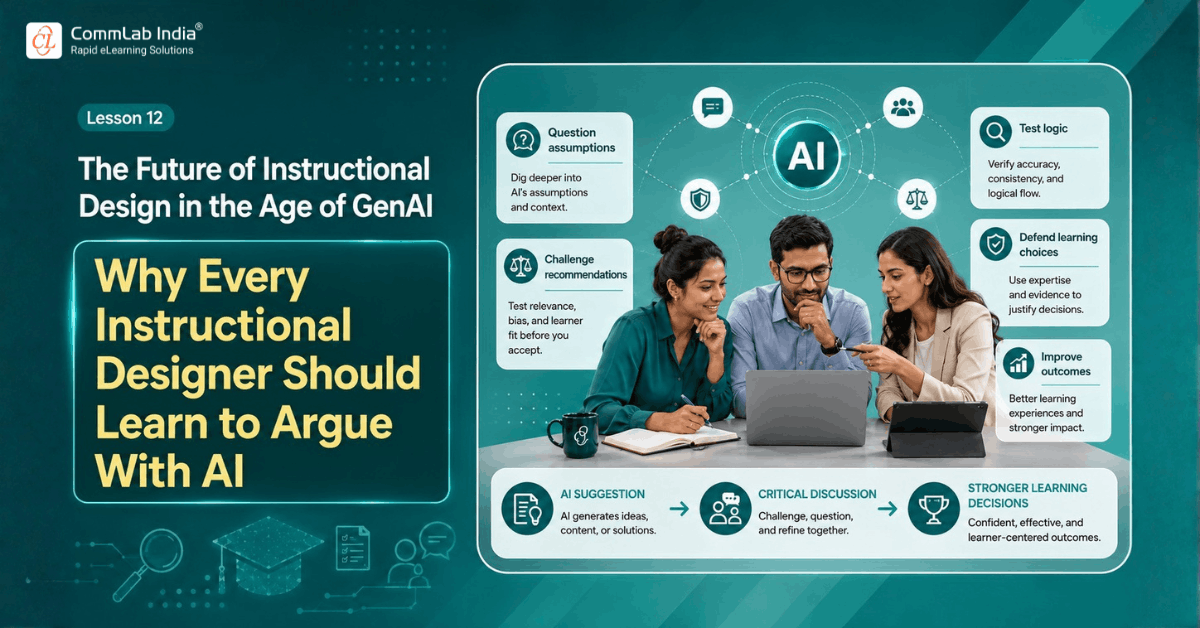
By arguing with AI, I mean something very practical: the ability to interrogate its logic, test its assumptions, reject weak options, ask for alternatives, expose hidden gaps, and force better reasoning before accepting its output into the design.
That is no longer an optional skill.
It is quickly becoming part of the craft.
This article is part of a series on the future of instructional design in the age of GenAI. The series explores how instructional designers can move beyond ad hoc prompting toward a more disciplined, challenge-based human–AI working method.
Table Of Content
- Why This Matters More Than It Seems
- AI Should Not Just Be Prompted. It Should Be Pressured.
- Why Agreement Is a Weak Standard
- Arguing With AI Builds Better Judgment
- What Arguing With AI Looks Like in Practice
- This Is Especially Important for Early-Career Designers
- What This Means for L&D Leaders
- The Larger Point
Why This Matters More Than It Seems
Instructional design has always involved judgment.
The designer has to decide what matters in the SME material, what does not matter, what to foreground, what to compress, how to sequence the learning, what to assess, where to provide practice, what to visualize, and where learners are likely to misunderstand or disengage.
GenAI does not remove those judgments.
It only changes the environment in which they happen.
Instead of working from a blank page, the designer is now often working from a generated suggestion. That sounds like a clear improvement. In many ways, it is. But it also changes the cognitive posture of the designer. The danger is that the designer moves from active architect to passive evaluator.
That shift is subtle.
And once it sets in, it can weaken the work.
Because reviewing a fluent answer is not the same as thinking through the problem from first principles. If the review is shallow, then the AI’s structure quietly becomes the designer’s structure. Its assumptions become the project’s assumptions. Its simplifications become the course’s simplifications. Its weaknesses travel forward unless someone actively stops them.
That is why the ability to argue with AI matters.
It keeps the designer mentally present.
AI Should Not Just Be Prompted. It Should Be Pressured.
This is one of the key mindset shifts the field needs.
Most instructional designers are learning how to prompt AI. Fewer are learning how to pressure it.
Prompting is about getting output.
Pressuring is about testing output.
Both matter. But the second skill is often the missing one.
When AI suggests a learning flow, the designer should be able to ask:
- Why this sequence?
- What alternative sequence might be better?
- What assumption are you making about the learner’s prior knowledge?
- What would an independent reviewer challenge in this structure?
When AI writes objectives, the designer should ask:
- Is this truly performance-based, or does it merely sound professional?
- What makes this objective weak?
- Which verb is doing too much work here?
- How would you rewrite this for observable performance?
When AI proposes assessments, the designer should ask:
- What is this question really testing?
- Is this measuring recall or judgment?
- Which distractor is the weakest?
- Where is the alignment thin?
When AI suggests visuals or interactions, the designer should ask:
- Is this instructionally useful or just attractive?
- What learning problem does this interaction solve?
- Which option adds activity without adding understanding?
- What is the simplest effective treatment?
That is what it means to argue with AI.
Not to dismiss it.
But to make it earn its place in the design process.
Why Agreement Is a Weak Standard
One of the reasons designers fail to argue with AI is that agreement feels efficient.
The AI offers something reasonable. The designer recognizes that it is “not bad.” The project is moving quickly. There is no time to challenge every suggestion. So the answer gets accepted with light revision.
This is understandable.
It is also how weak design slips through.
Because in instructional design, many poor choices are not obviously poor. They are just a little too vague, a little too dense, a little too generic, a little too easy, a little too decorative, or a little too disconnected from the real performance need. AI often produces exactly this kind of acceptable-looking weakness.
That is why agreement is too low a standard.
The goal should not be, “Does this look usable?”
The goal should be, “Is this the strongest instructional choice for this situation?”
That is a much harder standard.
And it can only be met if the designer is willing to challenge AI instead of simply cooperating with it.
Arguing With AI Builds Better Judgment
This is the deeper reason the habit matters.
When designers argue with AI well, they are not only improving the current output. They are also sharpening their own instructional thinking.
They become better at:
- spotting vague objectives
- noticing false alignment
- identifying weak distractors
- seeing when content has been oversimplified
- distinguishing between engagement and learning value
- choosing between multiple reasonable options
- recognizing where the design still lacks depth
In other words, arguing with AI does not just correct the machine.
It trains the human.
That is one of the most important opportunities in front of the profession right now. GenAI can either weaken judgment through overdependence or strengthen judgment through disciplined challenge. The difference lies largely in how the designer engages with it.
If the designer only extracts output, they may get faster while thinking less.
If the designer uses AI as something to question, critique, and pressure-test, they may get faster while also becoming more discerning.
That is a much better outcome.
What Arguing With AI Looks Like in Practice
This does not have to become dramatic or complicated. It can be built into simple working habits.
1. Ask for Alternatives, Not Just Answers
Do not accept the first structure, first objective set, or first assessment format. Ask for two or three alternatives and compare them.
This immediately raises the level of thinking.
2. Ask AI to Critique Its Own Output
Once AI generates something, ask:
- What is weak in this?
- What would a skeptical reviewer challenge?
- What have you oversimplified?
- Which option looks good but is instructionally weaker than it appears?
This is a powerful move because it turns AI from a generator into a critic.
3. Defend Your Own Choice Back to AI
If you choose one option, explain why and ask AI to challenge your reasoning:
“I selected option B because it reduces overload and supports application better. What is weak in my reasoning?”
That is an excellent habit. It forces clarity.
4. Use Counterfactual Questions
Ask:
- What if the opposite were true?
- What if this learning sequence is wrong?
- What if a novice learner misunderstands this?
- What if this scenario is too easy?
These questions expose hidden assumptions.
5. Treat Smoothness With Suspicion
The more polished the output sounds, the more carefully it may need to be examined. Fluency is not proof of quality.
That is a critical mindset shift.
This Is Especially Important for Early-Career Designers
Experienced instructional designers may already challenge weak logic instinctively.
Junior and mid-level designers often need to build that muscle more consciously. That is exactly why learning to argue with AI matters so much at earlier stages of professional development. If early-career designers only learn to use AI as a support engine, they may never fully develop the internal discipline required to evaluate what AI is producing.
That would be a major loss.
Because instructional design is not just about building deliverables. It is about developing the professional judgment to know whether those deliverables are sound.
AI cannot substitute for that.
But it can either weaken or strengthen it, depending on how it is used.
What This Means for L&D Leaders
For leaders, the implication is clear.
Do not just teach your teams how to prompt AI.
Teach them how to challenge it.
Model the kinds of questions stronger designers ask. Build critique into prompt guides. Encourage justification, not just usage. Reward better review, not just faster output. Make it normal for designers to push back against AI, reject its first answer, test its assumptions, and demand alternatives.
That is how stronger practice develops.
Because the future danger is not that instructional designers will refuse to use AI.
The future danger is that they will use it fluently without learning how to resist its weaker suggestions.
The Larger Point
Every major tool changes not only what professionals can do, but also the habits they need in order to use the tool well.
GenAI is no different.
For instructional designers, one of the most important new habits is the habit of argument.
Not argument for ego.
Not argument for display.
But argument as a discipline of quality.
The designers who thrive in this new environment will not be the ones who accept AI most easily.
They will be the ones who know how to question it well.
That is a much stronger professional skill.
And it is one the field needs to take seriously.
Next in the series: When AI Should Help, When It Should Challenge, and When It Should Stay Out of the Way.