Video has already established itself as one of the most powerful mediums in corporate learning. It simplifies complexity, improves engagement, and allows organizations to scale knowledge efficiently across distributed teams. Yet, despite these strengths, most video-based learning experiences remain fundamentally passive.
Learners watch, absorb, and move on. While this model works for awareness and knowledge transfer, it begins to break down when organizations expect deeper outcomes such as decision-making, behavioral change, and real-world performance improvement.
This is where the next evolution of video-based learning becomes critical.
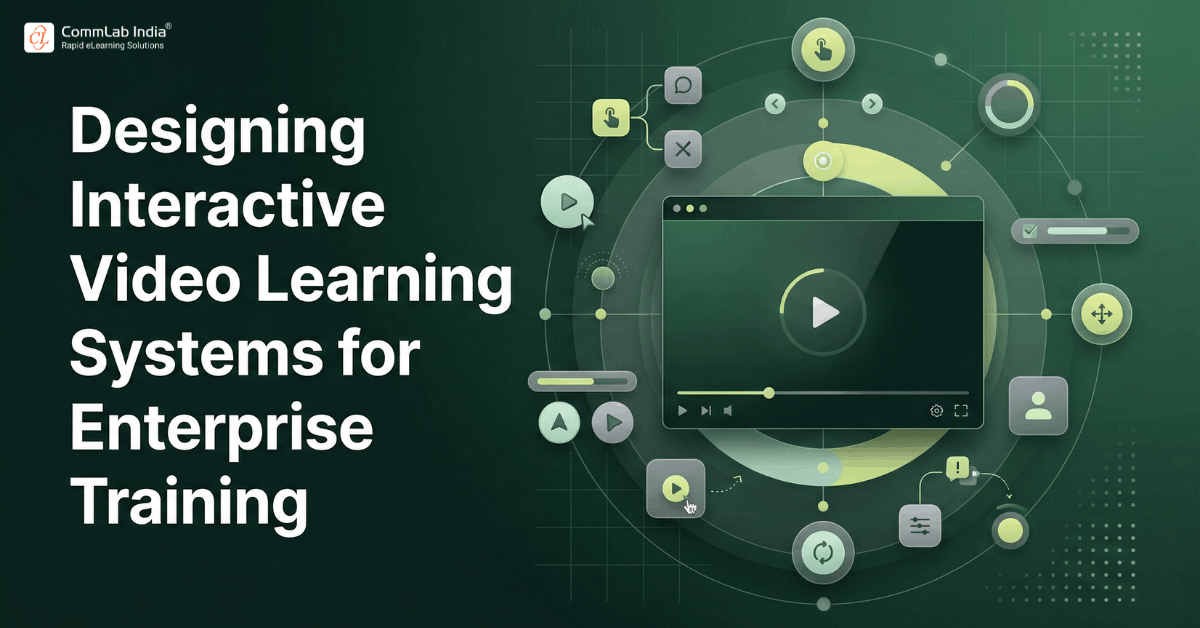
Interactive video learning transforms video from a medium of consumption into a medium of participation. It introduces decision points, branching scenarios, microlearning structures, and performance support elements that require learners to think, act, and respond within the learning experience itself.
At the same time, advances in accessibility and mobile-first design ensure that these experiences are inclusive and available exactly when they are needed.
The result is not just more engaging content, but a fundamentally different learning architecture, one that connects learning directly to performance and embeds capability-building into everyday work.
Download eBook: AI-Powered Technical Training
Table of Contents
- Why Passive Video Falls Short in Enterprise Learning
- Reframing Video as an Interactive Learning System
- Branching and Decision-Based Learning: Moving Beyond Linear Content
- Microlearning with Video: Enabling Continuous Learning
- Video as a Performance Support Layer
- Accessibility and Inclusive Video Design
- Immersive and Experiential Video Formats
- Embedding Interactive Video into Learning Ecosystems
- FAQs
Why Passive Video Falls Short in Enterprise Learning
Traditional video-based learning has been highly successful in capturing attention and improving comprehension. However, its limitations become evident when organizations attempt to translate learning into action.
Passive video experiences do not require learners to engage cognitively beyond observation. There is no need to make decisions, apply knowledge, or reflect on consequences. As a result, learning often remains superficial, with limited retention and minimal transfer to real-world scenarios.
In enterprise environments, where training is expected to influence performance, this gap becomes significant.
The challenge is not that video is ineffective. It is that it is often underutilized.
To bridge this gap, organizations must move from passive delivery to active, experience-driven learning, where learners are not just viewers but participants in the process.
Reframing Video as an Interactive Learning System
Interactive video represents a shift from linear content delivery to dynamic learning experiences. Instead of guiding every learner through the same path, interactive video allows for variation, exploration, and decision-making.
At its core, this approach transforms video into a system that supports:
- Active participation
Learners are required to engage with the content rather than passively consume it. - Contextual exploration
Different scenarios allow learners to understand how knowledge applies in varied situations. - Immediate feedback
Responses to learner choices help reinforce correct behavior and correct misunderstandings. - Adaptive progression
Learners can move through content based on their decisions or needs.
This shift is subtle in design but profound in impact. It aligns learning experiences more closely with how decisions are made in real-world environments.
Branching and Decision-Based Learning: Moving Beyond Linear Content
One of the most powerful capabilities of interactive video is the ability to simulate decision-making through branching narratives.
Unlike traditional videos that follow a fixed sequence, branching scenarios allow learners to make choices that influence how the story unfolds. Each decision leads to a different outcome, creating a more immersive and meaningful learning experience.
What branching enables in practice
- Realistic decision-making environments
Learners encounter situations that mirror actual workplace challenges. - Understanding consequences
Different choices lead to different outcomes, reinforcing cause and effect. - Safe experimentation
Learners can explore options without real-world risk. - Deeper cognitive engagement
Making decisions requires active thinking, which improves retention.
When applied effectively, branching transforms video into a simulation layer, particularly valuable for areas such as leadership, customer interactions, compliance, and sales.
Microlearning with Video: Enabling Continuous Learning
As work becomes more dynamic and time-constrained, the need for concise, accessible learning experiences has grown significantly. Microlearning addresses this need by breaking content into small, focused units that can be consumed quickly.
Video enhances microlearning by delivering information in a format that is both engaging and easy to process.
Why video works so well for microlearning
- Focused delivery
Each video addresses a single concept, reducing cognitive overload. - Faster comprehension
Visual and auditory cues accelerate understanding. - On-demand access
Learners can quickly find and use relevant content when needed. - Reinforcement over time
Short videos can be revisited easily, supporting long-term retention.
Rather than replacing structured training, microlearning videos extend it, ensuring that learning continues beyond formal sessions and remains accessible in everyday work contexts.
Video as a Performance Support Layer
One of the most significant shifts in modern learning strategy is the move toward performance support. Instead of relying solely on training events, organizations are embedding learning directly into workflows.
Video plays a critical role in enabling this transition.
Performance support videos are designed to be accessed at the moment of need, providing immediate, actionable guidance without disrupting work.
Key characteristics of effective performance support videos
- Highly focused
Each video addresses a specific task or problem. - Context-driven
Content is aligned with real-world workflows and scenarios. - Quick to access
Designed for minimal time investment. - Action-oriented
Enables immediate application.
| Scenario | How Video Supports Performance |
| Software usage | Step-by-step visual guidance reduces errors |
| Field operations | Demonstrates correct procedures in context |
| Customer interactions | Reinforces best practices through examples |
| Compliance tasks | Provides quick reminders of critical steps |
By integrating these videos into digital tools and platforms, organizations can create a seamless connection between learning and doing.
Accessibility and Inclusive Video Design
As video-based learning scales across diverse and global workforces, accessibility becomes both a necessity and a strategic advantage.
Inclusive design ensures that all learners, regardless of their abilities or context, can engage with and benefit from training content.
Core accessibility practices
- Captions and transcripts
Support learners with hearing impairments and improve comprehension for non-native speakers. - Clear visual hierarchy
Ensures that important information is easy to identify. - Consistent audio quality
Reduces cognitive effort required to understand content. - Device compatibility
Enables access across mobile, tablet, and desktop environments.
Accessibility is not simply about compliance. It is about ensuring that learning experiences are equitable, usable, and effective for every learner.
Immersive and Experiential Video Formats
Advancements in technology are expanding the possibilities of video-based learning beyond traditional formats.
360-degree videos and immersive experiences allow learners to explore environments and situations from multiple perspectives. This creates a deeper sense of presence and engagement.
These formats are particularly effective in scenarios such as:
- Safety and risk training
- Field-based operations
- Customer-facing roles
However, their effectiveness depends on alignment with learning objectives. Immersion should be used where it enhances understanding, not as a novelty.
When applied strategically, experiential video formats can significantly improve contextual learning and retention.
Embedding Interactive Video into Learning Ecosystems
Interactive video delivers its full value only when it is integrated into a broader learning ecosystem.
This includes its use within:
- Learning Management Systems
- Virtual Instructor-Led Training environments
- Performance support platforms
- Knowledge repositories
Tools such as Articulate Storyline enable the creation of interactive video experiences that are seamlessly embedded into structured learning journeys.
This integration ensures that interactive video is not an isolated feature, but a core component of a continuous learning system.
FAQs
What is interactive video learning?
Interactive video learning allows learners to engage with video content through decision points, branching scenarios, and interactive elements, creating a more active learning experience.
How do branching videos improve learning outcomes?
Branching videos enable learners to make decisions and see consequences, helping them develop critical thinking and decision-making skills in realistic scenarios.
Why is video effective for microlearning?
Video delivers focused, easy-to-understand content quickly, making it ideal for short learning bursts and just-in-time reinforcement.
What role does video play in performance support?
Video provides immediate, actionable guidance that helps employees perform tasks effectively without needing extensive training.
How can video-based learning be made accessible?
Accessibility can be improved through captions, transcripts, clear visuals, and compatibility across devices.
Conclusion
Interactive video learning marks a decisive shift in how organizations approach corporate training.
By combining interactivity, microlearning, performance support, and accessibility, it transforms video from a passive medium into an active system for capability building.
The real opportunity lies not in adding more features to video, but in designing experiences that require learners to think, decide, and act.
Organizations that embrace this approach will be able to create learning environments that are not only engaging, but also deeply aligned with real-world performance and long-term skill development.