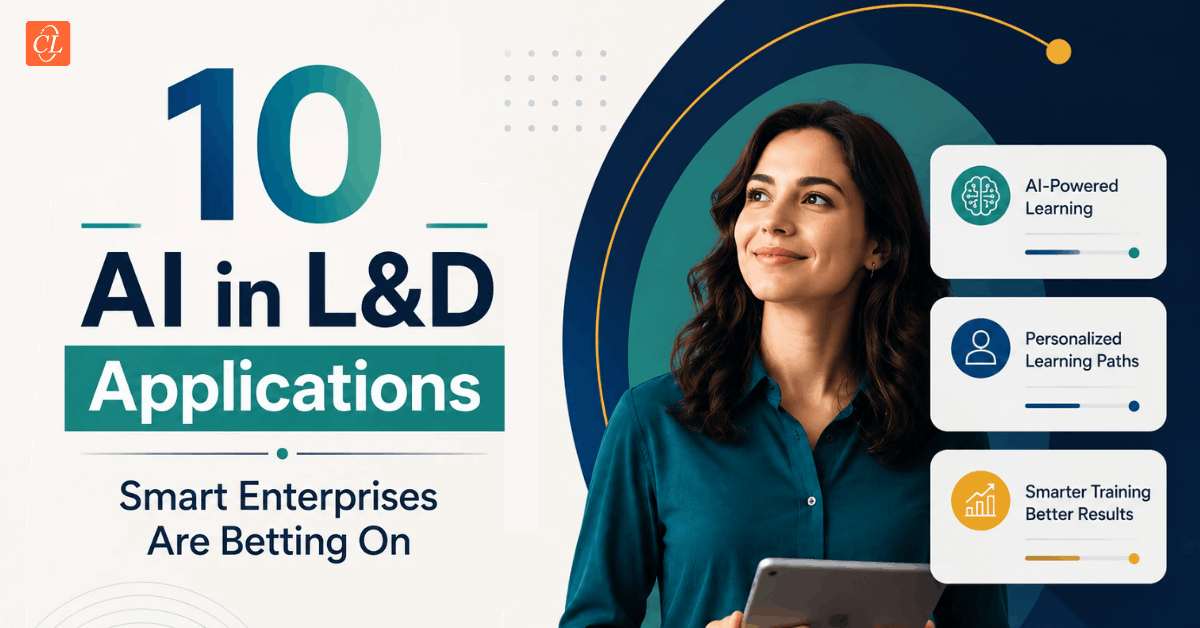
Artificial intelligence is rapidly reshaping employee training and development across global enterprises. For organizations with workforces exceeding 10,000 employees, traditional learning models often struggle to keep pace with changing skills, compliance requirements, and business transformation initiatives.
Organizations are increasingly investing in AI-powered learning ecosystems to personalize learning, accelerate upskilling, and improve workforce performance. As AI adoption expands across industries, Learning and Development (L&D) leaders are moving beyond experimentation and focusing on scalable applications that deliver measurable business value.
This blog explores the most impactful ways AI in L&D is transforming enterprise training across manufacturing, healthcare and pharmaceuticals, financial services, energy solutions, and logistics organizations.
Table Of Content
- What are the Most Impactful AI Applications in Enterprise Corporate Training?
- How Enterprise L&D Leaders Should Prepare for AI Adoption
- How AI in L&D Is Becoming a Strategic Enterprise Capability
What are the Most Impactful AI Applications in Enterprise Corporate Training?
As organizations scale learning across large and diverse workforces, AI is helping solve some of the biggest training and development challenges. Here are the key AI applications transforming enterprise corporate training today:
1. Personalized Learning Pathways at Enterprise Scale
One of the most powerful applications of AI in L&D is creating individualized learning experiences for thousands of employees simultaneously.
AI analyzes:
- Job roles
- Skill profiles
- Learning history
- Performance data
- Career aspirations
The system then recommends targeted learning paths tailored to each employee.
Industry Example
A multinational pharmaceutical company can automatically recommend specialized compliance training for clinical researchers while suggesting leadership development programs for senior managers.
The result is greater learner engagement and reduced training fatigue.
2. AI-Powered Skills Gap Analysis
Many enterprises struggle to identify emerging skill shortages before they impact performance.
AI can continuously assess workforce capabilities by analyzing:
- LMS data
- Performance metrics
- Certifications
- Internal talent profiles
- Industry skill trends
3. Intelligent Content Creation and Course Development
Developing training content at enterprise scale is often resource-intensive.
Generative AI can accelerate:
- Course outlines
- Learning objectives
- Assessment questions
- Microlearning assets
- Video scripts
- Scenario-based exercises
While human instructional designers remain essential for quality and strategy, AI significantly reduces development timelines.
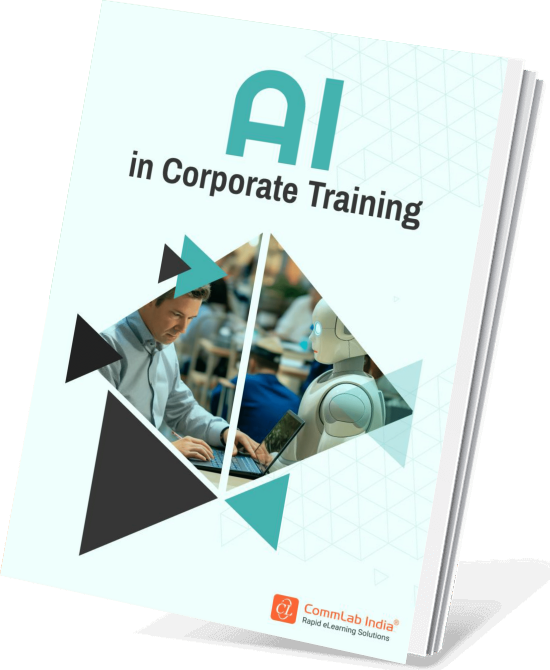
AI in Corporate Training
Partner, Not Replacement
- AI in Corporate Training
- AI Toolkit for Super-charged Learning
- Challenges to Consider with AI Implementation
- And More!
4. Predictive Learning Analytics
Traditional learning reports often focus on completion rates rather than business outcomes. AI enables predictive analytics that helps L&D leaders answer critical questions:
- Which employees are at risk of skill gaps?
- Which training programs drive performance improvement?
- Where are compliance risks emerging?
- Which teams require additional support?
Industry Example
Healthcare organizations can predict which employees may require refresher training before compliance certifications expire, reducing organizational risk.
5. Virtual Coaching and Learning Assistants
AI-powered learning assistants provide employees with immediate support during training and on the job.
These assistants can:
- Answer questions
- Recommend resources
- Explain concepts
- Guide learners through complex processes
- Reinforce learning after training
6. AI-Driven Compliance Training
Compliance training remains one of the largest investments across regulated industries.
AI improves compliance training by:
- Personalizing content
- Identifying risk-prone learners
- Monitoring completion patterns
- Recommending reinforcement activities
- Detecting knowledge gaps
Industry Example
Pharmaceutical companies must continuously update employees on evolving regulations. AI helps automate content updates and learner targeting. This increases compliance effectiveness while reducing administrative effort.
7. Adaptive Learning Experiences
Not all employees learn at the same pace.
Adaptive learning platforms use AI to adjust content and difficulty based on individual performance, helping employees learn more efficiently and effectively.
Key capabilities include:
- Personalized content recommendations
- Dynamic learning paths based on skill levels
- Real-time feedback and coaching
- Targeted reinforcement for knowledge gaps
- Customized assessments that adapt to learner performance
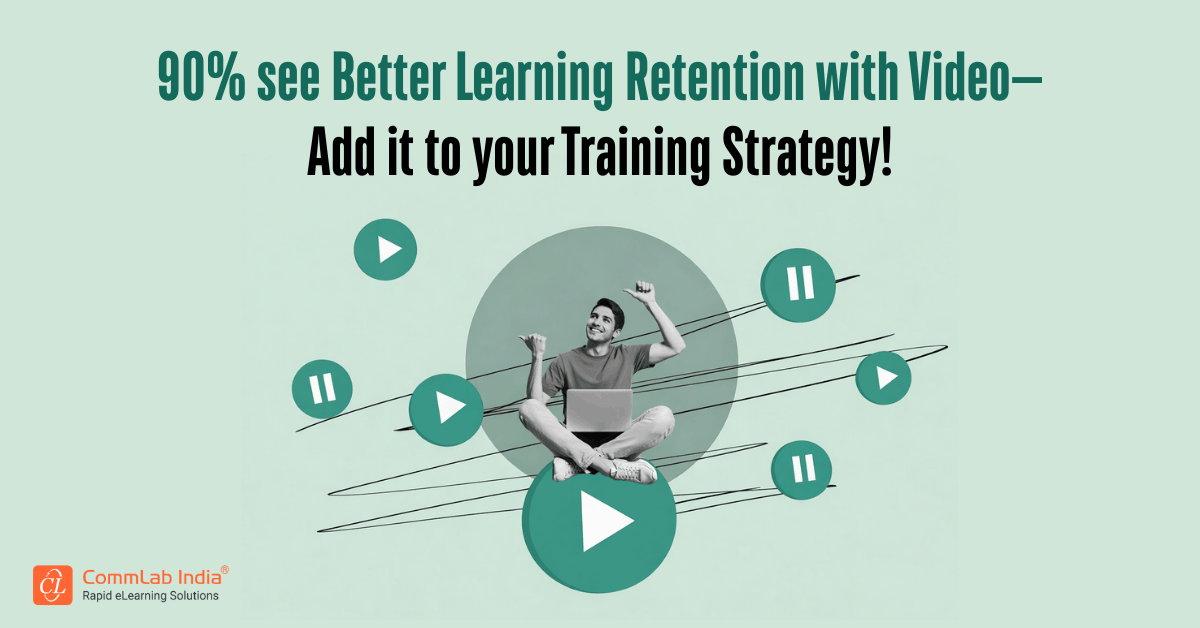
Watch the video to learn how adaptive learning moves beyond one-size-fits-all training.
Industry Example
In logistics operations, new warehouse employees may require additional support for safety procedures, while experienced workers can move through training more quickly. Adaptive learning improves both efficiency and learning outcomes.
8. AI-Powered Training Simulations
Simulation-based learning has become increasingly important for high-risk industries. AI enhances simulations by creating realistic, dynamic scenarios that respond to learner decisions in real time.
Industry Example
Energy companies can train field technicians using AI-powered simulations that mimic equipment failures, emergency situations, and operational hazards without exposing employees to actual risk.
This improves preparedness while reducing training costs.
9. Automated Translation and Global Learning Delivery
Global enterprises often deliver training across multiple countries and languages.
AI-driven translation technologies now support:
- eLearning translation
- Voiceover generation
- Subtitle creation
- Real-time language adaptation
Industry Example
A manufacturing organization operating across Germany, France, Spain, and the United States can rapidly deploy consistent training programs while maintaining local language accessibility.
This significantly reduces translation timelines and costs.
10. Learning Recommendations Based on Business Performance
Perhaps the most strategic application of AI in corporate training is linking learning directly to business performance.
AI can analyze relationships between:
- Sales outcomes
- Productivity metrics
- Safety incidents
- Quality scores
- Customer satisfaction
and learning interventions.
Industry Example
A logistics company may discover that employees who complete specific safety microlearning modules experience fewer operational incidents. AI can then recommend those programs to similar employee groups.
This helps transform L&D from a cost center into a measurable business driver.
How Enterprise L&D Leaders Should Prepare for AI Adoption
Successful AI implementation in L&D requires more than technology.
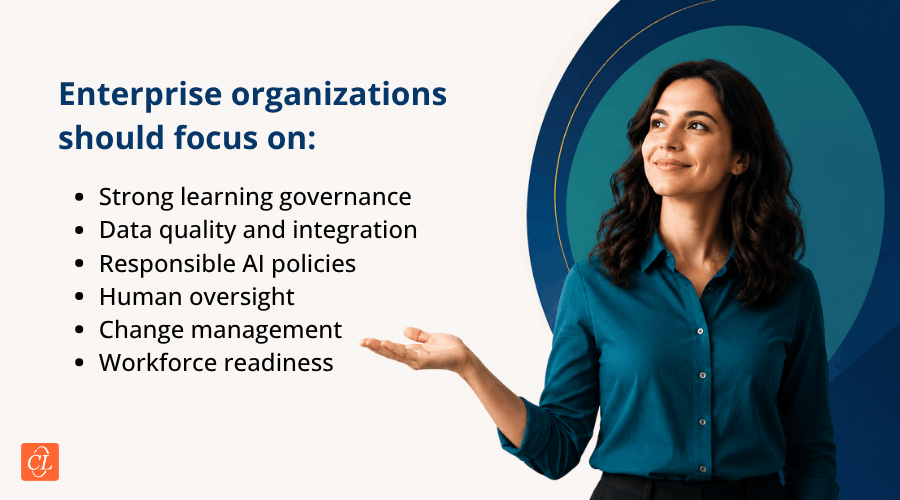
The most successful organizations view AI as an enabler that enhances learning teams rather than replacing them.
How AI in L&D Is Becoming a Strategic Enterprise Capability
AI is rapidly transforming employee training and development by personalizing learning, identifying skill gaps, automating content creation, and aligning training with business goals. For enterprises across industries, AI in L&D is a strategic capability that helps scale corporate training, improve workforce performance, and build a more agile, future-ready workforce.
Want to learn how to successfully integrate AI into your learning strategy? Download our eBook to explore how AI streamlines reskilling for a future-proof workforce, discover practical AI tools for design, development, and more, understand key implementation challenges, and learn how AI can seamlessly enhance your existing training programs.