You've sat through the webinars. You've forwarded the LinkedIn articles. You've nodded along to the phrase "AI will transform learning" more times than you can count. And yet, somewhere between all that noise and your actual training calendar, a real question sits unanswered: Is your organization actually ready for AI?
Not "ready" in the theoretical, boardroom-presentation sense. Ready in the practical, roll-up-your-sleeves, will-this-actually-work-for-our-learners sense. Because there's a significant gap between organizations that have added an AI tool to a slide deck and those that have genuinely embedded AI in eLearning in a way that moves the needle.
This blog is your starting point. No vendor pitch. No hype. Just an honest look at where your L&D function stands and what it takes to move forward with purpose.
Table Of Content
- What is AI Readiness and Why Does It Matter for L&D?
- What are the Stages of AI Readiness in L&D?
- What does an AI Readiness Assessment Actually Measure?
- How Do You Conduct an AI Readiness Assessment for Your L&D Team?
- How Should L&D Leaders Prioritize After an AI Readiness Assessment?
- What does "Good" AI Readiness Look Like in Practice?
What is AI Readiness and Why Does It Matter for L&D?
AI readiness is an organization's capacity to adopt, integrate, and scale AI tools in a way that produces measurable outcomes. For L&D leaders, this means more than purchasing an AI-powered authoring tool. It means evaluating whether your team, data, culture, and processes are prepared to support AI-driven learning at scale.
Without an honest readiness assessment, organizations tend to make one of two mistakes: they either move too fast (deploying tools their teams aren't equipped to use) or too slow (waiting for perfect conditions that never arrive). An AI readiness assessment gives you a structured way to evaluate where you stand and make smarter decisions about where to go next.
What are the Stages of AI Readiness in L&D?
Most L&D organizations fall into one of four maturity stages. Understanding these helps you benchmark your starting point honestly rather than aspirationally.
Stage 1: Unaware
There is no deliberate AI strategy in place. If AI tools are being used at all, it's informal — an individual designer experimenting with ChatGPT on their own time, not a sanctioned or supported initiative. Leadership hasn't yet connected AI to L&D goals, and there's no budget, governance, or roadmap tied to it.
Reality Check: According to McKinsey, only 13% of employees consider their organization an AI early adopter.
| What you'll see | Key risk |
|
|
Your next move: Run an internal awareness session. Map what AI tools already exist in your tech stack — your LMS or authoring tool may already have AI features you're not using.
Stage 2: Exploring
The organization is actively experimenting — piloting one or two AI tools, usually in content creation or translation. There's growing curiosity and some budget allocated, but adoption is inconsistent. Different team members use different tools with no standardization. Quality control is informal, and there's no clear measurement of what "good" looks like yet.
Reality Check: McKinsey reports that 65% of organizations regularly use generative AI in at least one business function.
| What you'll see | Key risk |
|
|
Your next move: Document your pilots. Define what success looks like before expanding. Draft a basic AI usage policy covering accuracy standards, bias checks, and IP ownership.
Stage 3: Implementing
AI is no longer a side experiment, it's embedded in how the L&D team works. Approved tools are integrated into content workflows, and the team has received training on how to use them responsibly. Data infrastructure is being developed or improved, and leadership is involved. Governance frameworks exist, even if they're still evolving.
Reality Check: According to ATD research, 55% of organizations provided practical AI skills training to employees, indicating that many organizations are moving beyond experimentation and investing in workforce capability building.
| What you'll see |
Key risk |
|
|
Your next move: Shift your measurement from efficiency (time saved) to effectiveness (learner outcomes). Introduce AI-driven personalization in at least one learning pathway.
Stage 4: Optimizing
AI is a core part of how learning is designed, delivered, and measured — not a bolt-on feature. Personalization operates at scale, learner data informs real-time content decisions, and the L&D team iterates continuously based on performance signals. AI literacy is embedded in team culture, and the organization can articulate clear business outcomes tied to AI-powered learning.
Reality Check: Gartner found that 85% of business leaders believe the need for skills development will increase significantly due to AI and digital disruption over the next three years.
| What you'll see |
Key risk |
|
|
Your next move: Stay ahead by auditing AI ethics regularly, diversifying your tool ecosystem, and preserving human-led learning experiences where they matter most.
What does an AI Readiness Assessment Actually Measure?
A meaningful AI readiness assessment evaluates six core dimensions. Each one influences how successfully AI in eLearning can be adopted and sustained inside your organization.
1. Leadership Alignment
Is there executive buy-in for an AI learning strategy, not just in principle, but in budget and accountability? Organizations that succeed with AI in L&D typically have at least one senior sponsor who connects learning outcomes to business priorities. Without that link, AI initiatives stall at the pilot stage.
2. Data Infrastructure and Learning Analytics
AI is only as good as the data it learns from. Evaluate whether your LMS captures meaningful data — completion rates, assessment scores, time-on-task, behavioral signals and whether that data is clean, structured, and accessible. If your data lives in silos or spreadsheets, AI personalization will be limited at best.
3. Team Digital Literacy
Your L&D team doesn't need to be AI engineers. But they do need a working understanding of how AI tools function, where they add value, and where they introduce risk. Assess whether your team can confidently evaluate, prompt, and quality-check AI-generated content or whether they'd use outputs uncritically.
4. Content and Curriculum Infrastructure
AI tools can accelerate content creation, but only when they have well-organized source material to work with. Review whether your existing content assets are structured, tagged, and accessible. Disorganized or outdated content libraries make AI-assisted development slower, not faster.
5. Technology Stack Compatibility
AI tools need to connect with your existing ecosystem — your LMS, content authoring tools, and communication platforms. Evaluate integration readiness before selecting any AI solution. A powerful AI authoring tool that doesn't connect to your LMS creates more work, not less.
6. Change Management Capacity
Perhaps the most underestimated dimension. AI adoption requires sustained behavior change from instructional designers, facilitators, and managers. Assess whether your organization has a track record of successfully implementing change and whether L&D has the credibility and communication channels to drive it.
What are the Most Common AI Readiness Gaps in L&D Organizations?
Based on patterns across organizations undertaking AI readiness assessments, the most frequent gaps are consistent and addressable. Here's what typically surfaces:
- Data immaHturity: LMS data is collected but rarely analyzed. Completion rates are tracked; behavioral and performance data are not.
- Skills gaps in the L&D team: Instructional designers have strong pedagogical skills but limited experience evaluating or prompting AI tools.
- No AI governance policy: Organizations lack clear guidelines on what AI-generated content can and cannot be used for, creating legal and ethical ambiguity.
- Tool fragmentation: Different teams use different AI tools with no standardization, making quality control difficult and scaling impossible.
- Absent measurement framework: There's no clear way to measure whether AI-assisted learning is actually improving outcomes versus saving time alone.
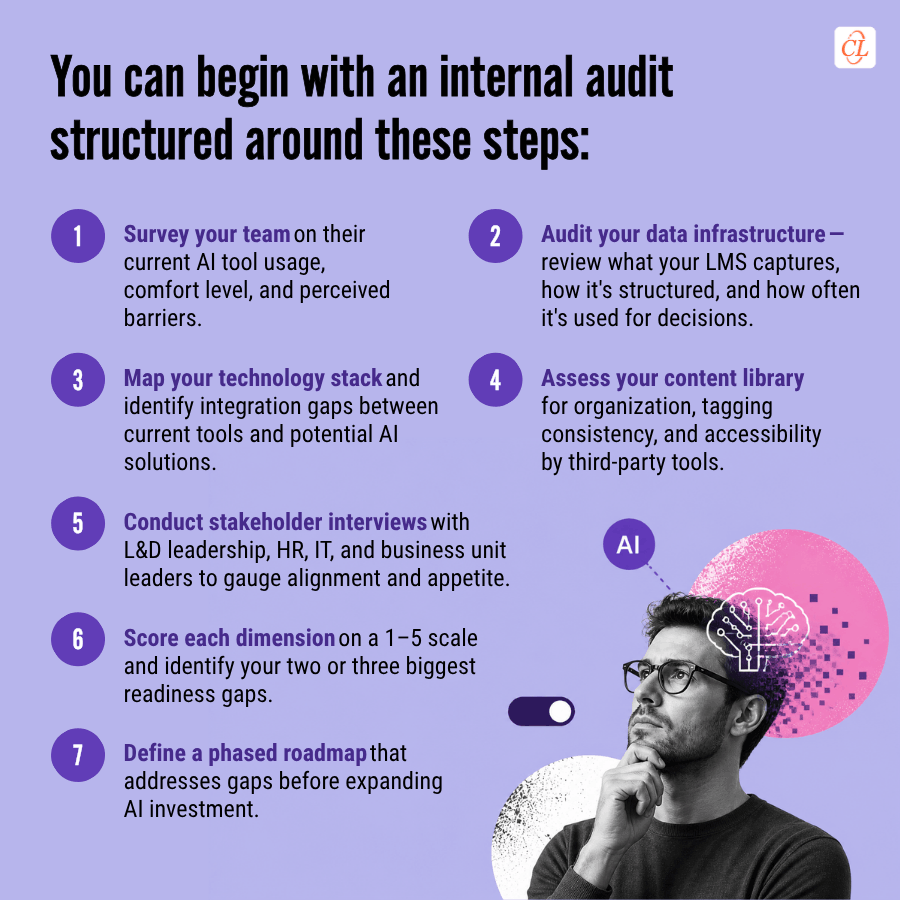
How Do You Conduct an AI Readiness Assessment for Your L&D Team?
A practical AI readiness assessment doesn't require a consultant or a six-month engagement.
How Should L&D Leaders Prioritize After an AI Readiness Assessment?
Once you've identified your readiness gaps, prioritization matters. Not all gaps are equally urgent or equally impactful. Here's a practical prioritization framework:
- Fix data gaps first. Without reliable learning data, no AI tool will deliver meaningful personalization or measurement.
- Build governance before scaling. Establish an AI usage policy — covering bias, accuracy, privacy, and IP before deploying tools across the organization.
- Upskill your team in parallel. AI literacy for L&D professionals is not optional. It determines the quality of every AI-assisted output your team produces.
- Pilot before committing. Run structured pilots with clear success metrics before enterprise-wide investment in any AI solution.
What does "Good" AI Readiness Look Like in Practice?
Organizations that score well aren't the ones with the biggest budgets — they're the ones with the right foundations. A well-tagged content library. An LMS that captures real data. A team that critically reviews AI outputs rather than blindly accepting them. A leadership sponsor who connects learning to business outcomes.
None of that requires enterprise-level spend. It requires intentionality.
The organizations that get AI right don't treat it as a separate initiative, they fold it into how they already work. That's the goal. And it starts with knowing honestly where you stand today.