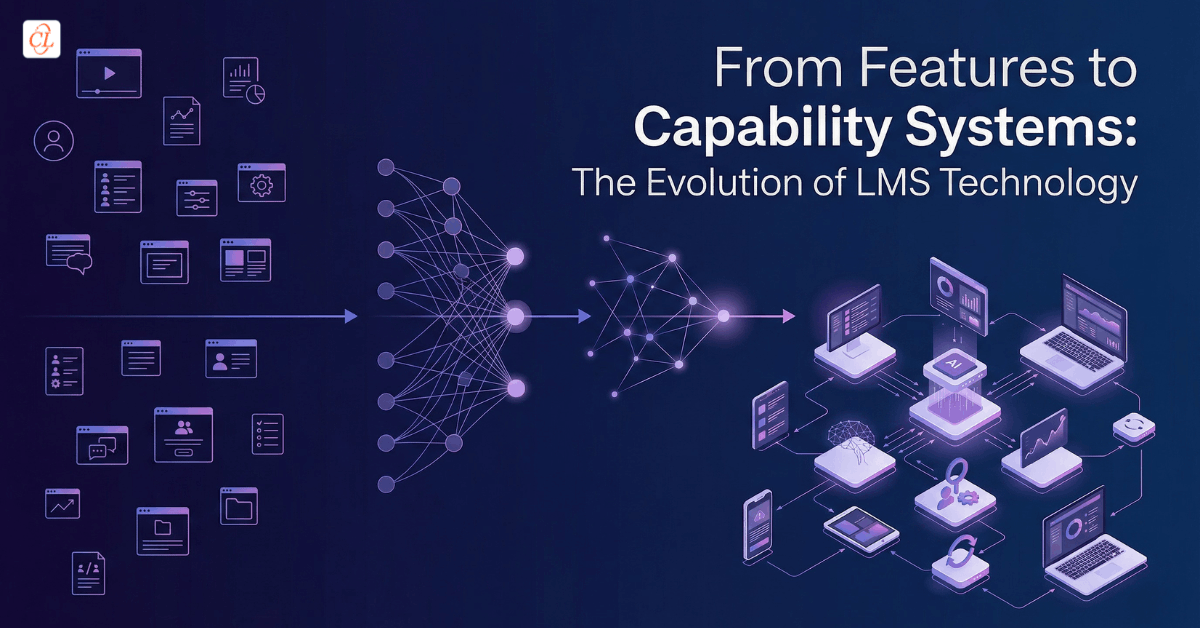
For years, conversations around learning management systems have been dominated by feature checklists. Organizations compare platforms based on course hosting, reporting dashboards, mobile access, and integration capabilities. Vendors respond by adding more functionality, more modules, and more layers of configuration.
Yet despite this expansion, a critical disconnect remains.
Many organizations still struggle to translate LMS features into meaningful learning impact. The issue is not the absence of capability. Modern LMS platforms are more powerful than ever. The issue lies in how those capabilities are understood and applied.
A feature is only valuable when it enables a specific learning outcome. A capability becomes strategic when it connects learning to performance. This distinction is essential.
Download Now: State of Learning (Now and Beyond) [eBook]
Today’s LMS is no longer a static system designed to administer training. It is a dynamic platform that enables continuous learning, supports performance in real time, and adapts to the needs of a distributed, digital-first workforce.
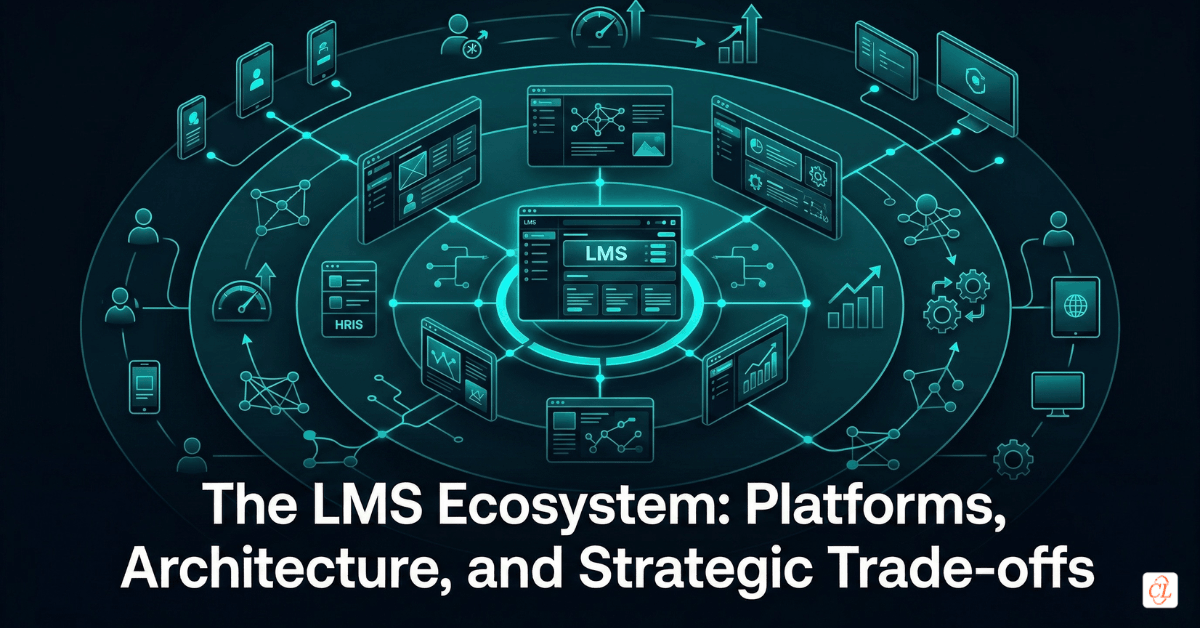
To fully leverage this potential, organizations must move beyond thinking in terms of isolated features and instead understand how LMS capabilities function as an interconnected system.
Moving Beyond Feature Lists to Capability Thinking
Most LMS evaluations begin with a checklist.
- Does the platform support mobile learning?
- Can it track completion?
- Does it integrate with other systems?
While these questions are necessary, they are not sufficient. They focus on what the LMS has, not what it enables. A more effective approach is to think in terms of capability systems.
Instead of asking whether a feature exists, organizations must ask:
- What learning problem does this capability solve?
- How does it support performance in real-world contexts?
- How does it scale across roles, regions, and business units?
This shift from features to capabilities transforms LMS selection and usage from a technical exercise into a strategic decision.
The Foundational Layer: Core LMS Capabilities
At its core, an LMS provides the infrastructure required to manage and deliver learning at scale. These foundational capabilities are often taken for granted, yet they remain critical to ensuring consistency, efficiency, and control.
Content management allows organizations to store, organize, and distribute learning materials across the enterprise. However, in modern environments, this function extends beyond simple storage. It includes version control, modular content structuring, and the ability to rapidly update learning assets in response to business changes.
User and role management ensures that learning is assigned and delivered based on job roles, responsibilities, and organizational hierarchy. This capability enables targeted learning rather than generic distribution, improving relevance and effectiveness.
Administration and automation reduce the operational burden associated with training. Automated enrollments, reminders, and certifications ensure that learning programs run smoothly without constant manual intervention.
Assessment and certification capabilities provide mechanisms to validate learning. Built-in quiz engines, scenario-based assessments, and competency tracking allow organizations to measure not just knowledge acquisition, but readiness for application.
These foundational elements create the structural backbone of the LMS. Without them, advanced capabilities cannot function effectively.
Experience Layer: Designing How Learning Happens
As learning shifts from event-based training to continuous development, the learner experience becomes a defining factor in LMS effectiveness.
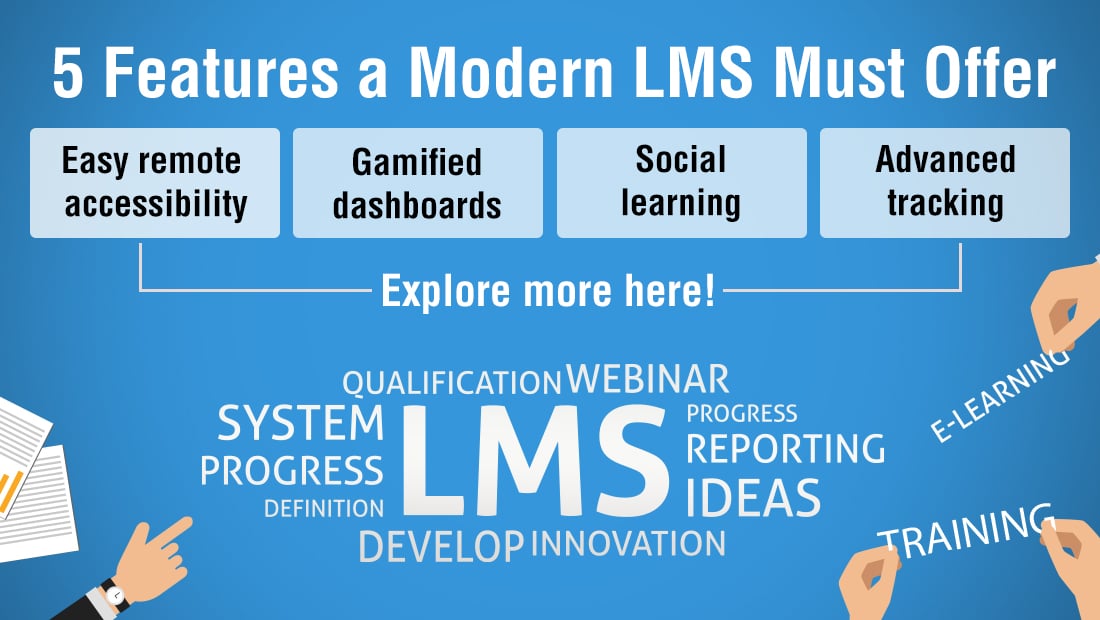
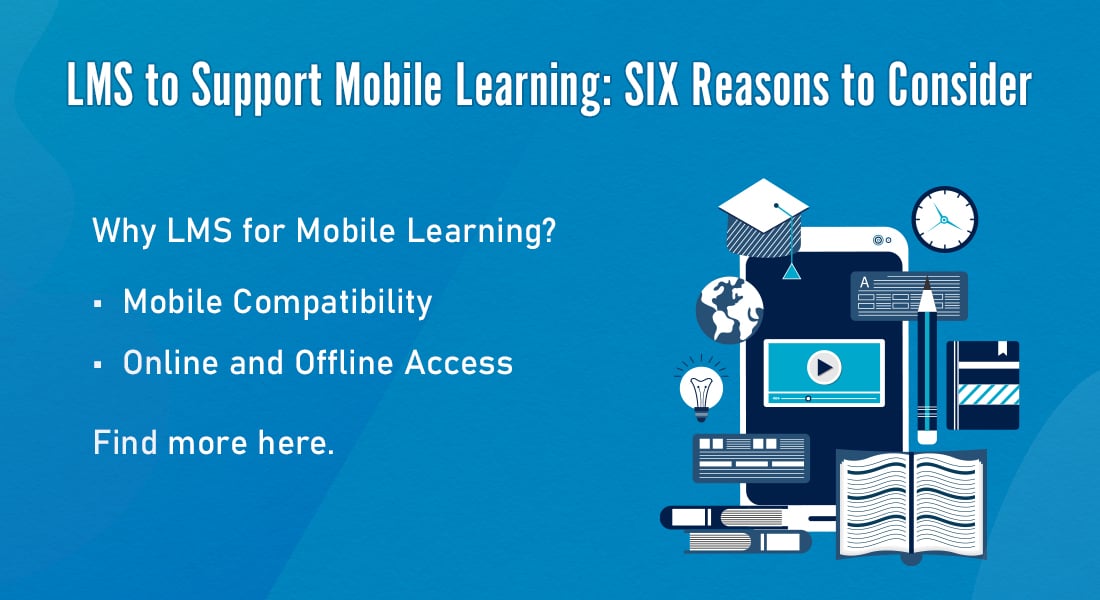
Modern LMS platforms support multi-device and mobile learning, enabling employees to access content anytime and anywhere. This flexibility is no longer optional. It is essential for supporting remote work, field roles, and just-in-time learning needs.
Multi-device compatibility ensures that learning experiences remain consistent across desktops, tablets, and smartphones. This is not simply about accessibility. It is about continuity, allowing learners to move seamlessly between contexts without losing progress.
Beyond accessibility, the LMS must support diverse learning formats, including microlearning, video-based instruction, and interactive modules. These formats align more closely with how people consume information in digital environments.
Equally important is the ability to support informal learning. Not all learning happens within structured courses. Modern LMS platforms enable knowledge sharing, user-generated content, and peer-driven learning experiences, making learning more organic and context-driven.
The experience layer determines whether learners engage with the system or avoid it. It transforms the LMS from a requirement into a resource.
Engagement Layer: Driving Motivation and Participation
One of the persistent challenges in corporate training is sustaining learner engagement.
Modern LMS platforms address this through capabilities designed to motivate participation and reinforce behavior.
Gamification introduces elements such as points, badges, leaderboards, and progress tracking to create a sense of achievement and competition. When applied thoughtfully, these elements encourage continued engagement without trivializing the learning experience.
Collaborative learning features enable discussion forums, peer interaction, and knowledge exchange. These capabilities recognize that learning is not an individual activity, but a social process that benefits from shared perspectives.
Performance support tools embedded within the LMS provide learners with access to resources at the moment of need. Instead of relying solely on formal training, employees can access quick references, job aids, and contextual guidance during real tasks.
Together, these capabilities shift learning from passive consumption to active participation.
Intelligence Layer: Data, Tracking, and Learning Analytics
The ability to track learning activity has always been a core function of LMS platforms. However, modern systems extend this capability significantly through advanced analytics.
Traditional tracking focuses on completion rates, assessment scores, and course participation. While these metrics provide visibility, they offer limited insight into actual performance impact.
Advanced LMS platforms integrate learning data with broader organizational metrics, enabling a deeper understanding of how learning influences business outcomes.
This includes identifying patterns in learner behavior, detecting skill gaps, and predicting future learning needs. Analytics can also support personalization, adapting learning pathways based on individual performance and preferences.
The intelligence layer transforms the LMS from a system of record into a system of insight, enabling data-driven decision-making at scale.
Integration Layer: Connecting LMS to the Digital Ecosystem
An LMS does not operate in isolation.
Its effectiveness depends on how well it integrates with the broader digital ecosystem of the organization.
Integration with HR systems allows for seamless user management and alignment between learning and workforce data. Performance management systems provide additional context, linking learning outcomes to employee performance metrics.
Collaboration tools enable learning to be embedded within daily workflows, making it more accessible and relevant. Content authoring tools ensure that learning materials can be created and updated efficiently.
These integrations create a unified environment where learning is not a separate activity, but an integrated part of work.
Commerce and Extended Learning Capabilities
As organizations expand their learning initiatives beyond internal audiences, new capabilities become essential.
E-commerce integration allows organizations to monetize learning programs by offering courses to external audiences such as customers, partners, and industry professionals. This transforms the LMS into a revenue-generating platform.
Extended learning capabilities support training for partners, vendors, and customers, ensuring consistency in knowledge and performance across the value chain.
These capabilities expand the role of the LMS from internal enablement to external growth.
The Role of xAPI in Expanding LMS Intelligence
One of the most significant advancements in LMS technology is the adoption of xAPI.
Traditional tracking standards capture learning activity within the LMS environment. However, they are limited in scope.
xAPI extends tracking beyond the LMS, enabling organizations to capture learning experiences across multiple contexts, including simulations, mobile apps, and real-world activities.
This provides a more comprehensive view of learning behavior and its impact on performance.
However, implementing xAPI also introduces challenges related to data management, integration, and interpretation. Organizations must ensure that data collected through xAPI is structured, relevant, and aligned with business objectives.
When used effectively, xAPI significantly enhances the intelligence capabilities of the LMS.
xAPI enables organizations to track learning beyond courses, capturing real-world learning experiences and connecting them to performance outcomes.
Building a Capability-Driven LMS Strategy
The true potential of an LMS is realized when its capabilities are aligned with organizational needs.
This requires a shift from feature selection to capability design.
Organizations must begin by identifying the learning challenges they need to address. These challenges should then inform the selection and configuration of LMS capabilities.
For example, if the goal is to improve onboarding efficiency, the focus should be on capabilities that support structured learning paths, assessments, and progress tracking. If the goal is to enhance continuous learning, capabilities such as microlearning, mobile access, and informal learning become more critical.
This alignment ensures that the LMS is not just implemented, but effectively utilized.
FAQ
1. What are the most important features in an LMS?
A. The most important features include content management, user administration, mobile access, analytics, integration capabilities, and assessment tools. However, their importance depends on how well they support organizational learning goals.
2. How does mobile learning impact LMS effectiveness?
A. Mobile learning increases accessibility and flexibility, allowing employees to learn anytime and anywhere. This is especially critical for remote and field-based roles.
3. What is gamification in an LMS?
A. Gamification involves using elements like points, badges, and leaderboards to increase engagement and motivation. It encourages participation and reinforces learning behaviors.
4. How does xAPI improve learning tracking?
A. xAPI enables tracking of learning experiences beyond traditional courses, capturing data from simulations, mobile apps, and real-world activities, providing a more comprehensive view of learning.
5. Why is LMS integration important?
A. Integration connects the LMS with HR, performance, and collaboration systems, ensuring that learning is aligned with business processes and workflows.
6. Can LMS platforms support external training?
A. Yes, modern LMS platforms support extended learning for customers, partners, and vendors, enabling organizations to expand learning beyond internal audiences.
Conclusion
The evolution of LMS technology is not defined by the number of features it offers, but by the depth of capability it enables. Organizations that continue to focus on feature comparisons will find themselves overwhelmed by options and underwhelmed by results.
Those that shift to a capability-driven perspective will unlock the full potential of their LMS. Not as a system that delivers training. But as a platform that enables learning, supports performance, and drives business outcomes at scale.
Organizations that evaluate LMS platforms based solely on feature checklists risk underutilizing their investment. A capability-driven approach ensures that the LMS is aligned with business goals, supports real-world performance, and evolves with organizational needs. The future of LMS is not defined by more features, but by better integration of capabilities.