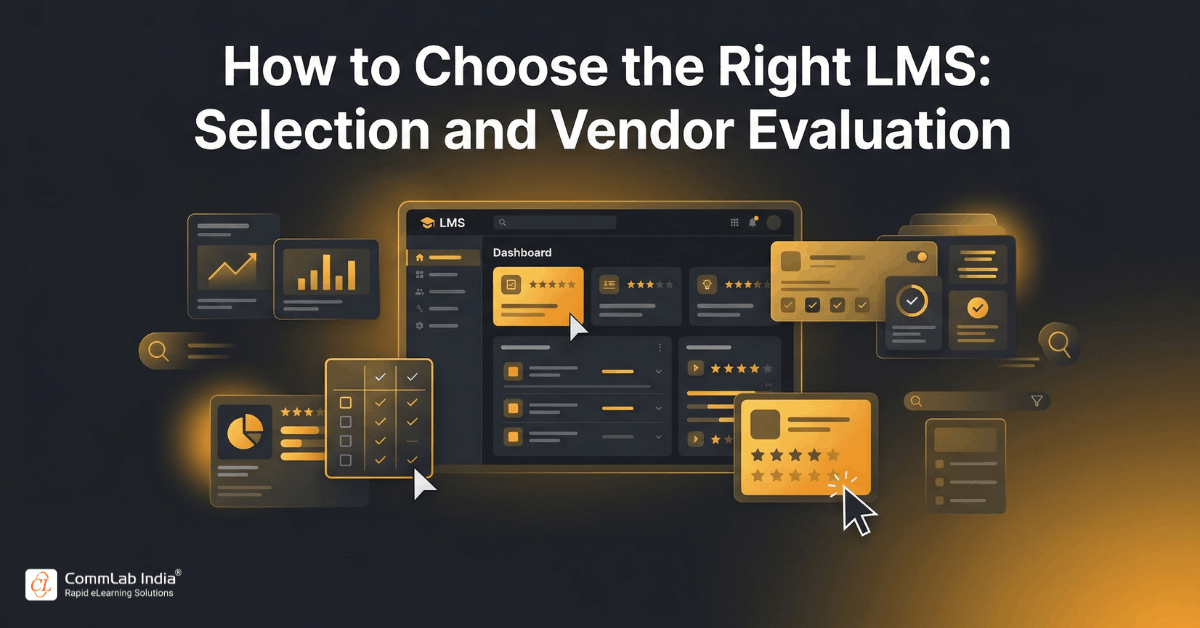
Selecting a learning management system is rarely a simple technology decision. It is a high-stakes investment that sits at the intersection of learning strategy, workforce capability, and long-term business performance.
And yet, many organizations approach it as a feature comparison exercise.
They evaluate platforms based on checklists, compare vendor demos, and focus on immediate requirements such as content hosting, reporting, and integrations. While these considerations are important, they often lead to decisions that solve short-term needs but fail to scale with the organization.
This is why many LMS implementations underperform. Not because the platform lacks capability, but because the selection process lacked strategic depth. Choosing the right LMS is not about finding the platform with the most features. It is about identifying the system that aligns with how your organization learns, operates, and evolves.
Download Now: How L&D And Business Can Align to Conquer The Future Of Work
It requires clarity on business outcomes, understanding of learning maturity, and a structured evaluation approach that balances technology, vendor capability, and long-term adaptability.
Organizations that approach LMS selection with this level of intent do not just implement a system. They establish a foundation for sustained learning impact.
Why LMS Selection Often Fails
Many LMS selection processes begin with good intent but lose direction as they progress. The most common failure is starting with the solution instead of the problem.
Organizations often begin by exploring available platforms before clearly defining what they need the LMS to achieve. This leads to fragmented requirements, inconsistent evaluation criteria, and decisions influenced more by vendor presentations than organizational priorities.
Another issue is over-reliance on feature comparisons. While feature parity is important, most modern LMS platforms offer similar baseline capabilities. The real difference lies in how those capabilities are implemented, integrated, and scaled.
Finally, many organizations underestimate the importance of vendor partnership. An LMS is not a one-time purchase. It is an ongoing relationship that influences implementation success, system evolution, and long-term value.
These gaps create a disconnect between selection and outcomes.
Reframing LMS Selection as a Strategic Decision
To make better decisions, organizations must shift their perspective. LMS selection is not a procurement activity. It is a strategic alignment exercise.
This means the process must begin with clarity on business priorities.
- What outcomes must learning support?
- Which capabilities are critical for workforce performance?
- How will learning evolve over the next few years?
These questions shape the selection process. Instead of evaluating platforms in isolation, organizations must assess how well each option aligns with their learning strategy, operational model, and future growth.
This reframing ensures that the selected LMS is not just functional, but fit for purpose.
Defining Requirements That Actually Matter
One of the most critical steps in LMS selection is defining requirements. However, not all requirements are equally valuable. Many organizations create long lists of desired features without distinguishing between essential capabilities and optional enhancements. This dilutes focus and complicates decision-making.
A more effective approach is to structure requirements across three layers.
Strategic Requirements
These define what the LMS must enable at a business level. Examples include supporting large-scale onboarding, enabling continuous learning, or improving compliance readiness.
Functional Requirements
These relate to specific capabilities such as content management, reporting, mobile access, and integration.
Experiential Requirements
These focus on usability, learner experience, and engagement.
By structuring requirements in this way, organizations can prioritize what truly matters and avoid being distracted by non-essential features.
Evaluating LMS Platforms Beyond Feature Checklists
Once requirements are defined, the evaluation process must move beyond surface-level comparisons.
The key is to assess how capabilities are delivered, not just whether they exist.
For example, many platforms offer reporting features. The real question is whether those reports provide actionable insights or simply display data.
Similarly, mobile learning capabilities must be evaluated based on user experience, performance, and consistency across devices, not just availability.
Integration capabilities should be assessed in terms of ease, flexibility, and scalability, rather than the number of supported systems.
Usability is another critical factor. A technically robust LMS can still fail if it is difficult for learners or administrators to use.
Evaluating these aspects requires hands-on testing, scenario-based demonstrations, and input from multiple stakeholders.
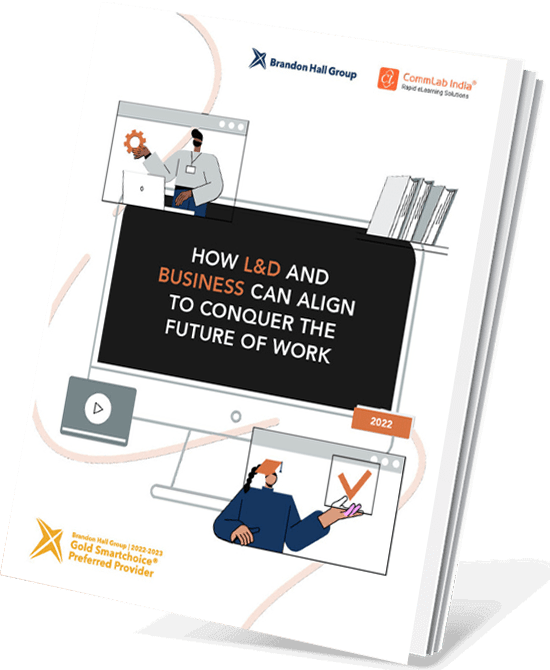
How L&D And Business Can Align to Conquer The Future Of Work
Bridging the Gap Between Organizational and Individual Goals!
- Learning Strategies Shaping the Future
- Changing Role of Learning Professionals
- Learning to Solve Business Challenges
- And More!
The Vendor Dimension: Why It Matters More Than You Think
An LMS is not just a product. It is a partnership.
The vendor plays a crucial role in implementation, customization, support, and ongoing optimization.
This makes vendor evaluation as important as platform evaluation.
Key considerations include:
- Experience in corporate learning environments
- Understanding of industry-specific needs
- Ability to provide strategic guidance
- Quality of support and responsiveness
- Product roadmap and innovation direction
A vendor with strong technical capabilities but limited understanding of learning strategy may struggle to deliver long-term value.
Conversely, a vendor that combines technology with domain expertise can significantly enhance the effectiveness of the LMS.
Structuring a Robust LMS Selection Process
A structured selection process ensures consistency, transparency, and alignment.
This process typically includes several stages.
- Initial research helps identify potential platforms based on high-level criteria.
- Requirement validation ensures that all stakeholders are aligned on priorities.
- Vendor shortlisting narrows down options based on strategic fit.
- Demonstrations and pilot testing provide deeper insights into platform capabilities and usability.
- Evaluation and scoring create a structured comparison framework.
- Final selection involves aligning stakeholders, negotiating terms, and planning implementation.
Each stage builds on the previous one, reducing risk and improving decision quality.
Building an Effective RFQ and Evaluation Model
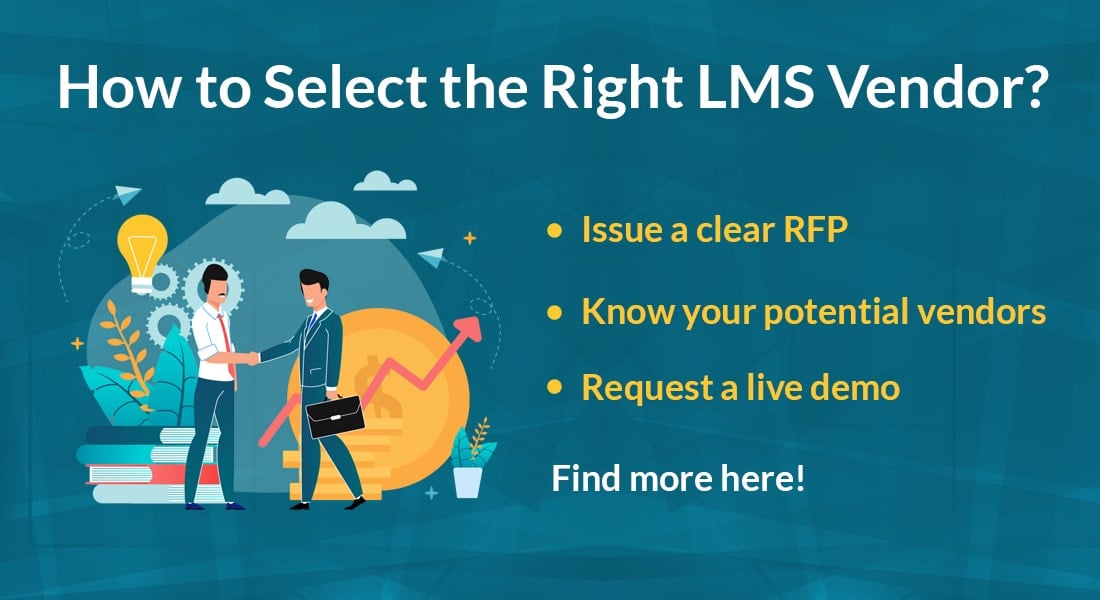
A well-designed RFQ is essential for gathering meaningful information from vendors.
It should go beyond generic questions and focus on specific use cases.
Instead of asking whether a platform supports a feature, the RFQ should ask how that feature is implemented and how it supports real-world scenarios.
Evaluation models should combine quantitative scoring with qualitative assessment.
Scoring provides objectivity, while qualitative insights capture nuances such as usability, vendor responsiveness, and cultural fit.
This balanced approach ensures that decisions are both data-driven and context-aware.
Avoiding Common LMS Buying Pitfalls
Even well-structured processes can be undermined by common pitfalls.
One of the most frequent mistakes is over-prioritizing cost. While budget considerations are important, selecting a lower-cost platform that fails to meet requirements can lead to higher long-term costs.
Another pitfall is focusing too heavily on current needs without considering future scalability. An LMS must be able to evolve with the organization.
Overlooking change management is another critical issue. Even the best platform will fail if users are not prepared to adopt it.
Finally, rushing the decision process can lead to incomplete evaluation and missed risks.
Avoiding these pitfalls requires discipline, stakeholder alignment, and a long-term perspective.
Making the Final Decision with Confidence
The final decision should not be based on a single factor.
It should reflect a balanced assessment of:
- Strategic alignment
- Capability fit
- Vendor strength
- Scalability
- Total cost of ownership
Confidence in the decision comes from the rigor of the process.
When organizations invest time in defining requirements, evaluating options thoroughly, and engaging stakeholders, they reduce uncertainty and increase the likelihood of success.
FAQ
1. How do you choose the right LMS for corporate training?
A. Start by defining business goals and learning requirements, then evaluate platforms based on how well they support those outcomes rather than just their features.
2. What factors are most important in LMS selection?
A. Key factors include strategic alignment, usability, integration capabilities, scalability, vendor expertise, and total cost of ownership.
3. Why is vendor selection important in LMS decisions?
A. The vendor influences implementation, support, and long-term success. A strong vendor partnership ensures better alignment, smoother adoption, and ongoing improvement.
4. What is an RFQ in LMS selection?
A. An RFQ is a structured document used to gather detailed information from vendors, focusing on how their platform meets specific requirements and use cases.
5. How long does LMS selection typically take?
A. The process can take several weeks to months, depending on organizational complexity, stakeholder involvement, and evaluation depth.
6. What is the biggest mistake in LMS selection?
A. The most common mistake is focusing on features rather than strategic fit, which leads to poor alignment with business needs.
Conclusion
Selecting an LMS is one of the most consequential decisions in corporate learning. It determines not only how training is delivered, but how effectively learning translates into performance. Organizations that approach this decision with clarity, structure, and strategic intent position themselves for long-term success. Because the right LMS does more than manage learning. It enables organizations to build capability, adapt to change, and drive meaningful outcomes at scale.
Organizations that approach LMS selection as a transactional purchase risk misalignment, underutilization, and limited ROI. Those that treat it as a strategic initiative create a foundation for scalable learning, improved performance, and sustained business impact. The difference lies in how the decision is made.