Many organizations have embraced the idea of microlearning, but far fewer have built the systems required to make it effective. That gap is important. Microlearning is often discussed as though it were simply a shorter content format, a way to break training into smaller pieces so employees can consume it more easily.
While that is part of the story, it is not the whole story, and it is certainly not the strategic part. In practice, successful microlearning is not just about shortening content. It is about making learning more focused, more relevant, and more closely connected to the moments when employees actually need support.
This is where many L&D teams run into difficulty. They may recognize the appeal of shorter learning experiences, but they still face more fundamental questions. Which training needs are truly suited to microlearning? Which ones require broader, more structured learning interventions? How do you design for brevity without stripping away clarity or usefulness? How do you develop microlearning efficiently without producing a scattered collection of disconnected assets? And how do you implement it in a way that improves performance rather than simply increasing content volume?
These are not tactical questions. They are operational and strategic questions, and they determine whether microlearning becomes a meaningful capability or just another content trend.
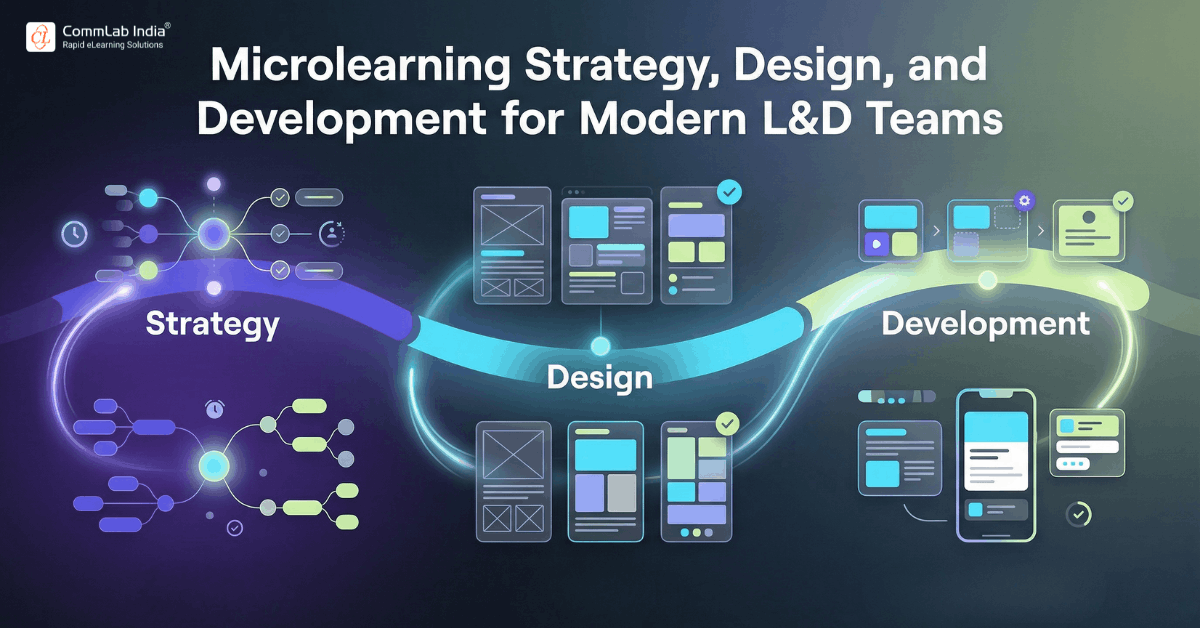
This article explores that full picture. It is designed to help L&D teams move beyond isolated tactics and think about microlearning as a system: how to identify the right opportunities, how to design effective experiences, how to build them efficiently, and how to implement them in a way that supports modern workplace learning.
Download Now: Microlearning — Where Does It Fit in Your Learning Strategy?
Table of Contents
- Why Microlearning Needs a Strong Strategic Foundation
- Where Microlearning Fits Within the Learning Ecosystem
- How to Identify the Right Opportunities for Microlearning
- Principles That Shape Effective Microlearning Design
- How to Structure Microlearning for Stronger Learning Impact
- Designing Assessments and Reinforcement for Retention
- Developing Microlearning Efficiently Without Compromising Quality
- Choosing the Right Formats, Tools, and Production Model
- How to Implement Microlearning Across the Learner Journey
- FAQs
Why Microlearning Needs a Strong Strategic Foundation
Microlearning often fails for a surprisingly simple reason: organizations build content fragments instead of learning solutions.
The assumption is understandable. Since microlearning is short, it appears easier to produce. Teams often believe they can take existing long-form content, trim it down, package it into smaller assets, and call it a modern learning strategy.
But short content is not the same as effective microlearning.
Without a clear strategy, microlearning tends to become:
- a collection of disconnected learning assets
- an overloaded library no one uses
- a content experiment without measurable business value
- a “nice to have” add-on instead of a performance support system
This is why many microlearning initiatives generate early enthusiasm but weak long-term impact.
The problem is rarely the format itself. The problem is that microlearning is often developed outside the context of performance, workflow, and learning architecture.
A stronger starting point is this:
Microlearning should not be designed as isolated content. It should be designed as a purposeful response to a specific learning or performance need.
That shifts the conversation immediately.
Instead of asking, “What short content can we create?” L&D teams begin asking:
- Where are learners struggling?
- What knowledge or behavior needs reinforcement?
- What moments in the workflow require support?
- What content needs to be accessible quickly and repeatedly?
That is where strategy begins.
Where Microlearning Fits Within the Learning Ecosystem
One of the most useful ways to improve microlearning decisions is to stop treating it as a standalone training category. Microlearning delivers the greatest value when it is positioned as part of a larger learning architecture rather than as an independent substitute for all other forms of training.
In practice, microlearning can play several different roles depending on where it appears in the learner journey. It can prepare employees before formal learning begins, reinforce key ideas during a broader learning experience, support transfer after training ends, or provide timely guidance at the point of need. This flexibility is one of its greatest strengths, but it also requires more thoughtful design.
When L&D teams place microlearning within the learning ecosystem, they begin to see it not as “short content” but as a strategic layer that extends learning into workflow and performance support. That is a much stronger position than using it as a simple replacement for longer courses.
How microlearning can function across the learner journey
| Role | Purpose | Typical Use |
| Pre-learning support | Build readiness and activate prior knowledge | Primers, quick orientation assets, expectation setting |
| In-learning reinforcement | Break up complexity and strengthen comprehension | Concept checks, mini scenarios, short recaps |
| Post-learning reinforcement | Improve retention and transfer | Refreshers, recall prompts, spaced practice |
| Point-of-need support | Help employees act correctly in real work moments | Job aids, quick process guidance, decision support |
This broader view is especially useful in corporate learning environments where employees do not experience learning as a single event. They move in and out of training, work, systems, collaboration, and application. Microlearning is well suited to that reality because it can be delivered in smaller, more accessible moments without losing relevance.
That said, microlearning works best when it complements other learning methods rather than trying to carry the entire burden alone. Complex skill building, deep conceptual learning, and high-risk judgment often require broader instructional experiences. Microlearning becomes most powerful when it is woven into these larger journeys with intention.
How to Identify the Right Opportunities for Microlearning
The quality of a microlearning strategy depends heavily on one early decision: whether the problem itself is suited to microlearning.
This is where discipline matters. Not every training need should be translated into short-form learning, and not every business request for “bite-sized modules” reflects a sound instructional choice. Some topics are ideal for focused learning bursts, while others need more depth, practice, and structured progression.
A strong opportunity for microlearning usually has a few defining characteristics. The need is narrow enough to be addressed in one focused unit. The learner benefit is immediate and practical. The content can be used before, during, or after work without requiring a lengthy build-up. Most importantly, the desired outcome is specific enough that success can be clearly recognized.
Microlearning tends to be a strong fit when learners need to:
- grasp one important idea without unnecessary surrounding content
- complete one task accurately
- avoid one common mistake
- reinforce one previously learned concept
- respond correctly in a recurring work situation
- recall a key process step, rule, or principle at the right moment
It tends to be a weaker fit when learners need to:
- build broad conceptual understanding across multiple topics
- develop a complex capability that requires layered practice
- navigate ambiguous or high-stakes judgment without prior grounding
- engage in sustained reflection, discussion, or collaborative problem-solving
The most effective L&D teams do not begin with content formats. They begin by locating the actual friction points in performance. These often appear in onboarding, product adoption, process changes, sales enablement, compliance reinforcement, manager support, customer interactions, and software training. In these areas, employees often benefit from focused, timely support rather than lengthy instruction.
Questions that help identify a genuine microlearning opportunity
Before deciding to build a microlearning asset, ask:
- What exact performance issue are we trying to improve?
- What should the learner be able to do differently afterward?
- Can this outcome be meaningfully addressed in one focused intervention?
- Will learners need this support once, occasionally, or repeatedly?
- Where in the learner journey would this create the most value?
These questions are simple, but they are powerful. They force the design conversation back to relevance and usefulness, which is exactly where microlearning needs to begin.
Principles That Shape Effective Microlearning Design
Once the right opportunity has been identified, the next challenge is design. This is where many teams underestimate the work involved. Because microlearning is short, it is often assumed to be simpler to design. In reality, brevity makes instructional decisions more demanding, not less.
A short learning experience leaves less room for drift, overload, or weak structure. Every sentence, interaction, visual, and example has to earn its place. Effective microlearning depends on disciplined design choices that keep the learning experience focused and usable.
The most important principles of strong microlearning design
1. Start with one clear outcome
Every microlearning asset should be built around one specific learner outcome. That outcome may involve understanding a concept, following a process, making a decision, or recalling a critical step. Once multiple unrelated outcomes begin to appear, the design loses sharpness and the learner experience becomes diluted.
2. Keep the scope intentionally narrow
One of the most common design mistakes is trying to squeeze too much into a short format. Good microlearning is selective. It concentrates on what the learner truly needs now, rather than trying to include every related detail for completeness.
3. Design for action, not just exposure
Employees should not leave a microlearning asset with vague awareness. They should leave with something usable, whether that is a clear next step, a decision cue, a better response pattern, or a practical understanding they can apply immediately.
4. Match the format to the learning need
Video is only one option, and often not the best one. Some learning needs are better served by scenarios, quick simulations, guided walkthroughs, interactive cards, short assessments, or visual job aids. The right design begins with the need, not the medium.
5. Reduce friction in use and reuse
Strong microlearning is often revisited. That means it should be easy to access, easy to understand quickly, and easy to return to later when the learner needs reinforcement or support.
Design priorities at a glance
| Design Principle | Why It Matters |
| One clear outcome | Keeps the experience focused and usable |
| Narrow instructional scope | Prevents overload and preserves clarity |
| Action-oriented design | Improves application and performance relevance |
| Format matched to need | Strengthens learner experience and effectiveness |
| Easy retrieval and reuse | Supports reinforcement and point-of-need value |
When these principles guide the work, microlearning feels purposeful rather than compressed. That distinction is critical because learners can immediately sense the difference between a well-designed short experience and content that has merely been cut down.
How to Structure Microlearning for Stronger Learning Impact
Even when microlearning is brief, it still needs instructional structure. One reason short learning sometimes feels superficial is that it is treated like a content snippet rather than a designed experience. But meaningful learning does not come from brevity alone. It comes from how the experience is shaped.
A strong microlearning asset usually begins by establishing relevance quickly. This can be done through a realistic situation, a role-based challenge, a common mistake, or a practical question that makes the learner immediately recognize why the content matters. That first moment is important because it creates attention through relevance, not gimmicks.
Once relevance is established, the learning needs to move directly into the core idea or action. The content should remain tightly aligned to the objective, avoiding tangents and explanatory excess. The learner should never have to work hard to figure out what this asset is trying to help them do.
From there, an interaction point often strengthens the learning considerably. This does not have to be elaborate. It may be a quick decision, a question, a sequencing task, or a short scenario that prompts the learner to think rather than passively consume. Even a small amount of active engagement can improve retention and make the experience feel more practical.
Finally, the learning should end with reinforcement. A brief summary, a practical reminder, or a take-this-to-work prompt helps consolidate the value of the experience and increases the chance that the learner will remember and apply it later.
A useful structure for many microlearning assets
- Trigger relevance
Open with a realistic need, challenge, or decision point so the learner immediately understands why the content matters. - Deliver focused learning
Explain only what is necessary to help the learner understand or act correctly. - Prompt interaction
Include a brief opportunity to think, choose, recall, or apply. - Reinforce the key takeaway
Close with a short reminder, summary, or practical application cue.
This structure gives even very short learning experiences a sense of momentum and purpose. It also helps designers avoid the trap of creating passive content that is easy to consume but easy to forget.

Where Does Microlearning Fit in Your Learning Strategy?
Uncover the Secrets to Crafting High-performing Micro Assets!
- What Microlearning is and What it is NOT?
- Types of Microlearning Assets
- Tips and Tools for Rapid Microlearning Development
- And More!
Designing Assessments and Reinforcement for Retention
Assessment in microlearning should not be limited to formal testing. In fact, one of the most effective aspects of microlearning is that assessment can be woven into the learning experience in subtle but meaningful ways.
This matters because short learning works best when it requires some form of mental retrieval or decision-making. When learners are asked to recall information, recognize the right choice, or respond to a realistic scenario, the learning becomes more durable. The goal is not to “test” in a traditional sense, but to strengthen memory and application through active engagement.
Microlearning assessments can take many practical forms:
- quick scenario decisions
- short recall questions
- identify-the-error activities
- sequencing steps
- confidence checks
- choose-the-best-response prompts
These brief interactions are especially valuable because they support both learning and measurement. They help the learner think more actively, and they also give L&D teams better visibility into whether the content is landing effectively.
Reinforcement deserves equal attention. One of microlearning’s greatest strengths is its ability to support learning after the initial training event. A larger course may create awareness or initial understanding, but reinforcement is often what determines whether employees remember and apply what they learned. Microlearning is well suited to this because it can revisit critical ideas in short, targeted intervals.
Ways to use microlearning for reinforcement
- resurface key concepts after formal training
- revisit high-risk process errors
- refresh policy updates or decision rules
- support recall during onboarding or system adoption
- provide spaced practice over time
When reinforcement is planned intentionally rather than added as an afterthought, microlearning becomes far more valuable. It shifts from being a delivery format to becoming a retention and performance mechanism.
Developing Microlearning Efficiently Without Compromising Quality
Microlearning is often expected to move faster through production because the content itself is shorter. In one sense, that is true. Smaller learning units can be easier to scope, quicker to update, and more efficient to deploy. But these efficiencies appear only when development is approached systematically.
If every microlearning asset is built as a one-off project with its own unique workflow, the speed advantage quickly disappears. Teams end up spending too much time on repetitive design decisions, fragmented review cycles, and avoidable rework.
The key is to develop microlearning through a repeatable system rather than an ad hoc production model.
A strong development workflow begins with a clear understanding of the learner need and performance context. From there, the scope is tightened to one clear objective, the most suitable format is chosen, and the content is mapped using a lightweight blueprint that defines the flow, interaction, and reinforcement element. This keeps the development process lean without making it careless.
The real goal is not just to produce content quickly. It is to produce focused, useful learning consistently.
A practical microlearning development workflow
- Clarify the need
Identify the business problem, learner context, and specific performance outcome. - Tighten the scope
Reduce the request to one clear, meaningful learning objective. - Map the experience
Outline the flow, interaction, visual approach, and reinforcement point before production begins. - Build with modular logic
Create assets that can be reused, updated, localized, or sequenced efficiently. - Review for usefulness
Evaluate whether the asset helps the learner act better, not simply whether it looks polished.
Development questions worth asking
- Does this asset solve a real learner problem?
- Is the objective clear enough to guide all design decisions?
- Can the asset be maintained and updated easily?
- Will learners know when and why to use it?
- Does it support action, recall, or performance improvement?
When development is guided by these questions, microlearning becomes easier to scale without losing instructional integrity.
Choosing the Right Formats, Tools, and Production Model
Organizations often spend too much time trying to choose the “best” microlearning tool and too little time deciding what kind of learning experience they actually need to create.
That is an important mistake to avoid. Tools matter, but only after the instructional decision has been made. The format should always be chosen based on learner need, context, and intended use, not because a particular tool is available or popular.
A quick product explainer may work well as a short video. A decision-based compliance issue may be better suited to a scenario. A software task may require a simulation or a guided walkthrough. A frequent workflow reminder may be most effective as a visual reference or interactive checklist. The format should emerge from the function.
Common microlearning formats and their strengths
- Short explainer modules for focused concept clarity
- Scenario-based interactions for decision-making practice
- Software simulations for systems and process training
- Short videos for demonstrations or visual walkthroughs
- Interactive cards or click-throughs for concise knowledge support
- Job aids and visual guides for point-of-need reference
- Quick quizzes or checks for reinforcement and recall
Once the format is clear, the tool conversation becomes more productive. L&D teams should evaluate tools not by the sheer number of features they offer, but by how well they support efficient production, mobile responsiveness, collaboration, easy updating, and deployment within the existing learning ecosystem.
AI can also strengthen parts of the workflow, particularly in scripting, content repurposing, draft quiz generation, ideation, and creating reinforcement variations. Still, AI should be treated as a support mechanism rather than a substitute for instructional thinking. It can increase speed, but it can also scale weak design if teams rely on it without judgment.
The real strategic question is not whether a tool is advanced. It is whether the production model helps the team create the right learning experiences efficiently and consistently.
Implementing Microlearning Across the Learner Journey
A well-designed microlearning asset still fails if it appears in the wrong place, at the wrong time, or without a clear connection to learner need. This is why implementation deserves as much strategic attention as design and development.
Implementation is often misunderstood as a launch step, but it is really a delivery design decision. L&D teams need to think carefully about when learners will encounter the content, how they will access it, and what makes it relevant in that specific moment.
A useful shift in perspective helps here. Instead of asking when an asset should be released, ask when it will create the most value. That question immediately moves the focus from publishing to performance support.
Microlearning can be deployed effectively before formal learning to prepare employees and reduce ramp-up time. It can appear during training to reinforce key concepts and break up complexity. It can be used after a course or program to sustain recall and improve transfer. And it can be embedded directly into workflow environments where employees need support in the moment of action.
Practical implementation priorities
- Map microlearning to clear points in the learner journey
- Align deployment with real work cycles and business priorities
- Make discovery and access as simple as possible
- Connect assets to the lms, lxp, or workflow tools employees already use
- Track patterns of use, relevance, and performance value
Implementation works best when microlearning is introduced as part of a learning rhythm. Employees should feel that these assets appear when they are useful, not when the system happens to publish them.
FAQs
1. What is a microlearning strategy?
A. A microlearning strategy is a structured approach to identifying where short, focused learning experiences can best support learner needs, business goals, and workplace performance. It helps organizations decide what to create, how to design it, where to deploy it, and how to measure its effectiveness.
2. How do you design effective microlearning?
A. Effective microlearning begins with one clear learning objective and a tightly defined learner need. It should be brief, relevant, easy to use, and designed to support action, recall, or application rather than simple content exposure.
3. What are the best practices for microlearning?
A. Strong microlearning practice includes narrowing the scope, designing around one outcome, matching the format to the need, embedding interaction or retrieval, planning reinforcement, and ensuring the asset is easy to access and maintain.
4. How should microlearning be implemented in corporate training?
A. Microlearning should be implemented across the learner journey, before, during, and after formal training, as well as at the point of need. It works best when it is tied to workflow moments, integrated into existing systems, and designed to support real job performance.
5. What tools can be used to develop microlearning?
A. Microlearning can be developed using authoring tools, video tools, rapid eLearning platforms, design systems, and AI-supported workflows. The right tool depends on the type of learning experience needed and how efficiently the team can build, update, and deploy it.
6. Can AI improve microlearning design and development?
A. AI can improve efficiency in areas such as scripting, content repurposing, ideation, and quiz generation. However, it should support instructional design rather than replace it, because design quality still depends on sound judgment about learner needs and performance context.
7. How do you measure whether microlearning is effective?
A. Microlearning is effective when learners use it, return to it, apply it, and perform better because of it. Useful measurement includes not only completion data, but also repeat usage, relevance, reinforcement value, and where possible, performance impact.
Conclusion
Microlearning is easy to underestimate because it appears simple on the surface. In reality, it demands a high level of instructional clarity and operational discipline.
Done well, it allows L&D teams to create learning that is more focused, more accessible, and more closely aligned with the real moments when employees need support. It can strengthen onboarding, accelerate adoption, improve reinforcement, and bring training closer to the workflow. But none of that happens automatically. It happens only when microlearning is guided by strong decisions about strategy, design, development, and implementation.
That is why the real opportunity is not just to produce shorter learning. It is to build a system that delivers the right learning experience, in the right format, at the right moment, for the right performance need.
When organizations make that shift, microlearning stops being a content trend and starts becoming a practical, scalable capability for modern workplace learning.