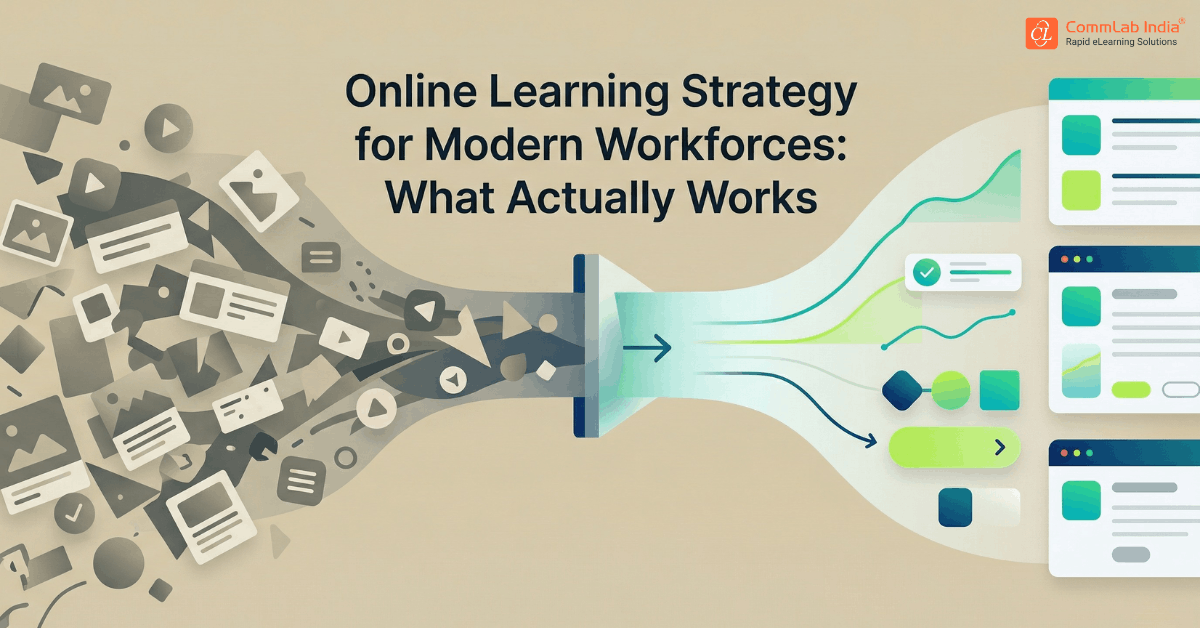
There is a quiet paradox unfolding in corporate learning. Organizations have never had more access to training content, platforms, and digital tools. Learning libraries are expanding, courses are being launched at speed, and employees can access training anytime, anywhere.
And yet, a familiar question continues to surface across leadership conversations: Why isn’t learning translating into performance at the pace we expect?
The answer lies not in the quantity of content, but in the absence of a cohesive system that connects learning to real work.
Download Now: Virtual Instructor-led Training
Too often, online learning grows organically. New courses are added to solve immediate needs, platforms are introduced to scale delivery, and content is created with good intent. But over time, this results in fragmented experiences where learning exists, but impact is inconsistent.
What’s missing is not effort. It is structure.
A well-defined online learning strategy shifts the focus from delivering courses to building capabilities. It ensures that learning is not just accessible, but purposeful, contextual, and continuously reinforced.
In this article, we move beyond surface-level approaches to explore how organizations can design online learning systems that are scalable, engaging, and deeply aligned with business performance.
Table of Contents
- What an Online Learning Strategy Really Means
- The Shift from Courses to Capability Building
- Where Most Online Learning Falls Short
- The Core Pillars of an Effective Online Learning Strategy
- Designing Learning That Drives Engagement
- Building for Scale: Cost, Speed, and Efficiency
- Technology as an Enabler, Not the Strategy
- Choosing the Right Learning Partner
- Measuring What Actually Matters
- FAQs
What an Online Learning Strategy Really Means
An online learning strategy is a deliberate and structured approach to designing, delivering, and evolving digital learning in alignment with organizational goals.
It goes far beyond selecting tools or producing courses. Instead, it brings together content, experience design, technology, and measurement into a unified system that supports continuous capability development.
At its core, it focuses on:
- Connecting learning initiatives to measurable business outcomes
- Structuring content so it is easy to access, absorb, and apply
- Designing experiences that encourage active participation and decision-making
- Ensuring learning extends beyond initial exposure through reinforcement
Online learning becomes effective only when it is treated as an integrated system rather than a collection of standalone interventions.
The Shift from Courses to Capability Building
For many organizations, learning has traditionally been designed as a series of events. Employees attend a course, complete a module, and move on. While this model ensures content delivery, it rarely ensures capability development. Modern learning strategies recognize that performance is built over time through repeated exposure, practice, and application.
This has led to a fundamental shift.
Instead of asking, “What content should we deliver?”
High-performing organizations now ask, “What capabilities do we need to build, and how do we enable them over time?”
This shift transforms the entire learning approach:
- Learning becomes continuous rather than episodic
- Content becomes modular rather than monolithic
- Success is measured by application rather than completion
When learning is designed as a journey rather than an event, it begins to influence behavior in meaningful ways.
Where Most Online Learning Falls Short
Despite significant investments, many online learning initiatives struggle to deliver consistent results. The challenge often lies in how learning is structured and experienced.
Content Without Structure
When large volumes of content are delivered without clear organization, learners find it difficult to navigate and prioritize what matters. This leads to cognitive overload and disengagement.
Lack of Contextual Relevance
Training that is too generic fails to resonate with learners. Without clear connections to real-world tasks, knowledge remains theoretical and difficult to apply.
One-Time Exposure
Learning that is not reinforced fades quickly. Without opportunities to revisit and apply concepts, retention drops and impact diminishes.
Superficial Engagement
Interactive elements are sometimes added for visual appeal rather than learning value. When interaction lacks purpose, it does little to enhance understanding or decision-making.
Fragmented Ecosystems
Learning platforms, content strategies, and business objectives often operate independently. This disconnect prevents learning from contributing meaningfully to organizational outcomes.
The effectiveness of online learning is not determined by how much content is delivered, but by how well it is structured, contextualized, and reinforced.
The Core Pillars of an Effective Online Learning Strategy
A scalable online learning strategy is built on a set of interconnected elements that work together to create meaningful and measurable impact.
Strategic Alignment
Learning must begin with clarity on what the organization is trying to achieve. This involves mapping training initiatives directly to business goals and identifying the capabilities that drive performance.
Rather than attempting to train everything, effective strategies focus on what matters most.
Structured Content Architecture
Content should be designed in a way that reflects how people learn and work.
This means moving away from long, linear courses toward modular structures that allow learners to access information in smaller, focused segments. Such an approach improves both usability and retention.
Experience Design
Learning experiences must be intentionally designed to engage the learner’s thinking process.
This involves integrating:
- Real-world scenarios
- Decision-making opportunities
- Contextual challenges
The goal is not just to inform, but to immerse learners in situations that mirror actual work environments.
Continuous Reinforcement
Learning does not end when a course is completed.
Reinforcement mechanisms such as microlearning, spaced repetition, and on-the-job application ensure that knowledge is retained and translated into action over time.
Measurement and Optimization
To understand whether learning is effective, organizations must look beyond surface-level metrics.
Tracking behavioral change, performance improvement, and real-world outcomes provides a clearer picture of impact. These insights can then be used to refine and improve the learning strategy continuously.
Designing Learning That Drives Engagement
Engagement is often misunderstood as a function of design aesthetics. In reality, it is driven by relevance and usefulness.
Context Creates Connection
When learning reflects real workplace challenges, it immediately becomes more meaningful. Learners are more likely to engage when they can see how the content applies to their roles.
Focus Enhances Retention
Short, well-defined learning units allow learners to absorb information without feeling overwhelmed. This approach aligns better with modern work environments where time is limited.
Interaction Should Drive Thinking
Effective interactivity goes beyond clicking and navigation. It should encourage learners to analyze situations, make decisions, and reflect on outcomes.
Emotional Relevance Strengthens Memory
Stories, scenarios, and relatable challenges create emotional connections, making learning more memorable and impactful.
Engagement is not something added to learning. It is a natural outcome of well-designed, relevant experiences.
Building for Scale: Cost, Speed, and Efficiency
One of the most significant advantages of online learning is its ability to scale across large and distributed workforces. However, scalability requires intentional design.
- Cost Efficiency: By reducing dependency on physical infrastructure and instructor-led sessions, online learning lowers operational costs while maintaining consistency in delivery.
- Speed of Deployment: Digital formats enable rapid updates and global rollouts, ensuring that training keeps pace with organizational changes.
- Content Reusability: Existing materials can be transformed into multiple formats, extending their value and reducing development effort. This also allows organizations to respond quickly to new training needs.
- Standardization: Online learning ensures that every learner receives the same quality of training, regardless of location. This consistency is critical for maintaining standards across the organization.
Scalability is achieved not just by reaching more learners, but by delivering consistent, adaptable, and efficient learning experiences.
Technology as an Enabler, Not the Strategy
Technology plays a crucial role in enabling online learning, but it should not be mistaken for the strategy itself.
What Technology Enables
Learning platforms facilitate content delivery, track learner progress, and provide data that supports decision-making.
What Technology Cannot Replace
No platform can compensate for poorly structured content or a lack of strategic alignment. Without a clear approach, even the most advanced tools will fall short.
Selecting the Right Platform
Organizations should evaluate platforms based on usability, integration capabilities, scalability, and analytics features. The goal is to support the learning strategy, not define it.
Technology amplifies the effectiveness of a strong strategy, but it cannot create one.
Choosing the Right Learning Partner
For organizations looking to scale efficiently, external partners can play a valuable role.
Expertise and Experience: A capable partner brings both domain knowledge and instructional design expertise, ensuring that learning solutions are relevant and effective.
Process Alignment: Alignment in workflows and timelines ensures smoother collaboration and faster execution.
Technology Capabilities: The ability to work across tools and platforms allows partners to integrate seamlessly into existing ecosystems.
Communication and Collaboration: Clear and consistent communication is essential for maintaining quality and achieving desired outcomes.
Measuring What Actually Matters
Measuring learning effectiveness requires moving beyond surface-level indicators.
- Beyond Completion Rates: While completion metrics provide basic insights, they do not reflect whether learning has translated into improved performance.
- Focus on Performance: Organizations should track how learning influences behavior, decision-making, and productivity.
- Use Data to Improve: Analyzing engagement patterns, assessment results, and application outcomes helps refine the learning strategy over time.
The true value of online learning lies in its ability to drive measurable change, not just participation.
FAQs
1. What is an online learning strategy?
A. An online learning strategy is a structured approach to designing and delivering digital training aligned with business goals. It focuses on scalability, engagement, and measurable performance outcomes rather than just content creation.
2. How can organizations improve engagement in online learning?
A. Engagement improves when learning is relevant, interactive, and contextual. Using real-world scenarios, short modules, and decision-based activities helps learners stay involved and apply knowledge effectively.
3. Why is online learning important for corporate training?
A. Online learning enables scalable, cost-effective training across distributed teams. It supports continuous learning, faster updates, and consistent delivery, making it essential for modern organizations.
4. How does online learning support compliance training?
A. Online learning ensures standardized content delivery, easy tracking, and quick updates for regulatory changes. It helps organizations maintain compliance while reducing manual effort.
5. What are the benefits of microlearning in online training?
A. Microlearning improves retention by delivering short, focused content. It supports just-in-time learning and reinforces knowledge over time, making it highly effective for busy professionals.
6. How do you measure the success of online learning?
A. Success should be measured through performance improvement, skill application, and behavioral change. Metrics like engagement, assessment scores, and business outcomes provide deeper insights.
7. What role does technology play in online learning?
A. Technology enables delivery, tracking, and scalability. However, it cannot replace a strong strategy or well-designed content. Its role is to support and enhance the learning experience.
Conclusion
Online learning has evolved far beyond content delivery. It now plays a central role in how organizations build capability, adapt to change, and drive performance.
The difference between learning that exists and learning that works lies in how it is designed.
Organizations that take a structured, strategic approach are able to:
- Align learning with real business needs
- Create engaging and relevant experiences
- Scale training efficiently across teams
- Continuously improve through data and feedback
When online learning is treated as a system rather than a series of courses, it becomes a powerful driver of growth, performance, and long-term organizational success.

![All About Instructional Design Strategies [Infographic]](https://www.commlabindia.com/hubfs/Imported_Blog_Media/instructional-design-strategy-for-online-training1.jpg)