Many product training programs appear successful on the surface. Employees complete courses, certifications are issued, and dashboards show high completion rates. However, when these same employees step into real customer interactions or internal decision-making scenarios, the gaps become visible almost immediately.
The issue is rarely the lack of content. In most cases, organizations already have abundant product information, detailed documentation, and well-designed presentations. What is missing is a cohesive strategy that connects knowledge to performance in a meaningful and repeatable way.
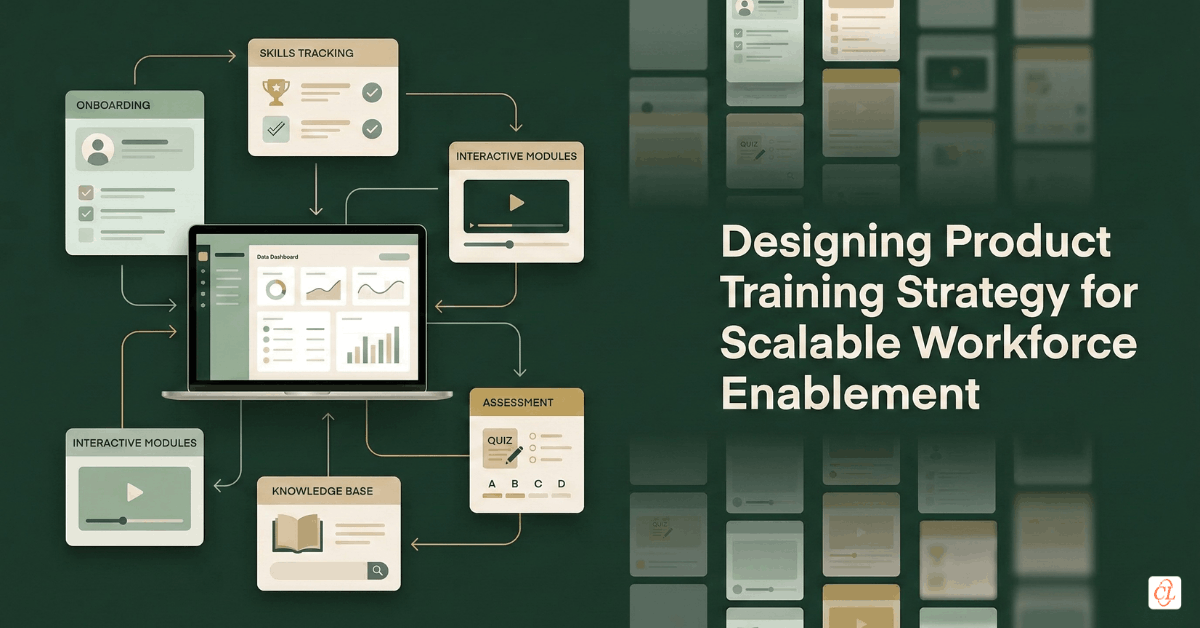
A well-defined product training strategy does far more than deliver information. It creates a structured learning ecosystem that aligns product understanding with real-world application, supports different roles across the organization, and evolves continuously as products and markets change.
In this article, you will explore how to design a product training strategy that transforms fragmented training efforts into a scalable system that drives workforce enablement and measurable business impact.
Download eBook: An L&D Manager’s Implementation Guide
Table of Contents
- What Is a Product Training Strategy
- Why Most Product Training Programs Fall Short
- Moving from Content Delivery to Capability Building
- Designing a Product Training Curriculum That Scales
- Making Product Knowledge Training Truly Relevant
- Digital Learning Strategies That Strengthen Product Training
- Aligning Product Training with Business and Sales Outcomes
- Building a Continuous Product Learning Ecosystem
- FAQs
What Is a Product Training Strategy
A product training strategy is often misunderstood as a collection of courses or a set of training materials delivered during onboarding or product launches. In reality, it is a structured system that ensures employees not only understand the product but can also apply that knowledge effectively in their specific roles.
It defines:
- what employees need to know
- how that knowledge is organized
- how it is delivered
- how it is reinforced and measured
At a deeper level, a product training strategy integrates product knowledge, contextual application, and performance expectations into a unified framework. This ensures that learning is not treated as a one-time activity but as an ongoing capability that directly influences how employees perform in real-world situations.
A product training strategy is a structured approach to designing and delivering training that enables employees to understand product value, apply knowledge in real-world scenarios, and achieve measurable performance outcomes across roles.
When designed correctly, it becomes a critical enabler of both sales effectiveness and workforce capability rather than just a support function.
Why Most Product Training Programs Fall Short
Despite significant investments in training, many organizations struggle to see a direct impact on performance. This disconnect is rarely accidental and often stems from systemic design issues that limit the effectiveness of training.
Information Overload Without Prioritization
Product training frequently attempts to cover every possible detail, from features and specifications to technical workflows and edge cases. While this approach may seem thorough, it often overwhelms learners and makes it difficult for them to identify what truly matters in their day-to-day roles.
As a result, learners may retain fragments of information but lack the clarity needed to apply knowledge effectively.
Lack of Role-Specific Context
Different roles interact with products in fundamentally different ways. A sales representative needs to focus on value positioning and differentiation, whereas a support specialist requires a deeper understanding of workflows and troubleshooting.
When training fails to reflect these distinctions, it becomes generic and less impactful for everyone involved.
Limited Focus on Real-World Application
Training programs that rely heavily on passive content consumption rarely prepare learners for real-world scenarios. Without opportunities to practice decision-making or engage with realistic situations, knowledge remains theoretical and is quickly forgotten.
Fragmented Learning Experiences
In many organizations, product training content is scattered across multiple formats, platforms, and resources. This fragmentation creates disjointed learning journeys, making it difficult for learners to navigate and build a coherent understanding of the product.
One-Size-Fits-All Design and No Reinforcement
The same training is delivered to sales teams, customer support, and partners, despite their different roles and needs. Knowledge is delivered once and rarely revisited, leading to rapid forgetting.
Weak Alignment with Business Goals
Training exists in isolation and is not linked to measurable outcomes like deal velocity or customer satisfaction.
Product training does not fail because of insufficient content. It fails because it is not designed as a performance-driven system.
Moving from Content Delivery to Capability Building
To create meaningful impact, organizations must shift their focus from delivering content to building capabilities. This requires rethinking how training is structured, delivered, and evaluated.
Instead of asking what information needs to be covered, the more important question becomes what employees should be able to do after completing the training.
Shifting from Features to Use Cases
While product features are important, they only become valuable when learners understand how those features solve specific problems. Training should therefore emphasize use cases, scenarios, and outcomes rather than isolated feature descriptions.
Transitioning from Courses to Learning Journeys
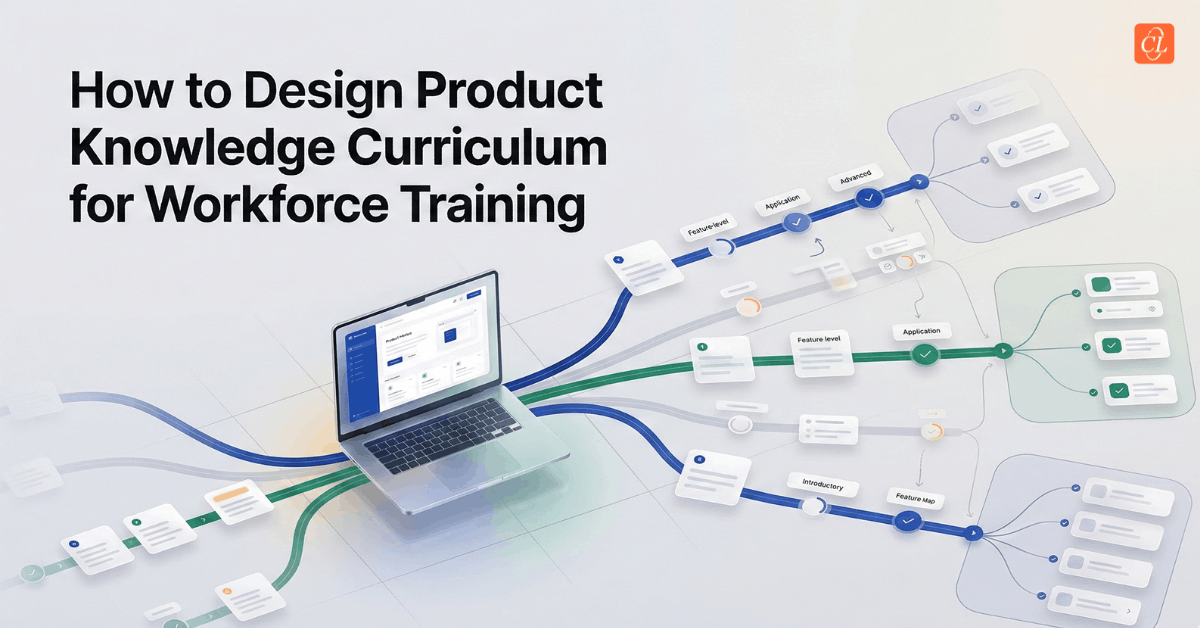
Single, standalone courses are rarely sufficient to build expertise. A structured learning journey that progresses from foundational knowledge to advanced application provides a more effective pathway for skill development.
Measuring Competence Instead of Completion
Completion rates offer limited insight into actual learning effectiveness. Organizations should instead focus on indicators such as decision-making ability, confidence in applying knowledge, and observable performance improvements.
A strong product training strategy prioritizes capability development, ensuring that learning translates into action and measurable outcomes.
Designing a Product Training Curriculum That Scales
A scalable product training curriculum must balance structure with flexibility. It should provide a clear framework while allowing for updates, customization, and expansion as products evolve.
Establish Layered Learning Architecture
An effective curriculum is built across multiple layers, each serving a distinct purpose within the learning journey.
- Foundation Layer focuses on core concepts, terminology, and the overall value proposition of the product, ensuring that all learners start with a consistent understanding.
- Role-Based Layer tailors content to specific job functions, enabling learners to focus on the aspects of the product most relevant to their responsibilities.
- Application Layer introduces scenario-based learning that allows learners to practice applying knowledge in realistic situations.
- Reinforcement Layer ensures that learning is sustained over time through refreshers, updates, and performance support resources.
Break Content into Modular Learning Units
Long, linear courses can be difficult to navigate and retain. By organizing content into shorter, focused modules, organizations make it easier for learners to access information when needed and revisit specific topics without unnecessary repetition.
This modular approach also supports faster updates, as individual units can be revised without overhauling the entire curriculum.
Create Clear Progression Pathways
Learning should follow a logical progression that gradually builds complexity. Starting with awareness and understanding, learners should move toward application and eventually mastery.
This progression ensures that learners are not overwhelmed early in the process while still providing opportunities for deeper learning as they advance.
Making Product Knowledge Training Truly Relevant
Relevance is one of the most critical factors in determining whether training leads to meaningful outcomes. When learners can clearly see how training applies to their roles, engagement and retention improve significantly.
Integrate Real-World Scenarios: Training should reflect the situations employees encounter in their daily work. For example, sales training can include scenarios that simulate customer conversations, while support training can focus on troubleshooting workflows and issue resolution.
These scenarios help learners bridge the gap between theory and practice.
Emphasize Decision-Making Over Memorization: Rather than testing learners on their ability to recall information, training should challenge them to make decisions based on their understanding of the product.
This approach not only improves retention but also builds confidence in applying knowledge in dynamic situations.
Personalize Learning Experiences: Learners come with different levels of experience, knowledge, and responsibilities. By tailoring training to these differences, organizations can ensure that content remains relevant and engaging for each audience segment.
Relevance is achieved when learners recognize a direct connection between training content and their everyday responsibilities.
Digital Learning Strategies That Strengthen Product Training
Digital learning offers significant advantages in terms of scalability and accessibility, but its effectiveness depends on how it is implemented.
Use Microlearning for Continuous Updates
Given the pace at which products evolve, it is essential to provide ongoing updates in a format that is easy to consume. Microlearning enables organizations to deliver concise, focused content that keeps employees informed without overwhelming them.
Apply Scenario-Based Learning for Skill Development
Interactive scenarios allow learners to practice applying their knowledge in a controlled environment. This is particularly valuable for roles that require decision-making, such as sales and customer support.
Combine Learning Formats for Better Outcomes
A blended approach that combines self-paced learning with live interactions can provide both flexibility and depth. Learners can absorb foundational knowledge independently and then apply it through discussions, workshops, or guided practice sessions.
Enable Learning in the Flow of Work
Providing access to on-demand resources, searchable knowledge bases, and quick-reference materials ensures that learning is available when it is needed most.
Digital strategies are most effective when they support accessibility, reinforce application, and adapt to changing learning needs.
Aligning Product Training with Business and Sales Outcomes
For product training to deliver real value, it must be closely aligned with organizational goals and performance metrics.
- Strengthening Sales Effectiveness: Sales teams need to move beyond product knowledge and focus on communicating value. Training should therefore emphasize positioning, differentiation, and the ability to handle objections effectively.
- Enhancing Customer Experience: Support teams play a critical role in shaping customer perceptions. Training that equips them with the skills to resolve issues efficiently and communicate clearly can significantly improve customer satisfaction.
- Measuring What Truly Matters: Organizations should track metrics that reflect real-world impact, such as improvements in sales performance, customer satisfaction, and the ability of employees to apply knowledge effectively in their roles.
The true measure of product training lies in its ability to influence performance outcomes rather than completion statistics.
Building a Continuous Product Learning Ecosystem
Product training should not be treated as a one-time initiative. Instead, it should function as an evolving ecosystem that adapts to changes in products, markets, and organizational needs.
Establish Feedback Loops: Regular feedback from employees, customers, and performance data provides valuable insights into what is working and what needs improvement. This information should be used to refine training continuously.
Update Learning Content Dynamically: As products evolve, training content must be updated accordingly. A dynamic approach ensures that employees always have access to the most current and relevant information.
Encourage Self-Directed Learning: Providing learners with the tools and resources to explore content independently fosters a culture of continuous learning and adaptability.
A sustainable product training strategy is one that evolves continuously, integrates feedback, and supports ongoing learning.
FAQ
1. What is a product training strategy?
A. A product training strategy is a structured framework that helps organizations design and deliver training programs enabling employees to understand product value, apply knowledge in real scenarios, and improve performance across roles.
2. How do you create a product training strategy?
A. Creating a product training strategy involves defining clear objectives, segmenting learners by role, designing a structured curriculum, incorporating real-world scenarios, and aligning training outcomes with measurable business goals.
3. Why is product knowledge training important?
A. Product knowledge training equips employees with the understanding needed to communicate product value effectively, handle customer interactions confidently, and perform their roles with greater accuracy and efficiency.
4. What are the best methods for product training?
A. Effective methods include microlearning for quick updates, scenario-based learning for application, blended learning for flexibility, and role-based training to ensure relevance for different audiences.
5. How can product training be made more engaging?
A. Product training becomes more engaging when it incorporates real-world scenarios, interactive elements, personalized learning paths, and opportunities for learners to actively apply their knowledge.
6. How do you measure product training effectiveness?
A. Effectiveness can be measured through performance indicators such as sales outcomes, customer satisfaction, knowledge application, and the ability of employees to make informed decisions in real-world situations.
7. What is a product training curriculum?
A. A product training curriculum is a structured framework that organizes training into logical learning paths, covering foundational knowledge, role-specific content, application-based learning, and ongoing reinforcement.
Conclusion
A product training strategy is not built through more content. It is built through better structure.
When training is designed as a system, aligned with roles, and focused on real-world application, it moves beyond knowledge delivery and becomes a driver of performance.
Organizations that rethink product training this way do not just train employees. They enable them to perform with clarity, confidence, and impact.