Rapid eLearning enables speed and scalability, but many organizations reach a point where internal teams alone cannot meet growing demands.
Courses need to be developed faster. Updates become more frequent. Training expands across regions and functions. At this stage, the question is not whether to scale, but how.
This is where vendor partnerships come into play.
Download eBook Now: Rapid eLearning Authoring Tools
However, selecting a rapid eLearning vendor is not just about outsourcing work. It is about choosing a partner who can align with your goals, adapt to your processes, and deliver consistent quality at scale.
In this article, you will understand how to evaluate rapid eLearning vendors, what services to expect, and how to build partnerships that support long-term training success.
Why Vendor Selection Matters in Rapid eLearning
Rapid eLearning depends on consistency, speed, and scalability. When these elements are not managed effectively, development slows down and quality becomes uneven.
Choosing the right vendor directly impacts:
- development timelines
- course quality
- scalability of training programs
- ability to handle large volumes of work
A strong partner can accelerate progress. The wrong one can create delays and rework.
When Organizations Should Consider External Partners
Not every organization needs external support immediately. But certain situations make vendor partnerships valuable.
Common scenarios
- high volume of courses to be developed
- tight timelines for training rollout
- need for specialized expertise
- frequent content updates
- limited internal team capacity
External partners are most valuable when demand exceeds internal capability.
What Rapid eLearning Services Typically Include
Rapid eLearning vendors offer a range of services that support the full development lifecycle.
Core services
- content analysis and structuring
- instructional design
- storyboarding
- course development
- media creation
- assessments and interactions
Extended services
- translation and localization
- legacy course conversion
- LMS integration support
- course updates and maintenance
- quality assurance
Vendors are not just developers. They support the entire training workflow.
Outsourcing vs Internal Development
Organizations often compare outsourcing with in-house development.
| Internal development | Outsourcing |
| Greater control | Faster scalability |
| Closer alignment with internal teams | Access to specialized expertise |
| Limited scalability | Reduced workload for internal teams |
The best approach is often a combination of both, where internal teams manage strategy and vendors support execution.
The Real Benefits of Partnering with Vendors
Vendor partnerships offer more than just additional capacity.
- Faster turnaround: Experienced vendors can deliver courses quickly due to established processes.
- Access to expertise: Vendors bring experience across industries, tools, and learning strategies.
- Scalability: They can handle large volumes of work without requiring organizations to expand internal teams.
- Cost efficiency: Outsourcing can reduce the need for hiring, training, and maintaining large internal teams.
- Consistency: Standardized processes help maintain quality across multiple courses.
Key Criteria for Selecting a Rapid eLearning Vendor
Choosing the right vendor requires evaluating multiple factors.
Experience and expertise
- track record in rapid eLearning
- understanding of instructional design
- familiarity with industry requirements
Process and workflow
- structured development approach
- clear timelines and deliverables
- efficient review mechanisms
Technology capabilities
- proficiency with authoring tools
- ability to handle multiple formats
- compatibility with your LMS
Quality standards
- consistency in design and development
- attention to detail
- usability and learner experience
Communication and collaboration
- responsiveness
- clarity in communication
- ability to work with internal teams
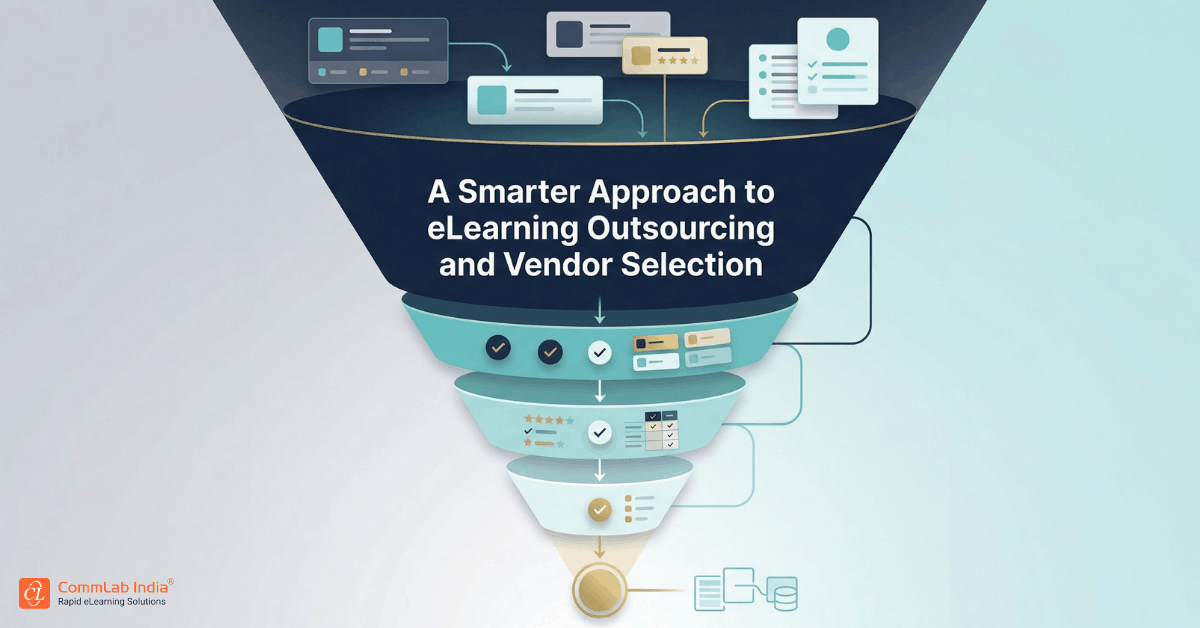
A Step-by-Step Vendor Selection Process
A structured approach improves decision-making.
Step 1: Define your requirements
- type of training needed
- volume of work
- timelines
- expected outcomes
Step 2: Shortlist potential vendors
- evaluate portfolios
- review case studies
- assess industry experience
Step 3: Conduct initial discussions
- understand their approach
- evaluate communication style
- assess alignment with your needs
Step 4: Request a sample or pilot
- test quality and turnaround time
- evaluate collaboration
Step 5: Finalize partnership
- define scope and expectations
- establish workflows
- set communication protocols
Evaluating Vendor Capabilities and Fit
Beyond technical skills, fit is critical.
What to evaluate
- ability to understand your business context
- flexibility in handling changes
- willingness to adapt to your processes
- consistency in delivery
The best vendor is not just capable, but compatible.
Common Mistakes in Vendor Selection
- Choosing based on cost alone: Low cost can lead to lower quality and higher long-term effort.
- Ignoring process alignment: Even skilled vendors can struggle if workflows do not align.
- Overlooking communication: Poor communication leads to delays and misunderstandings.
- Skipping pilot projects: Without testing, it is difficult to assess real performance.
- Building a Strong Long-Term Partnership: Successful partnerships go beyond individual projects.
Key practices
- Establish clear expectations
- Maintain regular communication
- Provide structured feedback
- Align on long-term goals
- Build trust over time
A strong partnership improves efficiency, consistency, and scalability.
FAQ
1. What is a rapid eLearning vendor?
A. A rapid eLearning vendor is a service provider that helps design, develop, and deliver eLearning courses quickly using structured processes and tools.
2. When should organizations outsource rapid eLearning?
A. When internal teams cannot meet demand, or when specialized expertise is required.
3. How do you choose the right vendor?
A. By evaluating experience, process, technology capabilities, quality standards, and communication.
4. Is outsourcing better than in-house development?
A. Not always. A hybrid approach often works best, combining internal strategy with external execution.
5. What services do rapid eLearning vendors provide?
A. They offer instructional design, development, content conversion, localization, and maintenance services.
6. Why is a pilot project important?
A. It helps assess quality, turnaround time, and collaboration before committing to a long-term partnership.
Conclusion
Rapid eLearning is built on speed and scalability, but achieving both requires the right support.
Choosing a vendor is not just about outsourcing tasks. It is about selecting a partner who can extend your capabilities, align with your goals, and deliver consistent results.
When the right partnership is in place, rapid eLearning becomes easier to scale, easier to manage, and more effective across the organization.
The focus should not be on finding a vendor, but on building a partnership that works.