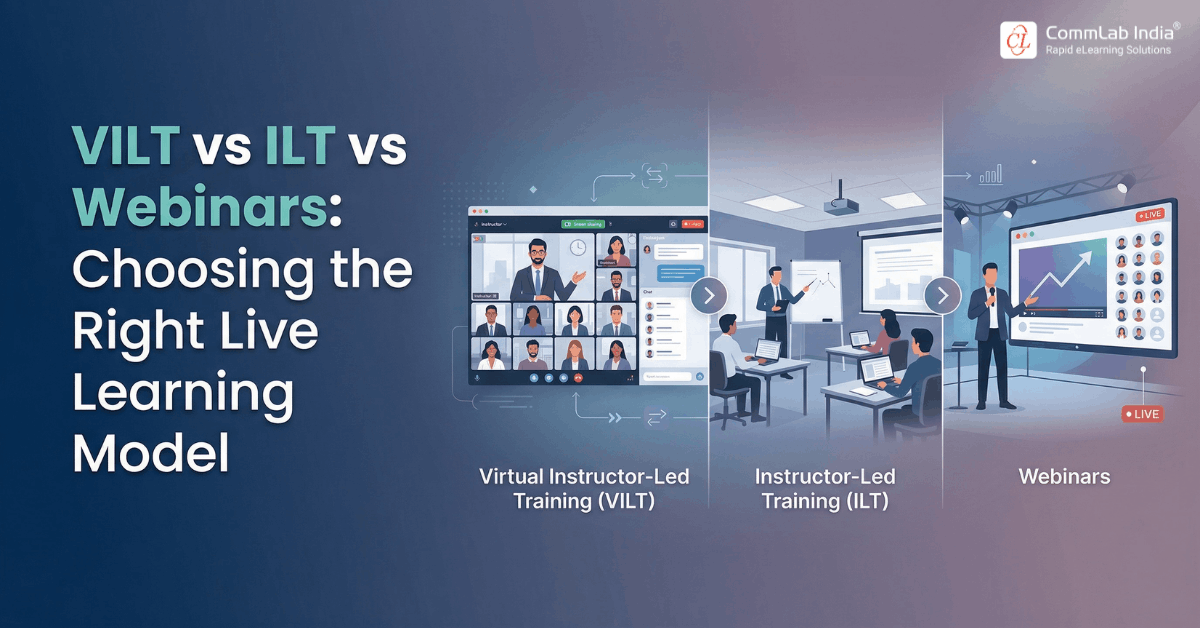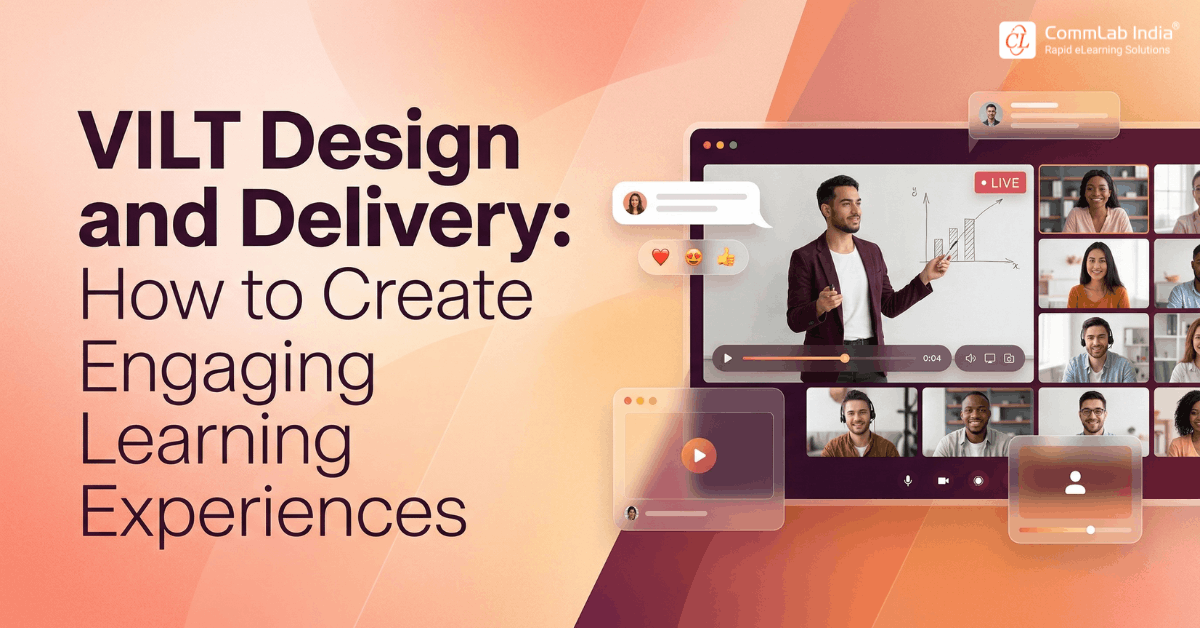
Virtual Instructor-Led Training (VILT) is live, instructor-led training delivered through virtual platforms that recreates the feel of a classroom, while letting learners join from any location and device. Unlike self-paced eLearning, VILT keeps learners in a scheduled, real-time environment where they can see the instructor, interact with peers, and get immediate feedback through tools like chat, audio/video, and collaborative whiteboards
As organizations scale VILT across regions, the challenge is no longer “Can we go virtual?” but “How do we deliver the same engaging, classroom-like experience at global scale without operational chaos?” L&D teams now need VILT programs that are not only interactive, but also operationally repeatable—so facilitators, schedules, and experiences stay consistent across time zones and languages while still giving remote learners space to collaborate and participate meaningfully.
Table Of Content
- Why is Scaling Virtual Instructor-Led Training across Regions Difficult?
- What Happens When VILT Is Not Scaled Properly?
- How Can Organizations Scale VILT Without Operational Chaos?
- What are the Best Practices for VILT Material Curation and Adaptation?
- What are the Best Practices for Engaging Remote Learners in VILT?
- What Types of Training are Best Suited for VILT?
- How Did CommLab India Turn a Complex Training Need into a Success Story?
- Elevate Your VILT from Ad-Hoc to Engineered
Why is Scaling Virtual Instructor-Led Training across Regions Difficult?
Scaling virtual instructor-led training is difficult because it combines live delivery, global coordination, and consistent learning design at the same time.
In large enterprises, training is not a one-time event. It happens in recurring waves across business units, regions, and languages. This creates continuous demand, while internal teams often struggle to keep up with coordination.
The complexity usually comes from a few recurring factors:
- Time zone differences that complicate scheduling
- Multiple languages requiring adaptation, not just translation
- Variability in facilitator delivery
- Multiple tools, vendors, and fragmented workflows
Virtual Instructor-led Training – A Beginner’s Guide
Explore the Art and Science of Replicating the Real Classroom, Virtually
- Pillars of VILT
- Instructional strategies in VILT
- Tips to engage virtual learners
- Technology platforms for VILT
What Happens When VILT Is Not Scaled Properly?
When VILT is not scaled properly, training becomes inconsistent, inefficient, and difficult to manage across regions.
In enterprise organizations, this problem doesn’t show up immediately. It builds gradually, session by session, region by region, until learning operations start breaking under pressure.
Organizations often experience fragmented learner experiences, duplicated effort, and delays in rollout. Facilitators may deliver sessions differently, and learners across regions may not receive the same quality of training.
Over time, this leads to deeper systemic issues:
1. Increased Operational Costs
Poorly scaled VILT increases costs because teams end up repeating work instead of reusing systems.
What looks like a simple training rollout often turns into multiple parallel efforts:
- The same content gets reworked for different regions
- Facilitators create their own versions of materials
- Sessions are rescheduled repeatedly due to coordination gaps
Real-world caution:
L&D teams think they are “saving time” by moving fast—but without standardization, they create hidden duplication that drives up costs over time.
2. Lower Engagement and Retention
Engagement drops when VILT sessions are not designed consistently or interactively across regions.
In some regions, sessions may be highly interactive. In others, they may feel like long webinars. This inconsistency directly impacts how learners experience the program.
Over time:
- Learners disengage from sessions
- Participation drops
- Knowledge retention weakens
Real-world caution:
When engagement varies by region, business leaders lose confidence in training effectiveness even if the content itself is strong.
3. Missed Business Outcomes Tied to Training
Poor VILT execution prevents training from translating into measurable business impact.
In large enterprises, training is rarely optional; it is tied to:
- Compliance requirements
- Sales enablement
- System rollouts
- Process changes
When VILT is inconsistent or delayed:
- Teams are not ready when needed
- Rollouts slow down
- Errors and risks increase
Real-world caution:
Corporate training failure doesn’t stay within L&D, it shows up as missed targets, compliance risks, and operational inefficiencies.
4. Facilitator Dependency and Burnout
Without standardized systems, VILT becomes overly dependent on individual facilitators.
Some facilitators may deliver excellent sessions, while others struggle. This creates uneven learning experiences and puts pressure on a few high-performing individuals.
Over time:
- Facilitators burn out
- Quality becomes unpredictable
- Scaling becomes impossible
Real-world caution:
If your VILT success depends on “who is delivering,” you don’t have a scalable system—you have a fragile one.
5. Coordination Overload for L&D Teams
Poorly structured VILT creates a coordination burden that overwhelms internal teams.
L&D teams end up managing:
- Scheduling across time zones
- Multiple vendors and platforms
- Last-minute changes and escalations
Instead of focusing on strategy, they get pulled into execution firefighting.
Real-world caution:
When coordination becomes the core job of L&D, learning strategy takes a back seat, and scaling becomes unsustainable.
Virtual Instructor-led Training – A Beginner’s Guide
Explore the Art and Science of Replicating the Real Classroom, Virtually
- Pillars of VILT
- Instructional strategies in VILT
- Tips to engage virtual learners
- Technology platforms for VILT
How Can Organizations Scale VILT Without Operational Chaos?
Organizations can scale virtual training without operational chaos by building a structured system that standardizes design, delivery, and coordination across regions.
Most organizations struggle not because they lack content, but because they lack a repeatable operating model. When training is treated as a series of sessions rather than a system, complexity multiplies quickly, especially in large enterprises with multiple regions, languages, and stakeholders.
To scale effectively, organizations need to shift from execution-heavy coordination to system-driven delivery.
1. Start by Redesigning, not Replicating Classroom Training
The first step is to recognize that classroom content does not automatically work in a virtual environment. Long sessions, dense slides, and instructor-led lectures often fail online because attention spans are different and interaction is limited. To make training effective in a virtual format, organizations need to break long classroom sessions into shorter, modular virtual sessions, replace passive explanations with guided activities that keep learners involved, and design for screen-based learning rather than relying on the dynamics of physical presence. This shift is what makes virtual training more usable, engaging, and scalable across regions.
At this stage, AI can play a practical supporting role by helping teams speed up the redesign process. Instead of starting from scratch every time, AI can accelerate the conversion of classroom content into virtual-ready formats
AI tools can:
- Summarize long content into modular learning units
- Suggest interaction points within sessions
- Generate quick drafts of facilitator guides or activities
2. Build Interaction into the Core of the Experience
Virtual training fails when learners are passive. Engagement must be designed into the session, not added as an afterthought.
Every session should create opportunities for learners to think, respond, and participate. This is what keeps attention high and learning effective.
The most reliable way to do this is to:
- Introduce interaction at regular intervals
- Use breakout discussions for application
- Encourage continuous input through chat and polls
3. Standardize What “Good Delivery” Looks Like
One of the biggest barriers to scaling is inconsistency across facilitators and regions.
Without clear standards, each facilitator interprets the content differently. This leads to variation in quality, pacing, and learner experience.
Organizations that scale successfully define:
- How each session should be delivered
- Where interactions should happen
- What outcomes should be achieved
This is typically supported through structured facilitator guides and participant materials.
4. Enable Facilitators to Deliver in a Virtual Environment
Facilitators are often experts in classroom delivery, but virtual training requires a different skill set.
Managing digital tools, maintaining energy online, and driving engagement remotely are all critical capabilities. Without proper enablement, even strong facilitators can struggle.
Organizations need to invest in:
- Training facilitators on virtual delivery techniques
- Familiarizing them with tools and platform features
- Providing clear session flow and support materials
Key takeaway: Scalable VILT as much on facilitator readiness as on content design.
5. Integrate Virtual Training into a Larger Learning Ecosystem
VILT should not carry the entire learning load.
When used in isolation, it becomes difficult to scale and sustain. Instead, it should be part of a blended approach where different formats serve different purposes.
A typical structure includes:
- Self-paced learning for foundational knowledge
- Virtual sessions for discussion and application
- Reinforcement through follow-up learning assets
6. Centralize Coordination to Remove Operational Bottlenecks
In large enterprises, coordination is often the biggest challenge.
Scheduling across time zones, managing multiple stakeholders, and tracking delivery can quickly overwhelm internal teams. When coordination is decentralized, inefficiencies multiply.
To avoid this, organizations need centralized systems that:
- Manage scheduling and communication
- Track sessions and participation
- Ensure consistency across regions
This allows L&D teams to focus on strategy instead of operational firefighting.
What are the Best Practices for VILT Material Curation and Adaptation?
Effective VILT content focuses on learning outcomes, uses modular design, and replaces passive slides with interactive activities.
1. Build Engagement into Every Session
Engagement in VILT must be intentionally designed into the session structure.
Virtual learners disengage quickly if they are passive. That’s why interaction needs to happen frequently throughout the session.
What are the Best Practices for Engaging Remote Learners in VILT?
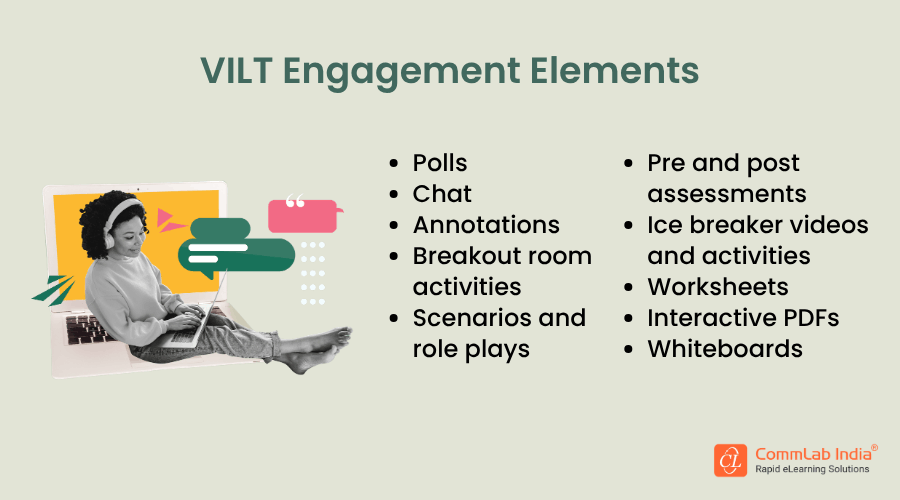
Remote learners engage better in scaled VILT programs when every session is designed for high interaction, repeatable activities, and real-time feedback that can work consistently across regions.
This can be achieved by:
- Using polls and questions at regular intervals
- Facilitating breakout discussions
- Encouraging chat-based participation
1. Standardize Facilitator and Learner Assets
Consistency across regions depends on standardized materials.
Facilitator guides ensure sessions are delivered in the same way, while learner materials provide clarity and support. This reduces variability and improves overall quality.
2. Enable Facilitators for Virtual Delivery
Facilitators play a critical role in VILT success.
They need to be trained not only in content but also in virtual engagement techniques and platform tools. Strong facilitation ensures that sessions remain interactive and effective.
3. Integrate VILT into a Blended Learning Strategy
VILT works best when combined with other learning formats.
Organizations use eLearning for foundational knowledge and VILT for discussion, application, and clarification. Microlearning is often used for reinforcement.
Recreate the spark of the classroom in virtual instructor-led training with experiences built for interaction, focus, and real learning.
4. Centralize Delivery and Operations
Operational control is essential for scaling VILT.
Organizations need centralized systems to manage scheduling, delivery, and tracking. This reduces coordination complexity and ensures consistency across regions.
If you want engaging, interactive, and high-impact sessions, these 5 VILT tools deserve a look.
What Types of Training are Best Suited for VILT?
VILT is best suited for training that requires interaction, discussion, and real-time feedback.
It is commonly used for:
- Leadership development
- Software and systems training
- Compliance training
- Sales and customer service training
- Onboarding and professional development
How Did CommLab India Turn a Complex Training Need into a Success Story?
Leadership Training for a Leading Infection Prevention Solutions Provider
An 18-week classroom training program was successfully converted to VILT by redesigning content for virtual delivery, creating structured guides, and embedding interactive elements.
The Challenge: Converting Classroom Training to Virtual
A leading infection prevention solutions provider needed to convert an 18-week classroom training program into a virtual classroom format.
The Solution: Redesigning for Virtual Delivery
The solution focused on adapting classroom training for the virtual platform and enabling structured delivery.
The following actions were taken:
- Redesigned classroom training material for the virtual platform
- Created facilitator and participant guides
- Designed a Tech Check deck to run activities on the virtual platform
- Designed engagement through polls, chats, breakout rooms, and workbook activities
The Execution Timeline
The entire solution was developed within 2.5 weeks
The Deliverables
The final deliverables included:
- 9 PowerPoint decks
- 9 facilitator guides
- 1 comprehensive participant guide
Result:
The conversion was achieved by redesigning content for virtual delivery, creating structured guides, and incorporating interactive elements to support engagement.
Elevate Your VILT from Ad-Hoc to Engineered
When VILT is done right, it stops being a quick fix for remote training and becomes a scalable engine for consistent, high-quality learning across every region you operate in. By standardizing your virtual classroom design, simplifying operations, and giving facilitators the right tools and guardrails, you can deliver live, interactive experiences that feel local to learners but are globally repeatable for L&D.
If you are ready to deepen your strategy, explore our eBook to craft truly engaging VILT experiences and uncover the crucial elements that make a virtual session successful—from design and facilitation to interaction and measurement. Download it now to turn your VILT program into a reliable, scalable blueprint for live virtual training across regions.