Corporate training has evolved dramatically over the past decade. Learning is no longer limited to structured courses inside a learning management system. Employees learn through mobile apps, simulations, workflow tools, virtual classrooms, and performance support systems.
Yet one requirement remains unchanged. Training content must communicate reliably with learning platforms.
Organizations need to know:
- Who completed training
- What scores learners achieved
- How learners interacted with content
- Whether compliance requirements were met
Without interoperability standards, this data exchange becomes impossible.
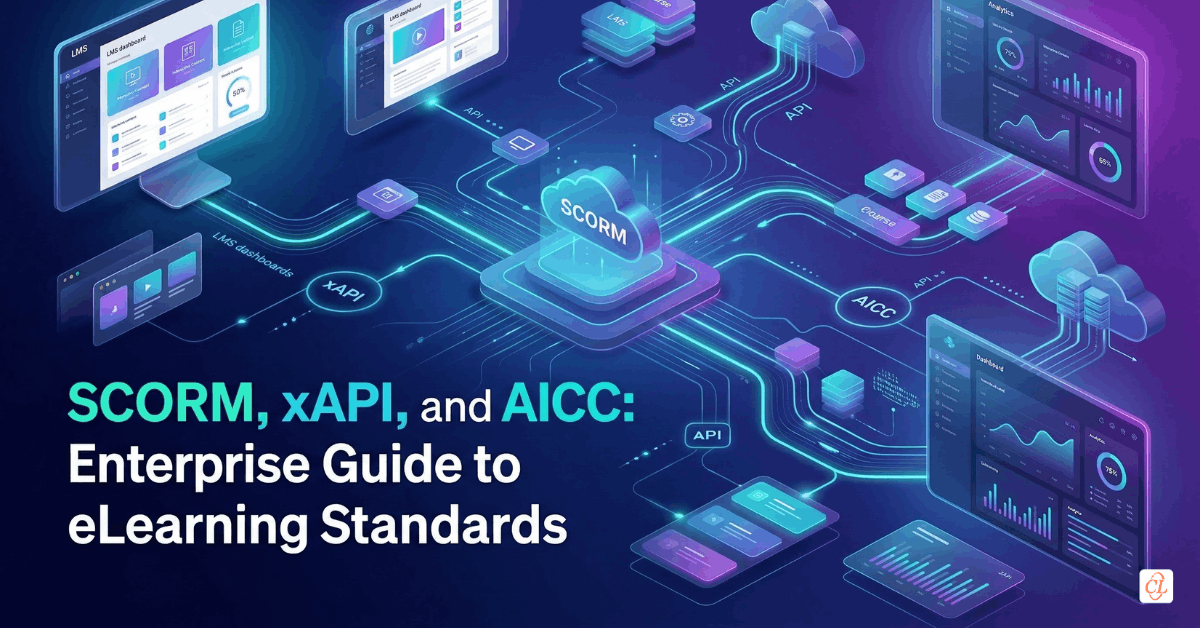
This is where eLearning standards such as SCORM, AICC, and xAPI play a critical role. These frameworks ensure training content can communicate with LMS platforms, track learner activity, and maintain compatibility across systems.
In this article, you will learn:
- How SCORM, xAPI, and AICC standards enable LMS interoperability
- How organizations design SCORM-compliant courses and track learning data
- Which authoring tools support standards-based course development
- When to use SCORM vs xAPI for modern enterprise learning ecosystems
If your organization develops digital training, understanding these standards is essential to ensuring your courses are trackable, scalable, and future-ready.
Download Now: State of Learning (Now and Beyond) [eBook]
Table of Contents
- Why Interoperability Standards Matter in Modern eLearning
- Understanding SCORM: The Foundation of LMS-Compatible Learning
- How SCORM Works Behind the Scenes
- SCORM Versions Explained: SCORM 1.2 vs SCORM 2004
- AICC: The Early Standard That Shaped LMS Communication
- xAPI (Tin Can): Expanding Learning Tracking Beyond the LMS
- SCORM vs xAPI vs AICC: Choosing the Right Standard
- The Process of Creating SCORM-Compliant Courses
- Authoring Tools That Support SCORM Development
- Designing SCORM Courses for Mobile Learning
- Testing SCORM Packages Before LMS Deployment
- Future-Proofing Corporate Training with Modern Learning Standards
- FAQs
Why Interoperability Standards Matter in Modern eLearning
Corporate learning environments are increasingly complex. Organizations deploy training through multiple systems including Learning management systems (LMS), Learning experience platforms (LXP), mobile learning apps, virtual classroom tools, and simulation environments.
Without interoperability standards, each training module would require custom integration with every platform.
This creates several problems:
- content becomes platform-dependent
- learning data becomes fragmented
- system migration becomes costly
- compliance reporting becomes unreliable
eLearning standards solve this problem.
They define a universal communication protocol between learning content and the LMS. This ensures courses can be reused across platforms while preserving learner data and reporting.
Standardized communication allows organizations to scale learning programs without rebuilding training for each platform.
Understanding SCORM: The Foundation of LMS-Compatible Learning
SCORM (Sharable Content Object Reference Model) is the most widely adopted eLearning standard used by learning management systems worldwide.
It defines how online courses:
- communicate with an LMS
- report learner progress
- track completion and scores
- store learning activity data
A SCORM-compliant course is packaged in a standardized format that an LMS can launch and track. Key capabilities include tracking course completion, capturing quiz scores, recording time spent in training and bookmarking learner progress. Because SCORM is supported by most LMS platforms, it became the industry standard for digital training distribution.
SCORM enables training content to function across different LMS platforms without requiring redevelopment.
How SCORM Works Behind the Scenes
SCORM relies on a communication model between two components:
- Learning Content
The training module delivered to learners. - LMS Platform
The system that launches the course and records learning data.
When a learner launches a SCORM course:
- The LMS opens the course package.
- The course initializes communication with the LMS.
- Learner activity is tracked during the session.
- Data such as scores and completion status are sent back to the LMS.
Typical data tracked includes completion status, lesson location, quiz scores, time spent and pass/fail results. This data exchange ensures training managers can generate reliable reports and track compliance.
SCORM creates a structured dialogue between training content and the LMS that enables real-time reporting.
SCORM Versions Explained: SCORM 1.2 vs SCORM 2004
Two major SCORM versions are commonly used in corporate learning.
SCORM 1.2
SCORM 1.2 remains the most widely supported version due to its simplicity and LMS compatibility.
Capabilities include:
- course completion tracking
- score reporting
- bookmarking
- session time tracking
However, SCORM 1.2 provides limited sequencing capabilities.
SCORM 2004
SCORM 2004 introduced advanced features, including:
- sequencing and navigation rules
- complex learning paths
- conditional branching across modules
Despite these improvements, many organizations still use SCORM 1.2 due to broader LMS support.
SCORM 1.2 prioritizes compatibility, while SCORM 2004 enables more advanced learning path control.
AICC: The Early Standard That Shaped LMS Communication
Before SCORM became dominant, the aviation industry developed AICC (Aviation Industry CBT Committee) standards to manage computer-based training.
AICC defined guidelines for:
- course packaging
- LMS communication
- learner progress tracking
Although AICC played an important role in shaping modern standards, its use has declined significantly. Most modern LMS platforms now prioritize SCORM or xAPI compatibility instead.
AICC laid the foundation for LMS interoperability, but SCORM and xAPI now dominate modern learning ecosystems.
xAPI (Tin Can): Expanding Learning Tracking Beyond the LMS
Traditional standards such as SCORM track activity only within LMS-delivered courses.
Modern learning environments require tracking far more complex experiences such as mobile learning, simulations, virtual reality training, offline learning and social learning platforms.
xAPI (Experience API) was developed to capture these broader learning activities. Instead of relying on an LMS, xAPI sends learning data to a Learning Record Store (LRS).
Learning statements follow a structured format:
Actor + Verb + Object
Example:
"Employee completed safety simulation"
This approach allows organizations to track learning that occurs across multiple environments.
xAPI enables organizations to track learning experiences that occur outside traditional LMS courses.

A Bird’s Eye View of What Top-Performing L&D Teams are Doin
- Aligning Learning Strategy with Business Strategy
- Developing Business Skills for the Future
- Investing in the Right Technology
- Much More
SCORM vs xAPI vs AICC: Choosing the Right Standard
Selecting the right eLearning standard is not just a technical decision. It directly influences how effectively your organization tracks learning, integrates systems, and scales training programs.
Understanding the strengths of SCORM, xAPI, and AICC helps L&D teams choose the standard that aligns with their learning ecosystem and reporting requirements.
| Standard | Best Use Case | Tracking Capability |
| SCORM | LMS-based course delivery | Tracks course completion and scores |
| xAPI | Modern learning ecosystems | Tracks any learning experience |
| AICC | Legacy systems | Limited modern adoption |
Key strategic considerations:
- Use SCORM when training is delivered primarily through an LMS.
- Use xAPI when learning occurs across multiple platforms such as mobile apps, simulations, and experiential environments.
- Most modern organizations use both standards together.
Choose SCORM when LMS compatibility and structured course tracking are your primary priorities. Consider xAPI when learning happens across multiple platforms and you need deeper analytics beyond traditional course completion.
SCORM ensures LMS compatibility, while xAPI expands learning analytics across the enterprise.
The Process of Creating SCORM-Compliant Courses
Developing SCORM-compliant training requires structured course design and technical packaging.
Step 1: Design the Learning Experience
Begin with instructional design that defines:
- learning objectives
- assessment strategy
- course structure
These elements determine how completion and scoring data will be tracked.
Step 2: Develop the Course Using Authoring Tools
Courses are typically created using authoring tools that automatically generate SCORM packages.
These tools embed SCORM tracking into the course.
Step 3: Configure Tracking Settings
During publishing, developers configure:
- completion criteria
- passing score thresholds
- learner bookmarking
These settings define how the LMS records learner activity.
Step 4: Publish SCORM Package
The course is exported as a compressed SCORM package that includes:
- course assets
- tracking configuration
- communication scripts
Step 5: Upload and Test in LMS
After publishing, the SCORM package is uploaded into the LMS for testing.
Testing verifies that the LMS correctly records:
- completion status
- assessment scores
- session data
SCORM compliance depends on both course design and correct LMS integration.
Authoring Tools That Support SCORM Development
Modern authoring tools simplify SCORM development by automatically generating compliant course packages.
Popular enterprise tools include:
- Articulate Storyline
- Adobe Captivate
- Lectora
- iSpring Suite
- dominKnow
Key capabilities offered by these tools:
- built-in SCORM publishing
- LMS testing features
- responsive course design
- assessment integration
These platforms allow instructional designers to focus on learning design rather than technical standards.
Authoring tools handle SCORM technical requirements automatically, enabling faster course development.
Designing SCORM Courses for Mobile Learning
Modern learners increasingly access training through smartphones and tablets, especially in field operations, sales roles, and distributed workforces. To ensure SCORM courses function effectively across devices, developers must design with mobile usability and performance in mind.
To achieve this, developers should focus on the following design practices:
Design responsive layouts
Courses should automatically adjust to different screen sizes and orientations. Responsive design frameworks used in tools such as Storyline, Captivate, and Lectora allow layouts, text, and media to adapt dynamically, preventing content distortion or scrolling issues on smaller screens.
Simplify navigation
Mobile learners interact with training in shorter sessions. Clear navigation, minimal menus, and linear progress indicators help learners move through content quickly without confusion or excessive tapping.
Optimize media assets
Large videos, heavy animations, and high-resolution images can slow down mobile performance. Compressing media, using streaming-friendly formats, and limiting unnecessary animations ensures faster loading and smoother playback on mobile networks.
Ensure touch-friendly interactions
Interactive elements such as buttons, hotspots, and drag-and-drop activities should be designed for finger taps rather than mouse clicks. Larger interaction areas and simple gestures improve usability on touchscreens.
Modern authoring tools now provide responsive player interfaces and device previews that allow developers to test how courses behave on phones, tablets, and desktops before publishing.
In addition, SCORM tracking functions must be validated across devices to ensure that learner progress, completion status, and scores are captured consistently regardless of the device used. Responsive course design ensures SCORM-compliant training remains accessible across devices.
Testing SCORM Packages Before LMS Deployment
Before launching any SCORM-based training program, organizations must thoroughly validate how the course communicates with the LMS. Even small configuration errors can lead to incomplete data reporting or failed course completion tracking.
Effective SCORM testing focuses on several critical aspects.
- Completion tracking: Verify that the course correctly reports when a learner has completed the training. This typically depends on defined criteria such as slide completion, assessment success, or time spent within the module.
- Assessment score reporting: Ensure that quiz results and pass/fail statuses are transmitted accurately to the LMS. Incorrect scoring configurations can cause learners to appear as incomplete even after finishing the course.
- Bookmarking and resume functionality: SCORM bookmarking allows learners to exit and return to the same point later. Testing confirms that the course remembers the learner’s last location and resumes properly across sessions and devices.
- Session time and data communication: Courses must reliably send learner data to the LMS during and after a session. Testing verifies that communication between the course and LMS API occurs without interruption.
To support this process, developers often use SCORM testing platforms that simulate LMS environments and analyze communication logs. These tools help identify issues such as incorrect completion triggers, missing data fields, or broken tracking scripts before deployment.
Testing is especially important when training programs are rolled out across large enterprises where thousands of learners may access the same course simultaneously.
Rigorous SCORM testing prevents reporting errors, protects compliance data integrity, and ensures a smooth learner experience once courses are deployed across the organization’s LMS.
Future-Proofing Corporate Training with Modern Learning Standards
Learning ecosystems continue to evolve rapidly.
Organizations are now integrating:
- learning experience platforms
- performance support systems
- AI-powered learning assistants
- immersive simulations
As learning environments expand, organizations must adopt standards that support interoperability across systems.
SCORM remains essential for LMS-based training delivery. However, xAPI is becoming increasingly important for capturing complex learning experiences. Forward-thinking organizations combine both approaches to build scalable learning ecosystems.
The future of enterprise learning lies in combining LMS-based standards with modern learning
FAQ
1. What is SCORM in eLearning?
A. SCORM is a technical standard that enables eLearning courses to communicate with a learning management system. It allows training programs to track learner activity such as completion status, scores, and time spent in the course.
2. What is the difference between SCORM and xAPI?
A. SCORM tracks learning activity within LMS-delivered courses. xAPI extends tracking beyond the LMS and captures learning experiences from mobile apps, simulations, and other digital learning environments.
3. Is AICC still used in modern eLearning?
A. AICC is largely considered a legacy standard. While some older LMS platforms still support it, most organizations now use SCORM or xAPI for modern training programs.
4. What tools create SCORM-compliant courses?
A. Common tools include Articulate Storyline, Adobe Captivate, Lectora, iSpring Suite, and dominKnow. These tools automatically package courses according to SCORM specifications.
5. Do SCORM courses work on mobile devices?
A. Yes. Modern authoring tools support responsive course design, allowing SCORM-compliant courses to function across desktops, tablets, and smartphones.
6. What is a Learning Record Store (LRS)?
A. An LRS is a database used by xAPI to store learning experience data. It records learning activities from multiple systems, enabling organizations to track learning beyond traditional LMS environments.
Conclusion
As corporate learning ecosystems grow more complex, interoperability becomes essential. Organizations must ensure their training content works seamlessly across platforms, devices, and learning environments.
Standards such as SCORM, xAPI, and earlier frameworks like AICC provide the technical backbone that makes this possible.
SCORM continues to power LMS-based training delivery, ensuring consistent tracking and reporting. At the same time, xAPI is expanding the scope of learning analytics to capture experiences beyond structured courses.
For enterprise learning teams, the strategic goal is not choosing one standard over another. It is building a learning architecture that combines these standards to support scalable, trackable, and future-ready corporate training.