Speed in training is not achieved by working faster. It is achieved by working smarter. Many teams attempt to accelerate eLearning development by compressing timelines or skipping steps. The result is often confusion, rework, and inconsistent quality. Rapid eLearning takes a different approach. It redesigns the development process itself to remove inefficiencies while keeping instructional integrity intact.
At its core, rapid eLearning is built on a structured workflow that enables faster production, better collaboration, and easier updates.
Download Now: The 4Rs of Rapid eLearning
In this article, you will understand how the rapid eLearning development process works, from initial analysis to final deployment, and what makes it effective in real-world training environments.
Why Process Matters in Rapid eLearning
Rapid eLearning is often associated with speed, but speed without structure leads to inconsistency.
A clearly defined development process ensures that:
- content is aligned with objectives
- teams collaborate efficiently
- rework is minimized
- quality remains consistent
- timelines are predictable
Without a structured process, rapid development becomes reactive rather than strategic.
The strength of rapid eLearning lies in its ability to standardize development while maintaining flexibility.
What Defines a Rapid eLearning Development Process
The rapid eLearning development process is a streamlined approach to designing and building training using structured steps, reusable assets, and efficient tools.
Quick definition
Rapid eLearning development is a structured workflow that enables fast course creation through content reuse, templates, and optimized collaboration.
It differs from traditional development in three key ways:
- shorter and more iterative cycles
- reliance on templates and authoring tools
- focused involvement of subject matter experts
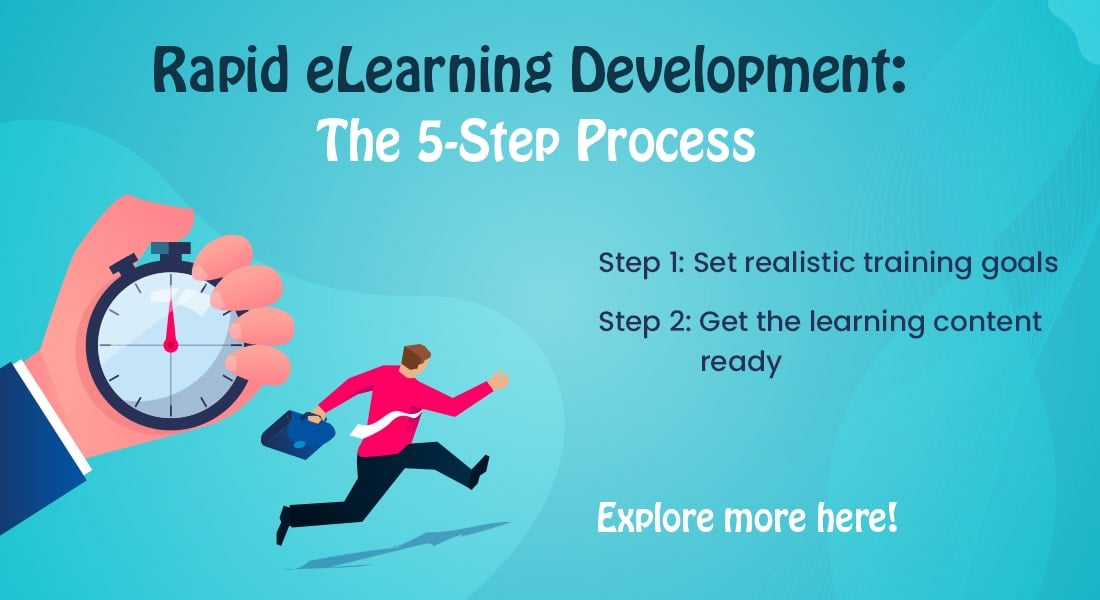
The End-to-End Rapid eLearning Development Workflow
The rapid eLearning process follows a logical sequence, but it is more flexible than traditional models.
Overview of the workflow
- Define goals and scope
- Analyze and organize content
- Create a storyboard
- Design the learning experience
- Develop using authoring tools
- Review and refine
- Publish and deploy
Each step is designed to reduce delays and improve clarity.
Step 1: Define Training Goals and Scope
Every successful course begins with clarity.
Key actions
- identify business objectives
- define learning outcomes
- determine target audience
- set timelines and constraints
This step ensures that development stays focused and avoids unnecessary content expansion.
Without clear goals, rapid eLearning can become overloaded with information, slowing down development and reducing effectiveness.
Step 2: Analyze and Prepare Source Content
Rapid eLearning relies heavily on existing materials.
Common content sources
- instructor-led training slides
- manuals and documents
- recorded sessions
- legacy courses
Key actions
- remove redundant or outdated content
- prioritize essential information
- organize content into logical modules
Content preparation is not about copying material. It is about refining it into a learner-ready format.
Step 3: Create the Storyboard
The storyboard is the backbone of rapid eLearning development.
What a storyboard includes
- content flow
- screen-level structure
- interaction ideas
- assessment points
- media requirements
Why storyboarding is critical
A well-developed storyboard reduces confusion during development and minimizes rework.
It also allows stakeholders to review and approve the structure before production begins.

Have You Met the 4 Rs of Rapid eLearning?
Accelerate Learning and Maximize its Impact With the 4 Rs of Rapid eLearning!
4Rs of rapid eLearning:
- Redesign
- Record
- Rebuild
- Republish
Step 4: Design the Learning Experience
At this stage, the focus shifts from content to learner engagement.
Key considerations
- how content will be presented
- what interactions will be used
- how learners will practice and apply knowledge
- how assessments will be structured
Important principle
Engagement should support learning, not distract from it. The goal is clarity and usability.
Step 5: Develop the Course Using Authoring Tools
This is where the course is built.
What enables speed here
- pre-built templates
- reusable layouts
- built-in interactions
- responsive design features
Key actions
- convert storyboard into course screens
- add media elements
- integrate assessments
- ensure consistency across modules
Development becomes faster because teams are not building everything from scratch.
Step 6: Review and Iterate Efficiently
Review cycles can slow down development if not managed properly.
Best approach
- conduct structured reviews
- limit feedback to relevant stakeholders
- focus on clarity and accuracy
- avoid unnecessary changes
Efficient reviews are essential for maintaining speed without compromising quality.
Step 7: Publish and Deploy
The final step is making the course available to learners.
Key considerations
- LMS compatibility
- responsive behavior across devices
- tracking and reporting
- accessibility
Once deployed, the course should be easy to update when needed.
How Rapid eLearning Saves SME Time
Subject matter experts are often a bottleneck in traditional development.
Rapid eLearning reduces this dependency through:
- structured content extraction
- focused review cycles
- clear storyboards
- reduced back-and-forth communication
SMEs spend less time reviewing and more time contributing meaningful insights.
Common Mistakes in Rapid eLearning Development
Even with a structured process, certain mistakes can slow down development.
- Overloading content: Including too much information reduces clarity and increases development time.
- Skipping the storyboard: Without a storyboard, development becomes inconsistent and requires more revisions.
- Overcomplicating interactions: Adding unnecessary complexity slows development without improving learning outcomes.
- Involving too many reviewers: Too many stakeholders can lead to conflicting feedback and delays.
- Ignoring templates and standards: Reinventing layouts for every course defeats the purpose of rapid development.
Best Practices for Faster and Better Development
To make rapid eLearning effective, teams should follow a few key practices.
Standardize templates and workflows
Consistency improves both speed and quality.
Focus on essential content
Keep content concise and relevant.
Use authoring tools strategically
Leverage built-in features instead of creating custom elements unnecessarily.
Plan reviews carefully
Define clear review stages and limit revisions.
Design for updates
Structure courses so they can be easily modified in the future.
FAQ
1. What is the rapid eLearning development process?
A. It is a structured workflow that includes goal setting, content preparation, storyboarding, design, development, review, and deployment to create courses quickly and efficiently.
2. Why is storyboarding important in rapid eLearning?
A. Storyboarding defines the course structure and content flow, reducing confusion during development and minimizing rework.
3. How does rapid eLearning reduce development time?
A. It uses templates, reusable content, and efficient workflows to eliminate unnecessary steps and speed up production.
4. What tools are used in rapid eLearning development?
A. Authoring tools with pre-built templates, interactions, and responsive design capabilities are commonly used.
5. How can SMEs contribute efficiently to rapid eLearning?
A. They can provide focused input during content preparation and review structured storyboards instead of reviewing full courses repeatedly.
6. What are the biggest challenges in rapid eLearning development?
A. Common challenges include content overload, unclear objectives, inefficient review cycles, and lack of standardization.
Conclusion
Rapid eLearning is not just a faster way to build courses. It is a more structured and efficient way to approach training development.
By following a clear process from storyboard to deployment, organizations can create learning that is both fast and effective.
When executed well, rapid eLearning transforms development from a slow, fragmented effort into a streamlined system that delivers consistent results at scale.
Editor’s note: This post was originally published on November 09, 2017 and has been updated for comprehensiveness.