For a long time, video has been embraced in corporate learning for a fairly straightforward reason: people prefer watching over reading. It is intuitive, engaging, and easier to consume. However, in today’s enterprise learning environments, preference alone is no longer a sufficient justification for investment.
Organizations are now operating in conditions where speed, scale, and adaptability define success. In such environments, learning is expected to do more than inform. It must enable employees to perform tasks more efficiently, adapt to evolving roles, and retain knowledge in ways that directly impact business outcomes.
This shift is forcing a more fundamental question.
If video is widely adopted and widely consumed, why does learning impact remain inconsistent?
The answer lies not in the medium, but in how it is used. Many organizations have scaled video production without developing a corresponding strategy for integrating it into the learning ecosystem. As a result, video becomes abundant but not necessarily effective.
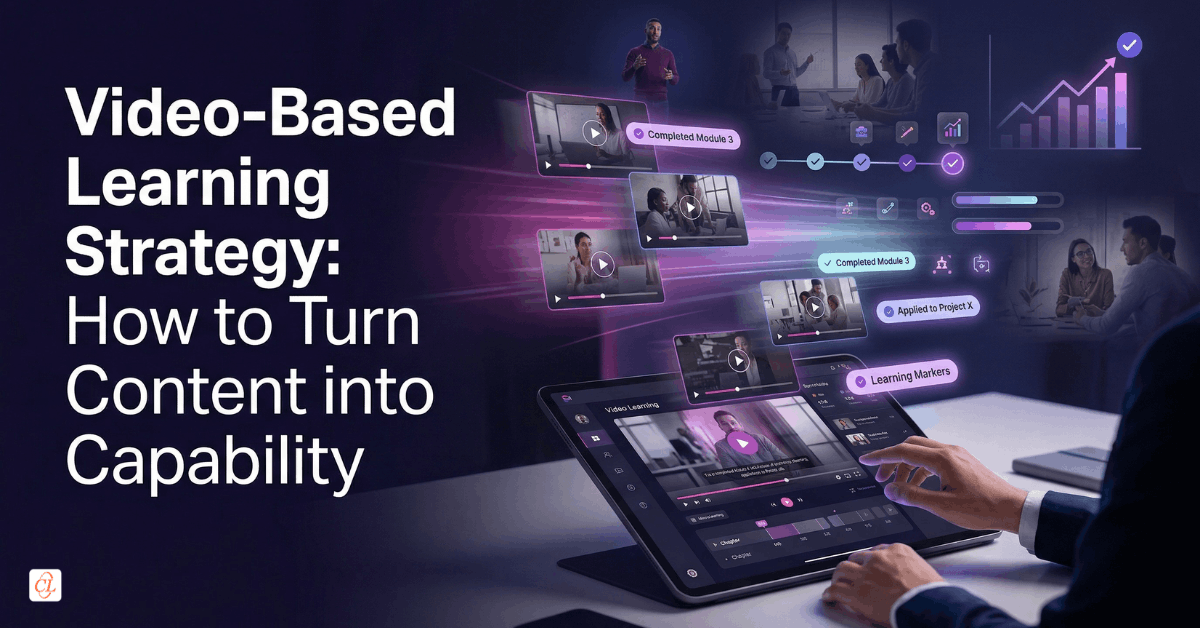
To unlock its full potential, video-based learning must be repositioned. It should not be treated as a content format, but as a strategic system that supports performance, reinforces learning, and scales capability across the enterprise.
Download eBook: Power of AI in Video-based Learning
Table of Contents
- From Engagement to Performance: A Strategic Shift
- What Video-Based Learning Really Means in Enterprise Contexts
- Why Video Continues to Outperform Traditional Learning Formats
- Where Video Delivers Tangible Business Value
- Why Most Video-Based Learning Strategies Fall Short
- Designing a Scalable Video-Based Learning Strategy
- The Evolving Technology Layer Behind Video Learning
- The Future Role of Video in Learning Ecosystems
- FAQs
From Engagement to Performance: A Strategic Shift
Video has traditionally been associated with engagement. It captures attention quickly, simplifies complex ideas, and provides a more immersive experience than static content. While these qualities remain valuable, they represent only the surface-level benefits of video.
In enterprise learning, engagement is not the end goal. It is simply the starting point.
The real objective is performance. Organizations invest in training to reduce errors, accelerate onboarding, improve decision-making, and enhance productivity. If video-based learning does not contribute to these outcomes, its value remains limited, regardless of how engaging it may appear.
This is where a critical shift must occur.
Instead of asking whether learners are watching videos, organizations must begin to evaluate whether those videos are enabling better on-the-job performance. This reframing changes how video is designed, delivered, and measured.
When video is embedded within real work contexts, aligned with specific tasks, and reinforced through application, it moves beyond passive consumption and becomes a performance support mechanism.
What Video-Based Learning Means in Enterprise Contexts
Video-based learning is often narrowly interpreted as the use of videos within training courses. In practice, its role is far more expansive and integrated.
At an enterprise level, video-based learning functions as a multi-layered system that supports different stages of the learning journey.
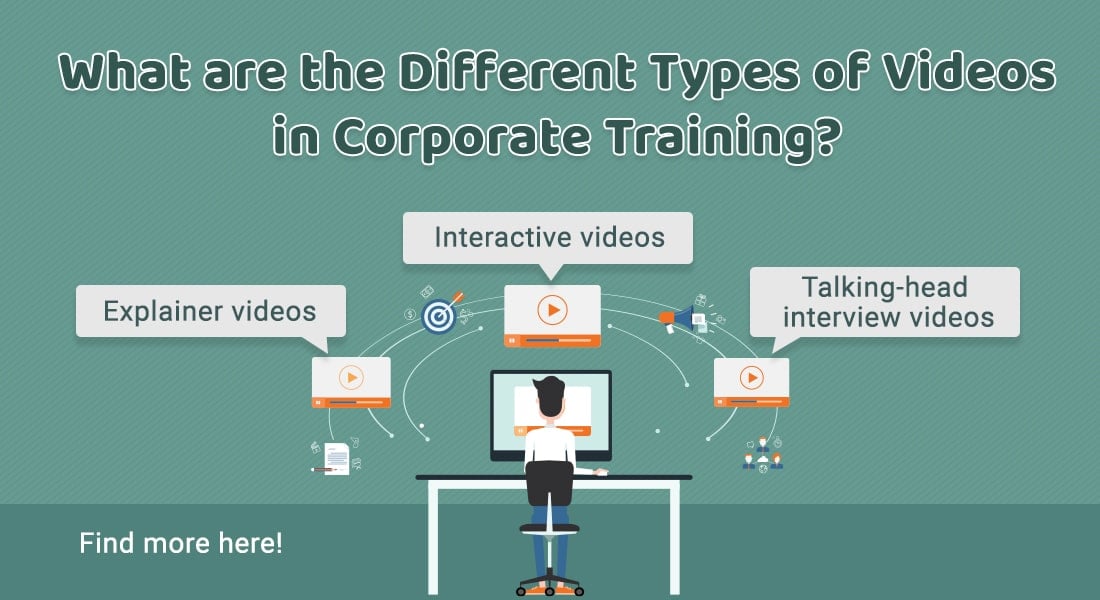
It typically includes:
- Structured learning videos
Used in onboarding and compliance programs to provide foundational knowledge in a consistent format. - Scenario-based videos
Designed to simulate real-world situations, particularly in areas like leadership, sales, and customer interaction. - Demonstration videos
Essential for systems and process training, where step-by-step clarity is critical. - Microlearning videos
Short, focused assets that reinforce key concepts and support quick refreshers. - Performance support videos
Embedded directly into workflows to provide just-in-time assistance.
What distinguishes mature organizations is not the volume of video content they produce, but how effectively these different types are orchestrated into a cohesive system.
Why Video Continues to Outperform Traditional Learning Formats
The effectiveness of video is rooted in how people process information. By combining visual and auditory elements, video reduces cognitive strain and accelerates comprehension, especially when dealing with complex or unfamiliar concepts.
However, its true strength lies in its adaptability.
Video is not confined to a single use case. It can be adapted to suit a wide range of learning scenarios, making it uniquely valuable in enterprise environments where training needs vary significantly.
Key advantages of video-based learning:
- Clarity in complex topics
Visual demonstrations make abstract or technical concepts easier to understand. - Consistency at scale
Ensures uniform training delivery across geographies and teams. - Faster knowledge transfer
Reduces the time required to grasp new information. - Flexibility in consumption
Enables learners to access content anytime, across devices. - Improved retention through reinforcement
Repeated exposure through short videos strengthens long-term memory.
These advantages explain why video continues to be a preferred modality, but they also highlight the importance of using it strategically rather than indiscriminately.
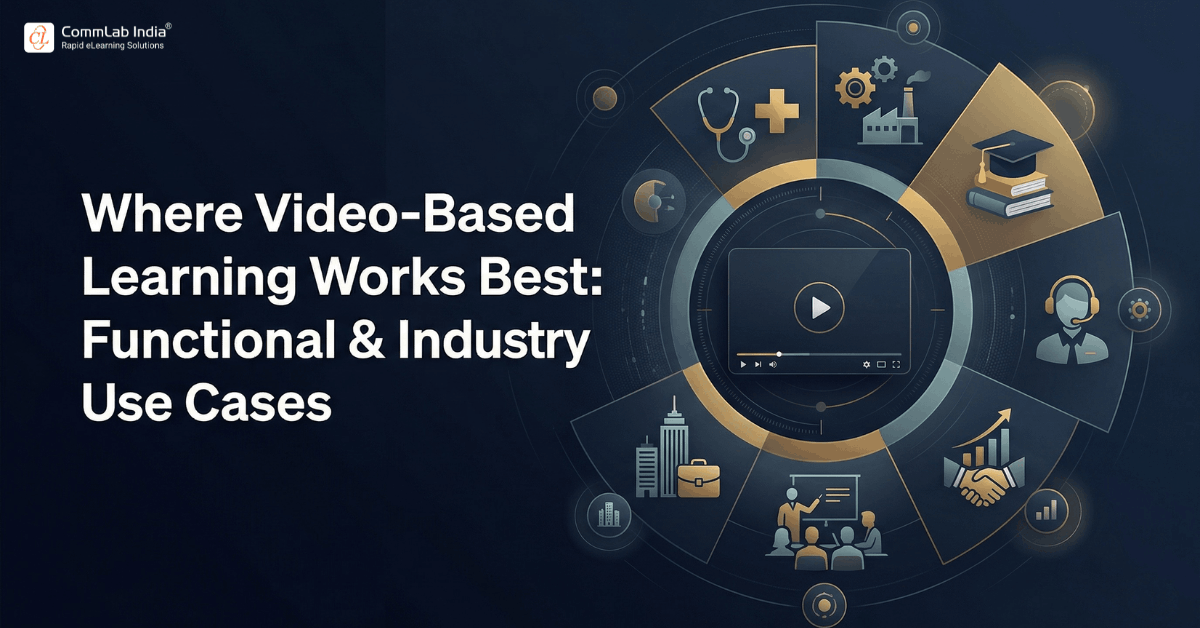
Where Video Delivers Tangible Business Value
While video is versatile, its impact is not uniform across all training scenarios. Its value is most pronounced in contexts where clarity, consistency, and speed are critical.
High-impact enterprise use cases
| Use Case | How Video Creates Value |
| Onboarding | Accelerates understanding of organizational processes and expectations |
| Systems Training | Demonstrates workflows with precision, reducing user errors |
| Sales Enablement | Simulates real conversations and improves response readiness |
| Compliance Training | Simplifies complex regulations and improves recall |
| Customer Education | Scales product knowledge consistently across audiences |
Beyond these structured use cases, video plays a vital role in reinforcement and retention. Short, targeted videos delivered after formal training help bridge the gap between learning and application, ensuring that knowledge is not lost over time.
Why Most Video-Based Learning Strategies Fall Short
Despite its potential, many organizations struggle to realize meaningful outcomes from video-based learning. The issue is rarely about technology or production quality. It is about strategy.
Several recurring challenges limit effectiveness:
- Content overload without direction
Organizations produce large volumes of videos without a clear framework, making it difficult for learners to identify what is relevant. - Lack of contextual integration
Videos are not aligned with actual job tasks, reducing their practical usefulness. - Passive learning experiences
Learners consume content but are not required to apply it, leading to low retention. - Inconsistent design standards
Variations in quality and structure create fragmented learning experiences. - Limited measurement frameworks
Success is often measured through views rather than meaningful outcomes.
Each of these challenges points to the same underlying issue: video is being treated as an output rather than as part of a system.

Next-Gen Training: Unlocking the Power of AI in Video-based Learning
Elevate your Training Videos with AI
- Relevance of Video-based Learning
- Various Video Formats
- Potential of AI in Videos
- And More!
Designing a Scalable Video-Based Learning Strategy
To move from fragmented execution to scalable impact, organizations must adopt a more structured approach to video-based learning.
Core components of a strategic approach
1. Purpose-led design
Every video should serve a clearly defined role within the learning journey, with a specific outcome in mind.
2. Modular content architecture
Breaking content into smaller, reusable units allows for flexibility and scalability across different contexts.
3. Ecosystem integration
Videos should be embedded within LMS platforms, knowledge systems, and workflow tools to ensure accessibility at the point of need.
4. Active learning design
Videos should be complemented with activities that encourage application, such as scenarios, quizzes, or reflection prompts.
5. Continuous reinforcement mechanisms
Follow-up content ensures that learning is retained and applied over time.
Together, these elements transform video from isolated content into a cohesive learning system.
The Evolving Technology Layer Behind Video Learning
Technology is playing an increasingly important role in shaping how video-based learning is created and delivered.
Recent advancements are not just improving efficiency but redefining what video can achieve.
Emerging capabilities include:
- AI-assisted video creation
Enables faster production while maintaining consistency in quality. - Interactive video experiences
Allows learners to engage with content through embedded decisions and feedback. - Personalized learning pathways
Tailors video recommendations based on individual learner needs and progress. - Advanced analytics
Provides deeper insights into how learners interact with content and where improvements are needed.
These developments are gradually transforming video into a dynamic and adaptive learning medium, rather than a static one.
The Future Role of Video in Learning Ecosystems
Video is evolving from a supporting element into a foundational layer of modern learning ecosystems.
As organizations continue to embrace digital transformation, the role of video will expand in several key ways:
- Enabling continuous, on-demand learning
- Supporting real-time performance in the flow of work
- Scaling knowledge across distributed teams
- Integrating with AI-driven learning systems
The future of video-based learning will not be defined by the volume of content produced, but by how intelligently it is designed, delivered, and connected to performance outcomes.
FAQs
1. What is video-based learning in corporate training?
A. Video-based learning uses video as a primary medium to deliver training, demonstrate processes, and reinforce knowledge. In enterprise settings, it extends beyond courses to include performance support and microlearning.
2. Why is video-based learning effective?
A. Video improves understanding by combining visual and auditory elements. It simplifies complex concepts, accelerates learning, and supports better retention when reinforced over time.
3. How can organizations scale video-based learning?
A. Scaling requires modular design, integration with learning systems, and alignment with business objectives. Technology such as AI and analytics further enhances scalability.
4. What are the common challenges in video-based learning?
A. Challenges include content overload, lack of contextual relevance, passive consumption, inconsistent quality, and limited measurement of outcomes.
5. How do you measure the effectiveness of video-based learning?
A. Effectiveness should be measured through retention, behavior change, and business impact rather than views or completion rates.
Conclusion
Video-based learning has evolved far beyond its original role as an engagement tool. It now sits at the intersection of learning, performance, and technology.
Yet, its effectiveness depends entirely on how it is implemented.
Organizations that treat video as a standalone content format will continue to see limited results. Those that approach it as a strategic system will unlock its ability to drive performance at scale.
The real opportunity lies not in creating more videos, but in making video work as a consistent, measurable driver of capability across the enterprise.