Video-based learning has moved well beyond the stage of experimentation. Most organizations today have already integrated video into their training ecosystems in some form, whether for onboarding, compliance, or product education. Yet, despite this widespread adoption, a critical gap remains.
Many organizations use video extensively, but not always strategically.
The result is a familiar pattern. Video content grows rapidly, engagement metrics look promising, yet the connection to business outcomes remains unclear. Learners watch, complete, and move on, but the expected improvements in performance, productivity, or decision-making do not always materialize.
This is not a limitation of the medium. It is a limitation of how it is applied.
To unlock meaningful value, organizations must shift from broad adoption to precision in application. Video must be aligned with specific functions, tailored to defined audiences, and adapted to industry contexts where its strengths can be fully leveraged.
When used in this way, video evolves from a general training asset into a targeted performance enabler, capable of solving real business problems.
This article explores how video-based learning is applied across functions, roles, and industries, highlighting where it delivers the greatest impact and how it supports measurable outcomes.
Download eBook: Power of AI in Video-based Learning
Table of Contents
- Functional Use Cases: Where Video Delivers Immediate Impact
- Role-Based Applications: Aligning Video with Audience Needs
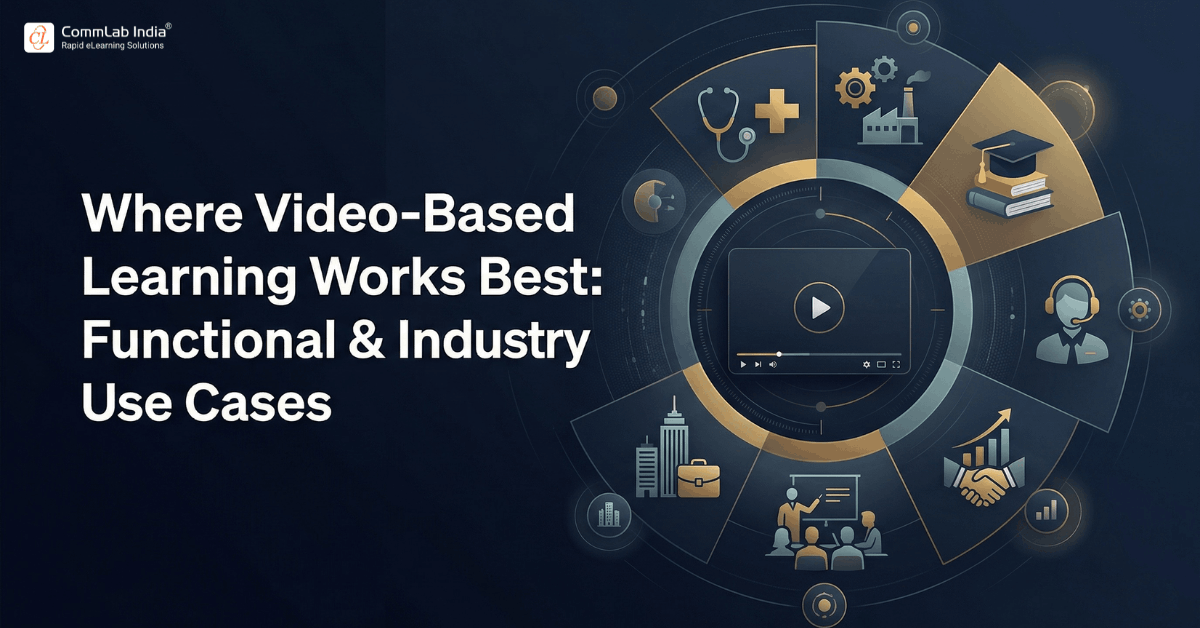
- Industry-Specific Use Cases: Context as a Force Multiplier
- Scenario-Based and Simulation Learning in Practice
- Selecting the Right Video Approach for Each Use Case
- Linking Video Use Cases to Business Outcomes
- FAQs
Functional Use Cases: Where Video Delivers Immediate Impact
Across enterprise environments, certain functions consistently benefit from video-based learning due to the nature of their training requirements. These functions typically demand clarity, consistency, and repeatability, all of which video delivers effectively.
High-impact functional applications
| Function | How Video Is Applied | Business Value Delivered |
| Onboarding | Structured learning journeys with visual guidance | Faster time to productivity |
| Sales Training | Scenario-based interactions and product demos | Improved conversion and confidence |
| Customer Service | Role-play scenarios and best-practice demonstrations | Enhanced customer satisfaction |
| Compliance Training | Simplified regulatory explanations | Higher completion and retention |
| Product Training | Feature walkthroughs and use-case demonstrations | Better product adoption |
These functions share a common characteristic. They require learners to quickly understand, retain, and apply information in real-world situations. Video supports this by making learning more intuitive and repeatable.
Role-Based Applications: Aligning Video with Audience Needs
While functional use cases provide a broad framework, the effectiveness of video-based learning increases significantly when it is tailored to specific roles.
Different audiences engage with learning in different ways, and their requirements vary based on responsibilities, experience levels, and context.
How video adapts to different roles
- Sales representatives
Scenario-driven videos allow them to observe and practice customer interactions, helping build confidence and improve response strategies. - Customer support teams
Demonstration and role-play videos provide clarity on handling queries, reducing response time and improving consistency. - New employees
Onboarding videos offer structured introductions to processes, culture, and expectations, making the transition smoother. - Managers and leaders
Branching scenarios support decision-making, allowing leaders to explore different outcomes in complex situations. - Technical users
Screen recordings and simulations provide step-by-step guidance for systems and tools, reducing errors and improving efficiency.
When video is aligned with role-specific needs, it becomes more than informative. It becomes directly actionable, enabling learners to perform tasks with greater confidence and accuracy.

Next-Gen Training: Unlocking the Power of AI in Video-based Learning
Elevate your Training Videos with AI
- Relevance of Video-based Learning
- Various Video Formats
- Potential of AI in Videos
- And More!
Industry-Specific Use Cases: Context as a Force Multiplier
The effectiveness of video-based learning becomes even more pronounced when applied within specific industry contexts.
Each industry presents unique challenges, and video can address these challenges in ways that other formats cannot.
Industry-level applications and impact
| Industry | Key Use Cases | Business Outcomes |
| Manufacturing | Safety training, process demonstrations | Reduced accidents, improved operational efficiency |
| Healthcare | Clinical procedures, patient interaction scenarios | Better compliance and improved patient outcomes |
| Finance | Regulatory training, financial literacy | Increased accuracy and reduced risk |
| Retail and Sales | Product knowledge, customer engagement | Higher sales performance |
| Technology | ERP and software training | Faster adoption and reduced user errors |
In these contexts, video acts as a bridge between theory and practice, helping learners visualize and apply knowledge in realistic scenarios.
Scenario-Based and Simulation Learning in Practice
One of the most impactful uses of video-based learning is in scenario-based and simulation-driven training.
Unlike traditional instructional methods, simulations allow learners to engage with situations that closely resemble real-world challenges. This approach is particularly valuable in environments where mistakes can be costly or risky.
Why simulation-based video learning works
- Realistic context
Learners experience situations that mirror actual workplace conditions. - Active participation
Decision-making requires deeper cognitive engagement. - Safe learning environment
Mistakes can be made and corrected without consequences. - Improved confidence
Practice builds familiarity and readiness.
For example:
- Sales teams refine their approach by handling simulated objections
- Employees learn safety protocols by observing and responding to risk scenarios
- System users navigate complex workflows through guided simulations
These applications highlight how video can move beyond explanation to experience-based learning.
Selecting the Right Video Approach for Each Use Case
Not all use cases require the same type of video. The effectiveness of video-based learning depends heavily on selecting the right format for the intended outcome.
Matching formats to objectives
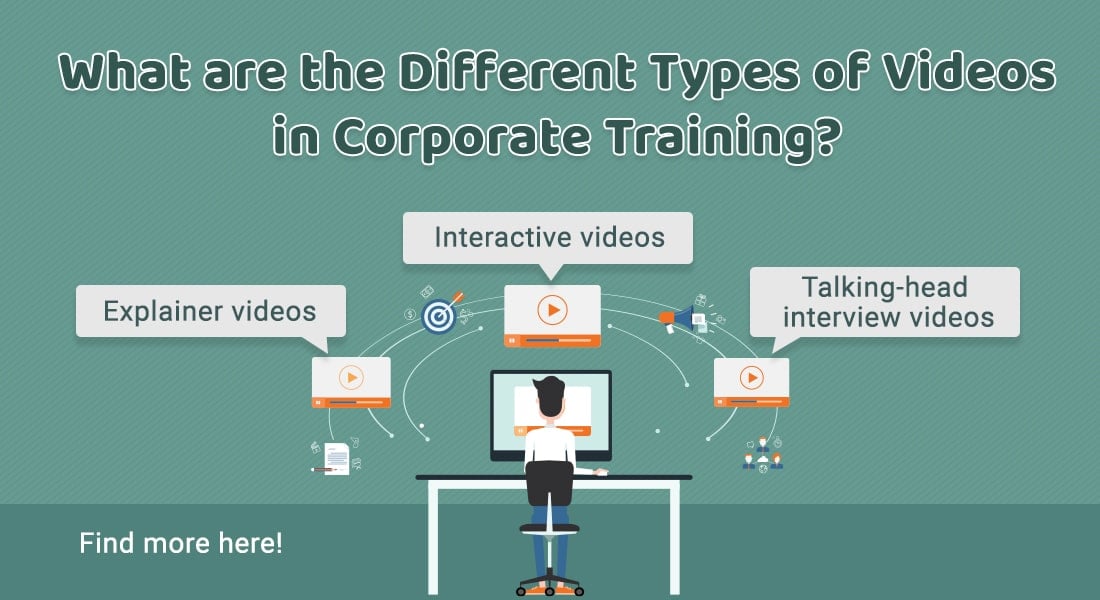
- Explainer videos
Ideal for introducing concepts and onboarding learners into new topics. - Scenario-based videos
Best suited for behavioral and decision-making skills. - Simulation videos
Effective for technical training and process understanding. - Microlearning videos
Useful for reinforcement and quick reference. - Animated videos
Simplify abstract or complex ideas that are difficult to visualize.
Choosing the right format ensures that the video is not only engaging but also aligned with the learning objective, making it more effective in driving outcomes.
Linking Video Use Cases to Business Outcomes
The true value of video-based learning lies in its ability to influence measurable business results.
Each use case should be directly connected to a specific outcome, creating a clear line of sight between learning and performance.
Examples of outcome alignment
| Use Case | Business Outcome |
| Onboarding videos | Reduced time to productivity |
| Sales training videos | Increased revenue and conversion rates |
| Safety training videos | Fewer workplace incidents |
| Compliance training videos | Improved audit performance |
| Customer training videos | Higher customer satisfaction |
This alignment strengthens the case for investment in video-based learning and ensures that training initiatives contribute meaningfully to organizational goals.
FAQs
1. What are the most common use cases for video-based learning?
A. Common use cases include onboarding, sales training, compliance training, customer service training, and product education.
2. How does video improve onboarding?
A. Video standardizes the onboarding process, helping new employees quickly understand processes, expectations, and organizational culture.
3. Why is video effective for sales training?
A. Video enables realistic scenario-based learning, allowing sales teams to practice interactions and improve their communication skills.
4. How is video used in safety training?
A. Video demonstrates correct procedures and highlights risks, helping employees understand how to avoid accidents.
5. Can video-based learning be customized for different industries?
A. Yes, video can be tailored to address industry-specific challenges, making it highly adaptable and effective.
Conclusion
Video-based learning has reached a point where its effectiveness is no longer determined by adoption, but by application.
Organizations that apply video strategically across functions, roles, and industries will be able to unlock its full potential as a performance enabler. Those that rely on broad, undirected usage will continue to see limited returns.
The opportunity lies in precision.
By aligning video with real business needs, organizations can transform it into a powerful tool that not only supports learning but also drives measurable outcomes across the enterprise.