Imagine an employee completing a training course perfectly. They answer every quiz question correctly, finish the module on time, and receive a completion certificate.
Now imagine that same employee facing a frustrated customer, a suspicious email, or a difficult sales objection. Suddenly the answers are not in multiple-choice format anymore. The situation is dynamic, uncertain, and requires judgment.
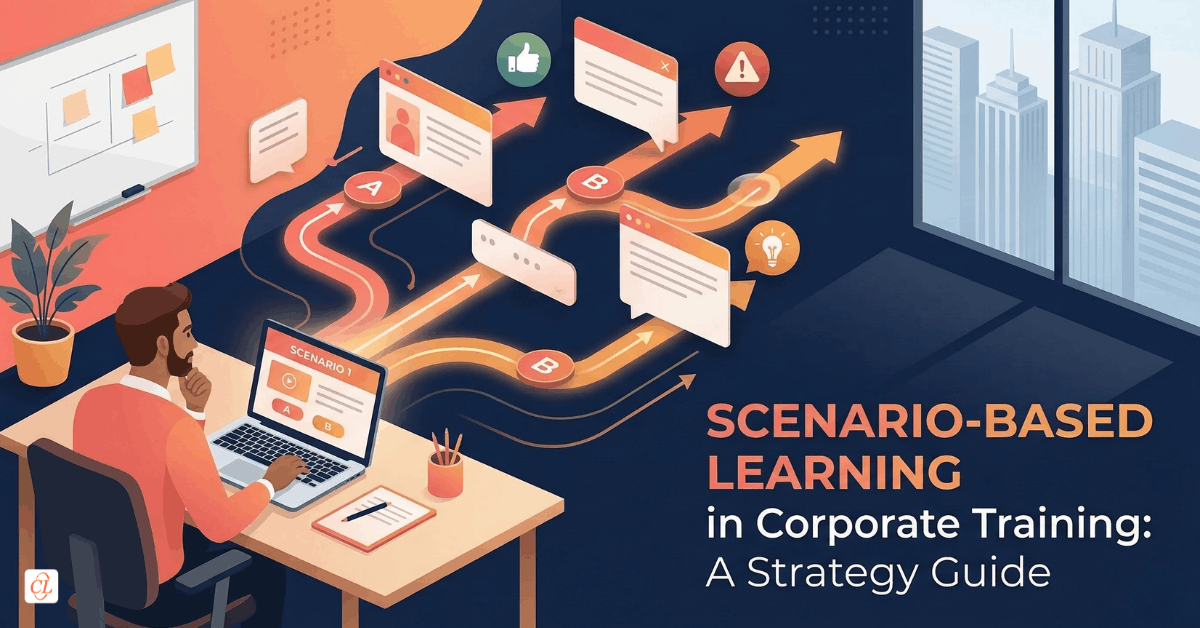
This is where scenario-based learning changes the game. Instead of presenting information and hoping employees remember it later, scenario-based learning places them inside realistic situations where they must analyze context, make decisions, and experience the consequences of their choices.
In this article, you will discover how scenario-based learning works, why it is one of the most powerful approaches in modern corporate training, and how organizations can design effective scenarios that improve real-world performance.
Download eBook Now: Scenario-Based Learning
Table of Contents
- Why Corporate Training Needs Scenario-Based Learning
- What Scenario-Based Learning Really Means
- Why Scenario-Based Learning Produces Stronger Learning Outcomes
- Where Scenario-Based Learning Creates the Most Business Value
- Types of Scenarios Used in Corporate Training
- The Core Design Principles of Effective Scenario-Based Learning
- Applying Scenario-Based Learning Across Training Programs
- Frequently Asked Questions
- Conclusion
Why Corporate Training Needs Scenario-Based Learning
Many workplace decisions are rarely straightforward. Employees often face situations that require judgment, interpretation, and context-based thinking.
For example:
- A customer service representative must respond to an upset customer.
- A salesperson must handle an unexpected objection.
- An employee must recognize a phishing email.
- A manager must address a sensitive employee issue.
These situations cannot be mastered through static slides or text-based explanations alone. Employees must practice decision-making in context.
Scenario-based learning provides that practice environment. It recreates realistic workplace situations and asks learners to choose actions, evaluate options, and see how their decisions influence outcomes.
Instead of simply learning information, employees learn how to apply knowledge when it matters most.
What Scenario-Based Learning Really Means
Scenario-based learning is an instructional approach that uses realistic situations to help learners practice decision-making and problem-solving.
Rather than presenting abstract concepts, the training introduces a narrative context that mirrors real work challenges.
A typical scenario includes:
- A realistic situation or problem
- Multiple possible responses
- Immediate feedback or consequences
- An explanation of the best course of action
This method helps learners connect knowledge to real-life application. It also encourages critical thinking, reflection, and practical understanding.
Most importantly, scenarios allow learners to make mistakes in a safe environment. They can experiment with different choices and see how decisions influence outcomes.
Why Scenario-Based Learning Produces Stronger Learning Outcomes
Scenario-based learning works because it mirrors how people actually learn and perform in real situations.
Traditional training focuses on information delivery. Scenario-based learning focuses on decision practice.
This shift has several advantages.
Active participation: Learners are not passive observers. They must evaluate the situation and choose how to respond. This active engagement increases attention and improves retention.
Contextual understanding: Information presented within a realistic scenario becomes easier to understand and remember. Learners see when and why a concept is important.
Safe failure: Employees can experiment with decisions without real-world consequences. This helps them understand mistakes and refine their thinking.
Better knowledge transfer: Because the training mirrors real situations, learners can apply what they learned more easily in their daily work.
Where Scenario-Based Learning Creates the Most Business Value
Scenario-based learning is especially effective when employees must interpret situations rather than simply recall information.
Some training areas benefit particularly well from this approach.
Customer service training
Customer service often involves emotionally charged conversations. Scenario-based learning helps employees practice responding to different customer personalities, complaints, and expectations.
Sales training
Sales professionals frequently encounter objections, negotiation challenges, and complex buying signals. Scenarios allow them to practice responding strategically.
Compliance and ethics training
Policies and regulations often involve gray areas. Scenarios help employees understand how rules apply in real situations rather than memorizing policy text.
Cybersecurity awareness
Employees must recognize suspicious emails, unusual requests, and potential threats. Scenario-based exercises help them develop situational awareness.
Software and systems training
Instead of simply demonstrating software functions, scenarios guide learners through realistic tasks and workflows.

Scenario-Based Learning: Mastering Real-World Problem Solving
Cultivate Critical Thinking and Problem-solving Skills with Scenario-based Learning!
- Types of Scenarios
- When to Use Scenarios and When to Refrain
- Tools and Best Practices for Crafting Scenarios
- And More!
Types of Scenarios Used in Corporate Training
Different training objectives require different types of scenarios.
Understanding these formats helps instructional designers select the most effective approach.
Decision-making scenarios
Learners analyze a situation and choose the best action from several options. Each choice leads to consequences that explain the reasoning behind the correct decision.
Conversation-based scenarios
These simulate real interactions with customers, colleagues, or stakeholders. Learners must choose responses during a conversation and see how the dialogue unfolds.
Process simulations
Learners complete tasks step by step in a simulated environment. This format is ideal for system training and procedural tasks.
Case-based scenarios
These provide a broader situation with multiple variables. Learners must evaluate the problem and determine a strategic solution.
Gamified scenarios
Game elements such as scoring, levels, or challenges can be added to increase engagement while reinforcing decision-making.
Scenario-based learning places learners inside realistic workplace situations where they must make decisions and evaluate outcomes.
The Core Design Principles of Effective Scenario-Based Learning
Designing powerful scenarios requires more than writing a story. The learning experience must focus on realistic decisions and meaningful consequences.
Several principles help ensure scenarios remain impactful.
Start with a real workplace challenge
The most effective scenarios are based on situations employees genuinely encounter. Interviews with subject matter experts and managers can help identify these moments.
Keep the situation believable
Scenarios should feel authentic. Learners must recognize the situation as something that could happen in their work environment.
Focus on critical decisions
Avoid overwhelming learners with too many choices. The scenario should center on the key decision that influences outcomes.
Provide meaningful feedback
Feedback should explain why a decision works or fails. This helps learners understand the reasoning behind the correct action.
Connect decisions to consequences
When learners see how their choices affect outcomes, the lesson becomes more memorable and impactful.
It is particularly effective for roles that require judgment, communication, and problem-solving rather than simple knowledge recall.
Applying Scenario-Based Learning Across Training Programs
Scenario-based learning can be integrated into many types of corporate training programs.
Leadership development
Managers must often handle difficult conversations, performance issues, and conflict resolution. Scenarios allow them to practice leadership decisions.
Onboarding programs
New employees can experience common workplace situations before encountering them in real life.
Product training
Sales teams can practice explaining product benefits and addressing customer concerns through simulated interactions.
Safety training
Workers can learn how to identify risks and respond to safety hazards in realistic situations.
Technical training
Scenarios can help employees apply technical knowledge to solve problems or perform complex tasks.
It is particularly effective for roles that require judgment, communication, and problem-solving rather than simple knowledge recall. Well-designed scenarios focus on authentic challenges, meaningful choices, and clear feedback that explains consequences.
Frequently Asked Questions
1. What is scenario-based learning?
A. Scenario-based learning is a training method that uses realistic situations to help learners practice decision-making and problem-solving in a safe environment.
2. Why is scenario-based learning effective?
A. It allows learners to apply knowledge in realistic contexts, which improves engagement, understanding, and retention.
3. When should organizations use scenario-based learning?
A. This approach is most effective when employees must interpret situations, communicate with others, or make complex decisions.
4. What types of training benefit from scenarios?
A. Customer service, sales, compliance, leadership, cybersecurity, and technical training often benefit from scenario-based learning.
5. How do you design a good scenario?
A. Start with a realistic workplace challenge, provide meaningful decision points, and offer feedback that explains the consequences of each choice.
Conclusion
Corporate training is most valuable when it prepares employees for the decisions they must make in real work situations. Scenario-based learning bridges the gap between knowledge and performance by allowing learners to practice responding to realistic challenges.
By designing authentic scenarios, focusing on critical decisions, and connecting choices to consequences, organizations can create learning experiences that go beyond information delivery. The result is training that builds confidence, improves judgment, and prepares employees to perform effectively when it matters most.


![Why Leverage Scenario-Based Learning for Sales Training? [Infographic]](https://www.commlabindia.com/hubfs/blogs/scenario-based-learning-sales-training-inf.jpg)