For years, Learning and Development focused on a single goal: delivering knowledge. Courses were built, content was deployed, and completion rates were tracked. Yet one persistent challenge remained: learning did not reliably translate into on-the-job performance.
This gap between knowing and doing is exactly where AI coaching agents are creating a fundamental shift. As LinkedIn's 2025 Workplace Learning Report found, the central L&D question has moved from 'How do we build a learning culture?' to something far more strategic: 'How do we build the right skills fast enough to execute our business strategy?' Nearly half of learning and talent development professionals now say their executives are concerned that employees lack the skills needed to deliver on business goals.
AI coaching agents are emerging as a key part of the answer: moving development from scheduled events into continuous, real-time performance support.
Download eBook: AI-Powered L&D Trends 2026
Table of Contents
- What Is an AI Coaching Agent?
- Why AI Coaching Agents Are Gaining Momentum
- How AI Coaching Agents Work
- Key Capabilities of AI Coaching Agents
- AI Coaching Agents vs Traditional Coaching
- Business Impact of AI Coaching Agents
- Implementation Strategy for L&D Teams
- Challenges and Considerations
- The Future of AI Coaching in L&D
- FAQs: AI Coaching Agents
What Is an AI Coaching Agent?
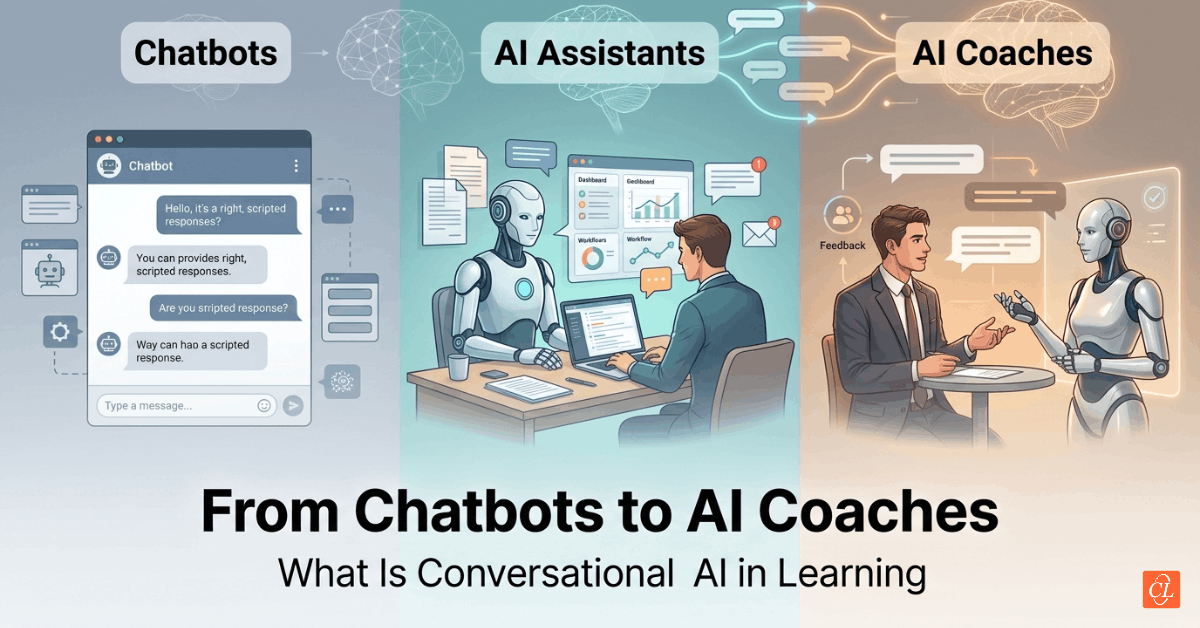
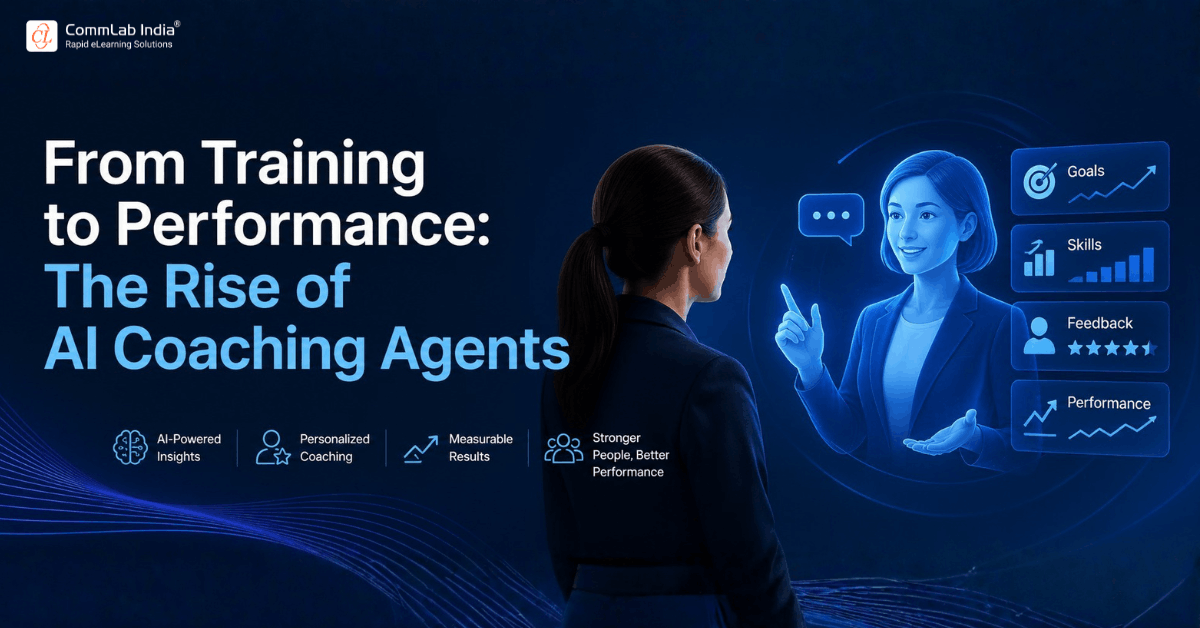
An AI coaching agent is a context-aware, autonomous system that provides real-time feedback, guidance, and performance support to learners as they apply skills in practice or on the job. Unlike traditional AI tools that simply respond to queries, a coaching agent is designed to observe, analyze, and guide behavior over time.
Rather than sitting inside a learning management system waiting to be opened, an AI coaching agent works where employees actually work: embedded in tools like Slack, Microsoft Teams, CRM platforms, or customer service interfaces.
In practice, a coaching agent typically does the following:
- Observes user behavior and actions in real or simulated environments
- Analyzes decisions and patterns against best-practice models
- Delivers immediate, contextual feedback while the experience is still fresh
- Suggests improvements, alternative approaches, or next steps
- Tracks progress over time and adapts its guidance accordingly
"Imagine a personal AI agent: one that knows who you are, your role, level, and experience: that is always there to teach you, constantly updated with new information about your job, career, and company. It's here.": Josh Bersin, March 2026
Why AI Coaching Agents Are Gaining Momentum
The accelerating adoption of AI coaching agents is not driven by technology novelty. It reflects a genuine shift in how organizations define learning success: and increasing pressure to deliver measurable performance outcomes, not just completed courses.
The Data Makes the Case
| 80–90% | Completion rates for AI-driven microlearning delivered via Slack or Teams, compared to 15–20% for traditional eLearning (Arist 2025 Benchmark Study) |
| 70–80% | Knowledge retention after 30 days with spaced, AI-delivered learning: more than double the 20–30% achieved by conventional courses (Arist 2025) |
| 60% | Improvement in knowledge retention after 90 days when learning occurs at the point of need, rather than in scheduled sessions (Arist research via Continu) |
| 44% | Share of workers' core skills projected to face significant disruption within five years, underscoring the urgency of continuous reskilling (World Economic Forum, cited in Naitive 2026) |
A Market Growing Rapidly
The coaching platform market is valued at approximately USD 4.22 billion in 2026 and is projected to reach USD 12.01 billion by 2036, expanding at an 11.0% compound annual growth rate. This growth is being driven by rising enterprise investment in workforce development, digital learning adoption, and increasing demand for leadership effectiveness measurement.
On the practitioner side, a 2026 Synthesia survey of L&D professionals found that 43% are actively exploring AI for coaching and mentoring, while 49% are investigating AI tutors. Only 4% expressed concern about agentic AI: suggesting that hesitation stems from unfamiliarity rather than resistance.
How AI Coaching Agents Work
AI coaching agents operate through a layered process of observation, analysis, feedback, and adaptation. The core workflow can be summarized in five stages:
Stage 1: Observation
The agent monitors user interactions, whether in live simulations, real customer conversations, or workflow tasks. In sales coaching, for example, this might involve listening to a call in real time. In a contact center, it could mean analyzing chat transcripts across multiple channels simultaneously.
Stage 2: Analysis
The agent evaluates observed performance against predefined models, competency frameworks, or historical patterns. Modern agents use multimodal AI to assess verbal content, tone, pace, and decision sequencing: going well beyond whether a task was completed.
Stage 3: Feedback
Actionable insights are surfaced immediately or shortly after the interaction, while context is still fresh. This immediacy is critical: delayed feedback requires learners to reconstruct situations mentally, which reduces its effectiveness.
AI-Powered L&D Trends 2026
Your L&D Playbook
- The need for AI fluency at work
- Skill-based learning 2.0
- Top AI tools for L&D
- Real stories from L&D teams
- And more
Stage 4: Guidance
The agent suggests next steps: alternative talking points, additional practice scenarios, or reinforcement content. In sophisticated implementations, it can trigger role-play simulations based on a rep's specific weak points.
Stage 5: Continuous Learning
The system refines its recommendations over time based on user progress, outcomes data, and evolving business requirements. This creates a feedback loop in which learning and performance continuously inform each other.
Key Capabilities of AI Coaching Agents
Not all AI coaching tools are equal. The following capabilities distinguish mature coaching agents from simpler training tools:
Real-Time, In-the-Flow Feedback
Feedback delivered at the moment of action: rather than in a post-session review: produces significantly better retention and behavioral change. AI agents embedded in Slack, Teams, or CRM systems can retrieve policies, flag errors, or suggest better responses without the employee leaving their workflow.
Contextual, Role-Specific Guidance
Recommendations are tailored not just to what the employee did, but to their specific role, customer segment, and organizational context. A new hire and a senior manager completing the same task should receive meaningfully different coaching.
Behavioral and Multimodal Analysis
Leading agents analyze how tasks are performed, not just whether they are completed. Tools like Retorio use multimodal AI to evaluate verbal, vocal, and visual cues together, providing holistic feedback that surface-level analytics miss.
Simulation and Safe Practice
AI agents can populate virtual environments with dynamic, non-scripted characters that respond differently each time. This creates a safe sandbox for high-stakes practice: whether a difficult customer objection, a compliance conversation, or a performance discussion: without real-world consequences.
Personalization at Scale
Each learner receives coaching calibrated to their own performance profile: without requiring human coach time for every interaction. This is the key structural advantage over traditional coaching: the cost per coaching touchpoint approaches zero as deployment scales.
AI Coaching Agents vs Traditional Coaching
Human coaching remains essential for nuanced, strategic, and emotionally complex development. AI coaching agents are not replacements: they are force multipliers that extend reach, consistency, and frequency in ways that human coaches alone cannot achieve.
| Dimension | Traditional Human Coaching | AI Coaching Agent |
| Availability |
Scheduled sessions; limited hours |
Always available, 24/7 |
| Scalability | One coach to ~5–10 coachees effectively | Scales to thousands simultaneously |
| Feedback timing | Hours to weeks after the event | Immediate, in-the-moment |
| Personalization | Depends on coach skill and time | Data-driven, consistent, continuous |
| Cost per session | High: coach time plus scheduling overhead | Near-zero marginal cost at scale |
| Emotional intelligence | High: nuanced, relational | Developing: improving with multimodal AI |
| Strategic guidance | Excellent for complex decisions | Limited: best used for skill reinforcement |
| Data visibility | Anecdotal, qualitative | Quantifiable, trackable, reportable |
While human coaching remains invaluable for nuanced and strategic development, AI coaching agents complement it by providing continuous, scalable support.
Business Impact of AI Coaching Agents
Organizations that have moved from pilot to scaled deployment of AI coaching agents are reporting measurable improvements across three categories:
Performance Outcomes
- Faster skill acquisition: microlearning-based AI coaching reduces learning curves from 8–12 weeks to 2–3 weeks in some implementations
- Improved task execution quality: real-time feedback enables course correction before habits form
- Increased consistency across large teams: AI coaches apply the same quality standards to every interaction
Operational Efficiency
- Administrative burden on L&D teams reduced by 60–80% through automated assignment, tracking, and reporting
- Development timelines and content costs drop by 70–85% when AI is used to generate and adapt learning material
- Faster onboarding: sales teams ramping to full productivity in 3 months rather than 6 months translate directly to revenue impact
Strategic Impact
According to a retail example from Deloitte research, stores where managers completed AI-supported coaching modules saw an 18-point Net Promoter Score gain, compared to only 4 points in control locations. This level of granularity is what transforms L&D from a support function into a demonstrable business driver.
However, a note of realism is warranted. Deloitte's research also indicates that typical AI use cases take two to four years to achieve satisfactory ROI, and only one in five companies currently has a mature governance model for autonomous AI agents. Organizations should plan for a meaningful ramp period, not overnight transformation
Implementation Strategy for L&D Teams
Adopting AI coaching agents requires more than selecting a vendor. The following five-step approach reflects what high-performing organizations are doing in practice:
Step 1: Identify High-Impact Use Cases
Focus first on areas where performance gaps most directly affect business outcomes. Sales, customer service, and compliance are natural starting points because they have measurable performance metrics and high-volume repetitive interactions: exactly the conditions where AI coaching delivers fastest ROI.
Step 2: Define What 'Better' Looks Like
Clearly establish behavioral and business KPIs before implementation. The question 'How will this initiative help you make money, save money, or mitigate risk?' should be answerable before the first prompt is written.
Step 3: Integrate with Existing Systems
AI coaching agents need access to relevant data to be useful: CRM histories, competency frameworks, LMS records, and real customer interaction data. Agents that operate in isolation from business systems quickly become generic and lose contextual relevance.
Step 4: Run a Structured Pilot
Test in a controlled environment with a defined cohort, clear measurement period, and pre-agreed success criteria. Pilots that lack defined endpoints tend to drift into permanent proof-of-concept status without ever scaling.
Step 5: Scale and Optimize
Expand usage while continuously refining based on performance data. Build in a feedback loop between the coaching agent's outputs and human L&D judgment: particularly for edge cases and complex situations the AI handles poorly.
Challenges and Considerations
The potential of AI coaching agents is real, but so are the challenges. Organizations that succeed tend to address these issues directly rather than discovering them mid-deployment.
Data Quality and Availability
AI coaching agents are only as good as the data they learn from. Poor-quality training data produces inaccurate feedback: and inaccurate feedback in a coaching context erodes trust quickly. Organizations should conduct a data audit before selecting a platform.
User Trust and Adoption
The Synthesia 2026 survey found that while 74% of L&D professionals say their culture encourages experimentation, only 45% feel that IT is actively enabling AI adoption. The trust gap between enthusiasm at the leadership level and readiness at the practitioner level is one of the most common implementation blockers.
Privacy, Ethics, and Governance
Monitoring employee behavior: even for coaching purposes: requires clear governance, transparent communication, and genuine consent processes. Deloitte's research notes that only 20% of enterprises have a mature governance model for autonomous AI agents. This is the area where most organizations are most underprepared.
Over-Reliance on Automation
AI coaching agents excel at high-volume, pattern-based feedback. They are not well-suited to complex emotional situations, novel ethical dilemmas, or the kind of developmental challenge that requires genuine human relationship. Designing AI coaching programs without this distinction leads to misapplication and employee frustration.
The ROI Lag
While 91% of organizations plan to increase AI spending, Deloitte's research indicates that returns can be slow to materialize: typically two to four years for AI use cases to achieve satisfactory ROI. Organizations treating AI coaching as a quick cost-reduction exercise often become discouraged before the compound benefits appear.
The Future of AI Coaching in L&D
By 2027, analysts expect enterprise learning ecosystems to include multi-agent architectures: networks of specialized AI agents working in coordination. A content agent generates learning material. A compliance agent monitors adherence. A performance agent tracks skill application. A nudge agent delivers timely reinforcement. These agents share data and handoff context between them automatically.
Gartner predicts that by 2028, two-thirds of enterprises will require that learning is experienced through generative AI capable of providing intelligent, personalized guidance on the skills employees should develop. This is not a distant horizon: organizations building these capabilities now will have a significant structural advantage.
For L&D leaders, the direction is clear: the function is moving from designing training programs to engineering continuous performance ecosystems. AI coaching agents are not a feature within that ecosystem: they are increasingly its operating layer.
The most effective organizations in 2026 are those combining AI-driven learning with strong career development systems. AI alone does not solve the skills challenge. The winning formula is AI coaching embedded within a broader structure of leadership development, mentorship, and internal mobility.
Key Takeaways
- AI coaching agents provide real-time, contextual, personalized feedback at a scale that human coaching cannot match: but they complement rather than replace human coaches.
- The business case is strongest in high-volume, pattern-based roles: sales, customer service, compliance, and technical upskilling.
- Measurable results require clear KPIs, quality data, system integration, and a 2–4 year horizon for full ROI realization.
- Governance, privacy, and employee trust are the most common failure points: and the ones most frequently underestimated.
- The trajectory points toward multi-agent learning ecosystems where coaching, content, compliance, and analytics agents work in concert.
FAQs: AI Coaching Agents
1. What is an AI coaching agent in simple terms?
A. An AI coaching agent is a digital system that provides real-time feedback and guidance to help individuals improve their performance while they are learning or working.
2. How is an AI coaching agent different from a chatbot?
A. A chatbot responds to user queries, while an AI coaching agent actively observes behavior, analyzes performance, and provides proactive feedback and guidance.
3. Can AI coaching agents replace human coaches?
A. No, they are designed to complement human coaches by providing continuous, scalable support, while human coaches focus on strategic and complex development.
4. Where are AI coaching agents most effective?
A. They are most effective in performance-driven areas such as sales, customer service, leadership development, and technical training.
5. What are the benefits of using AI coaching agents?
A. Key benefits include real-time feedback, improved performance, scalability, cost efficiency, and better alignment between learning and business outcomes.
6. What is required to implement AI coaching agents?
A. Organizations need clear use cases, structured data, system integration, and a phased implementation approach to successfully deploy AI coaching agents.
Sources and Further Reading
- LinkedIn Workplace Learning Report 2025
- Deloitte: State of AI in the Enterprise 2025–2026
- Synthesia: AI in Learning & Development Report 2026
- Arist 2025 Benchmark Study (via Continu research analysis)
- Josh Bersin: The Enterprise Learning Tech Market Transforms Around AI (March 2026)
- Future Market Insights: Coaching Platform Market Size & Demand 2026–2036
- Naitive: AI Agents in Corporate Training: Trends 2025
- TechClass: Future-Proofing Your Workforce: 5 AI Predictions for Corporate Training