

The Truth L&D Doesn’t Say Out Loud
Only 46% of employees are satisfied with their career development!
Source: Gartner
You can build the most brilliant course.
You can partner with the best subject matter experts (SMEs).
You can design the tightest, cleanest instructional flow.
And yet – if nobody knows about the training, nobody attends. If they attend but don’t feel motivated, they don’t complete. If they complete but don’t feel connected, they don’t apply the learning at work.
Training adoption is no longer an instructional design problem. It’s a marketing problem.

This is why learning marketing is emerging as a critical capability for modern L&D teams.
As workplaces become noisier, more digital, and more distracted, L&D must think like marketers:
- Captivating attention
- Communicating value
- Personalizing messaging
- Driving behavior change
- Reinforcing application
- Proving visible business impact
What Is Learning Marketing?
Learning Marketing is the intentional practice of promoting training initiatives to increase awareness, adoption, and application of learning across an organization.
It applies proven principles from consumer, product, and digital marketing – but adapts them to workplace learning.
Learning marketing helps L&D achieve things instructional design alone cannot:
- Win learner attention in overloaded inboxes
- Break through organizational noise
- Position training as essential, not optional
- Boost participation without forcing
- Create anticipation, not obligation
- Showcase benefits in learner-friendly language
- Build a strong, trusted L&D “brand” inside the company
In simple terms, learning marketing is how L&D ensures training is seen, understood, valued, and acted upon.
Why L&D Needs Learning Marketing – Now More Than Ever
Training no longer sells itself. Employees are overwhelmed by Slack/Teams messages, email overload, meeting-heavy calendars, daily operational pressure, and constant digital notifications.
In this noise, traditional training announcements are invisible.
Modern employees act like customers, not learners. They don’t sign up because a training exists. They sign up because they see value. Marketing bridges that gap.
Business leaders expect visible impact.
Training impact is now under scrutiny. CFOs and CEOs ask:
“Are people completing courses?”
“Are they applying skills quickly?”
“Is training reducing errors / boosting sales / improving safety?”
Learning marketing accelerates adoption and increases completion rates – which improves the likelihood of measurable impact.
Also Read: The Evolution of L&D: From Courses to Capability Building
AI and automation have increased the pace of change. Organizations need rapid skill adoption. Without marketing, even the most important programs get delayed.
Understand Your Learners
Before marketing a training program, you must understand the people you’re marketing to.
Segment Your Learners
Break your audience into meaningful groups – by:
- Role
- Department
- Skill levels
- Language
- Motivation type
Identify Their Pain Points
Learners often don’t resist training. They resist what the training costs:
- Time
- Effort
- Cognitive load
- Attention
- Productivity dips
Understand Their Triggers
People take action when they feel:
- Urgency
- Personal relevance
- Social proof
- Manager expectation
- Reward anticipation
Learning marketing builds these triggers into your campaigns.
Building a Learning Marketing Strategy (Step-by-Step)
A simple, action-ready framework to plan and execute high-impact learning marketing campaigns.
Step 1: Define Clear Objectives
Start by identifying the specific outcome your campaign needs to influence. Clear objectives guide your messaging, timing, and measurement.
Examples:
- Drive 80% completion for mandatory compliance
- Get 60% of salesforce certified before a product launch
- Reduce onboarding ramp-up time by 30%
- Improve adoption of a new tool (CRM, ERP, AI assistant)
Step 2: Identify Priority Learner Segments
Not all learners have the same motivations or challenges. Segmenting your audience helps you tailor communication that feels relevant, not generic.
Segment by:
- Role and function
- Work patterns (frontline, hybrid, shift-based, field)
- Regional operational context
- Language and cultural preferences
- Motivation type (career growth, compliance, performance, curiosity)
Step 3: Craft a Strong Learning Value Proposition (LVP)
Your campaign needs a simple, compelling message that tells learners why this training matters to them.
Build your LVP around:
- The problem the training solves
- Benefits to the learner (career, productivity, speed, confidence)
- What happens if they don’t learn (risk, delays, errors, missed goals)
- A clear, concise WIIFM statement
Instead of saying: “Complete the Data Security module.”
Say: “Protect customer trust. Learn how to avoid the 7 most common data breaches.”

Step 4: Design a Multi-Phase Campaign
Break your campaign into phases so learners move from awareness → action → completion → application smoothly.
Phases to plan:
- Awareness: Teasers, videos, announcements
- Launch: Strong messaging, benefits, easy access
- Activation: Reminders, manager nudges, early momentum
- Completion: Progress milestones, gamification, encouragement
- Application: Job-aids, follow-ups, on-the-job prompts
Step 5: Choose the Right Communication Channels
Use channels your learners naturally check throughout the day. Multi-channel messaging increases visibility and reduces drop-off.
A strong learning marketing plan uses multi-channel messaging:
- Emails
- Slack/Teams nudges
- Intranet/LMS
- Manager-driven communication
- WhatsApp/SMS
- Digital signage
- QR codes for quick access
Related read eLearning: 5 Communication Strategies
Step 6: Equip Managers as Learning Champions
Managers influence learner motivation more than any system or announcement. Give them simple tools that make promotion effortless.
Include:
- Talking points for team meetings
- Slack/Teams messages they can copy-paste
- Progress dashboards
- Scripts for reinforcing deadlines and expectations
- Short explainer videos
Watch the video to learn 5 high-level strategies to market learning inside your organization—so your programs get noticed, chosen, and applied.
Step 7: Use Behavioral Nudges to Drive Action
Leverage basic behavioral psychology to help learners start and finish without feeling pressured.
Nudges that work:
- Social proof (“70% of team has completed the training”)
- Scarcity (“Modules close in 5 days”)
- Commitment nudges (Reserve your spot now – it takes less than 10 seconds)
- Momentum triggers (milestones, badges – You’re halfway there! Just 2 modules to go.)
- Loss aversion (“Don’t miss your certification renewal deadline.”)
Step 8: Set Up a Measurement Framework
Measure what matters – not just clicks, but behavior change. Define what success looks like before the campaign goes live.
Track:
- Awareness: Opens, views
- Activation: Registrations, first login
- Progress: Module-level drop-offs
- Completion: Total % completed
- Application: Manager feedback, job performance
- Business impact: Sales, errors, productivity, customer satisfaction
Step 9: Optimize and Scale What Works
Every campaign gives you insights. Use them to build reusable templates and repeatable processes so future campaigns launch faster and perform better.
Standardize:
- Templates (emails, posters, scripts)
- Nudging sequences
- Creative formats (videos, microcontent)
- Dashboards
- Regional variants
- Best-performing messages
Read more: eLearning Marketing: Tips for L&D to Turn into Marketers
The Learning Marketing Funnel
A funnel helps L&D predict learner behavior instead of simply hoping for engagement.
Instead of viewing training as a one-time “announcement → completion” event, the funnel recognizes that learners move through stages, just like customers do in marketing.
This makes adoption more deliberate, measurable, and scalable.
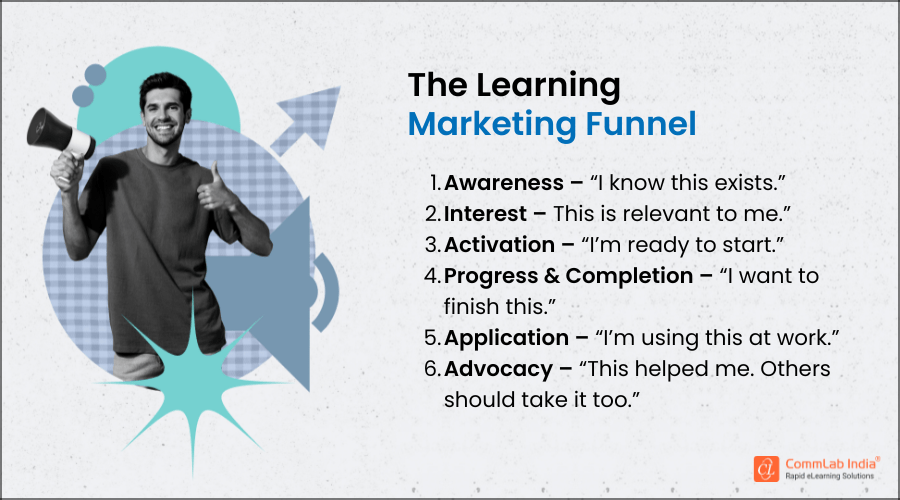
Below is the modern Learning Marketing Funnel – designed specifically for enterprise L&D teams.
1. Awareness – “I know this exists.”
This stage is all about visibility. The goal is not to convince learners, but to ensure the training becomes unmissable in their daily digital flow.
What works:
- Teasers & short trailers
- Catchy “Did you know?” hooks
- LMS banners & intranet highlights
- Save-the-date messages
- Leadership announcements
Key insight: If learners never notice the training, nothing else matters.
2. Interest – This is relevant to me.”
Once awareness is created, learners need a reason to care. Here, the campaign shifts from “There is training” to “This training solves a problem you have.”
What works:
- Clear WIIFM messaging
- Real-world problem statements
- Role-specific variants (“for managers,” “for sales,” “for frontline”)
- Short demos or previews
- Testimonials or examples of success
Key insight: Relevance is the bridge between knowing and acting.
3. Activation – “I’m ready to start.”
Interest doesn’t automatically create action. This stage removes friction and nudges learners to take the first step – logging in, registering, or starting Module 1.
What works:
- One-click access
- Personalized reminders
- Nudges for non-starters
- Manager encouragement
- Mobile-accessible modules
- Pre-registration (commitment nudge)
Key insight: Starting is the hardest part. Your job is to make it effortless.
4. Progress & Completion – “I want to finish this.”
This is where most learners fall off. The goal is to create momentum, celebrate progress, and soften the cognitive load so learners feel motivated to continue.
What works:
- Milestones
- Progress badges
- Short “Keep going!” nudges
- Microlearning modules
- Clear time expectations
- Learner-focused scripts (“Only 10 minutes left today”)
Key insight: Momentum is more powerful than motivation. Small wins drive big progress.
5. Application – “I’m using this at work.”
Completion is not the end of the funnel – it’s the pivot point. This stage ensures the new skill or knowledge translates into real workplace behavior.
What works:
- Job-aids & checklists
- Micro-reminders or spaced repetition
- Simulation refreshers
- Weekly “Try this at work” nudges
- Manager follow-up prompts
- Quick self-assessments
Key insight: Learning has no value until behavior changes.
6. Advocacy – “This helped me. Others should take it too.”
This is the most overlooked stage – and the most powerful. When learners become promoters, training spreads organically across teams.
What works:
- Learner spotlights
- “Share your takeaway” posts
- Success stories from early adopters
- Recognition for fast completers
- Team-based achievements
- Social-style testimonials
Key insight: Advocacy turns training into a movement – not a mandate.
Why the Funnel Matters?
It gives L&D a predictable adoption model, revealing where learners are dropping off (and why). The funnel improves campaign timing, messaging, and targeting. It ensures training doesn’t stop at “completed” but leads to habits, performance, and business results
It shifts L&D from course creators to experience designers. When L&D designs with this funnel in mind, engagement becomes predictable and repeatable.
For detailed insights into the Advantages of Learning Marketing for L&D, read this blog.
Tools, Assets, and Formats for Learning Marketing
A successful learning marketing campaign needs a mix of formats – some to grab attention, some to clarify value, and others to keep learners moving. Here’s a practical toolkit your L&D team can use immediately.
Teaser Videos (15–30 seconds)
Teasers build curiosity and give learners a quick “why should I care?” moment before launch.
Key elements:
- Problem statement: Show the pain or risk the training solves
- Quick visuals: Fast cuts, product shots, or relatable scenarios
- Emotional hook: Surprise, urgency, humor, or relevance
- Call to action: “Starts Monday,” “Don’t miss it,” or “Watch the intro”
Internal Email Campaigns
Email remains a high-visibility channel – but only when structured as a sequence that builds relevance and urgency.
A strong 3-email sequence includes:
Email 1:
Why now + key benefits
Email 2:
Reminder + role-specific relevance
Email 3:
Personal nudge or “last call” with deadlines
Social-Style Content
Employees consume work content the way they consume Instagram or YouTube – short, visual, and snackable.
Manager Communication Toolkits
Managers are the biggest influence on learner adoption – equip them with ready-to-share content.
Provide them:
- Talking points to reiterate in standups
- Sample messages they can share on Slack/Teams
- Target dates to reinforce urgency
- Role-specific expectations on what their team must complete and why
Learning Landing Pages
Instead of long announcements, use a simple landing page. A simple landing page gathers all relevant information in one place – reducing confusion and decision fatigue.
Essential elements:
- Why this training matters: 2–3 benefit-driven sentences
- Who should attend: Roles, levels, locations
- Benefits: What they gain, save, or improve
- What you’ll learn: Short bulleted outcomes
- Time needed: Clear expectations (e.g., 20 minutes)
- How to access: One-click link
- FAQs: Remove doubts before they arise
Posters, Digital Signage, QR Codes
For physical locations or frontline workforces, visual prompts increase awareness and make access effortless.
Use when learners are:
- In factories, warehouses, retail floors
- Not checking email regularly
- More responsive to visual reminders
Gamification Mechanics
Gamification boosts motivation and helps learners feel progress, not pressure.
Mechanics that work:
- Leaderboards: Friendly competition
- Badges: Visible achievements
- Rewards: Small incentives or recognition
- Micro-challenges: Short tasks to build consistency
- Level systems: Bronze → Silver → Gold completion tiers
Measuring the Success of Learning Marketing
A strong learning marketing strategy must be measurable. Marketing only works when you know which parts are performing well. Measurement turns your campaigns from guesswork into science.
Core Metrics to Track
These metrics help you see whether learners notice, start, continue, and apply the training.
- Awareness: Views, impressions
- Engagement: Opens, clicks, video watch rates
- Activation: Sign-up rate
- Completion: % finished and where they dropped off
- Application: Survey + job performance
- Business results: Sales, safety, productivity
Analytics Tools
Use multiple data sources to get a full view of learner behavior and campaign performance.
- Learning Management System reports: Progress, drop-offs, completions
- Email marketing dashboards: Open rates, click-throughs
- BI tools: Cross-department or region insights
- Experience APIs (xAPI): Track learning outside the LMS
- AI nudging analytics: Who nudges worked for
- Survey dashboards: Post-training feedback and application
Learn how to implement learning analytics effectively—watch the video for the ultimate step-by-step guide.
Reporting Templates
Consistent reporting helps spot patterns and act quickly. Your weekly training adoption report should include:
- Registrations: Who has signed up
- Completion rate: Individual and team
- Drop-off stages: Exactly where learners stop
- Top teams/low-performing teams: For targeted follow-ups
- Regions needing more nudges: Language or timing issues
- Manager engagement: Which managers are reinforcing adoption
Common Challenges L&D Faces – and How to Overcome Them
Even the best-designed training struggles without strong internal marketing. These are the barriers most L&D teams face – and simple ways to resolve them.
Challenge 1: “I don’t have time for training.”
Solution: Micro content, task-based nudges.
Challenge 2: Low manager involvement
Solution: Manager toolkits + dashboards showing team compliance.
Challenge 3: Global rollout complexity
Solution: Multi-language marketing packs; regional customizations.
Challenge 4: Too many corporate communications
Solution: Short-form content + creative formats.
Challenge 5: Employees don’t see the value
Solution: Benefit-led messaging, career relevance, real examples.
Challenge 6: Slow creative production
Solution: AI-assisted rapid development of videos, posters, and landing pages.
How CommLab India Helps L&D Market Learning Better
Most L&D teams struggle not because the training is bad – but because marketing it is hard.
CommLab India helps global enterprises solve exactly this problem with:
- Rapid production of learning marketing assets
- Multi-language communication in 35+ languages
- Enterprise-ready visual design and video creation
- Marketing toolkits and adoption playbooks
- Manager communication packs
- Pre-launch trailers, teasers, snackable videos
- Ready-made templates for posters, emails, landing pages
We make your learning impossible to ignore – and even harder to forget.
Impact Examples for Real Enterprises
Not just theory – explore real outcomes delivered for global organizations with complex, high-stakes training needs. Each example demonstrates how strategic learning marketing can transform adoption, accelerate readiness, and create measurable business impact.
Case Study 1: Global Retail – 60,000 Learners Activated in 14 Days
A Fortune 500 retail giant needed to upskill tens of thousands of store associates on new in-store processes – fast, consistently, and across multiple regions.
We delivered
- High-impact teaser video to spark initial awareness
- QR-code posters placed inside stores for instant access
- Ready-to-use manager messaging toolkit
- A structured 2-week nudging and reinforcement campaign
Business impact
- 68% completion in just 14 days
- 92% completion in 30 days
- 35% reduction in operational errors
Rollout landed smoothly across 1000+ store locations
Case Study 2: Pharma – Compliance Completion From 40% to 88%
This lading pharmaceutical company faced serious compliance risks due to poor course completion rates. A traditional announcement-based approach simply wasn’t working.
We delivered
- Clear, problem-based messaging to highlight risk and urgency
- Short, targeted micro-videos to simplify complex concepts
- Leader dashboards to equip managers with visibility and ownership
- Personalized email nudges based on learner progress
Business impact
- Completion rates doubled (from 40% to 88%)
- Audit issues significantly reduced
- Faster certification cycles across regulated teams
- A repeatable adoption playbook for future compliance programs
The organization moved from reactive compliance to proactive readiness – through better marketing.
Case Study 3: Global Tech Company – Sales Enablement at Product-Launch Speed
A fast-growing technology company needed its salesforce across 20 countries to master new product features before launch. Delayed adoption would have meant missed revenue targets.
We delivered
- Product-focused trailer videos that created excitement
- Clean, focused learning landing pages with role-specific benefits
- Regional, role-based campaigns for managers, SDRs, and solution engineers
Business impact
- 75% of the salesforce certified within 3 weeks
- Consistent product messaging across all markets
- On-time global product launch supported by confident, well-trained sales teams
This is the difference between training that “exists” – and training that truly accelerates business results.
L&D’s New Advantage: Turning Learning Into a Movement
The truth is simple: in today’s noisy, fast-moving workplaces, great training isn’t enough.
Learners won’t show up just because a course exists – they show up when it’s marketed with intention, relevance, and energy.
Learning marketing gives L&D a new advantage – it:
- Transforms training from a task into an experience learners want to be part of.
- Creates anticipation, builds momentum, and keeps people engaged long after the last module ends.
- Turns learning from a one-time event into a movement that spreads across teams, regions, and roles – delivering tangible business results leaders can actually see.
What L&D Should Do Next?
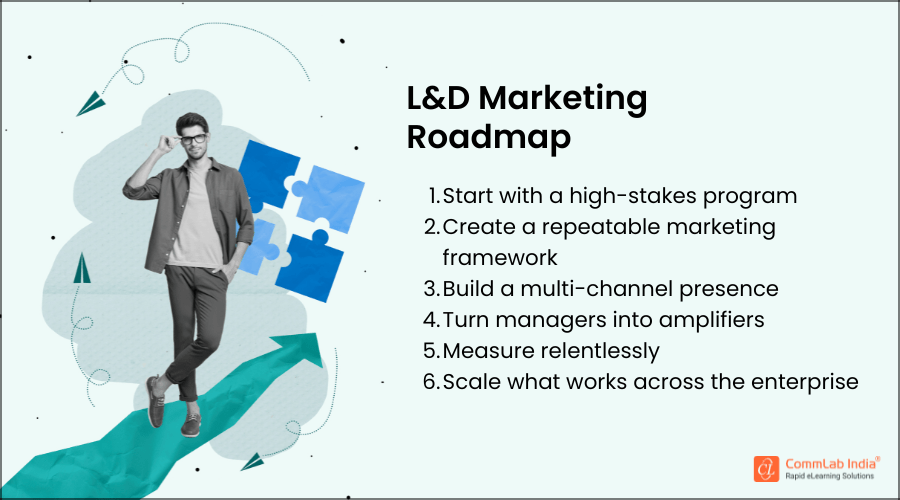
If your goal is to make learning visible, valued, and impossible to ignore, here’s your way forward:
The Future of L&D Belongs to Teams Who Market Their Learning
Organizations don’t need more courses. They need learning that gets noticed, learning that gets finished, and learning that gets used.
L&D teams who master learning marketing will be the ones who:
- Drive faster adoption
- Build stronger learning cultures
- Support business transformation at speed
- Earn a strategic seat at the leadership table
Because when you market learning with clarity and creativity, you don’t just deliver training, you deliver impact. You need to show employees how training connects to real business problems and their own growth. When learners see that alignment, adoption increases, application improves, and your training initiatives create measurable impact.