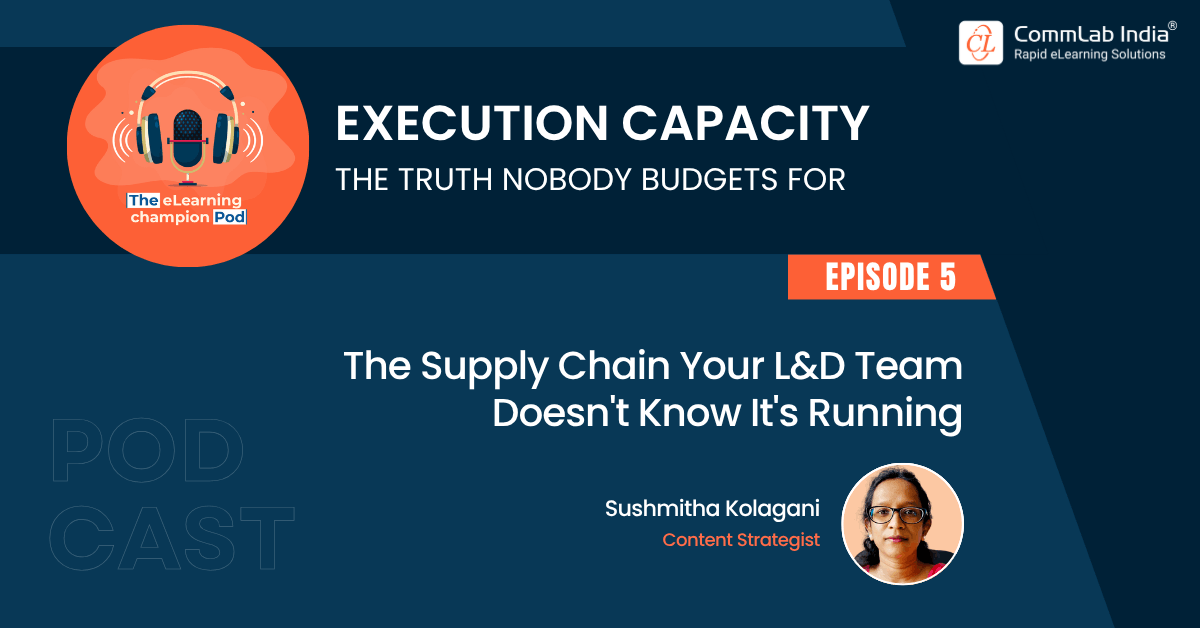
The Supply Chain Your L&D Team Doesn't Know It's Running
Know Who’s Talking
Sushmitha Kolagani
Sushmitha Kolagani is the Content Strategist at CommLab India. Sushmitha's journey started with a simple love: reading and writing. That love led her into instructional design, business writing, and along the way, she picked up the technical side of the craft too — SEO, AEO, and everything in between. Equal parts creative and imaginative, she's spent over 13 years finding new ways to make content that people actually want to engage with.
Think of the last time you relied on a supply chain. Behind that experience, a system moved raw inputs through defined stages into a finished, quality-checked output. Enterprise training operates the same way. And that’s exactly why most training supply chains suffer from bottlenecks, quality lapses, and delays that no one can fully explain.
In Episode 5, Sushmitha ties the entire series together with the learning operations model, the framework that makes everything else in this series actionable. She breaks down the components that transform training requests into governed outputs, what each maturity stage looks like in practice, and what the data reveals about where your production process is losing efficiency.
Click Here To Read Transcript
00:00:00 Sushmitha
Think about the last time you interacted with a supply chain.
00:01:08 Sushmitha
And that’s why most training supply chains have bottlenecks, quality failures, and delivery delays.
00:01:18 Sushmitha
I’m Sushmitha. Welcome to Episode 5.
00:01:50 Sushmitha
This is my favorite conversation in this series because the Learning Operations Model is the framework that makes everything else actionable.
00:04:18 Sushmitha
What your rework rate is, and what it tells you about where your production process is losing efficiency.
00:04:48 Sushmitha
Quality governance in a mature Learning Operations Model is built into the production process, not added at the end.
00:06:26 Sushmitha
These tell you whether the production system is working.
00:06:29 Sushmitha
Impact measurement tracks outcomes: capability acquisition, behavior change, performance metrics connected to the training objectives.
00:07:26 Sushmitha
Developing: a defined intake process exists.
00:07:28 Sushmitha
A regular prioritization review happens, but demand is largely reactive.
00:07:34 Sushmitha
The team responds to requests rather than anticipating them.
00:08:37 Sushmitha
But the process isn’t consistently applied, and there are recurring bottlenecks not being systematically addressed.
00:09:48 Sushmitha
Aspiration to measure more systematically, but limited methodology or capacity.
00:14:57 Sushmitha
Average review waiting time dropped to 3 days within 3 months.
00:15:24 Sushmitha
The CEO cited the training function’s delivery of the program in the annual report.
00:15:42 Sushmitha
Episode 1: Learning execution capacity, the dependable ability to turn learning priorities into finished, governed outputs at scale and speed, is the most consistently underinvested variable in whether an enterprise training function succeeds.
00:16:57 Sushmitha
I’m Sushmitha. Thank you for listening to the eLearning Champion Podcast.
Here are some takeaways.
Why does Training Need an Operations Model?
Because training is a supply chain, whether or not you manage it like one. Requests arrive, content gets produced, reviewed, and delivered, and results are expected on the other end. When there’s no model governing how work flows through those stages, the problems surface in predictable places: bottlenecks, quality failures, and a team stuck in constant reaction mode.
Episode 1 of this series defined learning execution capacity as the dependable ability to turn learning priorities into finished, governed outputs at scale and speed. It remains the most consistently underinvested variable in whether an enterprise training function succeeds. The learning operations model is how you build that capacity intentionally, instead of hoping it emerges on its own.
What are the Core Components of a Learning Operations Model?
Each component governs a different part of the training supply chain.
Demand Management
This is where work enters the system. A defined intake process captures requests, and a regular prioritization review decides what gets built and when. Without it, the team works on whatever arrives first or whoever pushes hardest.
The Production Process
This is how requests become finished learning assets. Its metrics tell you whether the production system is working and where it’s losing efficiency. Review cycles are a common place to look, since waiting time between stages quietly stretches every timeline.
Quality Governance
In a mature learning operations model, quality governance is built into the production process, not tacked on at the end. When quality checks sit only at the finish line, errors travel through every stage before anyone catches them, and rework becomes part of the schedule.
Impact Measurement
Production metrics tell you whether the system is working. Impact measurement tells you whether the training is. It tracks outcomes such as capability acquisition, behavior change, and performance metrics connected to the training objectives.
What does the “Developing” Stage Look Like?
Most enterprise training functions aren’t starting from zero. They sit in the middle, with some structure in place but not enough to make it dependable. Sushmitha describes this developing stage across the model.
Demand Is Defined but Still Reactive
A defined intake process exists. A regular prioritization review happens. But demand is still largely reactive. The team responds to requests rather than anticipating them, so capacity planning is always a step behind the business.
Process Exists but Isn’t Consistent
There is a production process, but it isn’t consistently applied. Recurring bottlenecks show up project after project and aren’t being systematically addressed. Everyone knows where the delays are, but nothing structural changes.
Measurement is an Aspiration
There’s an aspiration to measure more systematically, but limited methodology or capacity to do it. Outcomes like capability acquisition and behavior change go largely untracked.
If these signals sound familiar, the gap isn’t effort or talent. It’s the operating model around the team.
What Happens When You Fix the Bottlenecks?
Operational fixes produce visible results quickly, and they don’t stay inside the L&D function for long.
From Review Delays to a 3-Day Turnaroun
Review waiting time is one of the most common hidden bottlenecks in training production. In the example Sushmitha shares, once the process was addressed systematically, the average review waiting time dropped to 3 days within 3 months.
From Output to Recognition
The results reached the top of the organization. The CEO cited the training function’s delivery of the program in the annual report. That’s what happens when L&D can show both dependable production and measurable outcomes: its contribution becomes visible at the leadership level.
What Should You Do This Week?
Audit your Intake
Check whether your team anticipates demand or simply responds to it. If most work arrives unplanned, your demand management is still reactive.
Find your Recurring Bottleneck
Look at your last few projects and identify where work consistently waits, such as reviews. Measure the average waiting time so you have a baseline to improve on.
Move Quality Upstream
If quality checks happen only at the end, build them into each production stage instead.
Connect Measurement to Objectives
Pick one program and track an outcome beyond completion, such as capability acquisition, behavior change, or a performance metric tied to its training objective.
Next Step!
Strategy, structure, and capacity all matter, but the learning operations model is what turns them into consistent results. Once your training supply chain is governed from intake to impact, bottlenecks become visible, quality becomes predictable, and outcomes become something you can show the business.
That wraps up this series “Execution Capacity: The Truth Nobody Budgets For”. Thank you for listening to The eLearning Champion Podcast. Subscribe so you don’t miss more such interesting L&D insights!

WorkLearning.AI Interim Research Report
A Joint Research Initiative by Lancaster University, UK and CommLab India