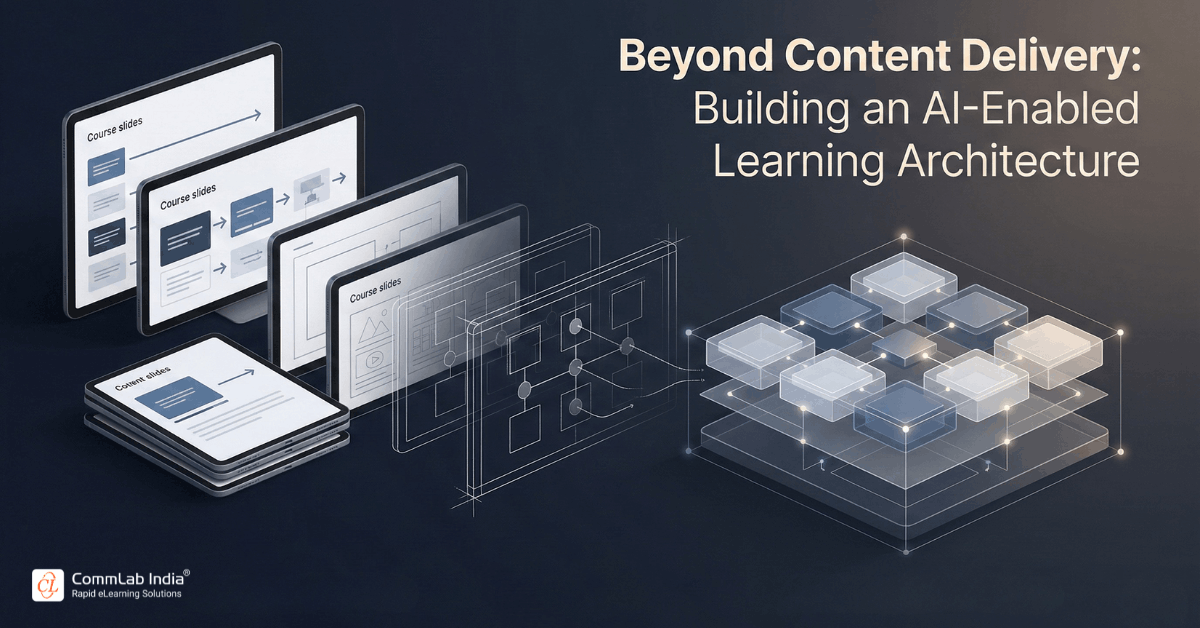
Corporate learning has digitized. But digitization alone has not made it intelligent.
Most organizations now deliver training through LMS platforms, mobile modules, microlearning libraries, and virtual classrooms. Yet the underlying structure of learning remains static. Content is pushed. Assessments are standardized. Engagement is measured in clicks. Insight into real capability remains shallow.
Artificial intelligence changes this equation.
Not because it creates content faster. Not because it automates quizzes. But because it introduces intelligence into the architecture of learning itself.
AI in corporate training is not a feature. It is a structural layer that enables systems to observe, adapt, predict, personalize, and respond in real time.
Download Now: AI in Corporate Training
This article explores how AI is reshaping corporate training through what can be described as the Intelligent Learning Stack — a layered model that integrates automation, augmentation, adaptive pathways, and intelligent interfaces into a cohesive system.
The shift is not from instructor-led to digital. It is from static delivery to adaptive capability-building systems.
Table of Contents
- The Structural Problem with Digital Training
- Defining AI in Corporate Learning
- The Intelligent Learning Stack: A System-Level Model
- Layer One: Automation That Frees Human Capacity
- Layer Two: Conversational Interfaces and Real-Time Guidance
- Layer Three: Synthetic Presence and AI Avatars
- Layer Four: Machine Learning and Adaptive Pathways
- From Tools to Architecture: Integrating AI Without Fragmentation
- FAQ
The Structural Problem with Digital Training
Digital transformation solved accessibility. It did not solve adaptability.
Traditional eLearning systems operate on a linear logic:
- Develop content
- Deliver content
- Test comprehension
- Record completion
The system does not dynamically respond to the learner’s behavior, knowledge gaps, emotional engagement, or contextual needs. Every learner moves through a similar pathway regardless of proficiency or risk exposure.
This creates three structural limitations:
- Personalization is superficial
- Feedback loops are delayed
- Learning impact remains difficult to correlate with performance
AI addresses these limitations by introducing responsive intelligence into the system itself.
Defining AI in Corporate Learning
Artificial Intelligence in corporate training refers to systems that use data-driven algorithms to analyze learner behavior, adapt content delivery, automate interactions, simulate instruction, and generate insights that improve workforce capability.
It includes:
- Machine learning models that predict learner performance
- Chatbots that provide contextual assistance
- AI avatars that simulate human instruction
- Adaptive engines that modify learning pathways
- Data systems that surface real-time skill insights
The strategic shift is from content management to intelligence management.
The Intelligent Learning Stack: A System-Level Model
Rather than viewing AI as separate tools, organizations benefit from understanding it as a layered stack.
The Intelligent Learning Stack consists of four interconnected layers:
- Automation Layer
- Interaction Layer
- Experience Layer
- Adaptation Layer
Each layer performs a distinct function. When integrated, they transform training from a static system into a responsive capability engine.
Layer One: Automation That Frees Human Capacity
The most visible applications of AI in corporate training begin with automation. This is the operational layer of the intelligent learning stack. It reduces friction, compresses cycle time, and eliminates repetitive manual effort.
At a functional level, automation can include:
- Automated content tagging and metadata generation that improves discoverability
- Intelligent assessment scoring that evaluates short answers and open responses
- Role-based course recommendations driven by behavioral data
- Administrative workflow automation across enrollment, reminders, and reporting
- Data aggregation and visualization across multiple platforms
On the surface, this looks like efficiency. But efficiency is not the end goal. The deeper strategic value of automation is capacity reallocation.
When instructional designers are no longer spending hours formatting content, manually scoring assessments, or reconciling spreadsheets, their attention shifts upward. Instead of maintaining systems, they begin shaping capability ecosystems.
Automation enables learning teams to invest in:
- Capability mapping aligned to evolving business roles
- Experience design that prioritizes behavior change
- Skill taxonomies that link learning to performance
- Outcome integration that ties training metrics to operational KPIs
In this sense, automation is not about replacing people. It is about liberating cognitive bandwidth. It forms the base layer that allows the rest of the intelligent stack to operate at scale.
Without automation, every other AI layer becomes constrained by operational drag.
Layer Two: Conversational Interfaces and Real-Time Guidance
If automation optimizes operations, conversational AI transforms the learner experience.
Traditional eLearning environments are static. They anticipate questions in advance and encode answers into prebuilt slides. But learners rarely move through content in predictable patterns. They hesitate. They misinterpret. They need clarification at unpredictable moments.
Chatbots introduce responsiveness into that gap.
Within learning environments, AI-powered chatbots can:
- Interpret learner questions in natural language
- Provide contextual clarifications tied to the exact module being viewed
- Deliver micro-explanations without forcing navigation away from the task
- Reinforce key principles through interactive dialogue
- Simulate decision-making conversations
The distinction between chatbots and traditional FAQ systems is critical. FAQ systems rely on keyword matching. Conversational AI interprets intent, context, and nuance. This shift matters because learning rarely fails due to lack of information. It fails due to misunderstanding in context.
Consider a compliance scenario. A sales employee encounters a grey-area situation during a simulation. Instead of passively reading a policy slide, the learner asks the system a situational question. The chatbot responds with contextual reasoning, highlights potential risks, and explains why one action creates exposure while another mitigates it.
This real-time interaction reduces cognitive friction. It prevents the learner from exiting the flow to search for answers. It keeps cognition anchored to the scenario.
Over time, conversational guidance also builds confidence. Learners experience support within the workflow rather than after the fact.
The system shifts from content repository to cognitive partner.
AI in Corporate Training
Partner, Not Replacement
- AI in Corporate Training
- AI Toolkit for Super-charged Learning
- Challenges to Consider with AI Implementation
- And More!
Layer Three: Synthetic Presence and AI Avatars
Digital learning historically struggled with presence. Static slides and voiceovers rarely create a sense of human connection. Video instructors helped, but they introduced production bottlenecks and scalability constraints.
AI avatars address this structural limitation by introducing synthetic presence.
AI-generated presenters can:
- Deliver dynamic instruction across languages
- Modify tone or pacing depending on audience
- Integrate seamlessly into branching scenarios
- Represent diverse personas across global regions
- Be updated without full studio re-production
The significance is not aesthetic. It is architectural.
For multinational organizations, consistency of messaging across regions is difficult to maintain. AI avatars enable centralized narrative control while allowing localized adaptation. Training updates can be deployed quickly without scheduling instructors or reshooting video.
More importantly, avatars enable experiential storytelling at scale.
They can act as:
- Virtual mentors guiding onboarding
- Scenario actors in compliance simulations
- Customer personas in sales training
- Technical supervisors in safety walkthroughs
When integrated with branching logic, avatars become interactive participants rather than passive narrators. The critical design question is not whether avatars replace instructors. It is how synthetic presence expands the expressive capacity of digital environments.
In blended learning ecosystems, avatars handle repetition and scalability, while human facilitators focus on reflection, coaching, and complex dialogue.
The result is role optimization rather than role displacement.
Layer Four: Machine Learning and Adaptive Pathways
The most transformative layer of the intelligent stack is machine learning. This is where systems begin to move beyond programmed logic toward adaptive intelligence.
Traditional branching logic follows predetermined pathways. If a learner answers incorrectly, the system redirects to a predefined remediation slide. Every learner encountering the same error sees the same correction.
Machine learning disrupts this rigidity.
ML systems:
- Analyze patterns across large volumes of learner interaction data
- Identify behavioral trends associated with performance gaps
- Predict areas of likely misunderstanding
- Adjust content sequencing dynamically
- Recommend targeted reinforcement unique to each learner
This transforms assessment into continuous diagnosis.
For example, in compliance training, instead of issuing the same remediation module to all learners who fail a scenario, the system analyzes decision patterns. It may determine that certain learners consistently underestimate risk severity. Others may struggle with policy interpretation. The reinforcement pathway becomes personalized.
High-performing learners can be challenged with increasingly complex scenarios. At-risk learners can receive contextualized reinforcement before risk translates into workplace errors.
The learning journey becomes iterative rather than episodic. Over time, machine learning also supports organizational foresight. By analyzing aggregate skill trends, systems can identify emerging capability gaps before they affect business performance.
This layer moves learning from reactive correction to predictive enablement.
Individually, each layer adds value. Collectively, they redefine architecture. When integrated, the system evolves from content delivery to intelligent capability development. The shift is structural.
Training is no longer a sequence of modules. It becomes a responsive system that observes, interprets, and adjusts in real time. That is the defining characteristic of an AI-enabled learning architecture.
From Tools to Architecture: Integrating AI Without Fragmentation
Most organizations do not struggle to experiment with AI. They struggle to connect those experiments into a coherent system.
A chatbot pilot launches within onboarding.
An avatar-based compliance module goes live in one region.
A predictive analytics dashboard is layered onto the LMS.
Each initiative demonstrates promise. Each produces local wins. Yet none meaningfully transforms the learning ecosystem.
Why? Because intelligence has been added at the feature level, not the architectural level. An Intelligent Learning Stack is not a collection of AI features. It is an integrated capability infrastructure.
That infrastructure depends on five structural foundations:
- Data interoperability: AI systems depend on data continuity. If chatbot interactions, assessment performance, simulation behavior, and course completions live in separate systems, intelligence cannot compound.
- Centralized skill taxonomy: AI can personalize only what it understands. If each department defines skills differently, adaptive systems cannot align learning with workforce capability. A centralized skill taxonomy provides standardized capability definitions, role-based skill mapping, competency progression levels and alignment with business objectives.
- Integrated LMS or LXP ecosystems: AI tools layered onto legacy platforms often operate as add-ons. This creates user friction and reporting gaps. The learner should not experience AI as a separate tool. It should feel native to the environment.
- Governance protocols: AI systems introduce new risks such as algorithmic bias, inaccurate recommendations, over-automation of judgment, and data privacy concerns. Governance protocols ensure AI remains accountable.
- Ethical oversight: AI in learning environments influences decision-making, certification, compliance status, and performance evaluation. Poorly designed systems can inadvertently reinforce bias, penalize learning differences, misinterpret behavioral signals and over-surveil employees. Ethical oversight ensures that AI augments fairness rather than distorting it.
AI must align with capability frameworks and performance metrics. Otherwise, intelligence remains superficial.
FAQ
What is AI in corporate training?
AI in corporate training refers to systems that use algorithms and data analysis to automate processes, personalize learning pathways, simulate instruction, and generate predictive insights to improve workforce capability.
How do chatbots improve eLearning?
Chatbots provide real-time guidance, answer contextual questions, reinforce knowledge, and reduce friction during learning. They transform static courses into interactive, conversational experiences.
Are AI avatars replacing human instructors?
AI avatars complement instructors by scaling delivery, enabling multilingual instruction, and supporting simulations. They enhance consistency but do not replace human facilitation in strategic learning environments.
What is adaptive learning powered by machine learning?
Adaptive learning uses machine learning algorithms to analyze learner behavior and adjust content difficulty, sequencing, and reinforcement dynamically to improve skill mastery.
How does AI improve compliance training?
AI identifies risk patterns, personalizes reinforcement for high-risk behaviors, and generates analytics that support proactive compliance management rather than reactive auditing.
Is AI adoption expensive for learning teams?
Costs vary based on architecture and integration depth. Strategic integration often delivers long-term efficiency gains that outweigh initial implementation investments.
Conclusion
AI is not an add-on to corporate learning. It is an architectural shift. The transition from digital training to intelligent training marks a deeper evolution — one where systems adapt, interfaces converse, experiences scale, and data predicts.
Organizations that design learning as an intelligent stack move beyond content delivery. They build responsive capability ecosystems.
AI reshapes not only content, but team roles. Learning functions must evolve toward data literacy, prompt engineering, workflow design, governance oversight and capability mapping. The shift is cultural as much as technological.
AI augments learning teams. It does not eliminate them. The most effective organizations treat AI as a strategic co-pilot.
The future of corporate learning is not automated. It is augmented.