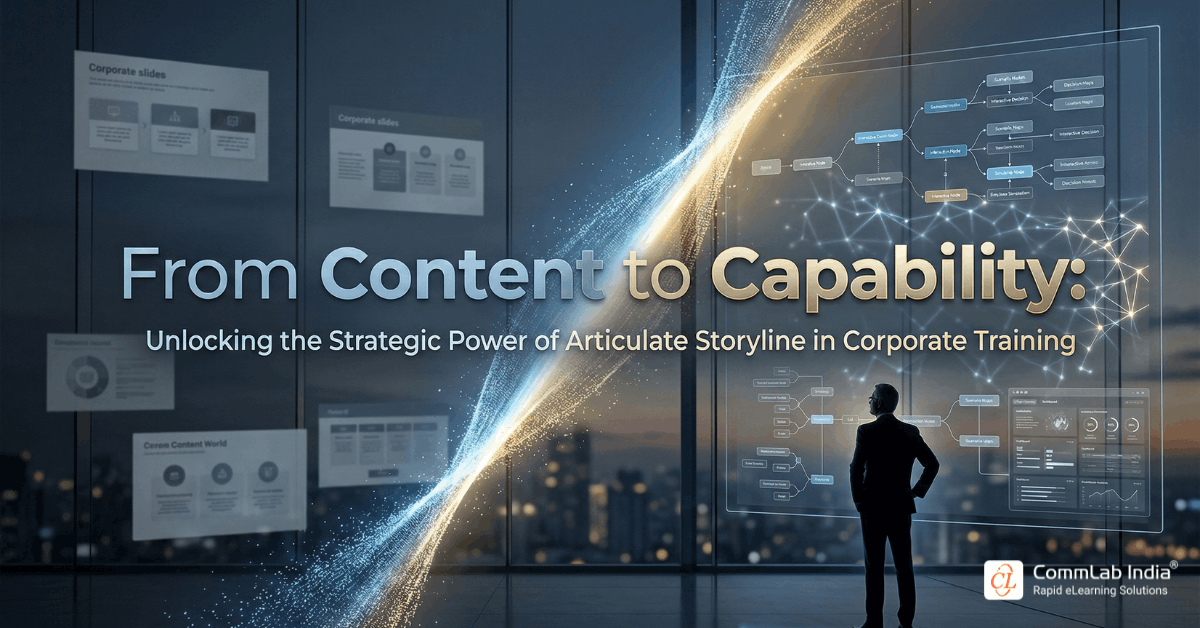
Many organizations adopt authoring tools with a tactical goal in mind: convert legacy content, develop compliance training quickly, or create interactive modules without heavy programming. Yet over time, the tool becomes far more than a production utility. It becomes an infrastructure decision.
Articulate Storyline sits at the center of that evolution.
While often introduced as a rapid authoring solution, Storyline has matured into a powerful experience-building platform. It enables instructional designers to construct simulations, scenario-based learning, adaptive assessments, and system-driven interactions that rival custom development. When used strategically, it supports enterprise-level transformation rather than isolated course creation.
This article reframes Storyline not as a feature set, but as a capability engine.
We examine what Storyline truly enables, where it fits in modern learning ecosystems, and how organizations can leverage it to build scalable, interactive, high-performance learning architectures.
Download eBook Now: Rapid eLearning Authoring Tools
Table of Contents
- The Strategic Role of Storyline in Corporate Learning
- What Storyline Enables: Core Capability Architecture
- Designing High-Fidelity Learning Experiences
- Advanced Capabilities That Elevate Instructional Strategy
- When Storyline Is the Right Strategic Choice
- Scaling Storyline Across the Enterprise
- From Rapid Development to Strategic Differentiation
- Key Takeaways
- Strategic Implications
- Action Framework Checklist
- FAQs
- Conclusion
The Strategic Role of Storyline in Corporate Learning
Authoring tools are often evaluated through surface metrics: ease of use, publishing formats, or multimedia support. But at enterprise scale, the question shifts.
Can the tool support instructional complexity?
Can it adapt to diverse learning contexts?
Can it scale across business units and geographies?
Storyline addresses a deeper need: controlled instructional flexibility.
It allows organizations to balance three critical tensions:
- Speed and sophistication
- Structure and creativity
- Standardization and customization
This balance is what makes it enterprise-ready. It supports rapid course production, but also enables intricate learning journeys involving branching logic, layered feedback, simulations, and system-like interactions.
In other words, Storyline enables learning experiences, not just content modules.
What Storyline Enables: Core Capability Architecture
At its core, Storyline is built around three foundational capabilities:
1. Interaction Architecture
Storyline’s triggers, variables, states, and layers allow designers to construct logic-driven experiences without programming. These elements function like an internal rule engine.
They enable:
- Branching decision pathways
- Conditional feedback
- Adaptive navigation
- Performance-based outcomes
- Scenario modeling
This architecture allows learning to respond to learner behavior, not just present information linearly.
2. Simulation and Practice Environments
For systems training, process training, or procedural workflows, Storyline enables screen recordings and step-based simulations.
More importantly, it allows designers to:
- Build guided practice
- Create free exploration modes
- Integrate scenario-based application
- Embed contextual feedback
This transforms static system walkthroughs into performance rehearsals.
3. Assessment Beyond Quizzes
While Storyline includes standard question types, its deeper value lies in custom assessment design.
Using variables and triggers, organizations can design:
- Scenario-based evaluations
- Cumulative scoring logic
- Performance thresholds
- Remediation pathways
- Competency-based assessments
This moves evaluation from knowledge recall toward behavioral readiness.
Designing High-Fidelity Learning Experiences
The true differentiator of Storyline lies in experience fidelity.
High-fidelity learning replicates real-world complexity. It mirrors uncertainty, decision-making pressure, and contextual nuance. Storyline enables this through layered design structures.
Scenario-Based Learning
Branching scenarios can simulate leadership dilemmas, compliance situations, customer interactions, and operational risks. Learners see consequences unfold based on their choices.
This creates cognitive engagement that slide-based modules cannot replicate.
Interactive Video Experiences
Video can be transformed from passive viewing into decision-driven exploration. Learners can pause, choose responses, trigger alternative scenes, and see dynamic feedback.
This approach is particularly powerful in soft skills and safety training.
Layered Learning Design
Using slide layers and states, designers can:
- Reveal contextual hints
- Offer optional deep dives
- Provide scaffolded support
- Present progressive disclosure
This enables differentiated learning paths within a single course architecture.
Rapid eLearning Authoring Tools
Explore the What and the Why of Popular Rapid eLearning Development Tools, and GenAI Tools
- Categories of eLearning Authoring Tools
- Considerations to Choose Your Next Authoring Tool
- Features of Popular Rapid Authoring Tools
- GenAI Tools to Create Content, Graphics, Audio, and Video
Advanced Capabilities That Elevate Instructional Strategy
Many organizations underutilize Storyline by staying within default templates. Its advanced capabilities unlock strategic differentiation.
Variables as Instructional Intelligence
Variables act as internal data points that track learner behavior. They allow the course to “remember” actions, responses, and decisions.
Applications include:
- Personalized feedback sequences
- Dynamic content displays
- Adaptive difficulty adjustments
- Competency mapping
When used systematically, variables create responsive learning environments.
Trigger Logic as Behavioral Modeling
Triggers connect actions to outcomes. They allow designers to simulate cause and effect relationships.
For example:
- Incorrect compliance decisions trigger escalating consequences
- Positive leadership behaviors unlock higher-level challenges
- Risk-based actions alter scenario progression
This transforms learning from linear consumption into experiential modeling.
Reusable Design Systems
Storyline supports master slides, shared templates, and interaction libraries. Enterprises can create internal design frameworks to ensure:
- Visual consistency
- Interaction standards
- Accessibility alignment
- Brand governance
This reduces development variability across teams.
When Storyline Is the Right Strategic Choice
Not every learning need requires high-interaction architecture. Strategic maturity requires knowing when to deploy Storyline.
Storyline is most effective when:
- Learning requires decision-based branching
- System simulations are necessary
- Behavioral modeling is critical
- High learner engagement is required
- Assessments must go beyond recall
It may not be necessary for:
- Static information updates
- Simple policy refreshers
- Linear content without interaction depth
Strategic deployment ensures development resources align with learning complexity.
Scaling Storyline Across the Enterprise
Storyline becomes truly powerful when embedded within organizational systems.
Governance Frameworks
Enterprises must define:
- Template standards
- Interaction guidelines
- Accessibility protocols
- Quality assurance checkpoints
This ensures scalability without fragmentation.
Collaboration Infrastructure
Through shared asset libraries and team workflows, organizations can:
- Accelerate development cycles
- Maintain design consistency
- Reduce redundant effort
Integration with Learning Ecosystems
Storyline outputs support LMS integration, analytics tracking, and xAPI implementation. When connected to broader learning analytics frameworks, Storyline modules contribute to performance insights rather than isolated completion metrics.
From Rapid Development to Strategic Differentiation
Storyline is often labeled as a rapid authoring tool. That label undersells its strategic potential.
Rapid development is only the entry point.
The real advantage lies in enabling:
- Behavioral learning design
- High-impact experiential modules
- Performance-based evaluation
- Cross-functional scalability
Organizations that treat Storyline as a slide converter miss its value. Those that treat it as an experience design platform gain instructional agility.
Key Takeaways
- Storyline is not just a rapid authoring tool but a strategic experience-building platform.
- Its triggers, variables, and layers enable adaptive, scenario-based learning.
- Advanced features support high-fidelity simulations and behavioral modeling.
- Strategic deployment depends on matching complexity with learning objectives.
- Enterprise scaling requires governance, templates, and ecosystem integration.
Strategic Implications
- Instructional capability becomes a competitive advantage when tools enable experiential depth.
- Learning design maturity increases when organizations move from content production to behavior modeling.
- Standardization and flexibility can coexist through governed design systems.
- Authoring platforms should be evaluated as infrastructure decisions, not tactical purchases.
Action Framework Checklist
Assess Learning Complexity
- Does the initiative require branching logic?
- Is behavioral modeling critical?
- Are simulations necessary?
Design Architecture Before Development
- Map decision pathways.
- Define variable logic.
- Align assessment to performance metrics.
Establish Governance
- Create design standards.
- Define accessibility protocols.
- Implement quality review checkpoints.
Scale Systematically
- Develop reusable templates.
- Train teams on advanced feature use.
- Integrate analytics tracking.
FAQs
1. What is Articulate Storyline primarily used for?
A. Articulate Storyline is used to create interactive eLearning courses, simulations, and scenario-based modules. It enables designers to build logic-driven experiences using triggers, variables, and layered content without programming knowledge.
2. How does Storyline support scenario-based learning?
A. Storyline enables branching logic, conditional triggers, and variable tracking. These features allow learning paths to adapt based on learner decisions, making it ideal for realistic, consequence-driven scenarios.
3. Is Storyline suitable for enterprise-scale deployment?
A. Yes. With proper governance, templates, and integration into learning ecosystems, Storyline supports scalable development across departments and global teams.
4. What makes Storyline different from basic authoring tools?
A. Its strength lies in advanced interaction control. Designers can build adaptive experiences, custom assessments, and system simulations that go far beyond slide-based presentation.
5. Can Storyline handle complex assessments?
A. Yes. Using variables and trigger logic, Storyline supports scenario-based scoring, remediation pathways, and performance thresholds aligned with competency outcomes.
6. When should organizations avoid using Storyline?
A. For simple, linear content updates or informational modules without interaction depth, lighter tools may be more efficient. Storyline is best used when instructional complexity is required.
Conclusion
Articulate Storyline represents more than a development tool. It represents instructional control.
In an era where corporate learning must move beyond static knowledge transfer, Storyline enables immersive, decision-driven, and performance-aligned learning experiences. When deployed strategically, it transforms course creation into capability development.
Organizations that understand this distinction elevate learning from content production to behavioral impact.