Learning is starting to look less like a one-way delivery system and more like an ongoing conversation. That shift is happening at the same time organizations face a sharper reskilling challenge: the World Economic Forum says 50% of the workforce has already completed training as part of L&D initiatives, up from 41% in 2023, and many employers expect far more training to be needed by 2030. LinkedIn’s Workplace Learning Report also shows that organizations strong in career development are more likely to be deploying AI training programs, which signals that AI is moving from experimentation into real learning operations.
That is why conversational AI has become such an important topic in learning. It promises something traditional digital training often struggles to deliver: timely help, back-and-forth practice, and feedback that feels personal instead of static. At the same time, the term is often used loosely. Many articles collapse chatbots, assistants, tutors, and coaches into one bucket, which makes it harder for L&D teams to decide what they actually need.
In simple terms, conversational AI in learning refers to AI systems that interact with learners through natural language, usually text or voice, to answer questions, guide tasks, simulate scenarios, support reflection, or provide feedback. The most important word here is not “AI.” It is “conversational.” The learning value comes from interaction, not just content delivery. IBM defines conversational AI as technology such as chatbots or virtual agents that people can talk to, powered by natural language processing and machine learning. In learning contexts, that means support can happen in the flow of work rather than only inside a course.
Download eBook: AI-Powered L&D Trends 2026
Table of contents
- What is conversational AI in learning
- How conversational AI works in simple terms
- Why this matters now for L&D
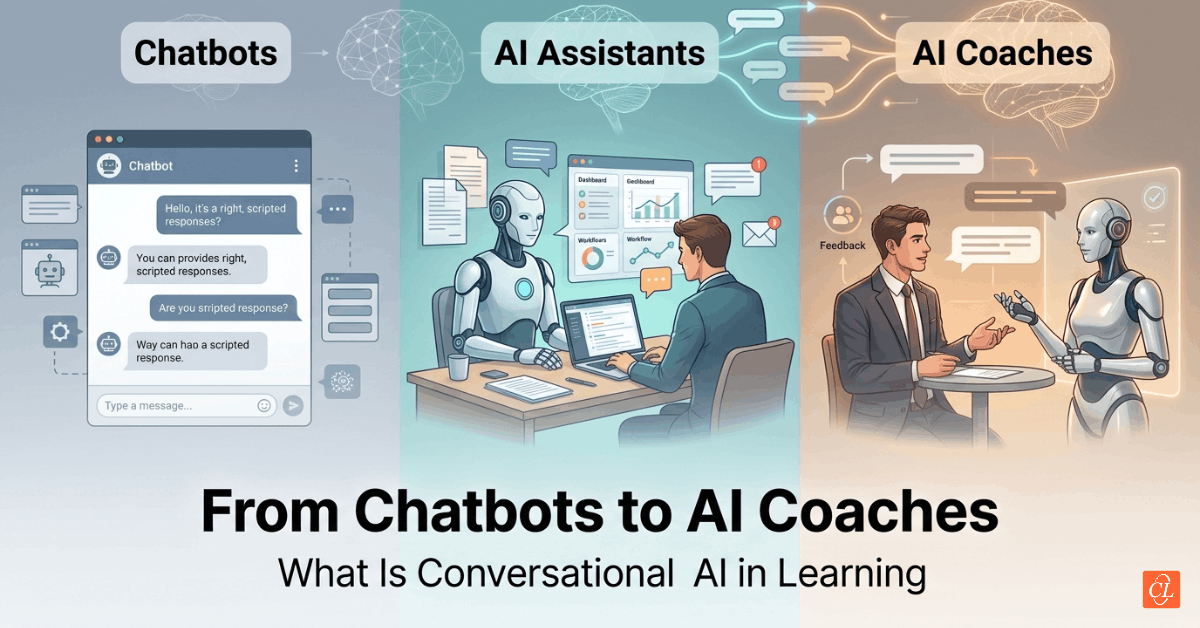
- AI chatbot vs AI assistant vs AI coach
- How conversational AI is used in corporate training
- What it does especially well
- Limits, risks, and where human judgment still matters
- How to implement it well
- What the future of learning conversations looks like
- FAQs
What Is Conversational AI In Learning
Conversational AI in learning is the use of AI systems that can understand natural language, respond in context, and maintain an interactive exchange that helps someone learn, perform, or improve. Instead of asking learners to hunt through menus, click through long modules, or wait for instructor feedback, it gives them a conversational layer over knowledge, practice, and support.
In education and workplace learning, that conversational layer can play several roles. It can answer questions, guide onboarding, explain concepts, summarize knowledge, simulate a customer interaction, prompt reflection, or provide feedback after practice. UNESCO’s work on AI in education consistently frames AI’s value around improving teaching and learning while also insisting on inclusion, equity, and human-centered design. That framing matters because the best use of conversational AI is not replacing learning design. It is extending access to support.
A strong beginner definition is this: conversational AI in learning is an AI-enabled interaction layer that helps people learn through dialogue rather than through static content alone. That dialogue may be simple, such as asking where to find a policy, or sophisticated, such as practicing a sales pitch and receiving adaptive feedback.
How Conversational AI Works In Simple Terms
At a basic level, conversational AI combines natural language processing with machine learning so the system can interpret what the user is saying, identify intent, and generate a relevant response. IBM explains that this process involves analyzing text or speech, understanding meaning and context, generating output, and improving over time through feedback loops.
For L&D teams, the technical detail matters less than the operational implication. A conversational learning system usually sits on top of one or more sources:
- a knowledge base
- learning content
- policies and SOPs
- role-specific frameworks
- performance data or rubrics
- workflow tools and business systems
That means the quality of the learning conversation depends on what the system is grounded in. If it is connected to current knowledge and clear performance standards, it can be useful. If it is disconnected from trusted content, it can sound fluent while being wrong.
This is one reason current coverage is often weak. Many articles talk about conversational AI as if the interface alone creates learning value. In reality, the value comes from the combination of interface, content grounding, feedback logic, and human oversight.
Why this Matters Now For L&D
The demand side is obvious. Skills are changing faster, training needs are becoming more continuous, and learners increasingly expect help at the moment of need rather than only at the moment of enrollment. The World Economic Forum reports rising training completion and continued large-scale reskilling demand, while McKinsey says almost all companies are investing in AI but only 1% see themselves as mature in deployment. That gap between investment and maturity is exactly where L&D has an opportunity: helping people use AI in ways that improve performance, not just awareness.
There is also growing evidence that conversational agents can support learning outcomes when used well. A systematic review and meta-analysis published in 2026 found moderately positive effects of generative AI-powered conversational agents on both cognitive and non-cognitive learning outcomes across the analyzed studies. An umbrella review on conversational AI agents in education also notes rising use and the need to better understand utilization, challenges, and responsible use.
That does not mean every chat interface is effective. It means the category is now mature enough to move beyond novelty. The real question is no longer “Can learners talk to AI?” It is “What kind of conversation actually improves learning?”
AI-Powered L&D Trends 2026
Your L&D Playbook
- The need for AI fluency at work
- Skill-based learning 2.0
- Top AI tools for L&D
- Real stories from L&D teams
- And more
AI Chatbot Vs AI Assistant Vs AI Coach
This is the distinction most articles either rush through or oversimplify.
AI Chatbot
A chatbot is usually the narrowest form. It handles repetitive, high-volume interactions and is often built around predefined tasks or structured retrieval. Slack describes conversational AI chatbots as well-suited to common, repetitive tasks and lower-complexity interactions. In learning, that makes chatbots useful for FAQs, policy lookups, basic onboarding questions, or directing learners to the right resource.
Best fit in L&D:
answering common questions, pointing to resources, handling routine support
AI Assistant
An AI assistant is broader and more context-aware. It can work across systems, remember context better, pull from integrated tools, and support multistep tasks. Slack’s distinction is helpful here: assistants are more adaptable, more proactive, and can operate across integrated applications rather than just within a single fixed flow.
In learning, that means an assistant does not merely answer “Where is the policy?” It might also summarize the policy, surface the relevant course, suggest the next action, and help the learner complete a task.
Best fit in L&D:
onboarding support, knowledge access, workflow guidance, personalized nudges
AI Coach
An AI coach is not just a smarter chatbot or assistant. Its main job is behavior improvement. It is oriented toward practice, reflection, feedback, and progression. A coach may simulate a conversation, challenge the learner, score a response against a rubric, and help the learner improve over repeated attempts LinkedIn’s UK Workplace Learning Report provides a strong real-world signal here: Visa embedded AI-powered training and coaching capabilities into a broader product knowledge program so teammates could practice pitches in a safe space and receive automated feedback without fear of judgment.
Best fit in L&D:
sales practice, leadership conversations, customer handling, difficult conversations, communication skill-building
The easiest way to remember the difference
- Chatbot = answers
- Assistant = helps
- Coach = develops
That simple distinction is not perfect, but it is far more useful for L&D decision-making than treating all three as the same thing.
How Conversational AI Is Used in Corporate Training
The strongest use cases are not “AI writes training.” They are interaction-heavy moments where learners need help, rehearsal, or feedback.
1. Natural language help for learners
One of the clearest use cases is on-demand support. Learners can ask questions in plain language instead of navigating a course catalog, LMS menu, or document repository. This is especially valuable in onboarding, compliance, product training, and process-heavy roles.
AWS recently described onboarding assistants that combine knowledge access with automated tasks, such as answering policy questions and handling requests like IT setup or benefits enrollment. That example is important because it shows conversational AI working as both information support and task support, which is exactly how workplace learning often happens.
In practice, this can look like:
- “What are the steps for escalating a customer complaint?”
- “Summarize our code review checklist for new engineers.”
- “Which learning path is relevant for a new sales manager?”
- “Explain this product feature in simpler language.”
This is where conversational AI starts to reduce friction. Learners do not stop needing content. They stop needing to search for it the old way.
2. Realistic practice before real conversations
This is where conversational AI becomes much more than support automation. It can create safe rehearsal environments for situations where live mistakes are costly.
Sales, customer success, leadership, frontline service, and manager training all involve conversations that are dynamic, emotional, and context-dependent. Static eLearning can explain these conversations, but it cannot fully simulate them. AI role play can.
The Visa example is especially useful because it captures the learning value clearly: people can practice pitches in a safe space and receive automated feedback. That matters because confidence, fluency, and situational judgment improve through repeated practice, not just explanation.
This opens up practical applications such as:
- practicing objection handling
- rehearsing coaching conversations
- handling upset customers
- preparing for compliance-sensitive responses
- refining product messaging
- improving manager feedback conversations
The key shift is from content consumption to conversational rehearsal.
3. Personalized feedback at scale
Feedback is one of the hardest things to scale in workplace learning. Managers do not always have time. Instructors are expensive. Peer feedback is inconsistent. Conversational AI can help close that gap by providing immediate response-level feedback after practice.
The recent meta-analysis on generative AI-powered conversational agents found positive effects not only on cognitive outcomes but also on non-cognitive outcomes, which points to the broader learning value of interactive systems that can respond, guide, and adapt.
Of course, “feedback” can mean different things. Weak systems only tell learners whether they were right or wrong. Stronger systems can identify missing steps, suggest alternative phrasing, flag tone issues, compare the response against a rubric, and prompt revision.
That is especially powerful in communication-heavy training where learners benefit from iteration, not just correction.
4. Administrator and instructor support
Conversational AI is not just for learners. It can support learning teams and administrators by helping them find resources, summarize knowledge, curate content, and respond faster to common support requests.
Microsoft’s piece on Genpact reflects a broader workplace pattern: generative AI is being used to help employees learn while doing work, not only while sitting inside formal training programs. LinkedIn’s report also points to organizations using AI to help workforces access content and practice core skills quickly.
For administrators, that may mean:
- reducing repetitive learner support tickets
- accelerating onboarding queries
- helping facilitators pull examples and scenarios quickly
- surfacing relevant learning assets for different roles
What Conversational AI Does Especially Well
Conversational AI tends to be strongest when the learning need is one of these:
- Immediate clarification
when learners need answers now, not after a search session - Low-stakes repetition
when learners need to practice the same skill multiple times - Context-sensitive guidance
when the right answer depends on role, situation, or workflow - Reflection and revision
when learners improve through responding, reviewing feedback, and trying again - Scalable support
when human coaches or facilitators cannot be available for every learner, every time
This is why conversational AI often fits better with performance support and applied skill-building than with purely informational content delivery.
Limits, Risks, and Where Human Judgment Still Matters
The strongest articles on this topic do not stop at benefits. They also acknowledge the risks of treating AI output as automatically educational.
UNESCO repeatedly emphasizes human-centered, inclusive, and equitable AI in education, warning against systems that outpace policy, widen divides, or weaken human agency. The umbrella review on conversational AI in education similarly highlights the need for ethical and responsible use.
For L&D, the biggest risks are practical:
- inaccurate or outdated answers
- false confidence from polished but shallow responses
- poor feedback logic
- bias in simulated conversations or coaching suggestions
- privacy and governance issues
- over-automation of situations that need human nuance
An AI coach can help someone rehearse a difficult conversation. It should not be the final authority on sensitive employee relations, legal interpretation, or high-stakes judgment. The right model is usually augmentation, not replacement.
How to Implement It Well
A useful conversational learning system is not built by starting with the interface. It is built by starting with the learning problem.
Start with the job-to-be-done
Ask what the learner actually needs:
- answers to repetitive questions
- help locating resources
- rehearsal for difficult conversations
- feedback on performance
- support inside the workflow
Different needs require different forms of conversational AI.
Choose the right role
Do not buy or design an AI coach when you only need a support bot. Do not deploy a chatbot and expect coaching outcomes from it. Match the tool to the learning function.
Ground it in trusted content
The assistant or coach should be connected to current, approved knowledge, role expectations, and clear rubrics. Otherwise the conversation will sound smart without being useful.
Design feedback intentionally
If you want coaching value, define what good performance looks like. What should the system evaluate? Accuracy, completeness, tone, empathy, policy alignment, persuasion, or clarity? Feedback should reflect real standards.
Keep humans in the loop
Human oversight matters most in high-stakes content, escalation paths, quality assurance, and continuous improvement. UNESCO’s human-centered stance is a strong principle here: AI should support teachers, trainers, managers, and learners, not erase their role.
Measure the right outcomes
Do not stop at usage. Measure:
- time to competence
- quality of responses after practice
- confidence before and after rehearsal
- support-ticket reduction
- ramp-time improvement
- transfer into real performance
What The Future of Learning Conversations Looks Like
The next phase of conversational AI in learning is likely to be less about generic chat and more about role-aware, context-aware support. McKinsey’s recent learning perspective notes that employees are experiencing more in-the-moment support with AI agents playing a growing role in guiding practice, coaching through tasks, and supporting reflection. That direction aligns closely with where L&D value is highest: not replacing learning, but embedding it more deeply into work.
That means the future is not simply “courses plus chat.” It is a more layered model:
- structured learning for foundations
- conversational assistance for support
- AI coaching for rehearsal and improvement
- human experts for nuance, judgment, and trust
The organizations that benefit most will be the ones that treat conversational AI not as a novelty layer, but as a carefully designed part of the learning experience.
FAQs
1. What is conversational AI in learning?
A. Conversational AI in learning is the use of AI systems that interact through natural language to help people learn, practice, ask questions, and receive feedback. It is powered by technologies such as natural language processing and machine learning.
2. Is conversational AI the same as a chatbot?
A. No. A chatbot is one form of conversational AI, usually focused on narrower, repetitive interactions. Conversational AI is the broader category, which can also include assistants and coaching systems with more context awareness and task depth.
3. What is the difference between an AI assistant and an AI coach?
A. An AI assistant mainly helps users complete tasks, find information, and move through workflows. An AI coach is more focused on skill development through practice, reflection, and feedback.
4. How is conversational AI used in corporate training?
A. It is commonly used for onboarding support, knowledge retrieval, practice simulations, feedback on communication skills, and learner support in the flow of work. Examples include AI-enabled onboarding assistants and AI-supported sales pitch practice.
5. Can conversational AI provide personalized feedback?
A. Yes, when it is designed with clear rubrics, context, and grounded content. Research on generative AI-powered conversational agents shows positive effects on both cognitive and non-cognitive learning outcomes, which supports its use for responsive feedback.
6. What are the biggest risks of using conversational AI in learning?
A. The main risks include inaccurate responses, shallow feedback, bias, privacy concerns, and overreliance on AI in situations that need human judgment. UNESCO stresses that AI in education should remain human-centered, inclusive, and ethically governed.
7. Is conversational AI replacing trainers and coaches?
A. Current evidence suggests it is better understood as support and augmentation rather than replacement. It can scale access to practice and feedback, but human experts remain essential for judgment, facilitation, trust, and high-stakes decisions.
Conclusion
Conversational AI in learning is best understood as a shift in interface and experience, not just a new layer of automation. It changes learning from something people periodically consume to something they can interact with, question, rehearse, and refine. That is why the category matters. It brings support closer to the learner, practice closer to the job, and feedback closer to the moment of need.
But not every conversational tool creates learning value. Chatbots answer. Assistants help. Coaches develop. The quality of the outcome depends on choosing the right role, grounding the system in trusted knowledge, and designing the interaction around real performance needs. When that happens, conversational AI becomes far more than a faster FAQ engine. It becomes a practical way to make learning more responsive, more continuous, and more usable at work.