
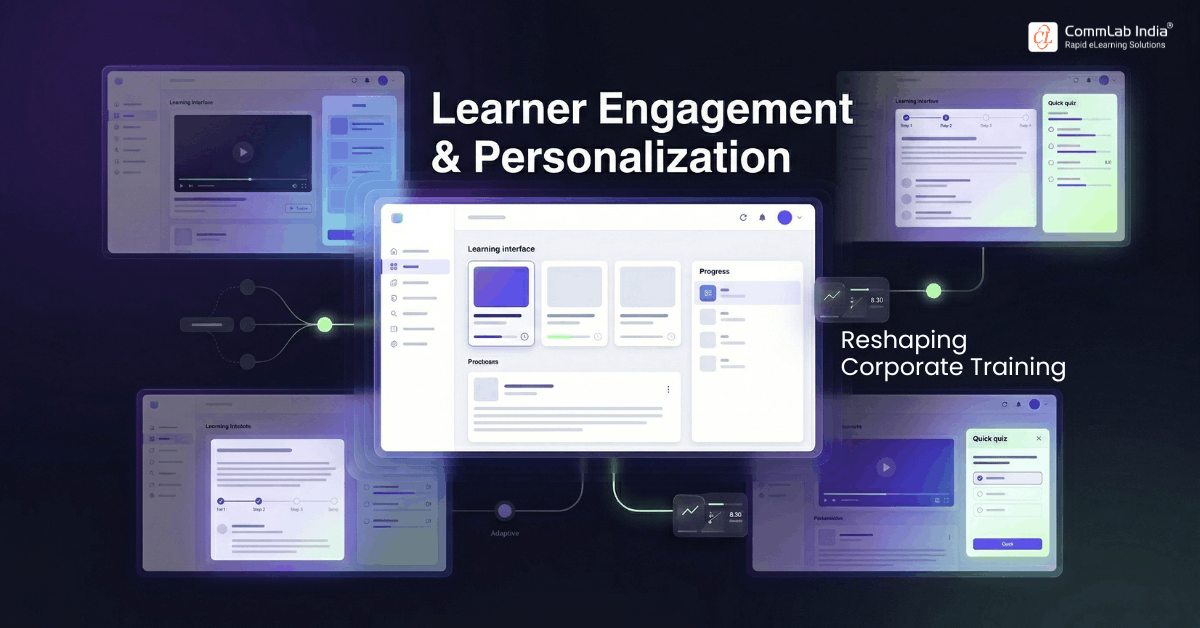
Today’s workforce is more diverse in age, work context, digital comfort, expectations, and career outlook than many traditional training models were built to handle. Employees are learning across hybrid environments, remote settings, shifting schedules, and fast-moving roles. They expect training to be relevant, usable, respectful of their time, and connected to real work. They are also far less tolerant of learning experiences that feel generic, outdated, overly rigid, or detached from how they actually operate.
This is why learner engagement in corporate training has become a strategic issue rather than a design preference.
Engagement is often discussed too narrowly, as though it were simply a matter of making learning more interactive or visually appealing. In reality, engagement is deeper than attention. It is shaped by relevance, accessibility, psychological connection, role fit, social context, and the learner’s belief that the experience is worth investing in. When training is aligned with the realities of the workforce, engagement improves naturally. When it is not, no amount of polish can fully compensate.
That makes this cluster especially important. It sits at the point where learning strategy meets workforce reality.
A modern employee-centered corporate training approach recognizes that organizations are no longer training a uniform audience in a uniform environment. They are supporting Gen Z employees entering the workforce with different learning expectations, experienced professionals working across functions, hybrid teams navigating distributed collaboration, remote and seasonal workforces with limited access to traditional learning structures, and multigenerational teams whose preferences and strengths are often discussed more simplistically than they should be.
The challenge is not to design separate training universes for every group. The challenge is to build training systems that are adaptable enough to meet different learners where they are, while still maintaining strategic coherence and business relevance.
This article explores how learner expectations are changing, why engagement must be understood more broadly, how personalization and empathy are reshaping training design, and what it takes to build workforce-centric learning experiences that are effective across generations, roles, and work models.
Download Now: AI in Corporate Training
Table of Contents
- What Employee-Centered Corporate Training Really Means
- Why the Modern Workforce Is Redefining Training Expectations
- Training for Gen Z Without Oversimplifying the Audience
- How to Design for a Multigenerational Workforce Without Designing by Stereotype
- Learner Engagement in Hybrid, Remote, and Seasonal Work Contexts
- Why Personalization, Peer Learning, and Empathy Matter More Now
- The Changing Role of Instructional Design in Workforce-Centric Training
- How Learner-Centered Training Supports Retention, Impact, and Long-Term Capability
- How to Build a Workforce-Centric Corporate Training Strategy
- FAQs
What Employee-Centered Corporate Training Really Means
The phrase employee-centered corporate training is sometimes used loosely, as though it simply means making training friendlier or more personalized. In reality, it signals a much more important design shift.
An employee-centered approach begins with the understanding that learning should not be shaped only by the content that needs to be delivered. It should also be shaped by the person expected to use it.
That does not mean every learner gets a completely unique experience. It means training is designed with a serious awareness of learner context, constraints, goals, and moments of need.
An employee-centered model typically asks questions such as:
- What is this learner trying to do on the job?
- What pressures or interruptions shape their workday?
- What prior knowledge or experience might they already have?
- What kind of support would make this learning easier to apply?
- What barriers could reduce engagement, even if the content itself is strong?
These questions change the quality of design because they shift attention from delivery to usefulness.
What This Looks Like in Practice
An employee-centered training strategy often reflects the following principles:
- Relevance over volume
Learners do not need more information than necessary. They need the right information framed in a way that matters to their work. - Clarity over complexity
Good training reduces friction. It helps learners move through ideas, decisions, and actions without unnecessary confusion. - Flexibility over rigidity
Employees may need different ways to access, revisit, and apply learning depending on role and work context. - Support over exposure
Training becomes stronger when it extends beyond a single event and includes reinforcement, peer input, or performance support. - Respect for the learner’s time and reality
Employees are more likely to engage when the training acknowledges the realities of workload, pace, and attention.
This approach is particularly important now because learners compare workplace experiences not only to past corporate training, but to the best digital experiences they encounter elsewhere. That does not mean corporate learning must mimic consumer media. It does mean expectations around usability, relevance, and responsiveness have risen.
Why the Modern Workforce Is Redefining Training Expectations
Corporate training is being reshaped by a deeper workforce shift. Employees are no longer learning within a stable, uniform environment where one delivery model can meet most needs. The workforce now includes different generations, different work arrangements, different digital habits, and different expectations around career development and learning support.
This does not mean organizations should over-fragment training. It does mean they must design with more sensitivity to variation.
Today’s workforce often expects learning to be:
- easier to access
- quicker to navigate
- more directly relevant
- less dependent on fixed schedules
- more connected to real work scenarios
- supportive of self-directed growth
- available across devices and work settings
These expectations are not arbitrary. They reflect a broader shift in how work itself is organized. Hybrid and remote work have changed when and where learning happens. Digital tools have changed how employees seek information. Career mobility has changed how people think about skill-building. Employees increasingly want learning that helps them perform now while also supporting future growth.
This is why traditional one-size-fits-all programs are under pressure.
What used to feel standardized now often feels impersonal. What used to feel comprehensive may now feel cumbersome. What used to feel structured may now feel inflexible.
A workforce-centric training strategy does not discard structure. It improves it. It creates learning systems that are coherent enough for the enterprise, but adaptable enough for the workforce.
Training for Gen Z Without Oversimplifying the Audience
Few workforce topics generate as much discussion as training for Gen Z employees, and for understandable reasons. Gen Z is entering organizations in larger numbers, and many teams are trying to understand how their expectations may differ from those of earlier generations.
There is value in that conversation, but it needs to be handled carefully.
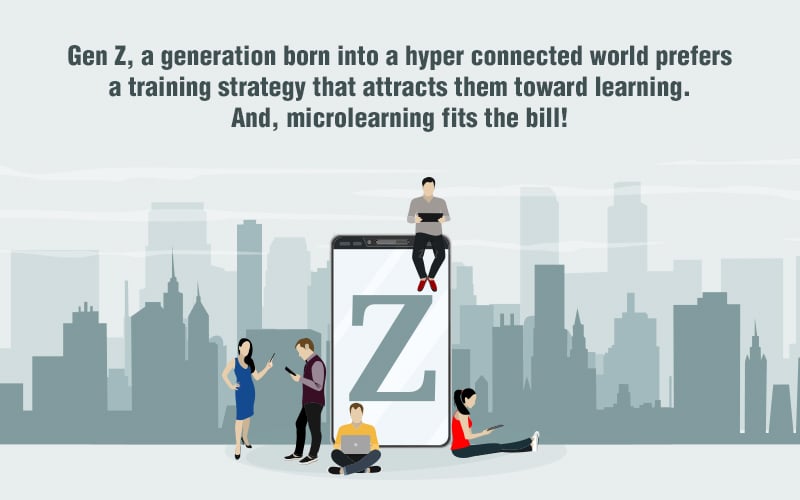
The biggest mistake organizations make is treating Gen Z as a stereotype rather than a learner group shaped by certain broad conditions. Gen Z employees have grown up in highly digital environments, with faster access to information, stronger expectations around immediacy, and greater exposure to personalized digital experiences. Many also place visible value on growth, purpose, feedback, and flexibility.
These are useful signals, but they should inform design, not flatten people into assumptions.
What Training for Gen Z Often Needs to Do Well
In practical terms, training for Gen Z employees tends to benefit from:
- Clear relevance
They are more likely to invest attention when the purpose of the learning is visible and immediately connected to their role or growth. - Shorter, well-structured learning experiences
This does not mean they cannot engage with depth. It means they respond better to learning that is designed cleanly and intentionally. - Faster feedback loops
Timely feedback helps sustain momentum and builds confidence, especially for employees early in their careers. - Digital fluency without digital clutter
Digital-native learners still expect a good experience. Familiarity with technology does not mean tolerance for poor design. - Opportunities for contribution and interaction
Many Gen Z employees respond well when learning feels participatory rather than purely top-down.
The most useful takeaway from Gen Z training is not that this generation is entirely different from everyone else. It is that many of the design principles they respond to are actually good principles for modern workforce learning more broadly: clarity, relevance, usability, speed, feedback, and authentic connection to work.
In that sense, training for Gen Z is less about building a separate training universe and more about accelerating the modernization of training overall.
How to Design for a Multigenerational Workforce Without Designing by Stereotype
The modern workplace is not only younger. It is also more age-diverse. In many organizations, teams now include early-career employees, mid-career professionals, experienced specialists, and senior leaders working side by side. This creates both richness and complexity for learning design.
Multigenerational workforce training matters because people bring different experiences, confidence levels, expectations, and learning preferences to the same environment. But here too, organizations need to avoid simplistic labels.
Generational thinking can be useful when it helps us notice broader patterns. It becomes unhelpful when it turns into rigid design assumptions such as “older employees prefer classrooms” or “younger employees only want video.” In reality, learner behavior is influenced by role, culture, prior exposure, confidence, task complexity, and digital accessibility, not just age cohort.
A Better Approach to Multigenerational Training
The strongest approach is not to build separate content paths based on stereotypes. It is to design for range.
That means creating learning experiences that:
- Offer multiple ways to engage with the material
- Balance structure with flexibility
- Support both independent learning and social interaction
- Provide clarity without oversimplification
- Allow learners to revisit information in usable formats
- Respect different starting points without lowering standards
What Matters More Than Generation Alone
In many cases, the following variables matter more than generational labels:
| Design Consideration | Why It Matters |
| Role context | Job demands shape learning need more directly than age |
| Digital confidence | Comfort with tools varies within every generation |
| Prior experience | Experienced employees may need different framing than new hires |
| Work environment | Hybrid, remote, field, and desk-based roles shape access |
| Motivation and career stage | People engage differently depending on immediate goals and aspirations |
This perspective strengthens design because it helps organizations move away from broad assumptions and toward more nuanced learner analysis. A workforce-centric strategy is inclusive not because it tries to please every preference equally, but because it creates conditions where different learners can succeed.
Learner Engagement in Hybrid, Remote, and Seasonal Work Contexts
One of the most significant shifts in workplace learning has been the move away from a single shared learning environment. Employees are now working across offices, homes, field settings, rotating schedules, and temporary staffing models. This changes the conditions under which training must operate.
The issue is not only physical distribution. It is also variability in time, access, supervision, communication, and belonging.
This is especially important for hybrid workforce training, remote teams, and seasonal employees, all of whom often experience training differently from centrally located full-time teams. If the learning strategy assumes shared schedules, synchronous access, stable connectivity, or high-touch support, it may unintentionally exclude or frustrate the very groups it is meant to develop.
What Hybrid and Remote Work Change
Hybrid and remote settings change training in several ways:
- Learners may have less informal access to peer help or manager clarification
- Attention is often fragmented by digital communication overload
- Employees may need more asynchronous access to learning
- Connection and engagement may require more intentional design
- Onboarding and cultural immersion may take longer without proximity
This means training for distributed workforces often needs to be more deliberate in its structure, reinforcement, and communication.
Seasonal and Remote Workforce Realities
Seasonal and temporary workforces present a different challenge. These employees often need to become productive quickly, may have limited time for formal training, and may not remain in the organization long enough to absorb lengthy learning paths. In such contexts, training needs to be especially focused, accessible, role-specific, and operationally aligned.
What Strong Design Often Includes
For distributed and time-sensitive workforces, training is usually stronger when it includes:
- Concise learning assets that reduce ramp-up time
- Asynchronous access for schedule flexibility
- Role-based examples and workflow relevance
- Manager or peer reinforcement where possible
- Searchable support for quick recall
- Intentional communication to reduce disconnection
The broader lesson is clear. Work context shapes engagement. If training ignores that context, engagement problems often follow.
Why Personalization, Peer Learning, and Empathy Matter More Now
As workforce expectations continue to evolve, several design principles are becoming more central to effective training: personalization, peer learning, and empathy. These are not soft extras. They are part of what makes training more usable, human, and credible.
Personalization as Relevance, Not Just Technology
Personalization is often interpreted as a technology feature, such as adaptive pathways or AI-driven recommendations. Those capabilities can help, but the deeper idea is simpler. Personalization means the learner feels the training is relevant to their role, level, need, and context.
That can be achieved in many ways:
- Role-specific pathways
- Optional branching based on learner need
- Different reinforcement assets for different audiences
- Relevant examples and scenarios
- Learning journeys tied to career stage or function
The goal is not to personalize every detail. It is to reduce the distance between the training and the learner’s reality.
Peer Learning as Social Credibility
Employees often learn effectively from one another because peers bring practical language, shared context, and lived examples. Peer learning in corporate training can strengthen engagement by making learning feel less abstract and more socially grounded.
It can show up through:
- cohort discussions
- peer demonstrations
- collaborative reflection
- SME conversations
- shared practice communities
- team-based debriefs
Peer learning is especially valuable in environments where judgment, adaptation, and informal know-how play a major role in performance.
Empathy as a Design Discipline
Empathy in training is sometimes treated as a vague sentiment. In practice, it is a highly practical design discipline. It means understanding the learner’s situation well enough to remove friction, anticipate confusion, acknowledge pressure, and build learning that feels respectful rather than burdensome.
Empathetic learning design asks:
- What might overwhelm this learner?
- What assumptions are we making about their time or access?
- Where might the experience feel irrelevant or discouraging?
- What kind of tone, pacing, and support would make this easier to use?
This is one of the most important shifts in modern corporate learning. As training becomes more digital, scaled, and distributed, empathy becomes essential to keeping it human.
The Changing Role of Instructional Design in Workforce-Centric Training
As workforce expectations evolve, instructional design is evolving too. The role of the instructional designer can no longer be limited to structuring content, writing assessments, and building courses around predefined inputs. Those skills still matter, but the strategic demand has grown.
Today’s instructional designers increasingly need to think like learner advocates, performance analysts, and experience architects.
That shift is visible across several dimensions.
From content organization to learner understanding
Instructional design now requires deeper attention to audience variation, work context, learner motivation, and barriers to engagement.
From course creation to ecosystem design
Designers are often shaping learning journeys that include multiple assets, formats, and reinforcement layers rather than a single contained intervention.
From information transfer to capability support
The goal is not simply to present content clearly. It is to help employees think, decide, apply, and improve in real work settings.
From standardization to thoughtful adaptability
Organizations still need consistency, but designers increasingly need to create structured systems flexible enough to work across different learner groups and environments.
This is why the changing landscape of corporate training has placed greater strategic pressure on instructional design. Workforce-centric training depends on designers who can synthesize business needs, learner realities, modality choices, and human-centered principles into coherent learning systems.
That is a far more influential role than simply producing courses.
How Learner-Centered Training Supports Retention, Impact, and Long-Term Capability
The business case for learner-centered training is often stronger than organizations initially realize. This is not only about improving learner satisfaction. It is about improving outcomes that matter to the organization over time.
One of those outcomes is retention.
Employees are more likely to stay engaged with an organization when they feel supported, developed, and equipped to succeed. Training is not the only factor in retention, of course, but it can influence how employees experience growth, confidence, belonging, and readiness. Poor training can quietly communicate that employees are expected to cope alone. Strong training communicates investment.
Learner-centered training also supports long-term impact because it improves the likelihood that learning will actually be used. When employees feel the learning was built with their role and environment in mind, they are more likely to return to it, trust it, and apply it.
Where the impact often shows up
A workforce-centric training strategy can strengthen:
- employee confidence during change
- faster role readiness for new hires
- stronger connection between training and performance
- better participation across distributed teams
- improved perception of learning and development
- stronger employee growth and development culture
This is why engagement, personalization, and learner-centered design should not be treated as aesthetic concerns. They are part of how organizations build capability that lasts.
How to Build a Workforce-Centric Corporate Training Strategy
A workforce-centric strategy does not emerge simply by adding more formats or by talking about engagement more often. It requires a more deliberate approach to learner analysis, design decisions, and support systems.
The following framework offers a practical starting point.
1. Understand the workforce before designing the learning
Go beyond topic requests and analyze who the learners are, where they work, what pressures they face, and what success looks like in their context.
2. Define engagement as meaningful use, not surface interaction
Do not reduce engagement to clicks or attendance. Focus on relevance, attention quality, return behavior, application, and learner trust.
3. Design for range rather than stereotypes
Recognize workforce variation without turning it into fixed assumptions. Build flexibility into access, pacing, examples, and reinforcement.
4. Match personalization to practical need
Use role-based pathways, relevant scenarios, and learner-appropriate support rather than personalization for its own sake.
5. Build social learning where it adds value
Use peer learning, manager input, and collaborative reflection to strengthen credibility and transfer.
6. Design with empathy
Reduce friction, clarify expectations, and respect the learner’s time, workload, and environment.
7. Measure what matters
Look at engagement quality, application, confidence, retention of learning, and workforce response across different learner groups.
A practical evaluation table
| Strategic Focus | Questions to Ask |
| Learner Context | Who are these learners, and what conditions shape how they learn? |
| Workforce Variation | What differences in role, experience, access, and work model matter most? |
| Engagement Design | Why would this training earn and hold attention? |
| Personalization | How is the learning made more relevant without becoming fragmented? |
| Reinforcement | What happens after the primary learning experience? |
| Inclusion | Can different kinds of learners succeed in this design? |
A workforce-centric strategy does not make training less structured. It makes it more intelligent.
FAQs
What is learner engagement in corporate training?
Learner engagement in corporate training refers to the degree to which employees pay meaningful attention, participate actively, connect emotionally, and apply what they learn. It goes beyond completion and includes relevance, motivation, cognitive involvement, and practical use.
What does employee-centered corporate training mean?
Employee-centered corporate training is learning designed around the learner’s role, context, needs, and constraints. It focuses on making training more relevant, usable, flexible, and supportive rather than simply delivering information in a standardized format.
How should organizations train Gen Z employees?
Training for Gen Z employees should emphasize relevance, clear structure, timely feedback, digital usability, and opportunities for contribution. The goal is not to stereotype the generation, but to design training that reflects modern learner expectations more effectively.
How do you design training for a multigenerational workforce?
Multigenerational workforce training should be designed for flexibility and range rather than age-based assumptions. Organizations should consider role, experience, access, digital confidence, and motivation, and offer multiple ways for learners to engage and succeed.
Why is training different for hybrid and remote employees?
Hybrid and remote employees often have different access patterns, support structures, and attention challenges. Training for these groups needs to be more asynchronous, context-aware, and reinforced because informal in-person learning support is often reduced.
What role does empathy play in corporate training?
Empathy helps designers understand learner pressure, constraints, confusion points, and work realities. In practice, empathetic design reduces friction, improves clarity, and makes training feel more relevant and respectful of the learner’s environment.
How does learner-centered training support employee retention?
Learner-centered training supports retention by helping employees feel invested in, capable, and prepared for success. While training alone does not determine retention, strong learning experiences can improve confidence, development perception, and connection to the organization.
Conclusion
The future of corporate training will not be shaped only by better platforms, faster production, or more digital content.
It will be shaped by how well organizations understand the people they are designing for.
That is the real lesson behind learner engagement, personalization, Gen Z expectations, multigenerational workforce design, hybrid work adaptation, and empathy-driven training. These are not separate trends competing for attention. They are signals of a larger shift toward workforce-centric learning.
Organizations that respond well to this shift will not simply make training more attractive. They will make it more relevant, more inclusive, more flexible, and more likely to influence real performance. They will stop treating employees as passive recipients of content and start treating them as participants in a learning system built around actual work, actual pressure, and actual human variation.
That is what modern corporate training increasingly requires.
Not just more content.
Not just more engagement tactics.
But a more thoughtful way of designing learning for a changing workforce.
![Why Microlearning Is the Ideal Training Format for Gen Z Workforce [Infographic]](https://www.commlabindia.com/hubfs/blogs/microlearning-ideal-training-format-gen-z-infographic.jpg)