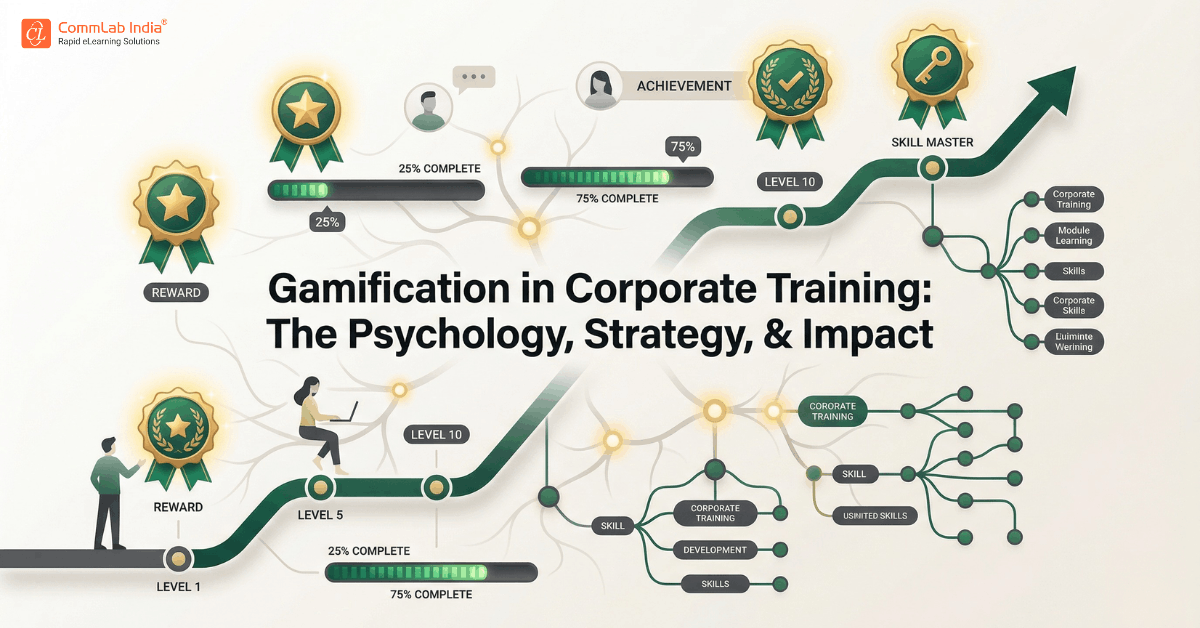
Most organizations do not struggle with delivering training. They struggle with making it stick. Completion rates look acceptable. Course catalogs are full. Yet behavior on the job remains unchanged. Learners disengage halfway through modules, compliance becomes a checkbox exercise, and knowledge fades faster than it is delivered.
This is where gamification entered the corporate learning conversation. Not as a trend, but as a response to a deeper problem: the disconnect between learning experiences and human motivation.
However, gamification is often misunderstood. Many organizations reduce it to points, badges, and leaderboards. Others dismiss it as superficial or irrelevant for serious workplace learning.
Both views miss the real opportunity.
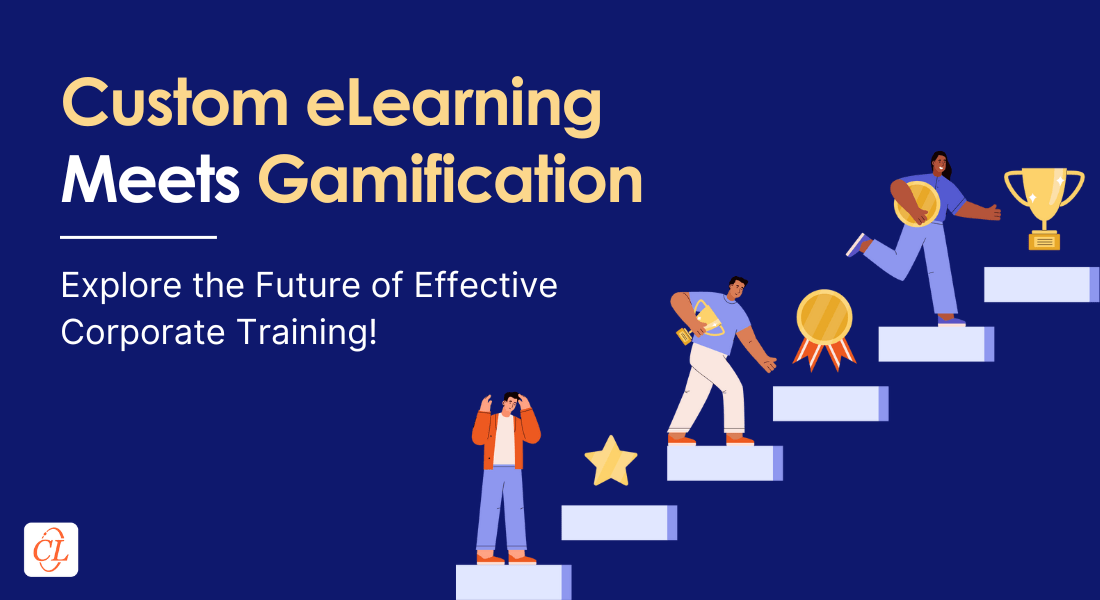
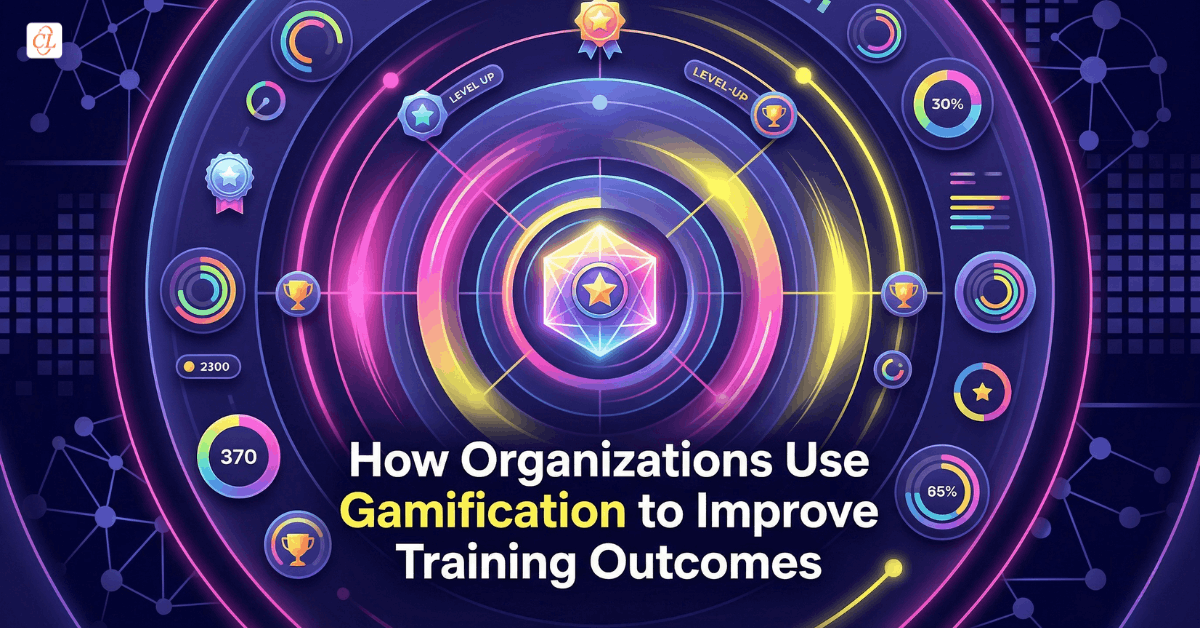
Gamification, when designed strategically, is not about adding game elements. It is about restructuring learning experiences around motivation, behavior, and progression. It transforms training from passive consumption into active participation.
This article reframes gamification in corporate training as a performance system, not an engagement tactic. It explores why it works, where it fails, and how organizations can use it to drive meaningful learning outcomes.
Download eBook Now: How AI Supercharges Gamification
TABLE OF CONTENTS
- The Real Problem Gamification Solves in Corporate Training
- What Gamification in Learning Actually Means
- The Psychology Behind Gamification: Why It Works
- From Engagement to Outcomes: The Strategic Value of Gamification
- Where Most Gamification Efforts Go Wrong
- Reframing Gamification as a Learning System
- When Gamification Delivers the Highest Impact
- The Future of Gamification in Enterprise Learning
- FAQs
The Real Problem Gamification Solves in Corporate Training
Corporate training has evolved in format but not always in experience. Digital learning made content scalable, but it also introduced new challenges:
- Passive consumption replaced active learning
- Completion became a proxy for effectiveness
- Motivation became external rather than intrinsic
The result is a familiar pattern. Learners complete training but fail to apply it. Engagement drops after initial exposure. Learning becomes episodic instead of continuous.
Gamification addresses this gap by introducing structure, feedback, and progression into the learning experience.
Instead of asking learners to consume content, it invites them to participate, decide, and progress.
This shift is subtle but powerful. It changes learning from something learners go through to something they actively navigate.
What Gamification in Learning Actually Means
Gamification is often defined as the use of game elements in non-game contexts. While technically accurate, this definition is too narrow for enterprise learning.
A more useful definition is:
Gamification in corporate training is the intentional design of learning experiences that leverage motivation, feedback, and progression to drive sustained learner engagement and behavior change.
This includes, but is not limited to:
- Progress systems that show advancement over time
- Feedback loops that reinforce correct decisions
- Challenges that require active problem-solving
- Recognition systems that acknowledge achievement
The distinction is important. Gamification is not about adding decorative elements. It is about designing learning as an experience with momentum.
The Psychology Behind Gamification: Why It Works
At its core, gamification works because it aligns learning with how people naturally engage with challenges, rewards, and progress.
Three psychological drivers are particularly relevant in corporate training.
1. Motivation Through Progress
People are more likely to continue an activity when they can see progress. Gamification makes progress visible through levels, milestones, or structured pathways.
This reduces cognitive fatigue and creates a sense of forward movement.
2. Feedback and Reinforcement
Immediate feedback strengthens learning. When learners see the consequences of their choices in real time, they adjust faster and retain better.
Gamified environments create continuous feedback loops, which are often missing in traditional training.
3. Autonomy and Control
Gamified learning often allows learners to make choices, explore paths, and test decisions. This creates a sense of ownership, which increases engagement and commitment.
Why does gamification work in corporate training?
Gamification works because it activates motivation, provides immediate feedback, and creates visible progress. These elements increase engagement, improve retention, and encourage behavior change by making learning interactive and goal-driven.
From Engagement to Outcomes: The Strategic Value of Gamification
Engagement is often the most cited benefit of gamification, but it is not the most important one.
The real value lies in how gamification influences learning effectiveness and business outcomes.
Where Gamification Creates Impact
| Learning Dimension | Traditional Training | Gamified Training |
| Engagement | Passive | Active participation |
| Retention | Short-term | Reinforced through repetition |
| Application | Delayed or inconsistent | Immediate and contextual |
| Motivation | External | Intrinsic and sustained |
Gamification improves outcomes by:
- Encouraging repeated interaction with content
- Reinforcing learning through feedback and challenges
- Simulating real-world decisions in safe environments
This makes it particularly effective for training that requires behavioral change, decision-making, or skill application.

Winning the eLearning Engagement Game: How AI Supercharges Gamification
Experience the Future of eLearning Engagement with AI-enhanced Gamification!
- Games to Engage Modern Learners
- Practical Tips to Incorporate Gamification in eLearning
- AI-enhanced Gamification
- And More!
Where Most Gamification Efforts Go Wrong
Despite its potential, many gamification initiatives fail to deliver meaningful results. The reasons are consistent across organizations.
Surface-Level Implementation
Adding points or badges without aligning them to learning objectives leads to superficial engagement. Learners may participate initially but quickly lose interest.
Misaligned Incentives
If rewards are disconnected from meaningful progress, learners focus on gaming the system rather than learning.
Lack of Context
Gamification without real-world relevance feels artificial. Learners need to see how their actions connect to actual job scenarios.
Overemphasis on Competition
Leaderboards can motivate some learners but discourage others. Without balance, competition can reduce participation.
What are the common mistakes in gamification for training?
Common mistakes include focusing only on points and badges, misaligning rewards with learning goals, ignoring real-world relevance, and overusing competition. Effective gamification requires strategic alignment with learning outcomes and learner motivation.
Reframing Gamification as a Learning System
To unlock its full potential, gamification must be treated as a system, not a feature.
This involves designing three interconnected layers:
1. Experience Layer
Defines how learners interact with content. Includes challenges, scenarios, and progression paths.
2. Motivation Layer
Defines why learners continue. Includes rewards, recognition, and intrinsic drivers such as mastery and achievement.
3. Feedback Layer
Defines how learners improve. Includes real-time feedback, performance insights, and corrective guidance.
When these layers work together, gamification becomes a structured experience that supports continuous learning and performance improvement.
When Gamification Delivers the Highest Impact
Gamification is not universally applicable. Its effectiveness depends on the nature of the training and the desired outcomes.
It delivers the highest impact in:
Skill-Based Training
Where learners must practice and refine skills through repetition and feedback.
Compliance Training
Where engagement is typically low and motivation needs reinforcement.
Sales and Product Training
Where performance is closely tied to knowledge application and decision-making.
Onboarding Programs
Where structured progression helps new employees navigate complex information.
The Future of Gamification in Enterprise Learning
Gamification is evolving beyond static design elements toward more adaptive and intelligent systems.
Emerging directions include:
- Personalized learning paths based on learner behavior
- Integration with AI-driven recommendations
- Real-time performance analytics
- Continuous learning ecosystems that extend beyond courses
The shift is clear. Gamification is moving from a design enhancement to a core component of learning architecture.
FAQ
1. What is gamification in corporate training?
A. Gamification in corporate training involves designing learning experiences using elements like progression, feedback, and challenges to increase engagement and improve learning outcomes. It focuses on motivating learners and driving behavior change rather than simply adding game features.
2. What are the benefits of gamification in learning?
A. Gamification improves engagement, retention, and knowledge application. It encourages active participation, provides immediate feedback, and creates structured learning pathways that help learners stay motivated and achieve better outcomes.
3. Is gamification suitable for all types of training?
A. Gamification is most effective for skill-based, compliance, onboarding, and performance-driven training. It may be less relevant for purely informational content unless combined with interactive elements.
4. How does gamification improve employee performance?
A. Gamification improves performance by reinforcing learning through feedback, encouraging repeated practice, and simulating real-world scenarios. This helps learners apply knowledge more effectively in their roles.
5. What are common mistakes in gamification design?
A. Common mistakes include overusing points and badges, misaligning rewards with objectives, ignoring real-world relevance, and relying too heavily on competition. These reduce long-term effectiveness.
6. How do you measure gamification success?
A. Success should be measured through behavior change, performance improvement, knowledge retention, and learner participation. Engagement metrics alone are not sufficient.
CONCLUSION
Gamification in corporate training is often misunderstood as a layer of engagement added to existing content. In reality, it represents a deeper shift in how learning is designed.
When approached strategically, gamification transforms training into a dynamic system that aligns motivation, feedback, and progression. It creates learning experiences that are not only engaging but also effective, measurable, and aligned with business outcomes.
For organizations seeking to move beyond completion metrics and toward real performance impact, gamification is not optional. It is a critical component of modern learning design.