Every L&D team using AI eventually runs into the same uncomfortable question: if AI can draft objectives, generate scenarios, and structure a module faster than a person can, what exactly is the instructional designer's job now?
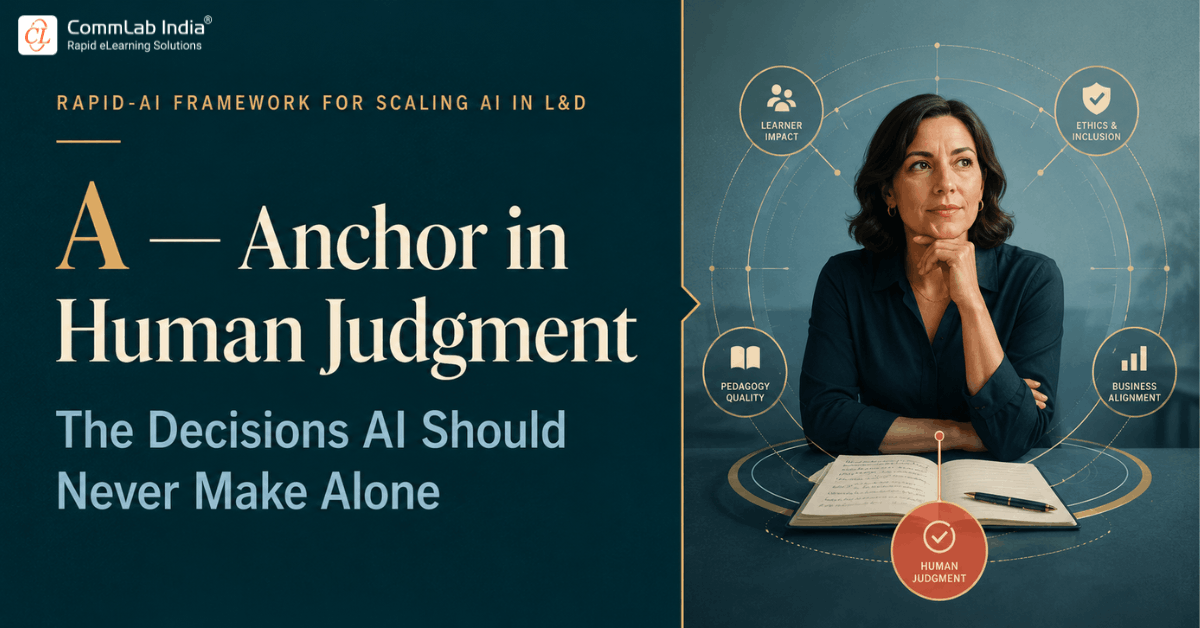
The second principle of RAPID-AI answers that question directly. Anchor in human judgment means drawing a hard line around a specific set of decisions that determine whether training actually works — and keeping those decisions with people, no matter how good AI gets at everything around them.
This isn't a defensive posture or a job-protection argument. It's a recognition that some judgment calls require context AI structurally cannot have, and skipping them produces a very specific, very common failure: polished courses that don't move performance.
This is the second of the seven RAPID-AI principles. See the full framework, including the five-stage workflow that operationalizes it, in the RAPID-AI guide.
Table Of Content
- Why AI Can Surface Options but Can't Decide
- How to Build Human Judgment Into the Workflow
- A Practical Example
- Common Mistakes Teams Make
- Why This Principle Is the Hardest One to Sell Internally
- What Good Anchoring Looks Like at Kickoff
- Frequently Asked Questions
The Three Decisions That Have to Stay Human
Anchoring in human judgment doesn't mean humans review everything equally closely. It means three specific categories of decision are never delegated to AI, regardless of how convincing its suggestions look.
- What the performance gap actually is. AI can summarize a request for training, but it can't independently diagnose why performance is falling short — whether it's a skills gap, a process problem, a motivation issue, or something environmental that no course will fix. That diagnosis requires talking to stakeholders, understanding organizational context, and often challenging the initial request.
- What the learner needs to do differently. This is a behavioral and business judgment, not a content-generation task. It requires knowing what "success" looks like on the job, not just what information is technically correct.
- Whether the instructional approach fits the audience. A scenario-based approach that works for a sales team may fall flat for a technical audience. AI can generate either approach convincingly; it can't reliably judge fit without a human supplying that context and making the call.
Why AI Can Surface Options but Can't Decide
AI is genuinely good at generating plausible instructional approaches. Ask it for three ways to teach a compliance topic, and it will produce three coherent, well-structured options. What it cannot do is know which of those options is right for this specific audience, this specific content, and this specific business context, because that requires information that usually isn't in the prompt at all — organizational politics, learner history with previous training, subtle audience sensitivities, or constraints from stakeholders that never got written down.
This is precisely why teams that skip this anchoring step end up with a specific, recognizable failure mode: training that reads well, looks professionally produced, and still doesn't change behavior on the job. The content isn't wrong. It's just not anchored to the actual gap it was supposed to close.
How to Build Human Judgment Into the Workflow
Anchoring in human judgment isn't a mindset alone — it needs a structural checkpoint, or it erodes under deadline pressure exactly like every other good intention does.
- Require a written performance-gap statement before any AI drafting begins. If nobody can articulate the gap in a sentence or two, no amount of AI-generated content will close it.
- Separate audience analysis from content generation as a distinct step. Do the audience-fit thinking before opening an AI tool, not while reviewing its output — otherwise the AI's first framing anchors the reviewer's thinking instead of the other way around.
- Build a mandatory human sign-off specifically on approach, not just on content quality. A review pass that only checks grammar and structure will miss a mismatch between instructional approach and audience; that requires a dedicated judgment call, tied to a named reviewer.
- Document the reasoning, not just the decision. Recording why a particular approach was chosen creates a reference point for the next similar project, and makes the judgment step visible and auditable rather than implicit.
A Practical Example
Take a global rollout of a new safety procedure. AI can generate a technically accurate, well-organized module explaining the procedure step by step. What it can't determine is that the actual performance gap in one region is a language and cultural-context issue, while in another region it's a supervisor-enforcement issue that no amount of employee-facing content will fix.
A team anchored in human judgment catches this at the diagnosis stage, before any drafting starts, and builds two different interventions — one instructional, one operational. A team that skips this step gets one well-produced global course that solves the wrong problem in at least one region.
Common Mistakes Teams Make
The most frequent mistake is confusing thoroughness of AI output with correctness of approach. A long, detailed, well-formatted AI-generated needs analysis can feel like it has already done the judgment work — but a needs analysis document and an actual judgment call about audience fit are not the same artifact.
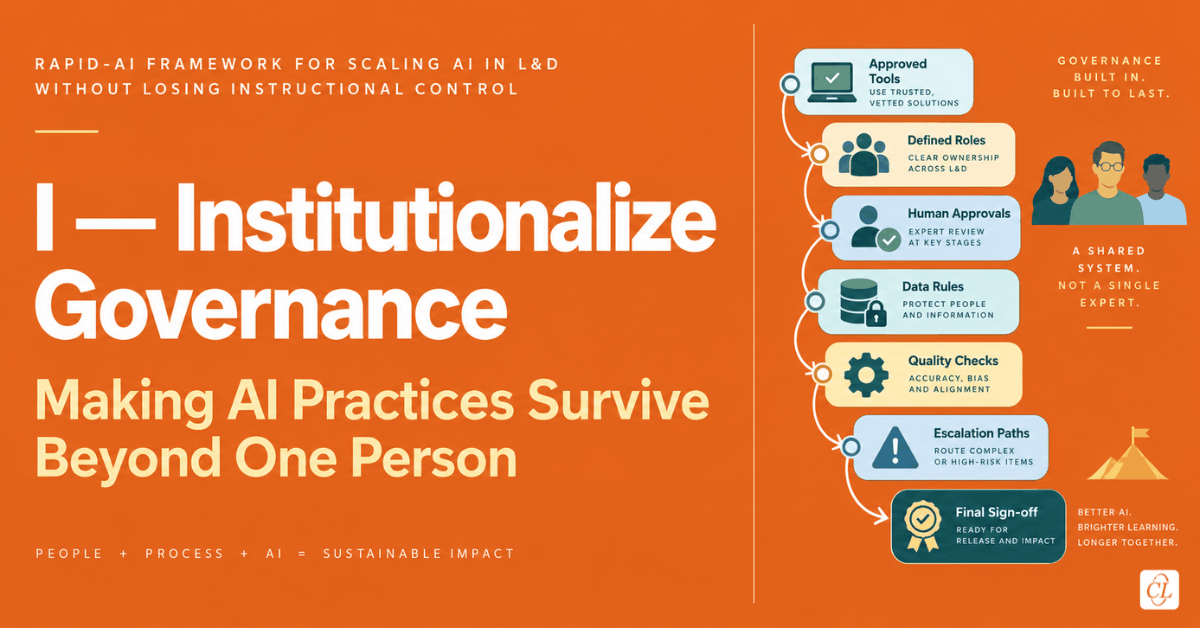
The second common mistake is letting speed pressure quietly demote this step from a required checkpoint to an optional nice-to-have. Once that happens once, under one deadline, it tends to happen every time after — which is exactly why the later Institutionalize governance principle in RAPID-AI treats this as a non-negotiable, not a best practice.
Why This Principle Is the Hardest One to Sell Internally
Of all seven RAPID-AI principles, Anchor in human judgment tends to face the most internal resistance, usually from stakeholders outside L&D who see AI's drafting speed and reasonably ask why a human still needs to weigh in on decisions that feel like they could be automated too. The honest answer is that performance-gap diagnosis, audience fit, and instructional approach are judgment calls with organizational and interpersonal context baked in — the kind of context that rarely gets fully captured in a written brief, let alone a prompt.
Making this case internally is easier with evidence than with argument. Teams that track outcomes — did the training actually move the metric it was built to move — build a much stronger case for protecting this checkpoint than teams that argue from principle alone. A single well-documented example of a technically polished, AI-assisted course that didn't move performance because the underlying approach didn't fit the audience tends to do more to protect this principle than any policy memo.
It also helps to frame this checkpoint by what it costs to skip, not just what it adds. Skipping the human judgment step doesn't just risk a worse course — it risks a course that looks complete, gets signed off, and only reveals its mismatch with the actual performance gap months later, when it's far more expensive to fix than it would have been to catch at the design stage.
What Good Anchoring Looks Like at Kickoff
The anchoring work is easiest to protect when it happens at a specific, visible moment: project kickoff, before any AI tool has been opened. A kickoff conversation anchored properly doesn't start with "what should the course cover" — it starts with "what changed, or needs to change, in what people actually do on the job," and works backward from there to content, only bringing AI in once that diagnosis has a clear, written answer.
Teams that do this well typically produce a short, plain-language performance-gap statement as a kickoff deliverable — a few sentences, not a lengthy needs-analysis document, capturing what's currently happening, what should be happening instead, and why the gap exists. This document then becomes the reference point every later AI-generated option gets checked against: does this scenario, this objective, this framing actually address the gap as stated, or does it just produce competent-looking content about the general topic area.
The discipline of writing this statement before opening any AI tool is itself a large part of what keeps human judgment anchored. Once a compelling, well-structured AI draft exists, it's psychologically much harder to step back and ask whether the underlying approach is right — the draft itself starts to feel like the answer. Doing the diagnostic work first, while there's nothing yet to react to, protects against that anchoring bias in the literal cognitive sense, not just the instructional-design sense.
This same logic applies when a project genuinely doesn't have time for a full diagnostic conversation — a surge request tied to a compliance deadline, for example. Even then, a single sentence answering "what changed in what people need to do differently" takes minutes to produce and gives every later AI-generated option a fixed point to be checked against. The discipline scales down to almost nothing in time cost; what it doesn't scale down is whether it happens at all.
Frequently Asked Questions
What decisions should never be delegated to AI in instructional design?
Three categories: diagnosing the actual performance gap, determining what the learner needs to do differently, and judging whether a given instructional approach fits the specific audience. AI can generate options for all three, but the decision has to stay with a person.
Why do AI-generated courses sometimes fail to improve performance even when the content is accurate?
Because accurate content and the right instructional approach for a specific audience and business context are different things. AI can produce correct information without correctly diagnosing what the training actually needs to change.
How do you keep human judgment from eroding under deadline pressure?
By making it a structural checkpoint rather than a mindset — requiring a written performance-gap statement before drafting, a dedicated sign-off on instructional approach (separate from content-quality review), and documenting the reasoning behind each decision.
Why do stakeholders sometimes push back on keeping human judgment in the loop?
Because AI's drafting speed makes it reasonable to ask why any decision still needs human input. The honest answer is that performance-gap diagnosis and audience fit depend on organizational context that's rarely captured fully in a written brief or prompt.
What's the best way to justify this checkpoint to non-L&D stakeholders?
Track outcomes. A documented example of a polished, AI-assisted course that didn't move its target metric because the underlying approach didn't fit the audience makes a stronger case than an argument from principle alone.
Can this diagnostic step be shortened for genuinely urgent projects?
Yes — a single written sentence naming what needs to change in learner behavior takes minutes and still gives every later AI-generated option a fixed reference point. What shouldn't be cut, even under time pressure, is whether the diagnostic happens at all.