A senior instructional designer has spent months refining a disciplined way to use AI in course development.
They know which prompts work, where AI-generated content tends to fail, which review checkpoints catch the most important issues, and when an SME or instructional reviewer needs to step in. The process is efficient, the team trusts it, and the quality is consistent.
Then that designer moves to another project.
The next person inherits the work, but not the unwritten rules behind it. Some checkpoints are skipped because no one is sure they are mandatory. A prompt library is reused without the context that made it effective. An AI-generated draft moves further through development than it should because the original reviewer is no longer there to challenge it.
Nothing failed because the team suddenly became less capable. The problem was that too much of the governance lived in one person’s judgment rather than in the operating process.
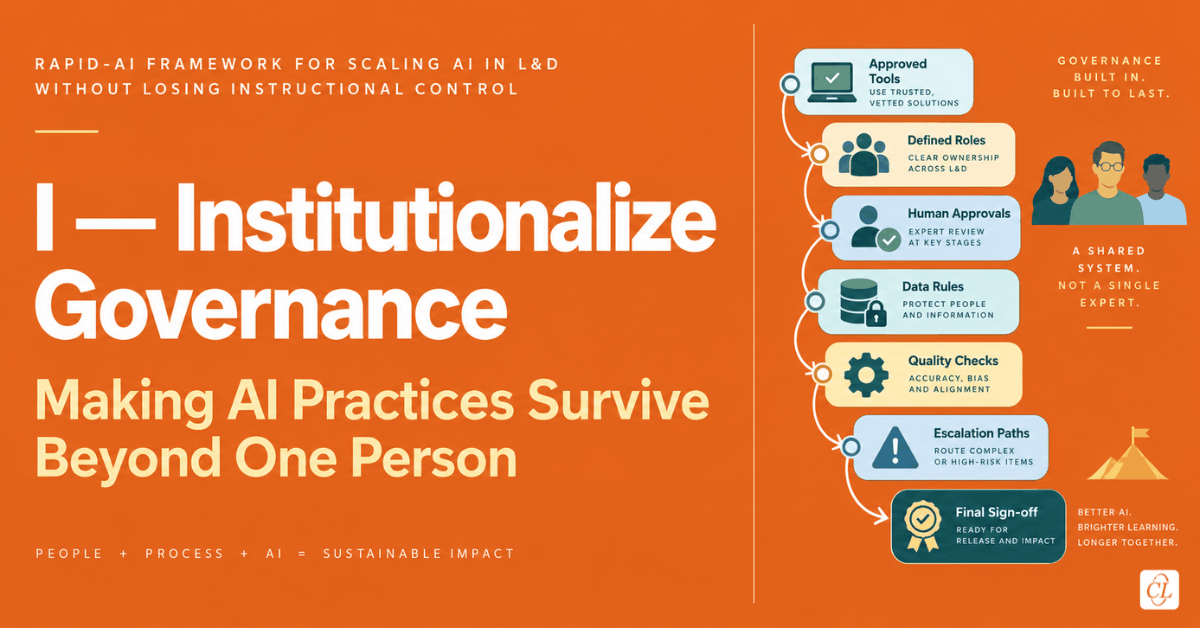
The seventh and final RAPID-AI principle, Institutionalize Governance, addresses that risk.
It focuses on turning good AI practices into documented roles, checkpoints, review criteria, and non-negotiable sign-offs that continue to work through staff changes, reorganizations, and deadline pressure.
A repeatable AI operating model should not depend on who happens to remember how the process is supposed to work.
What Institutionalized Governance Actually Means
Institutionalizing governance means documenting three things clearly for every stage of the AI-assisted workflow:
- What gets reviewed
- Who reviews it
- When the review happens
That documentation needs to be operational, not aspirational.
A statement such as “all AI-generated content should be reviewed by a human” is too broad to guide real work. It does not tell the team which human, what that person is expected to check, or whether the review happens before development, before SME sign-off, or immediately before release.
A useful governance document should make those decisions explicit enough that a new team member can follow the process without depending on unwritten norms.
It should also help resolve disagreements. If two people disagree about whether a storyboard is ready to move forward, the answer should come from defined criteria and ownership rather than from seniority, confidence, or whoever argues most forcefully.
Define the Non-Negotiables
Within a broader governance model, some checkpoints should be fixed.
These are the points where AI’s role stops and human judgment must make or approve the decision, regardless of time pressure or practitioner maturity.
Final SME sign-off on accuracy
No technical or factual content should move to production without validation from the appropriate subject-matter expert. AI-assisted drafts can appear highly credible while still containing omissions, incorrect assumptions, or subtle inaccuracies. The SME remains accountable for confirming that the content reflects the source of truth.
Final instructional sign-off on objective-assessment alignment
A named instructional reviewer should confirm that the assessment actually measures the stated learning objective.
An AI-generated question can be grammatically strong and still test the wrong level of performance. For example, an objective may require learners to apply a procedure, while the assessment merely asks them to recall a definition.
That mismatch needs human instructional judgment.
Mandatory human review for high-risk content
Regulated, safety-critical, legal, contractual, or similarly high-consequence content requires mandatory human review.
This checkpoint should not flex because the practitioner is senior, the project is late, or the AI-generated draft appears complete. Where the cost of error is significant, human validation remains a hard stop.
The value of naming these points explicitly is practical. Teams are less likely to negotiate them away in the moment when the project comes under pressure.
Why Written Governance Matters Under Pressure
Teams usually follow informal norms when conditions are calm. The test comes when a launch date moves forward, an SME becomes unavailable, or a stakeholder asks the team to “just push this through” because the AI-generated draft looks finished.
That is when undocumented practices are most vulnerable.
A written policy gives the team something concrete to refer to. It allows a junior designer to raise a concern without having to frame the issue as a personal objection. Instead of saying, “I don’t think we should skip this review,” they can point to the agreed process and the required sign-off.
The document also separates governance from individual authority. That matters because the process should continue to work even when the person who originally designed it is no longer available.
How to Institutionalize Governance in Practice
The starting point is the five-stage RAPID-AI workflow.
For each stage, document:
- The expected AI contribution
- The required human review
- The named reviewer or role
- The criteria used to close the stage
- Any non-negotiable approval
- What happens if the criteria are not met
This turns a conceptual workflow into an operating procedure.
The next step is to define the non-negotiable list separately. Keep it short enough to be usable. A policy with twenty “critical” checkpoints usually becomes difficult to remember and easy to ignore. Three to five genuinely fixed controls are more likely to remain visible in day-to-day work.
The final step is to establish a review cadence for the governance policy itself.
AI tools and practices change. Team structures change. New content risks appear. Practitioner maturity develops. The governance model should therefore be revisited periodically rather than treated as a one-time document.
Avoid Over-Documenting the Process
A common governance mistake is to respond to uncertainty by documenting everything.
The result is often a policy so detailed that people stop using it.
A governance document should provide enough specificity to guide decisions without forcing practitioners to search through pages of rules for routine work.
The most useful policy usually distinguishes between:
- Core rules that apply across projects
- Risk-based controls for specific content types
- Non-negotiable approvals
- Flexible practices that teams may adapt
That makes the system easier to follow and easier to maintain.
Non-Negotiables Must Actually Be Enforced
A checkpoint is only non-negotiable if the organization treats it that way.
If final SME sign-off is skipped because the deadline is tight and the project still moves forward, the team quickly learns that the rule is optional. Once that happens, the next exception becomes easier. The discipline weakens through precedent.
This is why the number of non-negotiables should remain limited. Each one should represent a point the organization is genuinely willing to protect.
Assign a Named Owner to the Governance Document
A policy needs more than an author. It needs an owner. The owner is responsible for keeping the governance model current as tools, workflows, team structures, and organizational risk tolerance change.
In many L&D functions, that role may sit with a senior instructional design lead or an L&D operations function. The owner does not personally approve every project. Those responsibilities remain distributed across the named reviewers in the workflow. The owner is accountable for the system itself.
That includes:
- Reviewing whether the policy is being followed
- Updating outdated sections
- Clarifying ambiguous requirements
- Coordinating changes with relevant stakeholders
- Acting as an escalation point when a proposed shortcut conflicts with documented policy
Without a named owner, governance often degrades into a static document sitting in a shared drive. The file still exists, but no one is responsible for ensuring that it reflects how the team actually works.
Connect Governance With Compliance and Legal
For L&D teams operating in regulated environments, documented AI governance may need to serve an audience beyond the learning function. Compliance, legal, risk, or audit teams may want to understand how AI-assisted content was produced, reviewed, and approved.
A documented process gives them something concrete to examine. It can show:
- Which roles reviewed the content
- Which checkpoints were completed
- Which approvals were mandatory
- How high-risk content was handled
- Where AI was used and where human review remained required
That is far more defensible than a general assurance that “someone reviewed it.”
Involve Compliance and Legal Early Where Appropriate
L&D should not always define high-risk checkpoints in isolation. Where regulated, legal, safety, or contractual content is involved, relevant stakeholders can help identify which decisions genuinely require a hard stop.
This can improve the governance model in two ways. First, it prevents L&D from over-classifying too many activities as high risk simply out of caution. Second, it makes the final policy easier to defend because the relevant risk owners helped define the controls.
The result is usually a more focused non-negotiable list.
Write the Policy So an Outsider Can Understand It
Governance documentation should stand on its own. A policy that only makes sense to the team that created it remains too dependent on tribal knowledge.
A useful test is to ask whether someone outside the immediate L&D team could understand:
- Who reviews what
- Which criteria are applied
- What cannot be skipped
- Who owns exceptions
- How approval is recorded
Writing for that external reader forces useful specificity. Even in organizations that are not heavily regulated, this discipline helps prevent vague governance language.
Build a Formal Exception Process
A mature governance model should distinguish between an approved exception and an undocumented shortcut. Those are not the same thing.
A legitimate exception should be:
- Specific
- Documented
- Time-bound
- Approved by the appropriate owner
- Recorded for later review
For example, a project may require a temporary deviation from a standard review sequence because a specific stakeholder is unavailable. If the exception is approved, documented, and revisited afterward, the organization still retains visibility and accountability.
Quietly skipping a checkpoint leaves no record of what happened or why. A defined exception process therefore strengthens governance. It gives teams a controlled way to deal with unusual situations without weakening the broader framework.
Common Mistakes Teams Make
Several patterns tend to undermine institutionalized governance. One is over-documenting until the policy becomes unusable. Another is defining non-negotiables that are routinely waived. A third is creating the document without assigning ownership for updates and enforcement.
Teams also run into trouble when governance exists separately from the actual workflow. If practitioners need to consult a policy that does not match the tools, roles, or review sequence they use in practice, they will eventually work around it. Governance becomes durable when it is embedded into the way work moves.
Frequently Asked Questions
What does it mean to institutionalize AI governance in L&D?
It means documenting what gets reviewed, who reviews it, and at what point in the AI-assisted workflow so responsible practices are repeatable across projects and people.
What are examples of non-negotiable AI checkpoints in instructional design?
Examples include final SME approval of factual accuracy, instructional approval of objective-assessment alignment, and mandatory human review for regulated, safety-critical, legal, or similarly high-risk content.
Why do unwritten AI governance practices break down?
They are difficult to enforce when deadlines or staffing pressures arise. Written governance gives the team a shared reference point and reduces dependence on individual memory or authority.
Who should own an L&D team's AI governance document?
A senior instructional design lead or L&D operations role is often a practical choice. The owner should keep the policy current, audit its use, and act as an escalation point when conflicts arise.
Does institutionalized governance only matter in regulated industries?
No. Regulated environments may require stronger controls, but any L&D team can benefit from documented reviewers, criteria, checkpoints, and ownership.
Should governance policies allow exceptions?
Yes, but exceptions should be documented, approved, specific, and time-bound. An exception process is different from informally skipping a checkpoint.
Conclusion
Responsible AI practices become scalable only when they stop depending on individual memory.
Institutionalized governance turns a good personal method into an organizational capability. It gives teams a common way to define review, protect high-risk decisions, assign ownership, and handle exceptions when real-world pressure appears. It also complements the broader discipline of AI governance in instructional design teams, where workflow, review, and capability are treated as part of how the team works rather than as a separate policy layer.
The strongest governance models are neither vague nor overly bureaucratic. They are specific enough to guide decisions, short enough to use, and clear enough that a new team member, reviewer, or auditor can understand how the process works.
That is what allows AI-enabled learning practices to survive personnel changes, increasing scale, and shifting tools without losing accountability along the way.