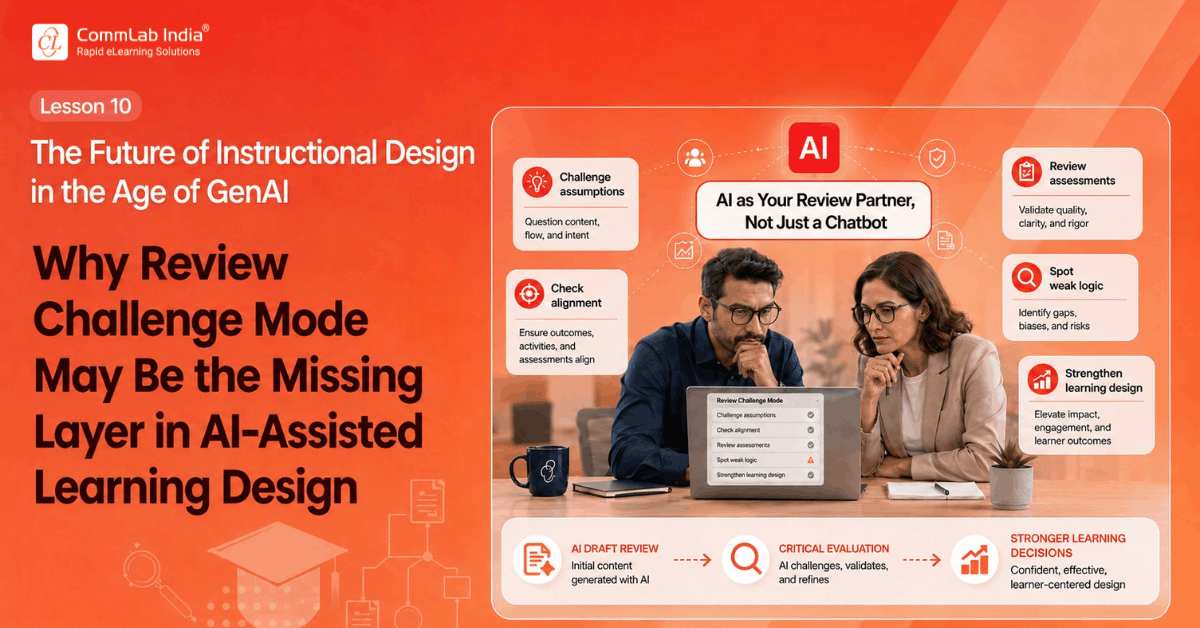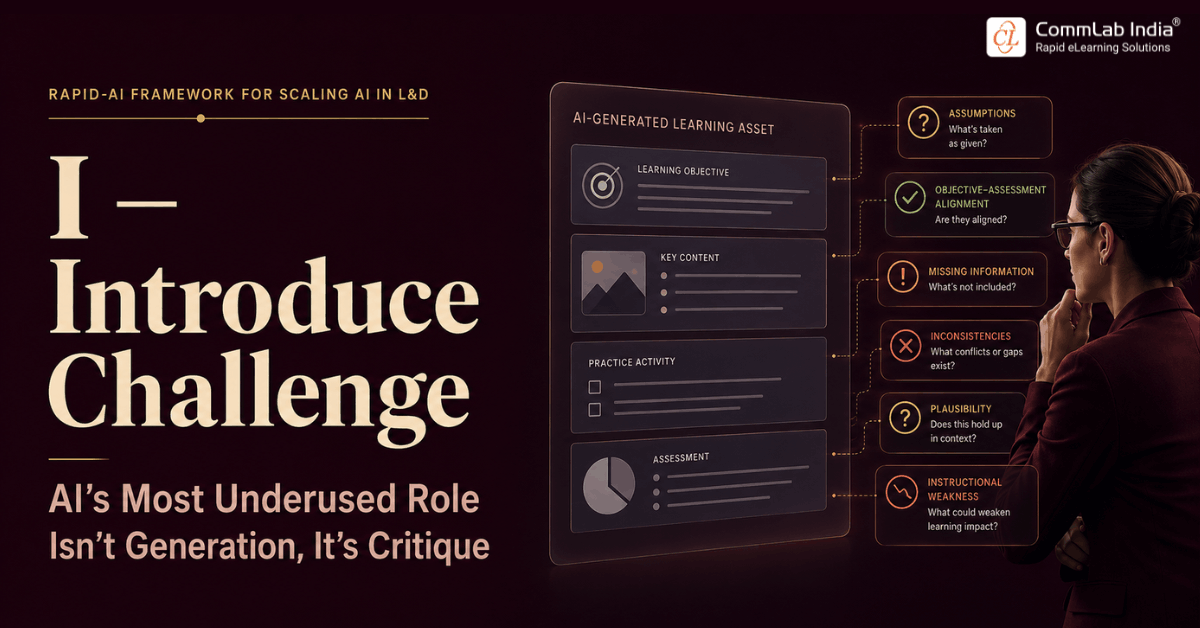
Most conversations about AI in L&D focus entirely on generation — drafting scripts, storyboards, assessments. That focus misses one of the most valuable and least-used applications of AI in the entire instructional design process: using it to challenge a draft, not create one.
The fourth principle of RAPID-AI, Introduce challenge, reframes AI as a devil's advocate. Instead of only asking "can AI write this," teams ask AI to critique what's already been written — flagging gaps, inconsistencies, and weak spots before a human reviewer ever sees the material. This single shift changes where quality problems get caught, and how much they cost to fix.
Table Of Content
- Why Critique Is a Different Job Than Generation
- Where This Fits in the Review Cycle
- Why This Reduces Downstream Review Burden
- How to Build This Into a Workflow
- Common Mistakes Teams Make
- Extending the Challenge Function Beyond a Single Draft
- The Psychological Value of an AI Devil's Advocate
- Frequently Asked Questions
Why Critique Is a Different Job Than Generation
Generating content and evaluating content require different skills, and it turns out AI is well-suited to a specific version of the second job: comparing two related artifacts and flagging where they don't line up. Given a set of learning objectives and a set of assessment questions, AI can reliably check whether each objective is actually being tested, and flag the ones that aren't. Given a scenario and a stated audience, it can flag places where the tone or complexity doesn't match.
This is fundamentally different from asking AI to judge whether content is "good." Quality judgment, as covered in the Anchor in human judgment principle, has to stay human. But structural, mechanical checks — alignment, consistency, completeness — are exactly the kind of pattern-matching task AI is reliable at, and exactly the kind of task that's tedious and error-prone for a tired human reviewer doing it by hand at the end of a long project.
Where This Fits in the Review Cycle
The value of introducing challenge comes specifically from where it happens: before a draft reaches SME or instructional review, not instead of that review. Positioned this way, an AI critique pass acts as a pre-filter, catching a category of errors — misalignment, gaps, internal inconsistency — that would otherwise consume expensive human review time to find.
- Objective-to-assessment alignment checks. Does every stated learning objective have at least one assessment item that actually tests it? Are there assessment items that don't map back to any objective at all?
- Internal consistency checks. Does terminology stay consistent across the module? Does a scenario introduced in one section get resolved, or does it just disappear?
- Gap identification. Are there steps in a process explanation that skip logically from one point to another without the connecting information a novice learner would need?
- Tone and register drift. Does the content stay consistent with the intended audience throughout, or does it shift register partway through, often a sign of stitched-together AI-generated sections?
Why This Reduces Downstream Review Burden
SME and instructional review time is expensive and often the actual bottleneck in course development, not content drafting. Every gap or inconsistency an AI critique pass catches is one a SME or senior reviewer doesn't have to spend their limited time finding manually — which means that time gets spent instead on the judgment calls only they can make: whether the content is accurate, whether the approach fits the audience, whether the training will actually work.
This is also where AI's speed advantage compounds. A generation-only workflow produces a draft fast, but if that draft still needs a full manual review to catch structural issues, most of the time saved in drafting gets spent again in review. Introducing an AI challenge pass in between preserves more of that original speed gain.
How to Build This Into a Workflow
Practically, this means adding a distinct step — not a person, a step — between drafting and human review. After a scenario, module, or assessment set is drafted (whether by AI, a human, or both), it gets run through a structured critique prompt before it goes to anyone for sign-off.
The critique prompt itself should be specific, not open-ended: "Compare these five learning objectives against this assessment set. Identify any objective without a corresponding test item, and any test item that doesn't map to a stated objective." A vague prompt like "review this for quality" produces a vague, low-value response; a structural, comparison-based prompt produces something a reviewer can act on directly.
Common Mistakes Teams Make
The most common mistake is skipping this step because it feels redundant with human review — but the entire value is that it happens before human review, catching the mechanical issues cheaply so expensive human attention goes to the judgment calls AI can't make.
A second mistake is asking AI to judge subjective quality ("is this a good scenario?") rather than structural alignment ("does this scenario map to the stated objective?"). The former invites AI opinion dressed up as evaluation; the latter produces a checkable, falsifiable finding a human can quickly verify.
Extending the Challenge Function Beyond a Single Draft
Once a team is comfortable using AI to critique individual drafts, the same discipline extends naturally to larger structures — comparing an entire course's assessment strategy against its stated objectives, or checking a multi-module program for consistency in terminology and difficulty progression across modules built by different team members at different times. This is where the challenge function starts catching a category of error that's almost invisible to any single reviewer: drift that accumulates gradually across a long project, where module five uses a slightly different vocabulary than module one, or the difficulty curve flattens unintentionally partway through.
This kind of cross-module consistency check is tedious and easy to get wrong when done manually, precisely because it requires holding the entire program in mind at once while comparing it piece by piece. It's exactly the kind of large-scale pattern-matching task where a structured AI critique pass adds real value without requiring any subjective judgment about quality — the check is factual: does terminology stay consistent, does difficulty follow the intended progression, does every module trace back to the program's overall objectives.
Teams that extend the challenge function this way often find it changes how they scope projects from the start — building the objective-and-terminology reference document up front, specifically so it can be used as the basis for AI-assisted consistency checks throughout development, rather than trying to reconstruct that reference retroactively once inconsistencies have already surfaced.
The Psychological Value of an AI Devil's Advocate
There's a less obvious benefit to introducing challenge that's worth naming directly: it changes the emotional dynamic of critique inside a team. Human reviewers, even well-intentioned ones, often soften feedback to avoid friction with a colleague, especially when that colleague drafted the content under time pressure. An AI critique pass doesn't carry that social cost — it can flag every gap and inconsistency without anyone worrying about how the feedback will land, which means more issues surface at this stage rather than getting quietly overlooked to preserve team harmony.
This also changes how instructional designers themselves experience receiving critique. A gap flagged by an AI critique pass, run before a human ever sees the draft, tends to read as a neutral, structural finding rather than a personal judgment on the designer's competence. That reframing lowers defensiveness and speeds up the revision cycle, because the designer is responding to a specific, falsifiable finding rather than a colleague's subjective opinion about their work.
None of this replaces substantive human feedback on approach and quality — that still has to come from a person, per the Anchor in human judgment principle. But it does mean the mechanical, structural issues get resolved before a human reviewer's time and social capital are spent on them, leaving that capacity for the judgment calls that actually need it.
There's a caution worth naming alongside this benefit: an AI critique pass should never become the reason a human skips giving direct feedback altogether. If instructional designers start treating "the AI didn't flag anything" as equivalent to "a human reviewed this and it's fine," the challenge function has quietly replaced human judgment rather than supporting it — which is exactly the failure mode the rest of the RAPID-AI framework is built to prevent.
Teams introducing this discipline for the first time often start with a narrow scope — objective-to-assessment alignment alone — before expanding into consistency and gap-checking across a full module. Starting narrow makes it easier to build trust in the practice: reviewers can quickly verify that the AI's structural findings are accurate on a small, well-defined check, which makes them far more willing to rely on broader critique passes once that initial trust is established.
Frequently Asked Questions
1. How can AI be used to review instructional design drafts, not just create them?
A. By running a structural critique pass — checking objective-to-assessment alignment, internal consistency, logical gaps, and tone drift — before the draft reaches a human reviewer. This catches mechanical issues cheaply, before expensive SME or instructional review time is spent finding them.
2. What's the difference between AI critique and AI quality judgment?
A. Critique is structural: checking whether a scenario aligns with its objective, or whether terminology is consistent. Quality judgment — whether the content is actually good, accurate, and right for the audience — has to stay a human decision.
3. Does adding an AI review step slow down course development?
A. It typically speeds the overall cycle up, because it catches structural gaps before they reach expensive SME or senior-reviewer time, reducing the number of review cycles needed later.
4. Can AI critique catch problems across an entire multi-module program, not just one draft?
A. Yes. AI can check terminology consistency and difficulty progression across modules built by different team members at different times, catching drift that accumulates gradually and is difficult for any single human reviewer to spot.
5. Can an AI critique pass replace human review entirely?
A. No. Treating 'the AI didn't flag anything' as equivalent to a completed human review lets the challenge function quietly replace judgment rather than support it, which undermines the rest of the framework.