Not every L&D team needs to apply RAPID-AI in the same way from the start. In fact, trying to build organization-wide AI governance before people have developed disciplined working practices can produce a policy that looks complete on paper but has little connection to how instructional designers actually work.
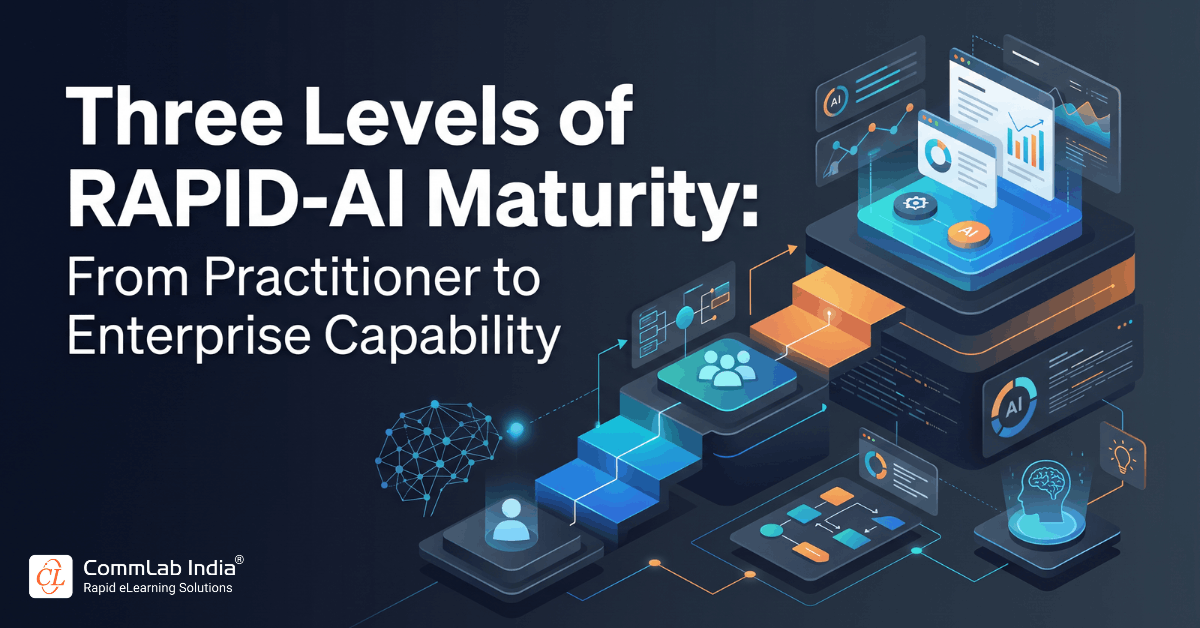
RAPID-AI develops across three maturity levels: Practitioner Method, Team Operating System, and Client Advisory Framework. Each level represents a different degree of repeatability. The progression begins with an individual applying the framework consistently, moves to a team embedding it into shared ways of working, and eventually reaches the point where the approach can be transferred to other teams or organizations.
The important question is therefore less about how many AI tools an organization has adopted and more about where the discipline for using those tools actually lives.
Level 1: Practitioner Method
At the first level, an individual instructional designer applies the RAPID-AI principles to their own work.
They may use task-specific prompts rather than generic instructions, run AI-generated output through a deliberate critique step, check their work against the five-stage workflow, and maintain clear points where human judgment or SME validation is required.
This level often develops informally. One or two instructional designers begin creating stronger habits before the team has agreed on a common framework. They may maintain their own prompt library, use a personal checklist for AI-assisted projects, or consistently review AI-generated assessments before passing them forward.
That practice has real value. It can improve the consistency of one person’s work and provide the organization with a working example of responsible AI use.
Its limitation is equally important: the capability still belongs mainly to the practitioner. If that person moves to another project or leaves the team, much of the discipline may disappear with them because the rationale, checkpoints, and decision rules have not yet been turned into a shared process.
Level 1 should therefore be viewed as the place where useful practices are developed and tested, not as the final destination for enterprise AI adoption.
Level 2: Team Operating System
At Level 2, RAPID-AI stops being primarily an individual working method and becomes part of how the L&D team operates.
Practitioner habits are translated into a shared workflow. Reviewers are named. Sign-off points are documented. The five stages are applied consistently across projects, and non-negotiable decisions no longer depend on whoever happens to be leading a particular piece of work. This is where institutionalized AI governance becomes operational rather than aspirational.
This is also where an important distinction emerges between having AI tools and having AI execution capacity.
A team can give every instructional designer access to AI and still produce highly variable work. One person may use AI carefully for analysis and critique, another may use it primarily to generate content, while someone else may accept polished output with minimal review. The organization has AI access, but its capability is uneven.
A Level 2 team reduces that variation by embedding the discipline into the operating process. When a compliance update, technical-training request, or sales-enablement project arrives, the quality of the AI-assisted workflow should not depend entirely on which designer happens to be available.
The framework begins to live in the team rather than in individual memory. That is a more meaningful indicator of maturity than the number of people using AI or the sophistication of the tools they have purchased.
What Changes When AI Becomes a Team Operating System?
Moving to Level 2 requires more than documenting a set of prompts. A team needs agreement about where AI can accelerate the work, which decisions remain human-owned, how output will be reviewed, and what happens when the normal process cannot be followed.
For example, a strong practitioner may already know instinctively that an AI-generated assessment needs to be checked against the performance objective. Once that practice becomes part of the team operating system, the review should no longer depend on instinct. The workflow identifies who performs the check, when it occurs, and what counts as acceptable alignment. That reflects the broader RAPID-AI rule that AI accelerates while humans own the decision.
This shift is what makes the practice transferable. A new designer joining the team should be able to understand the expected AI workflow without relying on an experienced colleague to explain a series of unwritten rules.
Level 3: Client Advisory Framework
At the third level, the framework becomes transferable beyond the team that originally developed it.
This may apply to an L&D consultancy advising clients, an internal center of excellence supporting different business units, or an enterprise learning team helping another function adopt a disciplined AI-assisted development model.
The bar is higher because the framework now needs to work in contexts the original team does not fully control.
Different teams bring different stakeholders, content types, levels of experience, constraints, and risk profiles. A framework that succeeds only because the people who created it already understand its unwritten assumptions is not yet ready for advisory use.
Level 3 therefore requires the organization to explain the method clearly enough that another team can apply it with guidance rather than constant direct supervision.
That transferability is what separates a mature advisory framework from a well-documented internal practice.
Why Pressure Is an Important Maturity Test
A framework often appears stronger under ideal conditions than it really is.
When timelines are comfortable, SMEs are available, and reviewers have capacity, most teams can follow a disciplined process. More revealing situations occur when a compliance deadline moves forward, a product launch compresses the development window, or the team suddenly needs to absorb additional training demand.
Pressure exposes whether the framework contains real operating discipline or depends on favorable conditions.
A mature team may still adapt its process. It can shorten meetings, change sequencing, reassign reviewers, or reduce scope. What matters is whether those changes preserve the human-owned decisions and required governance points.
This is particularly important at the advisory level. Teams are often asked for help precisely because another group needs greater delivery capacity or faster execution. If speed causes the governance model to disappear, the framework is not yet robust enough to transfer.
How to Tell Which Level Your Organization Is Actually At
Job titles, AI licenses, and policy documents can make maturity appear higher than it is. A better diagnostic is to look at where the discipline resides.
If the quality of AI-assisted work changes significantly depending on which practitioner is assigned, the organization is still largely operating at Level 1.
If different practitioners can follow the same documented process and produce consistently governed work, the organization has begun functioning at Level 2.
Level 3 becomes credible when another team can adopt the approach, understand the reasoning behind its checkpoints, and use it without continuous oversight from the people who created it.
This diagnostic can reveal an uncomfortable but useful reality: an organization may have a Level 2 policy document while still operating on Level 1 behavior. The document alone does not determine maturity. Repeatable practice does.
Moving From Practitioner Method to Team Operating System
The transition from Level 1 to Level 2 begins by identifying which individual practices are worth standardizing.
A strong practitioner may already have a reliable way to structure prompts, critique AI-generated output, validate SME content, or check objective-assessment alignment. The team then needs to separate personal preference from practices that should become common operating standards. Building in deliberate review is especially important because instructional judgment does not improve through AI exposure alone.
Documentation is part of that work, but agreement is usually the harder part.
Different designers may have developed their own methods. One may use AI heavily in analysis, another mainly in storyboarding, and another only for review. Moving to a shared operating model requires the team to agree on the decisions that need consistency without eliminating useful professional discretion.
The goal is not to make every instructional designer work identically. It is to make critical quality and governance decisions predictable regardless of who performs the work.
A useful readiness test is straightforward: could a new team member follow the documented process successfully without needing the original practitioner to explain what the document really means? If the answer is no, the approach still contains too much tacit knowledge to function as a true team operating system.
Moving From Team Operating System to Advisory Framework
The shift from Level 2 to Level 3 is less about documentation and more about transferability.
An internal process may work extremely well because the team shares the same vocabulary, understands the organization’s risk tolerance, and knows which exceptions are acceptable. Those assumptions become visible when the framework is introduced to another team.
Before using RAPID-AI as an advisory model, the organization should be able to show that the process has worked across different projects and operating conditions.
That means understanding which elements are genuinely universal and which need to adapt.
For instance, mandatory SME validation may remain constant, while the number of review checkpoints could vary according to content risk, practitioner maturity, or project complexity. An advisory framework needs to make that distinction clear enough that another team can adapt appropriately without weakening the underlying governance.
This is a more demanding test than proving that the framework works internally.
Why Skipping Levels Creates Fragile Governance
Organizations facing executive pressure to demonstrate AI progress may be tempted to begin with enterprise policy.
The problem is that governance written before people have practiced the underlying decisions can become abstract very quickly.
A policy may instruct instructional designers to “critically evaluate AI output,” but if the team has not yet developed a shared understanding of what good evaluation looks like in scenarios, assessments, objectives, or SME content, the requirement remains difficult to apply consistently.
Level 1 creates practical experience with those decisions. Level 2 tests whether they can be translated into a repeatable team process. Level 3 tests whether that process can travel into another environment. The same logic appears in guidance on deciding when AI should help, challenge, or step back during instructional design.
Each stage generates knowledge that improves the next. Skipping the earlier work means later governance is built more heavily on assumptions.
That does not mean organizations need to spend years at every maturity level. Progress can be deliberate and relatively fast when teams are focused. What matters is demonstrating the capability associated with a level before claiming the next one.
What Maturity Looks Like From Outside the Team
An outside observer can often see maturity more clearly than the team itself.
At Level 1, AI-assisted quality varies by practitioner. One designer may consistently challenge AI-generated output while another uses it mainly for speed. The difference is visible in the work, and there is little shared documentation explaining the expected approach.
At Level 2, the process becomes much less person-dependent. Different designers follow recognizable checkpoints, new team members can be onboarded against documented practices, and human sign-offs remain consistent across projects.
At Level 3, the organization can transfer the approach to another team, business unit, or client. The receiving team understands not only the steps but also which parts can adapt and which governance points must remain intact.
That progression reflects a deeper change in where organizational knowledge resides: first in the practitioner, then in the team’s operating system, and finally in a framework that can be taught and applied elsewhere.
A Practical Maturity Diagnostic for L&D Leaders
L&D leaders assessing their current maturity can start with a few practical questions:
- Would AI-assisted quality change noticeably if our strongest practitioner left tomorrow?
- Can a new instructional designer follow our AI workflow without relying on unwritten guidance?
- Are human review points and decision rights clear across projects?
- Does the process still work when delivery pressure increases?
- Have we successfully transferred the approach to another team or context?
- Can we explain which parts of the framework are fixed and which can adapt?
The answers provide a more useful maturity signal than tool adoption rates alone.
A team with sophisticated AI tools may still be at Level 1. A team using relatively simple tools may already be operating at Level 2 if its process is disciplined, documented, and repeatable.
Frequently Asked Questions
What are the three maturity levels of the RAPID-AI framework?
They are Practitioner Method, where an individual applies RAPID-AI to their own work; Team Operating System, where the approach becomes a documented and repeatable team workflow; and Client Advisory Framework, where the method can be transferred to other teams or organizations.
How do you know if your organization has reached Team Operating System level?
The strongest indicator is reduced dependence on individual practitioners. Different team members should be able to follow the same documented workflow and maintain the required governance and quality standards.
Why is pressure a useful test of AI maturity?
Compressed timelines reveal which practices are genuinely embedded. If critical human review points disappear whenever delivery pressure increases, the operating model is not yet as mature as it appears under normal conditions.
When is a team ready to use RAPID-AI as an advisory framework?
When the approach has proved repeatable across different projects and can be explained clearly enough for another team to apply it with guidance rather than constant direct supervision.
Can an organization skip directly to Level 2 or Level 3?
It can create policies or advisory materials immediately, but those artifacts may be fragile if the practices behind them have not first been exercised and refined. Each maturity level provides operating experience that strengthens the next.
Conclusion
AI maturity in L&D is easy to mistake for tool maturity.
An organization can deploy increasingly capable AI platforms without becoming more mature in how it uses them. The more meaningful progression is from individual discipline, to shared operating discipline, to transferable organizational capability.
That distinction matters because enterprise scale depends on practices that survive changes in people, projects, and context. A strong practitioner shows that the method can work. A team operating system shows that it can be repeated. An advisory framework shows that the discipline can travel.
That is the real progression RAPID-AI maturity is designed to measure.