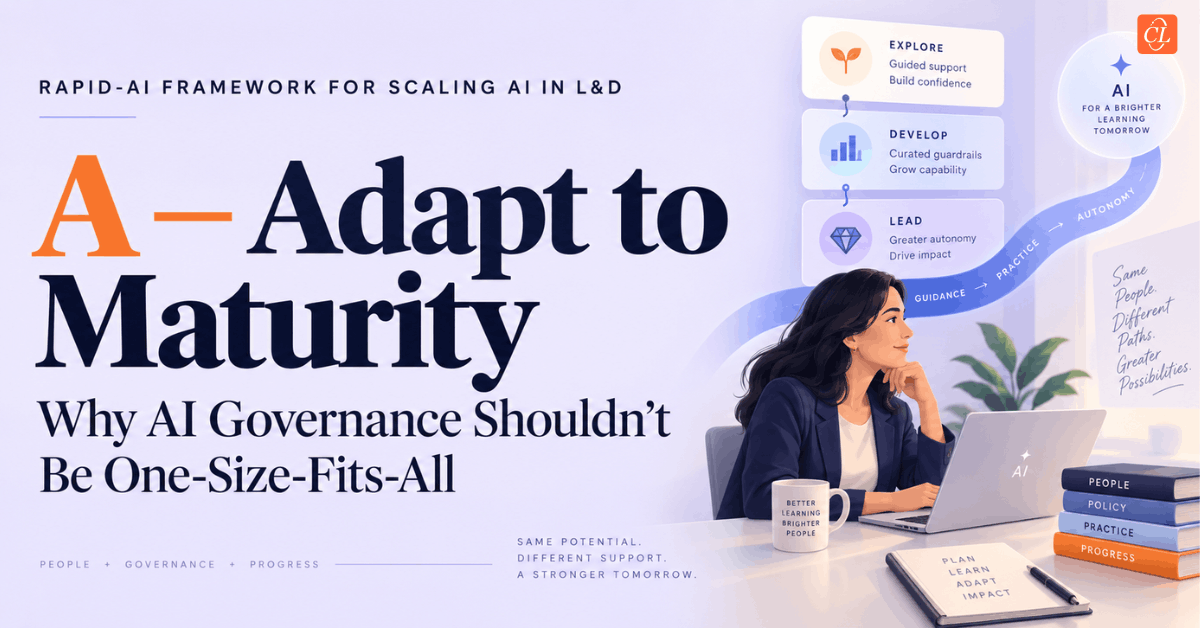
A governance framework applied identically to every instructional designer creates two problems at once. It can place unnecessary friction around experienced practitioners while giving less experienced designers too little structure at the points where judgment matters most.
The sixth RAPID-AI principle, Adapt to Maturity, addresses that imbalance. The principle does not change the standards the team is expected to meet. It changes the amount of structure, review, and independent checking surrounding the work, based on the practitioner's demonstrated ability to make sound instructional decisions.
That makes the RAPID-AI framework usable across a mixed-experience L&D team rather than only by a small group of highly experienced designers who already know how to challenge AI output instinctively.
Table Of Content
- Why Uniform Oversight Doesn't Work
- What Adapting to Maturity Looks Like in Practice
- What Maturity Should Change, and What It Should Not
- Build Maturity Into the Team Structure
- Maturity Tiers Should Be Able to Change
- Use Maturity Tiers as a Development Model, Not Only a Control Mechanism
- Use Evidence, Not Impression, to Support Tier Progression
- Maturity Can Apply to Teams, Not Just Individuals
- A Simple Tiering Model to Start With
- Review Tiers on a Predictable Cadence
- Maturity May Vary by Skill or Content Type
- Common Mistakes Teams Make
- Frequently Asked Questions
- Conclusion
Why Uniform Oversight Doesn't Work
A junior instructional designer and a senior instructional designer with ten years of experience do not approach AI-generated output with the same depth of pattern recognition.
A developing designer may be less likely to notice that an AI-generated scenario is technically polished but unrealistic for the audience, or that an assessment is measuring recall when the performance requirement calls for application. Those are judgment gaps that typically become easier to identify after repeated exposure to successful and unsuccessful learning designs.
A senior designer with a strong track record is more likely to recognize those weaknesses early. Requiring the same level of independent review at every stage may add delay without materially improving quality.
The reverse is also true. Applying light-touch oversight uniformly can leave less experienced designers working with insufficient support, especially when the AI output is fluent enough to appear stronger than it actually is.
The practical answer is to keep the instructional standards stable while varying the oversight around those standards.
What Adapting to Maturity Looks Like in Practice
The five-stage RAPID-AI workflow can remain consistent across the team while the review model around it changes.
For a junior instructional designer, the workflow may include more explicit criteria, more formal checkpoints, and mandatory second-reviewer sign-off at stages where a more experienced designer would be allowed to self-certify.
For a mid-level instructional designer, the same checkpoints may still apply, but with greater discretion. A documented self-review may be enough for lower-risk work, while independent review is reserved for projects with greater complexity or business consequence.
For a senior instructional designer with a demonstrated track record, oversight can be lighter. Self-certification may be appropriate at more stages, with second-reviewer involvement focused on genuinely ambiguous, unfamiliar, or high-risk decisions.
The intent is developmental as much as operational. More structure early in a practitioner's growth helps build the pattern recognition that eventually supports greater autonomy.
What Maturity Should Change, and What It Should Not
Adaptation should never become an informal exemption from governance.
The underlying RAPID-AI requirements still apply across the team. Required human judgment remains human-owned. Non-negotiable approvals remain in place. SME validation, instructional sign-off, or other mandatory review points do not disappear because someone is experienced.
What changes is the amount of supporting structure around those decisions. A developing designer may need an independent reviewer to confirm that a learning objective matches the required performance. A senior designer may be trusted to complete that check independently for a routine project. In both cases, the objective still has to be reviewed against the same instructional standard.
Tenure and confidence are not substitutes for accountability. Mature practitioners earn greater autonomy within the framework; they do not move outside it.
Build Maturity Into the Team Structure
Maturity-based oversight works best when it is explicit.
If review levels are decided informally, teams can quickly drift into inconsistent practices. One manager may trust a designer because they have worked together for years, while another may apply stricter controls to someone with an equally strong record. Those decisions are difficult to explain, calibrate, or defend.
A documented tiering system creates a more consistent basis for oversight. Useful criteria can include:
- Demonstrated instructional judgment
- Track record across completed projects
- Ability to identify weak or misleading AI-generated output
- Evidence of sound audience and performance analysis
- Reliability in following governance and review requirements
- Experience with the type of content or risk involved
Tenure can be one input, but it should not be the only one. An instructional designer with many years of experience may still be new to regulated content, a new industry, or AI-assisted design. A less-tenured practitioner may demonstrate unusually strong judgment in a specific area. The system should reflect actual capability rather than job title alone.
Maturity Tiers Should Be Able to Change
A maturity model loses value if people are placed into a tier and left there indefinitely.
As a designer builds a stronger record across projects, the oversight around their work should change. That might mean fewer mandatory second reviews, greater freedom to choose prompt strategies, or the ability to self-certify at selected stages.
The progression should be visible and evidence-based. For example, a designer might demonstrate readiness for greater autonomy by consistently:
- Identifying audience-fit problems before SME review
- Calling out objective-assessment misalignment
- Escalating unclear source material rather than allowing AI to fill gaps
- Applying governance requirements without reminders
- Completing several projects without significant instructional issues surfacing later
That gives managers a clearer basis for changing oversight levels and gives practitioners a concrete sense of what stronger professional judgment looks like in practice.
Use Maturity Tiers as a Development Model, Not Only a Control Mechanism
Maturity-based governance is often discussed primarily in terms of risk: more checkpoints for people who are more likely to miss a problem. That is only part of its value.
A well-designed tiering system can also serve as a development roadmap. For a junior instructional designer, additional checkpoints can feel restrictive when they appear arbitrary or permanent. The same checkpoints feel different when they are tied to visible progression: demonstrate reliable judgment in these areas, build a consistent track record, and greater autonomy follows.
That turns oversight into a capability-building mechanism. It also helps senior practitioners understand their role more clearly. Their responsibility is not only to review junior work, but to make expert judgment more visible. Explaining why a scenario is weak, why a proposed assessment is too shallow, or why an AI-generated recommendation does not fit the audience helps less experienced designers build the pattern recognition they need to move forward.
Use Evidence, Not Impression, to Support Tier Progression
A maturity model is more credible when progression is tied to observable evidence.
Some teams may use a small portfolio of completed projects. Others may document examples where a designer correctly identified a gap before formal review, challenged an AI-generated assumption, or handled a complex instructional decision without additional support.
This does not need to become a heavy certification process. The objective is simply to avoid vague judgments such as “they seem ready” or “I trust them.” Concrete evidence makes progression easier to explain and reduces the chance that maturity levels become inconsistent across managers.
Maturity Can Apply to Teams, Not Just Individuals
The same principle can be extended beyond individual instructional designers.
A newly formed L&D team may include experienced practitioners, but the group may still have no shared track record of applying AI governance together.
The team has not yet established how it handles disagreements, who catches which kinds of issues, how consistently checkpoints are followed under pressure, or how AI-assisted work moves between designers, SMEs, reviewers, and other stakeholders.
For that reason, a newly assembled or recently merged team may benefit from tighter team-level oversight during its early period, even when individual members are experienced. As the group demonstrates consistent use of the framework, those controls can become lighter.
This distinction is useful for enterprise organizations operating across business units or regions. Individual capability and collective operating maturity are related, but they are not the same thing.
A Simple Tiering Model to Start With
Teams do not need an elaborate competency framework before they can adapt governance to maturity. A practical starting model can use three tiers.
Tier 1
Developing
More structured prompts and explicit criteria, with mandatory second-reviewer sign-off at key stages.
Tier 2
Established
Self-review for routine work, with independent review reserved for higher-risk or unfamiliar projects.
Tier 3
Trusted
Self-certification at most routine checkpoints, with review focused on ambiguous or high-impact decisions.
The key word is demonstrated. Trusted status should reflect evidence, not simply tenure or confidence.
Review Tiers on a Predictable Cadence
Maturity assignments should be revisited periodically rather than only when someone asks for more autonomy. A quarterly review may be practical for many teams, although the exact cadence should reflect project volume and organizational needs.
Regular review prevents the system from becoming stale and gives practitioners a predictable opportunity to have new evidence considered. It also helps managers identify where someone may need additional support rather than simply more experience.
Maturity May Vary by Skill or Content Type
One of the more important refinements to a tiering model is recognizing that maturity is rarely uniform.
An instructional designer may be highly capable in audience analysis, learning architecture, and scenario design while having far less experience with regulatory, legal, or highly technical content. In that case, applying a single blanket tier to the person may create the wrong level of oversight.
A more realistic model allows maturity to vary by type of instructional task, content risk, domain familiarity, regulatory sensitivity, and complexity of the decision.
A designer may therefore operate with Trusted-level autonomy in one area and Established-level checkpoints in another. That more closely reflects how professional judgment actually develops.
Common Mistakes Teams Make
The most common mistake is leaving maturity-based oversight informal. When managers rely on instinct rather than documented criteria, the system becomes harder to apply consistently and may introduce bias.
Another mistake is confusing autonomy with exemption. A senior practitioner may require fewer independent reviews, but the core human decision and governance requirements still apply.
Teams can also make the opposite mistake by keeping people in a higher-control tier long after their work demonstrates readiness for greater autonomy. That creates unnecessary bottlenecks and weakens the developmental value of the model.
Finally, maturity should not be treated as a single permanent label. Capability can vary by task, content category, and business context.
Frequently Asked Questions
1. Should AI oversight be the same for junior and senior instructional designers?
A No. The instructional standards can remain consistent while the amount of structure and independent review changes. Junior designers generally benefit from more checkpoints, while experienced practitioners with a strong track record may work with lighter oversight.
2. Does adapting to maturity mean senior staff can skip governance steps?
A No. Required human decisions and non-negotiable approvals still apply. What changes is the amount of supporting review around those decisions.
3. How should a team decide someone's oversight tier?
A Use documented criteria based on demonstrated judgment, project track record, governance reliability, and relevant experience. Tenure can contribute to the decision, but it should not be the sole basis.
4. Can maturity-based oversight support professional development?
A Yes. When progression is tied to clear evidence, the tiering model gives practitioners a visible path toward greater autonomy and helps managers coach toward specific capabilities.
5. What is a simple starting model?
A A three-tier structure works well as a starting point: Developing, Established, and Trusted. Each tier changes the amount of independent review while preserving the same core instructional and governance standards.
6. How often should tier assignments be reviewed?
A A quarterly review is a reasonable starting cadence for many teams, although the timing should reflect project volume and organizational needs.
7. Can one designer have different maturity levels in different areas?
A Yes. A designer may be highly experienced in one instructional task or content category and less experienced in another. Oversight can be adjusted accordingly.
Conclusion
Maturity-based AI governance works when it does two things at the same time: protects instructional quality and develops professional judgment.
A uniform model cannot do that well across a team with different levels of experience. The better approach is to keep the standards stable while varying the amount of structure, independent review, and autonomy around them.
That creates a more useful definition of maturity. It is not simply seniority, confidence, or tool proficiency. It is a demonstrated ability to use AI without surrendering the judgment required to recognize when the output is incomplete, inappropriate, or wrong.
For enterprise L&D teams, that is what makes AI governance scalable. People earn greater freedom as their judgment becomes more reliable, while the decisions that protect quality remain firmly human-owned.