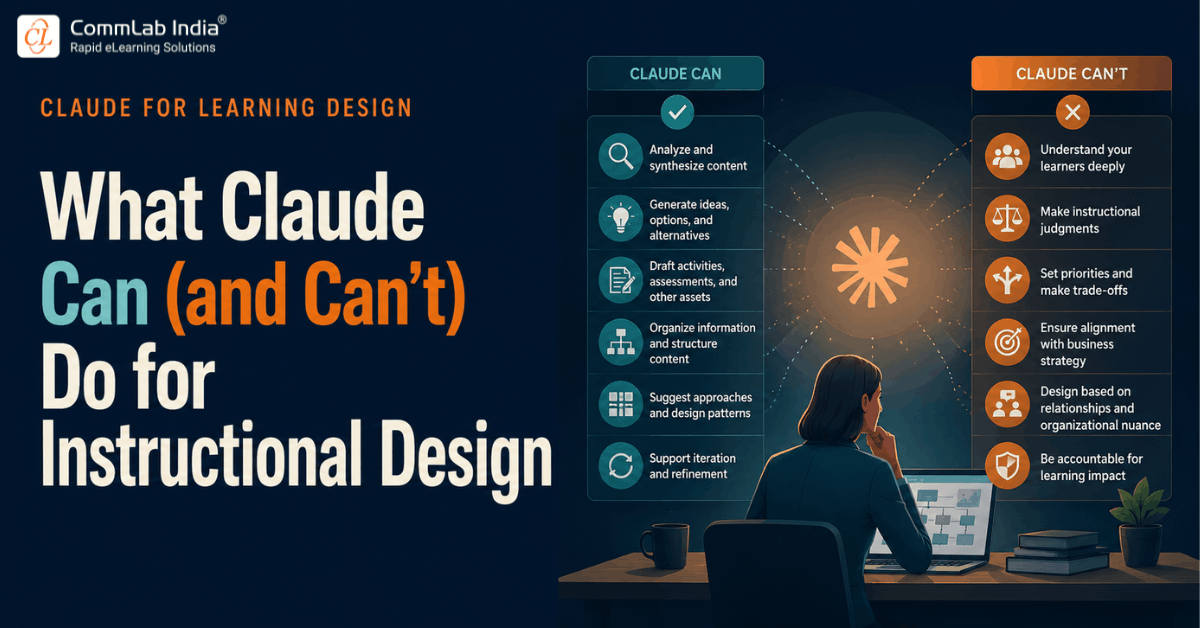

Understanding that instructional design expertise and AI capability serve different roles is a useful principle. It's not, on its own, an operating process. Principles that live only as a shared understanding tend to erode under deadline pressure, applied inconsistently depending on who's running a given project and how much time they have that week.
RAPID-AI is the framework we built to close that gap: a structured, five-stage approach to integrating Claude into learning design work that keeps AI accelerating the process at every stage, while keeping instructional designers responsible for the decisions that determine whether the resulting learning actually works. Rather than treating AI as just another productivity tool bolted onto an existing process, RAPID-AI defines specifically what happens at each stage of a project, where Claude adds genuine value, and where human judgment has to take over.
Table Of Content
- Why a Framework, Not Just a Principle
- The Five Stages of RAPID-AI
- What's Consistent Across All Five Stages
- Where RAPID-AI Came From
- Seeing RAPID-AI Applied from Start to Finish
- Applying RAPID-AI to Your Own Team
- Frequently Asked Questions
Why a Framework, Not Just a Principle
The distinction between "Claude can support this" and "instructional designers decide this," covered in depth earlier in this series, is only useful if it's applied consistently across every project, every team member, and every deadline. Without a structured process, that consistency depends entirely on individual discipline, which is precisely the kind of thing that erodes first when a project falls behind schedule.
RAPID-AI solves this by mapping the distinction onto the actual stages of a learning design project, so the question of "where does Claude help and where do I need to apply judgment" has a concrete answer at every point in the workflow, rather than being left to individual interpretation under time pressure.
The Five Stages of RAPID-AI
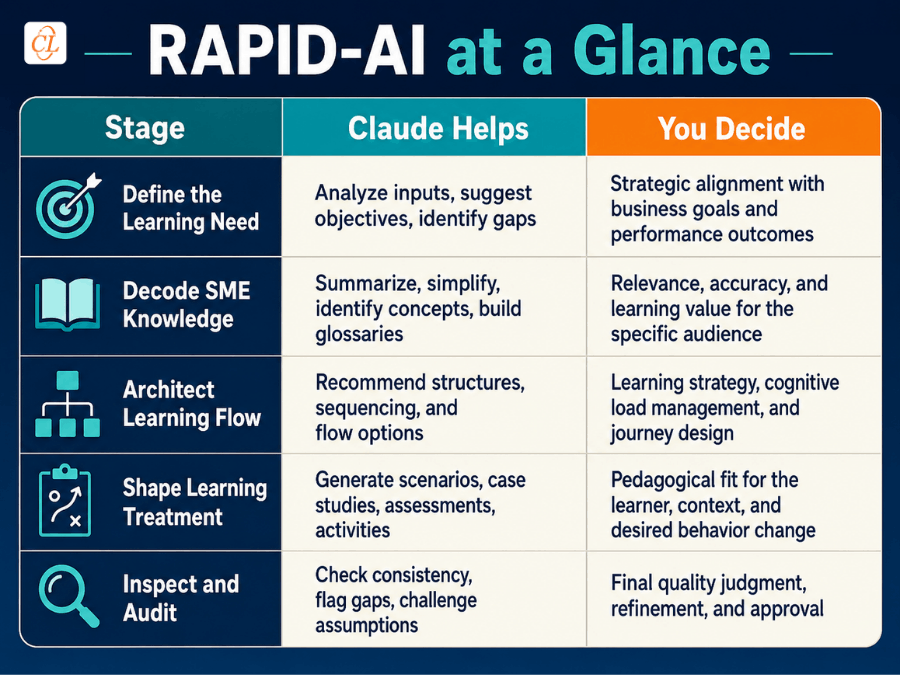
Stage 1: Define the Learning Need
What happens: The project begins with understanding the actual business goal, the learners involved, and the outcomes the organization needs from the training.
Claude helps: Analyzing stakeholder inputs, summarizing discussions and meeting notes, suggesting draft learning objectives, and identifying gaps in the information gathered so far.
You decide: Whether training is genuinely the right solution to the business problem, how the learning initiative aligns with broader business goals, and what the desired performance outcomes actually are. Every decision that follows in the project depends on getting this stage right, and it's the stage where strategic thinking, not content generation, does the real work.
Stage 2: Decode SME Knowledge
What happens: Expert knowledge, often scattered across SOPs, technical manuals, and SME interviews, gets extracted and organized into material a learner can actually use.
Claude helps: Summarizing lengthy source material, simplifying technical language, identifying key concepts, and building glossaries, work that would otherwise consume days of manual reading and note-taking.
You decide: What's actually relevant to the learner, what level of accuracy and detail is appropriate for the audience, and what has genuine learning value versus what the SME simply considers important. Claude doesn't know your audience's prior knowledge or working conditions; that judgment has to come from the instructional designer.
Stage 3: Architect Learning Flow
What happens: The identified content gets structured into a logical learner journey: what comes first, where practice opportunities sit, and how the experience builds over time.
Claude helps: Recommending module structures, proposing content sequencing, and suggesting alternative flow options to compare against each other.
You decide: The actual learning strategy: how to manage cognitive load, where learners genuinely need to pause and practice, and how confidence should build across the experience. Designing a learning journey requires understanding how people learn, not simply how information can be organized, and that distinction is where this stage's real value sits.
Stage 4: Shape Learning Treatment
What happens: The learning experience takes its actual form: scenarios, case studies, simulations, assessments, and activities that give learners something to engage with rather than just read.
Claude helps: Generating scenario ideas, case studies, assessment questions, simulation concepts, and a range of activity formats quickly and in volume.
You decide: Which instructional treatment actually fits the learner, the business context, and the desired behavior change. Faster content generation doesn't automatically produce better learning; the pedagogical judgment about which treatment will genuinely work is still an instructional design decision, and it's arguably the most consequential one in the entire framework.
Stage 5: Inspect and Audit
What happens: Before any learning solution reaches a learner, it gets reviewed for alignment, accuracy, and overall quality.
Claude helps: Checking consistency across assets, identifying gaps or inconsistencies, and even challenging assumptions made earlier in the process, functioning effectively as an additional reviewer.
You decide: Whether the suggestions Claude surfaces actually strengthen the learning experience. Quality at this stage is determined by professional judgment, not by the volume or confidence of AI-generated suggestions. The instructional designer evaluates, refines, and ultimately approves the final solution.
What's Consistent Across All Five Stages
Look across the full framework and one pattern holds at every stage without exception: the instructional designer's role never shrinks. If anything, it becomes more central, because every stage depends on a judgment call that Claude cannot make independently, regardless of how sophisticated its output at that stage becomes.
This is the core philosophy behind RAPID-AI, and it's a deliberate departure from frameworks that treat AI adoption purely as a productivity initiative. AI doesn't replace instructional expertise in this model. It amplifies it, stage by stage, freeing up time and cognitive bandwidth that gets reinvested into the decisions that actually determine whether a learning solution works.
Quick Reference: RAPID-AI at a Glance
Where RAPID-AI Came From
RAPID-AI wasn't designed on a whiteboard in advance of using AI in learning design. It emerged from watching where our own projects consistently succeeded and where they occasionally went sideways once Claude became a regular part of the workflow. Early on, without a structured framework, quality was inconsistent in exactly the way the demo comparison in the previous piece of this series illustrated: some projects handled the Claude-instructional designer relationship well by instinct, and others quietly let AI output substitute for judgment at a stage where judgment mattered.
The five stages in RAPID-AI map directly onto the natural phases of an instructional design project, define, decode, architect, shape, inspect, which is deliberate. A framework that requires learning an entirely new project structure on top of an existing one adds friction and rarely survives contact with a real deadline. RAPID-AI is designed to sit on top of a process instructional designers already recognize, rather than replace it, which is a large part of why it's held up consistently across different project types and team members.
Seeing RAPID-AI Applied from Start to Finish
Consider a project building a new-manager onboarding program. At Define the Learning Need, Claude helps synthesize interview notes from HR and department leads about what new managers currently struggle with, while the instructional designer decides that the real gap is delegation and difficult-conversation skills, not the generic leadership content the original request assumed. At Decode SME Knowledge, Claude summarizes existing HR policy documents and manager toolkits, while the instructional designer determines which policies are genuinely relevant to a first-time manager versus which are edge cases better handled as a reference resource.
At Architect Learning Flow, Claude proposes a module sequence moving from self-awareness to delegation to difficult conversations, and the instructional designer adjusts that sequence based on knowing that new managers need an early, low-risk win before tackling the harder delegation content, a judgment about motivation and confidence-building that no content structure alone would reveal. At Shape Learning Treatment, Claude generates several scenario options for practicing a difficult conversation, and the instructional designer selects the one that most closely mirrors situations new managers at this specific company actually report facing, rather than a generic scenario that could apply anywhere. At Inspect and Audit, Claude flags an inconsistency between the delegation module and the difficult-conversations module in how they each define "accountability," and the instructional designer resolves it by deciding which definition better serves the program's overall goals.
By the end of the project, Claude has meaningfully accelerated every single stage. And at every single stage, a specific instructional decision, one that depended on understanding this company's managers, not managers in general, shaped the direction the project actually took.
Applying RAPID-AI to Your Own Team
A useful exercise for any L&D leader introducing this framework is to ask, stage by stage, which one currently presents the greatest opportunity for improvement on your team. For some teams, the bottleneck sits at Decode SME Knowledge, where technical complexity slows everything else down. For others, it's Shape Learning Treatment, where time pressure pushes teams toward the first workable activity idea rather than the best one.
The real value of a framework like RAPID-AI isn't using AI everywhere uniformly. It's knowing precisely where AI adds the most value at each stage, while making sure instructional expertise stays firmly in control of the decisions that determine whether the learning actually works once it reaches a learner.
Frequently Asked Questions
1. What is the RAPID-AI framework?
A. RAPID-AI is a five-stage framework for integrating AI, specifically Claude, into instructional design work responsibly. The five stages are Define the Learning Need, Decode SME Knowledge, Architect Learning Flow, Shape Learning Treatment, and Inspect and Audit. At each stage, the framework specifies what Claude can help with and what remains an instructional design decision.
2. Does RAPID-AI slow down projects by adding more process?
A. The framework is designed to run alongside existing project timelines rather than extend them. Because it clarifies exactly where Claude can accelerate work at each stage, teams typically move faster overall, since less time is spent deciding case by case whether to trust AI output or rework it manually.
3. Which stage of RAPID-AI is most commonly underinvested in?
A. Define the Learning Need and Inspect and Audit are the two stages most often compressed under deadline pressure, since neither produces visible content on its own. Skipping rigor at either stage tends to have outsized downstream effects: a poorly defined learning need misdirects everything that follows, and a rushed audit lets misaligned content reach learners undetected.