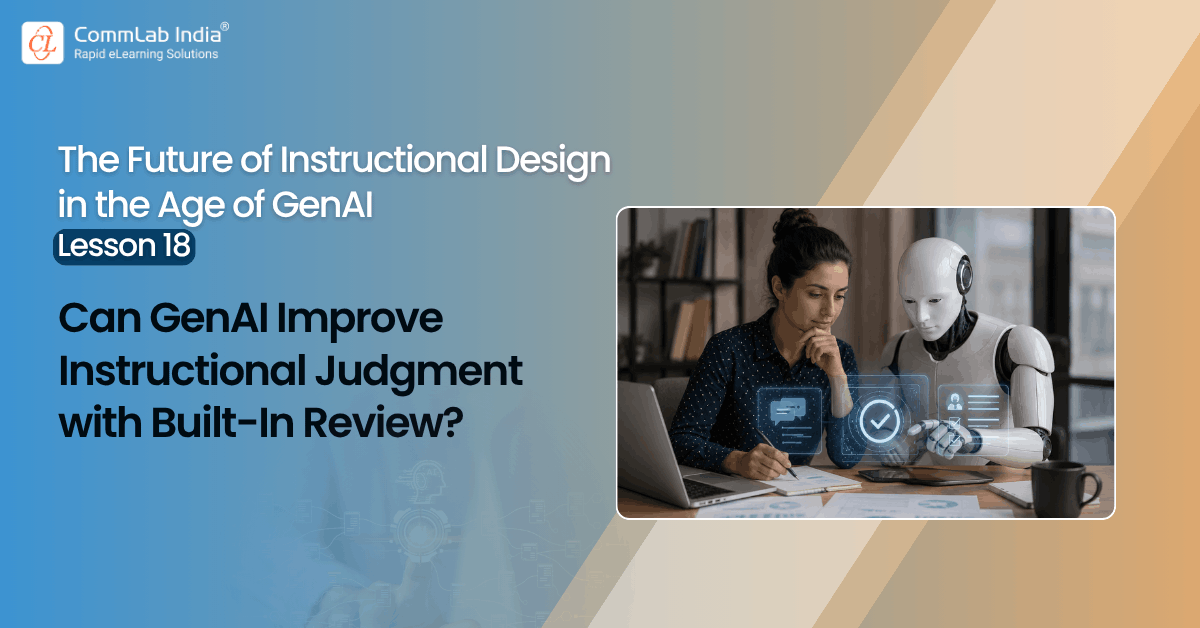
A claim now appears almost everywhere in conversations about AI and learning: GenAI will make instructional designers better. That may prove true, but improvement is not an automatic consequence of using the technology.
GenAI can certainly help instructional designers work faster. It can summarize SME content, generate alternatives, reduce drafting time, improve wording, and accelerate early-stage design work. These are valuable productivity gains, especially when teams are working under tight timelines or managing a high volume of deliverables.
The more demanding test is whether GenAI can improve instructional judgment: the ability to decide what matters, detect weak reasoning, strengthen alignment, reduce cognitive overload, and choose an appropriate design response. Those capabilities shape learning quality far more than production speed does.
GenAI can contribute to stronger judgment when review is treated as a deliberate part of the workflow. Without that discipline, a team may produce cleaner work more quickly while doing little to strengthen the reasoning behind it. In some situations, habitual acceptance of plausible AI output may even weaken that reasoning.
This article is part of a continuing series on the future of instructional design in the age of GenAI. The series explores how instructional designers can move beyond ad hoc prompting toward a more disciplined, challenge-based human-AI working method.
Table Of Content
- Judgment Does Not Improve Through Exposure Alone
- Review Is Where the Designer Learns
- The Hidden Risk of Plausible Output
- What Built-In Review Looks Like
- Judgment Sharpens Through Comparison
- Implications for Team Development
- The Larger Point
Judgment Does Not Improve Through Exposure Alone
It is tempting to assume that regular exposure to AI-generated material will naturally sharpen a designer's judgment. Designers may see more alternatives, notice useful patterns, and encounter phrasing or structures they would not have considered on their own. Exposure can expand the range of possibilities they see, but it does not teach them how to evaluate those possibilities.
A designer can review hundreds of generated objectives without becoming much better at determining whether an objective is observable and performance-based. The same designer might generate dozens of assessments without learning to spot a weak distractor, or use AI to draft storyboards every day without improving their ability to judge whether the learning flow is instructionally sound.
Judgment develops through evaluation. The designer must examine an output, test it against clear criteria, identify its limitations, and decide what to change. When AI is used mainly to supply answers, the work can move forward without requiring this intellectual effort. Review creates the point at which assistance becomes active professional practice.
Review Is Where the Designer Learns
Review is usually treated as a quality-control step, but in AI-assisted instructional design it also has a developmental role. The designer encounters alternatives, trade-offs, omissions, and hidden assumptions, then has to determine which choices serve the learning need.
For example, an AI-generated objective may sound clear while remaining difficult to observe or assess. A proposed scenario may appear realistic but give the learner no meaningful decision to make. A shortened screen may read more smoothly while omitting a qualifier that is essential for safety, compliance, or technical accuracy. Recognizing these weaknesses requires the designer to apply instructional principles rather than respond to polish.
These review decisions matter more to professional growth than the initial generation of the material. When designers repeatedly diagnose what is weak, explain why it is weak, and improve it, they exercise the reasoning that experienced practitioners use. A workflow that omits these moments may be productive, but it offers limited developmental value.
The Hidden Risk of Plausible Output
The risk of shallow review is easy to miss because AI output often looks competent. The language is clean, the structure is orderly, and the deliverable may be produced faster. That visible fluency can encourage a reviewer to approve work that is coherent on the surface but weak in its instructional logic.
Over time, designers may begin to depend on AI-generated structures, spend less time working through ambiguity, and review polished material less critically. The quality threshold can gradually shift from instructionally strong to acceptable enough to proceed. Dependence grows in this way because the output is plausible, not because every output is obviously poor.
A quick sense check is therefore insufficient. Teams need a review process that makes scrutiny unavoidable at the moments when important learning decisions are made.
What Built-In Review Looks Like
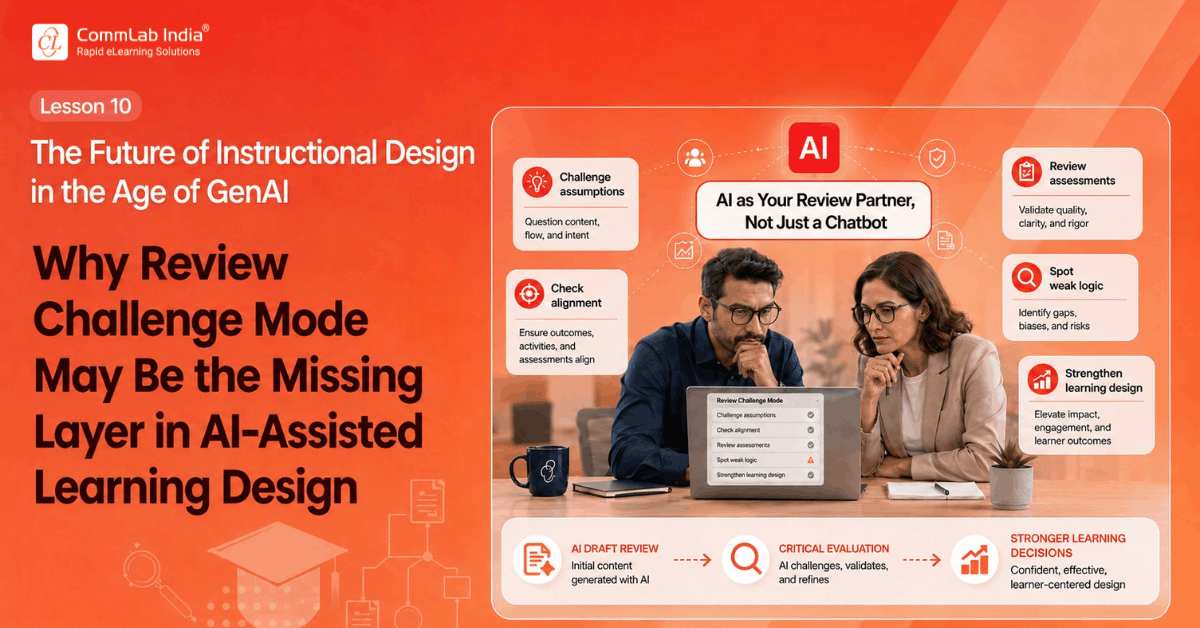
Review strengthens judgment when it is designed into the workflow rather than left to individual preference. Four practices make that review more reliable.
1. Pause at meaningful decision points
AI-generated work should not move automatically into the next stage. Teams can place deliberate review points after SME-content analysis, learning-flow design, objective development, storyboard structure, visual treatment, and assessment design. The designer then decides what is ready to move forward, what requires revision, and what should be rejected.
2. Use explicit review questions
A general instruction to check the work rarely produces a rigorous review. Questions tied to the design decision make the designer's reasoning visible and repeatable. Useful prompts include:
- What is the weakest part of this structure, and why?
- What has been omitted or oversimplified?
- Where is the alignment between the objective, practice, and assessment weaker than it appears?
- What would an independent reviewer be most likely to challenge?
Questions like these direct attention beyond surface quality and help teams develop a shared standard for instructional strength.
3. Use AI to critique as well as create
AI can support review by identifying assumptions, comparing alternatives, testing alignment, or arguing against a proposed design. A designer might ask it to find where an assessment rewards recall despite an application-level objective, or to explain how a scenario could fail for a specific audience. The designer still verifies the critique and makes the decision, but the challenge can reveal issues that deserve closer inspection.
4. Require a rationale for consequential choices
Designers think more carefully when they have to explain why they selected one option, rejected another, revised an objective, or chose a particular assessment type. A brief rationale turns an implicit preference into a decision that can be examined and discussed. This is especially useful for junior and mid-level instructional designers because it makes the reasoning process available for coaching rather than leaving it hidden in the final deliverable.
A Simple Example of Review in Practice
Consider an AI-generated objective that states, 'Understand the process for responding to a customer complaint.' The wording may appear acceptable in an early draft, and the AI may pair it with a multiple-choice question that asks learners to recall the steps in order.
At a built-in review point, the designer tests the objective against the required workplace performance. If employees must assess a complaint and choose an appropriate response, 'understand' is neither observable nor specific enough. The recall question also fails to demonstrate the required decision-making.
The designer could revise the objective to: 'Given a customer complaint, select the appropriate response and escalation path using company guidelines.' The assessment could then present a realistic complaint with several defensible-looking options. The improvement comes from diagnosing the mismatch between the desired performance and the original design, not from generating another polished sentence.
Judgment Sharpens Through Comparison
A designer becomes stronger by weighing alternatives and explaining the criteria behind a choice. Comparing two learning flows, several versions of an objective, or different assessment formats exposes trade-offs that a single answer can conceal. One version may be concise but incomplete; another may look sophisticated while testing less; a third may be accurate but unnecessarily demanding for the audience.
GenAI can make these alternatives available quickly, which gives designers useful material for comparison. The developmental benefit depends on the workflow creating time to examine those differences before the first acceptable answer becomes the final answer.
Implications for Team Development
For L&D leaders and design managers, built-in review is more than an individual working preference. It determines whether faster production also contributes to stronger team capability. When AI is used mainly for generation, some designers may improve through their own habits, while others become increasingly reliant on AI-produced structures.
A shared review method produces a more deliberate development path. Junior designers learn to identify weaknesses and apply criteria. Mid-level designers strengthen their ability to justify design choices and manage trade-offs. Senior designers can use AI to pressure-test assumptions, audit alignment, and coach others through the reasoning behind revisions.
This approach also gives managers something concrete to observe. Instead of evaluating AI use by the amount of content produced, they can examine the quality of review questions, the rationale behind decisions, and the improvements made between an AI-generated draft and the approved design.
The Larger Point
GenAI has the potential to improve instructional judgment, but the technology cannot provide that outcome through presence or speed alone. The workflow must keep the designer mentally engaged through evaluation, comparison, challenge, and conscious decision-making.
When review is systematic, AI becomes useful for more than producing content. It gives designers material to question, alternatives to compare, and assumptions to test. The lasting value is not simply a faster deliverable; it is a team that can explain its design decisions and make those decisions with greater care.