Over the years, the conversation around online training has evolved from simply digitizing classroom content to designing technology-enabled learning experiences that can scale across global workforces. Yet, despite this progress, many organizations continue to approach training technology as a collection of isolated tools rather than as a unified system.
This fragmented approach often leads to inconsistent learner experiences, duplicated efforts, and limited visibility into learning outcomes. Teams adopt platforms, experiment with emerging technologies, and introduce new tools to solve immediate challenges, but these decisions are rarely aligned within a broader strategic framework.
The real opportunity lies in shifting from tool selection to ecosystem design.
A well-structured online training ecosystem integrates platforms, content creation tools, immersive technologies, and performance support systems into a cohesive environment. Such an ecosystem does not merely deliver training. It enables continuous learning, supports real-time performance, and adapts to evolving business needs.
When technology is aligned with strategy, it becomes more than an enabler of learning. It becomes a driver of organizational capability and performance.
Download eBook: (Online) Confessions of an L&D Professional
Table of Contents
- From Isolated Tools to Integrated Learning Ecosystems
- Deconstructing the Modern Training Technology Stack
- Platforms and Delivery Systems as Experience Hubs
- Content Creation and Visual Learning Infrastructure
- Simulations and Immersive Technologies for Real-World Practice
- AI and Accessibility as Strategic Enablers
- Performance Support and Learning in the Flow of Work
- Scaling Content Through Rapid Development Approaches
- Navigating Platform Complexity with Strategic Clarity
- Building a Future-Ready Learning Technology Strategy
- FAqs
From Isolated Tools to Integrated Learning Ecosystems
Most organizations begin their digital learning journey with a tactical mindset. A platform is implemented to host courses, a few tools are introduced to create content, and additional technologies are layered in as new needs arise.
While this approach may address short-term requirements, it often results in a fragmented landscape where tools operate in silos and learners experience inconsistency across different training initiatives.
A more sustainable approach involves thinking in terms of ecosystems rather than individual tools.
An integrated learning ecosystem ensures that:
- Technologies work together seamlessly
Systems are connected, reducing friction and duplication. - Learner experiences remain consistent
Navigation, design, and interactions follow unified principles. - Data flows across the system
Insights can be gathered and used to improve learning outcomes. - Scalability is built into the design
New tools and capabilities can be added without disruption.
This shift transforms technology from a set of disconnected solutions into a coordinated system that supports continuous learning and performance improvement.
Deconstructing the Modern Training Technology Stack
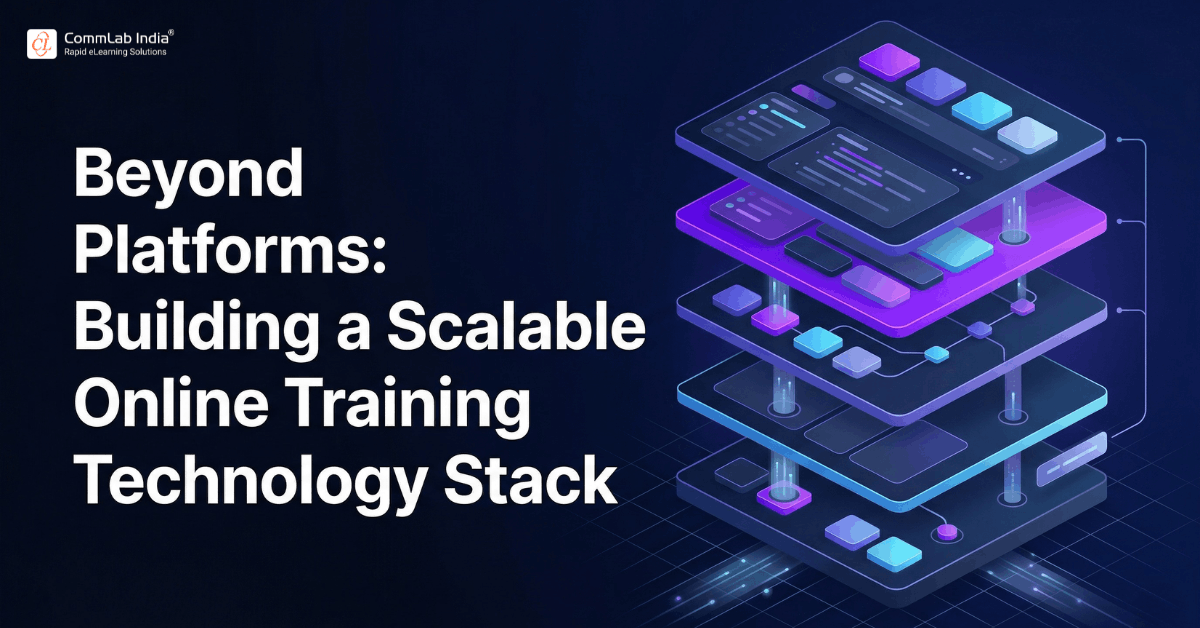
To design an effective ecosystem, it is useful to understand the different layers that make up a modern training technology stack. Each layer serves a specific function, yet its value is realized only when it is aligned with the others.
| Layer | Role in the Ecosystem |
| Delivery Platforms | Host, manage, and track learning experiences |
| Content Development Tools | Create structured, interactive learning content |
| Visual and Media Tools | Enhance clarity through graphics and multimedia |
| Immersive Technologies | Enable experiential learning through simulations and VR |
| Intelligence Layer | Personalize learning and improve accessibility |
| Performance Support | Provide just-in-time assistance during work |
This layered structure helps organizations move beyond ad hoc decisions and adopt a more strategic approach to technology selection and integration.
Platforms and Delivery Systems as Experience Hubs
Learning platforms have traditionally been viewed as repositories for courses. However, their role has expanded significantly.
Modern platforms function as experience hubs, where learners discover, access, and interact with a wide range of learning resources. They are no longer limited to hosting content but are central to shaping the overall learning experience.
An effective delivery system should:
- Enable intuitive navigation
Learners can easily find and access relevant content. - Support diverse formats
From videos and simulations to microlearning and job aids. - Integrate with enterprise systems
Allowing seamless data exchange and workflow alignment. - Provide actionable insights
Analytics help track engagement, progress, and outcomes.
The platform sets the tone for how learners perceive and interact with training. Its effectiveness depends not just on features, but on how well it integrates with the broader ecosystem.
Content Creation and Visual Learning Infrastructure
Content remains at the heart of any training initiative, but the way it is created and presented has evolved.
Modern learners expect information to be clear, visually engaging, and easy to consume. This has led to increased reliance on visual and multimedia elements that enhance understanding and retention.
Key components of this infrastructure include:
- Infographics for clarity
Simplify complex ideas into visual formats that are easier to process. - Multimedia content for engagement
Combine text, audio, and visuals to create richer experiences. - Image and design tools for consistency
Ensure that content maintains a professional and cohesive look.
The strategic advantage of these tools lies in their ability to:
- Accelerate content development
- Improve learner comprehension
- Maintain consistency across programs
- Enable collaboration among distributed teams
When used effectively, visual tools transform content from static information into engaging learning experiences.
Simulations and Immersive Technologies for Real-World Practice
One of the most powerful capabilities of modern training technology is the ability to replicate real-world environments through simulations and immersive experiences.
These technologies allow learners to practice skills in safe, controlled settings where mistakes become opportunities for learning rather than risks.
They are particularly valuable in situations where:
- Practical experience is critical to performance
- Errors carry significant consequences
- Decision-making requires contextual understanding
Simulations provide:
- Hands-on practice
Learners actively apply knowledge rather than passively consume it. - Realistic scenarios
Training reflects the complexity of actual work environments. - Immediate feedback
Learners understand the impact of their decisions.
Virtual reality takes this a step further by creating immersive environments that enhance engagement and realism.
While these technologies require thoughtful implementation, their ability to bridge the gap between learning and performance makes them a valuable addition to the training ecosystem.
AI and Accessibility as Strategic Enablers
Artificial intelligence is rapidly transforming how training is delivered and experienced. Its true value lies not in automation alone, but in its ability to make learning more adaptive, inclusive, and scalable.
AI enables:
- Personalized learning experiences
Content adapts based on learner behavior and performance. - Intelligent recommendations
Learners receive relevant content at the right time. - Enhanced accessibility
Features such as captions, translations, and adaptive interfaces improve usability.
Accessibility, in particular, is becoming a critical priority. Ensuring that training is inclusive and usable for all employees not only meets compliance requirements but also expands the reach and impact of learning initiatives.
Together, AI and accessibility redefine how learning is experienced, making it more responsive to individual needs.
Performance Support and Learning in the Flow of Work
Formal training is only one part of the learning journey. In many situations, employees need immediate access to information while performing tasks.
Performance support tools address this need by embedding learning within the workflow.
These tools are designed to:
- Provide quick, actionable guidance
- Reduce reliance on memory
- Improve accuracy and efficiency
- Enable continuous learning
Common forms of performance support include:
- Checklists and quick reference guides
Offer step-by-step assistance for tasks. - Interactive job aids
Provide dynamic, context-sensitive guidance. - Embedded help systems
Deliver support directly within applications.
By integrating these tools into daily work, organizations ensure that learning is not confined to scheduled sessions but becomes an ongoing, accessible resource.
Scaling Content Through Rapid Development Approaches
As training demands increase, organizations must find ways to develop content quickly without compromising quality.
Rapid development approaches enable this by streamlining the creation process and leveraging reusable components.
Key enablers include:
- Authoring tools with templates
Standardized structures reduce development time. - Modular content design
Content can be reused and adapted across programs. - Collaborative workflows
Teams can work simultaneously, improving efficiency.
The goal is not simply to produce more content, but to create scalable systems that maintain consistency and adaptability.
Navigating Platform Complexity with Strategic Clarity
The growing number of learning platforms presents both opportunities and challenges. While organizations have access to a wide range of options, selecting the right platform can be complex.
A strategic approach involves evaluating platforms based on:
- Alignment with learning objectives
- Integration capabilities with existing systems
- User experience and adoption potential
- Scalability and future readiness
Rather than focusing on individual features, organizations should consider how a platform fits within the overall ecosystem and supports long-term goals.
Building a Future-Ready Learning Technology Strategy
A future-ready strategy is not defined by the adoption of the latest tools, but by the ability to integrate and adapt technologies over time.
This requires:
- Clear alignment between technology and business objectives
- Thoughtful selection of tools across different layers
- Seamless integration to ensure consistency
- Continuous evaluation and refinement
When these elements are in place, technology becomes a strategic asset that supports learning, performance, and organizational growth.
FAQs
1. What is an online training technology stack?
A. It is a combination of platforms, tools, and systems that work together to deliver, manage, and enhance learning experiences across an organization.
2. How do simulations improve training effectiveness?
A. Simulations provide realistic environments where learners can practice skills and experience outcomes, leading to better understanding and retention.
3. What role does AI play in training?
A. AI enables personalization, improves accessibility, and provides intelligent recommendations, making learning more adaptive and scalable.
4. Why are job aids important?
A. Job aids provide immediate support during tasks, improving accuracy and reducing the need to recall information from memory.
5. How can organizations scale training effectively?
A. By using rapid development tools, modular content design, and integrated platforms, organizations can scale training without compromising quality.
6. What should organizations consider when choosing a platform?
A. They should evaluate alignment with learning goals, integration capabilities, user experience, and scalability.
7. How can organizations future-proof their learning technology?
A. By focusing on integration, adaptability, and alignment with strategic objectives rather than relying on individual tools.
Conclusion
The evolution of online training technology is not defined by the tools organizations adopt, but by how effectively those tools are integrated into a cohesive system.
Organizations that take a strategic approach to building their technology stack create environments where learning is continuous, accessible, and closely aligned with performance.
In doing so, they move beyond fragmented solutions and establish a foundation for long-term capability building and growth.
This is where technology transcends its operational role and becomes a true driver of organizational success.