AI-enabled learning platforms are changing how organizations create, manage, and deliver employee training. Yet adopting more capable technology does not automatically make existing learning content accurate, current, accessible, or ready for AI-assisted experiences.
For enterprises investing in the Workday and Sana ecosystem, a critical challenge is preparing existing training libraries, instructional workflows, and governance processes to take advantage of emerging AI capabilities.
The convergence of AI-powered authoring, personalized learning, and enterprise workforce data presents an opportunity to rethink how training is developed and delivered. Organizations can potentially reduce content development time, make learning more responsive to employee needs, and connect training more closely with skills development and business priorities.
Realizing these benefits requires coordinated efforts across several areas, from modernizing legacy content and applying instructional design principles to managing multilingual learning, platform integration, and compliance reporting.
The following priorities can help enterprise L&D teams build a strong foundation for AI-enabled learning while maintaining the quality, consistency, and control required at scale.
Table of Contents
- Modernizing Legacy Training for AI-Native Learning
- Designing Effective Learning Experiences with Sana Create
- Preparing Enterprise Knowledge for Reliable AI Tutoring
- Scaling Global Learning Through AI-Assisted Localization
- Connecting Learning Experiences with Workday HCM and Skills Data
- Establishing Governance for AI-Enabled Enterprise Learning
- A Practical Approach to Implementing Workday Learning + Sana AI
- Where Specialized Learning and Technology Expertise Adds Value
- Turning AI-Native Learning Ca[BF19.1]pabilities into Enterprise Value
1. Modernizing Legacy Training for AI-Native Learning
Many enterprise learning libraries contain years of accumulated training content: PowerPoint presentations, PDFs, SOPs, recorded sessions, SCORM courses, and older interactive modules.
Much of this content remains valuable. The challenge is that it was often designed for linear consumption rather than interactive learning, personalized recommendations, or AI-assisted knowledge retrieval.
Workday Learning, powered by Sana, offers capabilities for AI-assisted content creation and interactive learning. However, successful modernization requires decisions about content structure, instructional relevance, and accuracy.
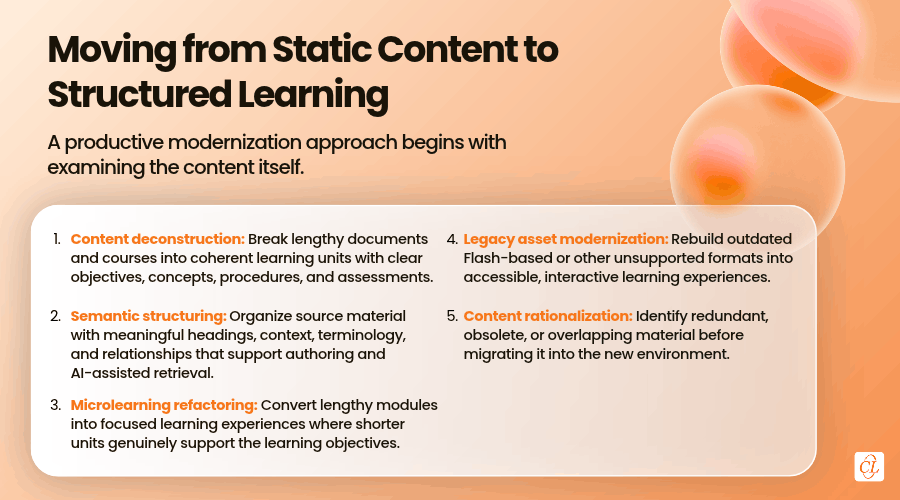
Structured Markdown or other clean source formats can support content preparation workflows where appropriate. However, the final format should reflect the platform's supported authoring and import capabilities.
Consider a global manufacturing organization with hundreds of legacy safety and equipment-training modules. Simply importing these courses into a modern platform may preserve outdated navigation, unnecessary content, and inconsistent assessments.
A stronger approach would identify essential procedures, separate foundational knowledge from task-specific instruction, and redesign appropriate content into concise lessons, demonstrations, and practice activities.
The objective is to make existing knowledge easier to maintain, retrieve, and apply.
2. Designing Effective Learning Experiences with Sana Create
AI-assisted authoring can significantly reduce the effort required to generate course outlines, draft explanations, create knowledge checks, and adapt learning material.
Sana Create extends these possibilities through collaborative authoring and interactive learning elements. But instructional effectiveness still depends on the decisions behind the content.
A well-written AI-generated explanation does not automatically help an employee perform a complex task, make a judgment, or respond to an unfamiliar situation.
Applying Instructional Design to AI-Generated Content
Effective learning experiences need more than accurate information. They require appropriate instructional strategies based on what learners must be able to do.
Several design priorities become especially important.
Role-specific learning: Content should reflect the responsibilities, context, and decisions associated with different roles. A frontline supervisor, technical specialist, and compliance manager may need different learning experiences even when working with the same underlying information.
Meaningful practice: Interactive assessments, scenarios, simulations, and decision exercises should help employees apply knowledge rather than simply recall it.
AI-supported learning interactions: AI tutors can help learners explore concepts, receive explanations, and practice understanding. Their effectiveness depends partly on the quality, relevance, and boundaries of the knowledge sources they use.
Collaborative content development: Instructional designers, SMEs, compliance reviewers, and learning administrators need shared processes for reviewing and maintaining content.
Reusable learning structures: Consistent templates, assessment patterns, and content standards can help distributed teams develop courses efficiently while maintaining instructional quality.
For example, an enterprise sales enablement program could use AI-assisted authoring to generate initial product knowledge modules. Instructional designers could then develop customer scenarios, objection-handling exercises, and assessments based on realistic sales conversations.
This combination allows AI to accelerate content preparation while experienced learning professionals focus on the design decisions that influence performance.
3. Preparing Enterprise Knowledge for Reliable AI Tutoring
One of the more significant developments in AI learning platforms is the ability to provide conversational support within the learning experience.
Instead of relying entirely on predetermined course navigation, employees can ask questions, clarify concepts, and access explanations relevant to the material they are studying.
This makes the quality of the underlying knowledge particularly important.
Why Knowledge Architecture Matters
An AI tutor working with incomplete, outdated, or poorly organized materials may provide answers that are unhelpful, ambiguous, or inaccurate.
Organizations should therefore establish processes for preparing and governing the content made available to AI-assisted learning experiences.
These include:
- Source validation: Confirm that learning resources are accurate, current, and approved by appropriate SMEs.
- Knowledge organization: Structure content so concepts, procedures, exceptions, and dependencies are clearly distinguishable.
- Terminology consistency: Maintain agreed definitions for technical, regulatory, and organization-specific terms.
- Source and scope controls: Define which approved resources an AI tutor should use for particular learning activities, where the platform supports these settings.
- Response evaluation: Test AI-generated explanations against representative learner questions, including ambiguous and high-risk scenarios.
- Content maintenance: Establish ownership and review cycles so AI-supported learning remains aligned with changing business requirements.
For regulated industries, these controls become especially important.
An employee asking about a manufacturing safety procedure or financial compliance requirement needs guidance grounded in current, approved documentation. AI tutoring can support understanding, but it should not substitute for required procedural controls or authoritative policies.
The goal is to improve the reliability and usefulness of AI-assisted learning while keeping human expertise and organizational accountability in place.
4. Scaling Global Learning Through AI-Assisted Localization
For multinational enterprises, learning content must remain consistent across languages, regions, and business units without losing the context necessary for employees to apply it.
AI-powered translation capabilities can accelerate multilingual course development within supported Workday and Sana workflows.
This creates opportunities to reduce the delays traditionally associated with sequential translation workflows. However, global learning requires more than converting text from one language into another.
Combining AI Translation with Human Quality Assurance
An effective localization process should consider the technical, linguistic, cultural, and instructional requirements of each target audience.
Terminology management: Enterprise-specific language, technical terminology, product names, and regulatory expressions must remain consistent.
Human post-editing: Qualified reviewers should validate translations for meaning, tone, accuracy, and local relevance, particularly in high-stakes training.
Multimedia localization: Videos, voiceovers, captions, transcripts, and AI-generated avatars may require adaptation for different audiences.
Assessment localization: Questions, scenarios, and examples should remain valid and understandable after translation.
In-context testing: Reviewers should examine localized content within the actual learning experience to identify layout, navigation, accessibility, or usability issues.
Consider compliance training deployed across North America and Europe. While the core policy may be consistent, terminology, legal references, examples, and local reporting procedures can vary.
AI can accelerate the initial translation, while human review ensures that employees receive clear and contextually appropriate instructions.
This approach makes global learning production more scalable without treating linguistic accuracy or instructional quality as optional.
AI in Corporate Training
Partner, Not Replacement
- AI in Corporate Training
- AI Toolkit for Super-charged Learning
- Challenges to Consider with AI Implementation
- And More!
5. Connecting Learning Experiences with Workday HCM and Skills Data
One of the defining characteristics of the Workday and Sana ecosystem is its relationship with enterprise workforce data.
The integrated model creates opportunities to connect AI-enabled learning experiences with employee information, learning assignments, skills data, and reporting workflows.
These connections are particularly valuable for large organizations managing complex workforce structures, multiple business units, and regulatory requirements.
Aligning Content, Skills, and Learning Operations
Several technical and operational priorities help organizations make effective use of this connected environment.
Skills and competency mapping
Learning content should be aligned with relevant job roles, competencies, and skill taxonomies. This requires clear metadata conventions and careful mapping between training objectives and the organization's workforce skills framework.
Where supported and configured, these relationships can strengthen personalized learning recommendations and skills-based development.
Content metadata and catalog management
Courses need consistent titles, descriptions, classifications, languages, audiences, and other metadata required by the learning environment.
Well-managed metadata makes content easier to discover, assign, maintain, and report on.
Platform configuration and integration
Enterprise implementations require attention to access permissions, catalog configuration, learning assignment rules, supported integrations, and administrative workflows.
These activities should be aligned with the organization's Workday architecture, security requirements, and operational processes.
Completion and assessment tracking
Learning administrators need confidence that required completions, assessment results, and other supported learning records are captured and reported correctly.
This calls for defined tracking requirements, configuration checks, and end-to-end testing across relevant learning workflows.
Compliance and audit readiness
Regulated training often requires reliable evidence of assignment, completion, assessment, and reporting. Appropriate controls and validation are therefore essential, particularly when learning records are used for audits or mandatory certifications.
For example, a global enterprise launching mandatory training across several business units may need different assignment rules based on employee role, location, or regulatory requirements.
The learning experience can be modern and interactive, but the organization must also ensure that enrollment rules, completion criteria, reporting, and audit records operate as intended.
This is where learning content expertise, LMS administration, Workday configuration, integration development, and testing expertise need to operate together.
6. Establishing Governance for AI-Enabled Enterprise Learning
As AI authoring becomes more accessible, course creation may extend beyond centralized instructional design teams to SMEs, department managers, and other business contributors.
This can accelerate knowledge sharing, especially when information changes frequently.
It can also introduce inconsistencies if organizations lack agreed processes for content approval, instructional design, version control, and quality assurance.
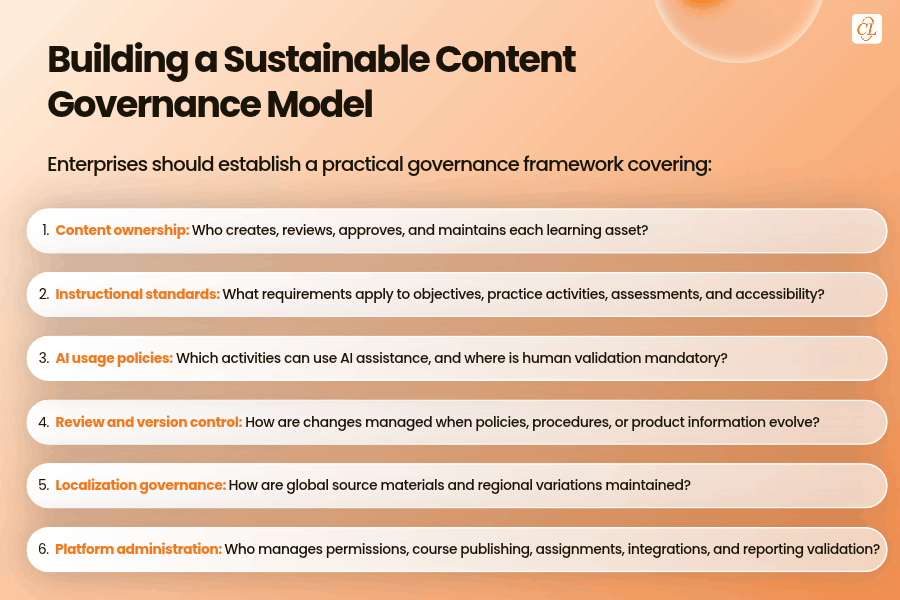
Governance should reflect the risk and complexity of the content.
A short product-awareness module may require a relatively lightweight review process. A safety certification or regulatory training program may require formal SME approval, assessment validation, and auditable records.
Well-designed governance enables decentralized content creation while maintaining enterprise standards.
7. A Practical Approach to Implementing Workday Learning + Sana AI
Enterprises can benefit from approaching adoption as a coordinated content, technology, and learning operations initiative rather than a platform migration exercise alone.
A phased approach helps establish requirements and evaluate results before expanding across the organization.
|
Phase |
Key activities |
Intended outcome |
|
1. Assess |
Audit existing content, formats, skills mappings, workflows, and reporting requirements |
Identify modernization priorities and implementation dependencies |
|
2. Prepare |
Rationalize content, structure source materials, establish metadata and governance standards |
Develop a reliable foundation for AI-assisted learning |
|
3. Design |
Build interactive lessons, assessments, role-specific experiences, and AI tutoring use cases |
Create instructionally sound learning experiences |
|
4. Configure and integrate |
Align platform settings, permissions, assignments, catalog structures, and supported integrations |
Connect learning experiences with enterprise operations |
|
5. Validate |
Test content quality, localization, accessibility, AI responses, completion tracking, and reporting |
Identify and resolve issues before wider deployment |
|
6. Scale and optimize |
Expand proven workflows, monitor results, maintain content, and refine governance |
Support sustainable enterprise-wide learning delivery |
A pilot might focus on one high-priority training program involving multiple roles, languages, and reporting requirements.
The organization could compare development effort, content quality, learner engagement, assessment performance, and administrative efficiency with its previous delivery approach.
Importantly, evaluation should go beyond course creation speed and completion rates. The real measure of success is whether employees can access relevant knowledge, demonstrate required skills, and apply what they have learned.
8. Where Specialized Learning and Technology Expertise Adds Value
AI-native platforms increasingly automate activities that previously required substantial manual effort. Course drafting, translation, content organization, and routine administrative workflows are becoming faster.
This changes the nature of the expertise enterprises need.
For organizations managing extensive learning portfolios, the most valuable capabilities often combine several disciplines.
|
Capability |
Contribution to enterprise learning |
|
Rapid eLearning development |
Modernizes large volumes of legacy training efficiently |
|
Instructional design |
Connects content and AI interactions with learning and performance objectives |
|
AI-ready content preparation |
Improves the structure, accuracy, and maintainability of source knowledge |
|
Translation and localization |
Supports consistent multilingual delivery with appropriate quality controls |
|
Learning content governance |
Maintains quality, accountability, and consistency across contributors |
|
LMS administration and configuration |
Supports reliable learning operations, assignments, access, and reporting |
|
Integration and validation |
Connects supported workflows and verifies expected learning data behavior |
These disciplines are complementary. Effective implementation requires decisions about content, learning design, workforce data, security, technology configuration, and ongoing operations.
The balance will differ by organization. Some enterprises will have mature internal teams capable of managing the entire transition. Others may draw on specialized learning development, localization, LMS, or integration expertise to accelerate implementation and manage complex workloads.
Turning AI-Native Learning Capabilities into Enterprise Value
The Workday and Sana ecosystem represents an important development in the convergence of AI-assisted authoring, personalized learning, workforce skills intelligence, and enterprise learning management.
Its potential extends beyond faster course production. Organizations can use these capabilities to make learning more accessible, relevant, responsive, and connected to business needs.
Realizing that potential requires careful attention to the content and operational foundations supporting the technology.
Legacy training needs to be evaluated and modernized. AI-generated content needs instructional oversight. Knowledge sources must be accurate and governed. Global learning requires localization quality. And learning experiences must connect reliably with workforce data, administration, and reporting.
For enterprise L&D leaders, the priority is to establish a learning operating model that combines AI efficiency with instructional quality, technical reliability, and human judgment.
The real opportunity is to make enterprise learning easier to create, maintain, personalize, and apply at scale, while preserving the standards organizations depend on.
Building that operating model starts with knowing which AI tools to use, where they add value, and which challenges to plan for. Our eBook, AI in Corporate Training: AI Tools and Challenges, offers a practical guide to adopting AI across your training lifecycle without compromising quality.