For large organizations, training employees is usually supported by an established learning ecosystem. Employees already exist in HR systems. They have corporate credentials. LMS access can often be automated. Reporting relationships are known. Compliance requirements are mapped. Internal L&D teams understand how learning moves from development to deployment.
Then the learner population expands.
Contractors need mandatory training before entering a site. Temporary workers need access for only a few months. Partners need product or process training. Distributors operate across regions. External learners do not have company credentials. Someone has to create accounts, assign courses, track completions, support users, generate reports, and remove access when the relationship ends.
Suddenly, what sounded like a simple request... "We need to train our contractors." ...becomes an enterprise learning operations challenge.
For mature organizations with established L&D teams, the issue is rarely whether the team understands how to design training.
The bigger question is: Can the organization develop, deliver, administer, track, maintain, and scale external workforce training without overwhelming the people and systems already supporting employee learning?
What Is External Workforce Training?
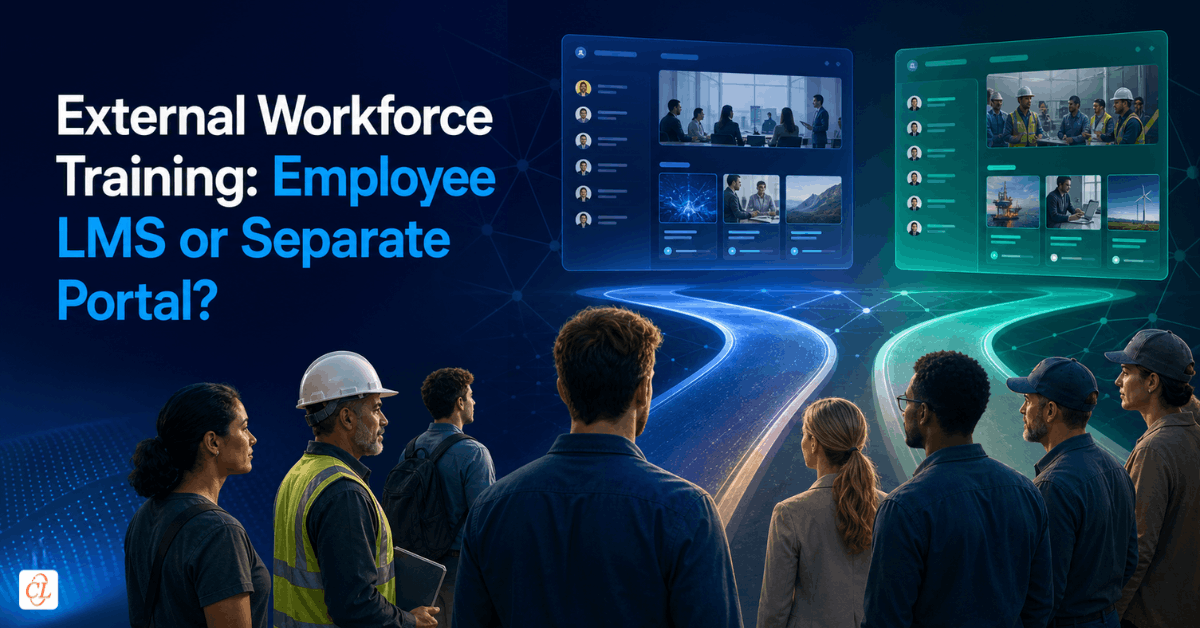
External workforce training is learning provided to contractors, contingent workers, temporary staff, partners, distributors, vendors, customers, and other people who need organizational knowledge or skills but are not part of the traditional employee population.
These audiences may require training for onboarding, compliance, safety, product knowledge, certification, operational readiness, partner enablement, customer education, or process requirements. The challenge is that systems and processes created for employees may not automatically work for people outside the organization.
That makes external workforce training more than a content-development requirement. It becomes an operating-model question.
External Workforce Training Readiness Depends on Six Areas
Before scaling an external workforce training program, assess six connected dimensions:
| Readiness Area | Core Question |
| 1. Learner Population | Who exactly needs training? |
| 2. Learning Requirements | What do they need to know or do? |
| 3. Access & LMS Administration | How will they access and move through the learning environment? |
| 4. Compliance & Reporting | Can assignments and completion be tracked reliably? |
| 5. Global Scale & Localization | Will the model continue working as complexity grows? |
| 6. Capacity & Sustainability | Can your team operate the program over time? |
A weakness in any one area can create problems elsewhere. Excellent learning content will not solve an enrollment problem. A capable LMS will not solve unclear ownership. Automated reporting will not help if the wrong learners receive the wrong training. And a successful pilot does not guarantee that the same model will work for 20,000 external learners across multiple countries.
Let's examine the 30 questions enterprise L&D teams should consider.
1. Who Exactly Are You Training?
Start by Defining the External Learner Population
One of the easiest mistakes is treating "external workforce" as a single audience.
It rarely is.
A contractor working inside a manufacturing facility may require safety and compliance training. A distributor may need product knowledge. A technology partner may require certification. A customer may need training that improves product adoption.
They are all external learners, but their learning needs, system access, reporting requirements, and business relationships are different.
Before choosing technology or creating content, answer these five questions.
1. Have you identified every external learner group that requires training?
Look beyond contractors. Your extended learning ecosystem might include contingent workers, temporary employees, consultants, vendors, suppliers, franchisees, dealers, channel partners, distributors, and customers. The more accurately you segment the learner population, the easier later decisions become.
2. Do you know why each learner group needs training?
Purpose determines design. Training required for regulatory compliance needs stronger governance than optional product education. A distributor-learning program may focus on selling capability. A contractor program may focus on safe operating procedures.
3. Have you separated mandatory learning from developmental learning?
This affects assignment rules, reminders, assessments, certification, completion tracking, escalation, and reporting.
4. Do different audiences require different learning experiences?
Consider differences in job role, responsibilities, geography, existing knowledge, system access, language, and relationship with your organization. Sending every external learner through the same curriculum may simplify administration initially but reduce relevance significantly.
5. Do you understand how often external learners enter and leave the ecosystem?
A stable partner network creates a very different administration model from a high-turnover contractor population. If thousands of learners enter and leave throughout the year, account creation and deactivation become part of the learning workload.
The First Readiness Test Do not ask only: "How many external learners do we have?" Ask: "How many different external learner populations do we need to support, and how different are their requirements?" That distinction influences almost every decision that follows.
2. Is Your Learning Actually Designed for External Learners?
Employee Training Cannot Always Be Reused As-Is
Once the learner populations are defined, organizations often look at their existing training library and ask: "Can we simply give external learners access to what employees already use?"
Sometimes.
But not automatically.
Employee learning may contain:
- internal terminology
- employee-only policies
- references to inaccessible systems
- confidential information
- organization-specific context
- workflows external learners do not perform
- examples that make sense only to employees
Before repurposing content, ask the next five questions.
6. Is the business outcome clearly defined?
What should learners be able to understand, perform, demonstrate, avoid, or comply with after the training? A clear business outcome prevents the project from becoming a content-conversion exercise.
7. Have you identified what each external learner group needs to do differently?
Start with expected behavior or performance. Not with PowerPoint decks. Not with the existing LMS catalog. Not with the question, "What content do we have?"
8. Have you evaluated whether existing employee training is genuinely suitable?
A course may be technically reusable while still being inappropriate for an external audience.
Ask whether it contains:
- unnecessary employee context
- internal systems
- confidential scenarios
- irrelevant processes
- assumptions about prior knowledge
9. Have you identified where new or adapted content is required?
External audiences may need shorter modules, role-specific versions, new assessments, introductory context, multilingual and localized versions, job aids, or certifications.
10. Have you defined how effectiveness will be measured?
Completion rates answer: "Did they finish?" They do not necessarily answer: "Did the training achieve what the business needed?" Depending on the program, effectiveness may involve assessment performance, certification, compliance, reduced errors, safety behavior, product adoption, operational readiness, partner performance.
Instead of: "What training can we reuse?" start with: "What does this external learner need to be able to do?" Content decisions become much clearer once the outcome is defined.
3. Can Your LMS Support External Learners?
Access and Administration Can Become the Real Bottleneck
The course may be ready. The rollout may still fail.
Imagine a compliance deadline is approaching. Training has been approved. But contractors cannot authenticate into the LMS. Account creation is manual. Nobody is certain who owns enrollment. Reports are being consolidated across spreadsheets.
The problem is no longer instructional design. It is learning operations.
External learners may not have:
- corporate email addresses
- employee IDs
- single sign-on credentials
- HRIS profiles
- permanent LMS accounts
- access to internal networks
That makes access and LMS administration critical.
11. Have you decided how external learners will access training?
Possible approaches include the existing enterprise LMS, extended enterprise functionality, a separate learning portal, or another controlled delivery environment. The right model depends on scale, security, reporting, learner experience, and administration requirements.
12. Can your LMS securely support external users?
Review authentication, user permissions, security, data separation, privacy, licensing, reporting, and learner volume. An LMS designed around employees may technically accommodate external users but still require significant operational work.
13. Is there a defined process for creating and enrolling external learner accounts?
Someone must determine:
- who creates accounts
- what data is required
- how accounts are approved
- how courses are assigned
- how credentials are communicated
If these steps depend on repeated manual intervention, scale quickly becomes expensive.
14. Who owns external learner LMS administration?
A sustainable program usually requires ownership across activities such as:
Account Creation → Enrollment → Assignment → Support → Tracking → Reporting → Updates → Deactivation
Course production may be temporary. These tasks can continue every week or every month.
15. Is there a process for removing or changing access?
External relationships change. Contracts end. Partner roles change. Temporary staff leave. Learners move to different locations. Access should change with them.
Why LMS Administration Is Easy to Underestimate
Organizations often estimate the effort required to develop training, while underestimating the effort required to operate training. At enterprise scale, the operational workload can become just as important as the content itself.
4. How Do You Track Contractor Training and Compliance?
Availability Is Not the Same as Accountability
When external workforce training supports compliance, safety, certification, contractual obligations, or regulatory requirements, simply making training available is not enough.
You need evidence. Ask:
16. Have all compliance, policy, regulatory, and certification requirements been identified?
Requirements may vary by role, site, geography, contract, learner type, business unit, or regulatory environment.
17. Can the right training be assigned to the right learners?
Not every contractor or partner needs every course. Assignment logic should reflect actual responsibilities and risk.
18. Can completion, certification, and recertification be tracked reliably?
You should be able to identify who was assigned training, who completed it, who passed, who is overdue, and who requires refresher training.
19. Can reporting be segmented according to stakeholder needs?
Different stakeholders may need reporting by learner type, site, geography, partner, vendor, role, course, completion status, or certification status.
20. Are data ownership, security, and privacy responsibilities clear?
External learner information may move across multiple systems and teams, requiring coordination among L&D, IT, HR, Security, Compliance, Legal, and Operations. Governance should be designed intentionally rather than resolved after launch.
The "Tomorrow Morning" Test Ask your team: If Compliance asked tomorrow morning for evidence showing everyone who was required to complete the training, their completion status, and the version they completed, how quickly could we produce it? If several teams would need to assemble spreadsheets before answering, reporting is not yet truly scalable.
5. How Do You Scale External Workforce Training Globally?
A Successful Pilot Is Not Yet a Scalable Model
A solution designed for 200 contractors in one location may work perfectly. Then the organization expands it to 10,000 learners, 12 countries, 7 languages, and multiple partner organizations. Manual processes that were invisible at pilot scale can become operational constraints.
Assess scalability across five dimensions.
- Learners: Can the system support more users without dramatically increasing administration?
- Content: Can new courses and updates be produced fast enough?
- Administration: Can enrollment, assignment, support, and reporting scale efficiently?
- Geography: Can languages, regulations, and local requirements be handled systematically?
- Governance: Can consistency and visibility be maintained as complexity increases?
Now ask:
21. Have you identified every region and language the program must support?
Global requirements should be part of initial planning, not added after the first course is developed.
22. Have you identified what requires translation or localization?
Translation may be necessary for language access. eLearning localization may additionally involve terminology, regulatory references, examples, cultural context, visuals, and local policies.
23. Can localized versions stay synchronized with source content?
When source content changes, every affected version may also need review. Without a structured update process, organizations can quickly end up with outdated translations, inconsistent versions, unclear approval status, and duplicated review effort.
24. Can your model absorb sudden increases in learner volume?
Business events can create sharp demand spikes such as new contracts, acquisitions, seasonal staffing, geographic expansion, and regulatory change. The operating model should not depend on learner volumes remaining predictable.
25. Can you add new learner populations without rebuilding the program?
True scalability means additional audiences, courses, regions, languages, and reporting requirements can be incorporated without redesigning the entire ecosystem each time.
6. Does Your L&D Team Have Enough Execution Capacity?
Capability and Capacity Are Different Problems
This distinction matters particularly for large organizations with mature internal L&D teams. A strong internal team may have strategy expertise, instructional design capability, stakeholder relationships, business knowledge, technology ownership, and governance processes, yet still struggle to execute everything the business is asking for.
External workforce training can add workload across:
- instructional design
- course production
- visual development
- LMS administration
- translations
- reporting
- learner support
- project coordination
- content maintenance
The question is therefore not: "Is our internal L&D team capable?" It is: "Does our internal team have enough execution capacity to sustain this program alongside everything else it already owns?"
Ask these final five questions.
26. Is one team or individual accountable for the overall program?
External workforce training often touches several functions. Without clear ownership, tasks can fall between teams.
27. Does your internal L&D team have enough development capacity?
Look beyond the first launch. Can the team also handle revisions, new audiences, additional courses, changing priorities, and maintenance without delaying other strategic learning initiatives?
28. Is there enough LMS administration capacity?
External learner administration can become an ongoing workload involving accounts, enrollments, assignments, reminders, troubleshooting, reporting, and deactivation. If those activities consume specialist L&D time every week, the operating model may deserve reconsideration.
29. Have you decided what should remain internal and what can be supported externally?
This does not have to be an all-or-nothing decision. Many mature learning organizations retain strategy, stakeholder management, governance, business context, and final decision-making internally, while using staff augmentation or other external execution models for instructional design, eLearning development, localization, LMS administration, or project management.
The objective is not outsourcing for its own sake. It is protecting internal capacity for the work where internal knowledge creates the most value.
30. Is the program sustainable after launch?
Launch day is not the finish line.
A sustainable model needs to accommodate:
New Learners + Content Changes + Recertification + LMS Administration + Reporting + Localization + Support
If the model works only while the project team is heavily involved, it may not yet be scalable.
How Ready Is Your External Workforce Training Model?
You can turn these 30 questions into a simple diagnostic assessment. Score each answer: Yes = 2 points, Partly = 1 point, No = 0 points. The maximum score is 60.
49–60: Ready to ScaleMost foundational elements are in place. Your next priorities are likely to involve:
|
37–48: Ready, With Gaps to ResolveYou have a workable foundation, but some areas could become bottlenecks as the program expands. Identify the sections where you answered Partly or No most frequently. Those are likely to represent your greatest scaling risks.
|
24–36: Strengthen the Operating Model Before ScalingSeveral important execution decisions are unresolved. Growing the program at this point could increase:
Address the operating model before significantly increasing complexity. |
0–23: Build the Foundation FirstThe training requirement may be clear, but the execution framework is still developing. Prioritize:
Technology and content decisions become easier once those foundations are established. |
5 Questions Every External Workforce Training Program Must Answer
Thirty questions provide detail. These five provide the executive-level test.
1. Who exactly are we training? Not "external learners." Specific learner populations with defined requirements.
2. What do they need to know or do? Start with performance, compliance, or business outcomes.
3. How will they securely access training? Resolve access before scale exposes the problem.
4. Who will manage enrollment, tracking, reporting, support, and updates? Someone must own the operating workload.
5. Can our current model sustain the program as learner volume and complexity increase? That is the real readiness question.
When Should External Workforce Training Be Outsourced?
External support can make sense when an organization has strong internal learning expertise but insufficient production, administration, localization, technology, or project capacity to execute external workforce training at the required scale and speed.
The decision should not begin with: "Should we outsource?" A better sequence is: Keep internally activities where organizational context, strategic ownership, stakeholder relationships, or governance are critical. Extend externally activities where additional production capacity, specialized capability, or operational support can increase speed and scalability.
For example:
|
Internal Ownership |
Potential External Execution Support |
| Learning strategy | Instructional design production |
| Business priorities | eLearning development |
| Stakeholder decisions | Visual development |
| Governance | LMS administration |
| SME ownership | Localization |
| Final approvals | Project execution |
| Performance expectations | Specialized learning resources |
This hybrid model can allow internal L&D teams to increase capacity without permanently expanding headcount for every peak in demand.
External Workforce Training Is Really an Execution-System Challenge
External workforce training is rarely just a course-development challenge. It sits at the intersection of learning design, content development, learning technology, LMS administration, compliance and reporting, localization, and execution capacity.
The quality of the learning experience matters, but so does everything required to get that learning to the right person, at the right time, in the right language, with the right access, and with reliable evidence that it happened. For multinational programs, a structured multilingual training strategy helps keep language versions, reviews, and updates manageable as scale increases.
Frequently Asked Questions About External Workforce Training
1. What is external workforce training?
External workforce training provides learning to contractors, temporary workers, partners, distributors, vendors, customers, and other non-employees who require knowledge, skills, compliance training, certification, or product education connected to an organization.
2. How is external workforce training different from employee training?
External learners may not have employee credentials, HR-system profiles, standard LMS access, internal context, or the same compliance requirements. This often requires different approaches to access, content, enrollment, reporting, support, and administration.
3. Can contractors use an enterprise LMS?
Yes, depending on the LMS's external-user functionality, licensing, authentication, permissions, privacy controls, reporting capabilities, and administrative processes. Organizations should evaluate both technical access and the operational workload required to manage external users.
4. How should contractor training be tracked?
Organizations should be able to track assignment, enrollment, completion, assessment results, certification, expiry, recertification, and overdue training where relevant. Reporting requirements should be defined before rollout.
5. What should an external workforce training plan include?
A robust plan should address learner populations, learning outcomes, content, access, LMS administration, compliance, reporting, localization, ownership, scalability, internal capacity, and ongoing maintenance.
6. When should companies use an external learning partner?
An external learning partner can be useful when an internal team has strategic expertise but needs additional execution capacity, specialized learning resources, LMS administration support, localization capabilities, or faster production capacity.
Find the Gaps Before You Scale
If several of these 30 questions were difficult to answer, that does not necessarily mean there is a problem with your learning strategy. The issue may be that the operating model behind external workforce training has not yet been designed for the scale the business requires.
That is exactly what the External Workforce Training Readiness Checklist is designed to uncover.
Use it with your L&D, Learning Operations, Compliance, HR, Technology, and business stakeholders to identify what is ready, where gaps remain, and what should be addressed before your external learner population grows.