L&D as a Business Transformation Engine: A Conversation with Matt Haag
Know Who’s Talking
Matt Haag
Matt Haag is an organizational effectiveness and learning leader focused on turning business strategy into results through leadership development, talent systems, and organizational design. He is a strategic advisor known for driving scalable transformation, culture change, and the adoption of innovative and AI-driven solutions to drive measurable performance.
With a background including in-house leadership roles in financial services at Thrivent Financial and in specialty chemicals at Ecolab, Matt has spent his career developing leaders and teams at all levels of the business. Recent accomplishments include the rollout strategy for Microsoft Copilot to the entire workforce, ensuring sustained ongoing usage, and driving significant leadership behavior change to bring a leadership competency model to life.
Matt is known for translating complex ideas into clear roadmaps and helping leaders implement organizational effectiveness and change efforts at scale, ensuring that they actually stick. He holds an MBA from the University of Minnesota, is PROSCI Change Management Certified, and is a certified Lean Six Sigma Black Belt.
In this spare time, Matt serves as a coach for soccer and baseball, and as a volunteer for Junior Achievement of the North. When not involved in those pursuits, you can find him on a hike, traveling, or reading a book.

Welcome to CommLab India’s eLearning Champion Podcast featuring Matt Haag, Senior Organizational Effectiveness and Learning Leader. He is focused on turning business strategy into results through leadership development, talent systems, and organizational design. He is known for driving scalable transformation, culture change, and the adoption of innovative, AI-driven solutions that improve measurable performance.
With leadership experience spanning financial services at Thrivent Financial and specialty chemicals at Ecolab, Matt has spent his career helping leaders and teams translate strategy into execution. His recent work includes the rollout of Microsoft Copilot across the workforce, sustained AI adoption, and significant leadership behavior change tied to competency models. He is known for turning complex ideas into clear roadmaps and helping organizations make change efforts stick at scale.
Click Here To Read Transcript
[00:00:10] RK Prasad: Good evening, good morning, good afternoon, viewers from wherever you are in the world, and welcome to our podcast, Comm Lab India's Podcast. Enterprise learning is changing and for many years, L&D was seen mainly as a training delivery function: create courses, run programs, track completions, support compliance. But in today's environment, that is no longer enough. Organizations are dealing with transformation, AI adoption, changing skills, sales complexity, compliance, and so on. In this environment, learning must become much more than content. It must become a system for business readiness. Our guest today, Matt Haag, brings exactly that perspective. Matt is an experienced organizational effectiveness and learning leader who has worked at the intersection of L&D strategy, organizational change, leadership development, knowledge management, analytics, sales enablement, and AI adoption. At Thrivent, he led enterprise learning organization effectiveness for 9,400 learners, helped drive M365 Copilot adoption. At Ecolab, he led global learning and knowledge management for a 6 billion industrial business group operating across 170 countries and supporting 1,000 learners. His work comprised global sales leadership training, multilingual instructional design, LMS transformation, compliance improvement, customer training, and AI-enabled learning tools. In this episode, we will explore a simple but powerful question: how can L&D move from being a training function to becoming a business transformation engine? We will discuss enterprise learning strategy, sales, technical enablement, knowledge management, and the role of AI for faster, smarter, and more scalable organizations. Thank you very much, Matt, for agreeing to join us for this webinar. I know that you have such great experience, and I also thank you for the wonderful relationship that we share over these, I think, more than a decade.
[00:03:01] Matt Haag: Thank you, RK. I really appreciate the very warm and flattering introduction and it's so great to be with you and all of your listeners today.
[00:03:10] RK Prasad: Thank you very much, Matt. Based on everything you have seen across enterprise learning, sales enablement, change management, and so on, what is one mindset shift L&D leaders must make now if they want to remain relevant over the next five years?
[00:03:32] Matt Haag: That's a great question, and it's one that I've been wrestling with as well. I think that the speed of business has certainly increased and it's absolutely continuing to accelerate. So I said it before, I will say it again, that I'm waiting for a precedented year in learning and development because we've always had unprecedented years for the last number of years. And I don't think that trend is going to change given the speed of business and the speed with which the environment around us is changing. I recall Satya Nadella at Microsoft saying that when he took over as CEO, they needed to move from a know-it-all culture to a learn-it-all culture. And given the speed with which things are changing, I think that that's an evolution that we as learning leaders and org effectiveness leaders can really help to accelerate. Artificial intelligence is actually further accelerating this transition away from know-it-all to learn-it-all. Knowledge is no longer a differentiator. I have the entirety of the internet at my fingertips through a prompt. And so that knowledge is becoming a given rather than a differentiator. The judgment, the human skills that we bring to this as learning professionals and as professionals in general, for those that we're trying to upskill, that is the differentiator, but knowledge is no longer the differentiator. And so I think for us as learning and effectiveness professionals, it's really the acceleration of that idea of learning in the flow of work. In my view, and perhaps this is a bit of a hot take, but the idea of the course as the unit of output by which learning professionals are measured, I think is actually dying. Now, I don't mean to suggest that it's going to go away in the next two months or anything like that. But given the fact that we have essentially these unlimited knowledge solutions at our fingertips that can provide performance support in the moment of need at any point in time, we're going to have to be much more strategic about the courses, the learning experiences that we deliver and how we do that, and then how we train the systems and design the systems so that they can provide that performance support in the moment of need. A framework that I really like for this is Cathy Moore's action mapping framework. She wrote a book called Map It a number of years ago. It essentially requires learning practitioners to ask the question, what change do we want to see in business performance and how will we measure it? It becomes a question for us as learning professionals to ask what do people need to do on the job that they are presently not doing? It requires us to look at not just, well, I need you to build me a course to do this, but what are the systems, what is the surrounding environment that is either preventing or enabling people from making that change. It might not be training that is the solution, or it might not be solely training that is the solution. So we really need to think about what the incentives are, what the behaviors are, what culturally within the organization or within the country or part or region of the world is acceptable and what are the norms. And then where I think we really add our secret sauce to the mix is the activities and the mindsets, really enabling people in those soft and human skills, in order to practice those new behaviors. And I think that's really, from a course design perspective, the place where we can add a ton of value. That's really the place where I see the learning profession going in the long run.
[00:07:43] RK Prasad: I think that is a very comprehensive answer and you have done your crystal gazing very well. Business transformation and scaling across a global organization is something that we have covered, and I think the key takeaway is that we no longer need to provide knowledge because knowledge is available. Not just knowledge, even distilled knowledge or wisdom is available, especially with AI. But what is that secret sauce? Everybody is going after speed. If I use ChatGPT, it looks like I have 100 people working for me. But how do you define that secret sauce, Matt? I'm very interested to learn about that secret sauce. I'm sure my viewers would like to know how we differentiate human intelligence from artificial intelligence.
[00:09:38] Matt Haag: It's a great question. And I do want to clarify one other thing before I answer that. I was thinking about this idea of knowledge being commoditized, and I think by and large that's true. There is an exception to that rule, which tends to be compliance or regulated courses, in particular for regulated industries, because in financial services or healthcare or other places, there are exams and other tests, knowledge-based tests, that the workforce needs to be able to pass in order to practice. So there is still a place for courses and knowledge and formal training, as well as in those soft skills. But by and large, for the vast majority of things, I would absolutely agree with what you just said, that knowledge has become commoditized. Where I think that secret sauce comes into play is where there is person-to-person or human-to-human interaction. That's really where as learning professionals and effectiveness professionals, we really need to enable our learners. As an example, if we're thinking about customer service, there's probably a knowledge base, whether it's ServiceNow or SharePoint or whatever the case is, that I can query for technical questions. But the ability to manage the human interaction that I'm having in that customer service moment with the client or customer, and how I do that, that's a very human thing. I may get the answer surfaced, but how I conduct the conversation, how I emotionally relate to the party on the other end of the line depending upon the type of day they're having, those are very human skills, and I think that's really where I draw the line or the differentiation.
[00:11:47] RK Prasad: If you see that AI has also permeated into that role, one of our customers, APA.org, which is the world's largest professional body of psychologists and psychiatrists, is experimenting with AI as a coach because AI is most non-judgmental. I have also come across an app which is called Person. I don't know whether you read this book by Mark Manson, who wrote a bestseller. He came up with an app which is your personal counselor. What I'm trying to say is that the touch you're talking about, the human touch, can well be mimicked by AI. So where do you think we really differentiate ourselves and still be relevant and valuable?
[00:14:03] Matt Haag: You're absolutely right. I've seen that firsthand using LinkedIn's AI coach. LinkedIn has a solution as part of their learning offering where you can input a scenario and live role-play verbally with the AI, and then it gives you feedback on your performance. There are a number of other tools, and I think we've explored them in past lives, RK, that check whether you hit all the points in your sales pitch or things of that nature. So I would agree that AI can support, can provide coaching, can be impartial, and can do some of those things. What I worry about a little bit is relying solely on AI in that space, because we've also seen the counterexamples of ChatGPT giving really poor advice or radicalizing individuals that use it for coaching because of the sycophantic reinforcement that it oftentimes provides. As learning professionals, again, the secret sauce is how do we train or set up that agent or bot that's doing the training or the coaching with the right guardrails to try to prevent some of that. I think there is a role for learning and development professionals there. I also feel like there is never a substitute for that human touch. Yes, you can get multiple reps with your AI coach at any hour of the day, repeating the same thing over and over and exploring what happens. At the same time, I don't think it can be a pure 100% substitute for that human touch because you never know how it's actually going to land if you're not actually working and touching another human being. As much as the systems are intelligently trained and can mimic human behavior and human emotion and things like that, there's really no substitute for the actual human interaction.
[00:16:16] RK Prasad: Correct. I totally agree with you that the creation cannot be greater than the creator if you go by a natural principle. All our creations are in some aspect superior to us in transport, computing, and whatever else, but they're all our creation. When we have created something which can be the creator, we still are the creators, right? My question here is about the guardrails you're talking about. Let us move a little outside the L&D space and talk more globally. We see that the world is now the Gen Z's. Gen Z is so powerful that they can overthrow governments. A very interesting fact is happening here in India. Nepal's Gen Z threw over the government and a rap singer became the prime minister. Now, a latest thing here in India: the Chief Justice of India commented that unemployed students or unemployed youth are cockroaches and parasites. Immediately, within hours, a political party registered a website called Cockroach Janata Party. In the first one hour, 40,000 memberships. Today is the 20th, four days later, four million. So that kind of power they have, and they use social media collaboration to connect, learn, and communicate. We have also read news items where even older people go to ChatGPT and ask it about some personal problem, and the GenAI misleads them, even to commit suicide. That is why I'm coming back to the guardrails. What do you think, as L&D leaders inside a company, when my own staff misuses ChatGPT to bring out a storyboard, how do I train them? Because it's so seductively easy, and it looks so good.
[00:20:32] Matt Haag: Google recently gave a commencement address and was roundly booed by the students graduating, even here in the United States, when he was praising the merits of AI and how it's going to transform society. So I think there's truly angst around what this means and what the implications are for society. You'll see it even in some of the posts that Sam Altman did around universal basic income. I think there is a broader conversation that needs to be had that isn't being had because I don't know that we've really thought through the implications of everything going on here. Specific to your question about how you manage it with your team, I'll go back to what I said earlier, which is really around the idea of judgment. A storyboard or an outline looks awfully good, but unless it can be verified, unless you or your team can look at that and say, show me your sources, cite me your sources, where did that come from, it is not enough. My wife is a teacher, and she was using ChatGPT to help her write a lesson plan. It provided her with a quote from a book that she was modeling this lesson on. She went back to ChatGPT and said, tell me where you found the quote and on what page. It said, well, it wasn't really a direct quote. That was really just the synthesis or summary of the chapter. So that's a case in point where we as leaders need to make sure that our teams are informed and properly interrogating and questioning the outputs they're getting in order to make sure that it is scientifically sound and valid. You may get a 20-page document and it may be a great first draft or starting point, but that's where the judgment, the expertise, the accumulated knowledge, the experience, and the human touch come in. That's how you use AI as a partner and not just simply rely on the outputs and say, yep, good enough, AI said it, it must be true. It kind of goes to that old adage of I found it on the internet, therefore it must be true. Perhaps not.
[00:23:09] RK Prasad: Actually I was just having an argument with my son. He was telling me, give me an output from all these GenAI tools—ChatGPT, Claude, Bard, Copilot, Grok, DeepSeek—give me an output and I will tell you which one produced what. So if he can catch them, then after some time everybody will catch them. Now coming back to the judgment part of it, right in the beginning you said that we need to train the GenAI in such a way that it helps us do stuff faster and better. Can we also train it so that it will not go forward unless the human gives his input? For example, I give a very dense policy document to ChatGPT. I'm an instructional designer. So I say, give me the essence of this. Within six or eight seconds, it gives me the essence. Then what do I do? I say, okay, make about five or six learning objectives. Then I go off. But did I really check whether the essence is right? No, I don't.
[00:24:44] Matt Haag: Yeah, I'm not going to disagree with you, RK. I think that is certainly a risk. In some of the AI experimentation I have been doing, I had written a program in Copilot. There's a way in which you provide all of the paragraph-length instructions up front and say, Copilot, I want you to act as a researcher that does X, Y, and Z. You'll behave in this sort of way. I was intending to create a coach bot, if you will, just as a thought experiment to see what would happen. One of the instructions I placed in that instruction set or in the programming for the bot was act as a coach and do not give me a solution. I realized in my first draft of this that I had instructed it altogether too well because it wouldn't actually give me a solution no matter how hard I tried to press it to give me the answer, even though I had given it an out in the programming instructions. So I do think there is very much an art form and experimentation that we as professionals need to do in order to provide those guardrails. The technology evolves so rapidly. I think it's something we're going to have to continuously explore and evaluate. We will have to be really mindful and thoughtful about how we architect the prompts or the programming to make sure that we're building the systems in. As I said before, when I thought about L&D as a business transformation function, what are the systems around us that allow us or enable us to be successful? Perhaps some of it is programming the bot or the chatbot or whatever we're using so that if I'm going to have it be an L&D learning-objective bot, I actually need it to prompt me to make sure that I cite my sources. Have you investigated my sources to make sure this is right? What are the things we can do systematically, borrowing nudge theory and some behavioral economics, to prompt the team and put that performance support right in the place of need?
[00:27:15] RK Prasad: Wow, that is a beautiful answer. So what I understood from what you're saying is that we prompt the system or the master prompt in such a way that it doesn't let go of the instructional designer. It will start engaging and demanding some kind of input. Actually, I have programmed a kind of master prompt for instructional designers. In the reading comprehension part of it, where I said the content comprehension should require ten questions for this person to answer so that I know he has read the synthesis. Unless he gets this score, don't go forward. So something like what you have said.
[00:28:34] Matt Haag: Yeah, something along those lines. We need to ensure as designers of courses and as architects of bots and other things that we are getting the results that we expect, or perhaps if not getting the results that we expect, because you never know what scenario a learner might present to you, we need to make sure we're not getting results that we don't want. We may need to think of it more as positioning it as a negative than as a positive, at least in terms of the instructions that we provide the AI or the bot. But I think that's the biggest opportunity when we think about these systems. We need to consider the end learner. They're not going to put a detailed prompt with all the guardrails in. So we need to think about the systems that we have in place and how, as the architect of the systems, we can impose those guardrails so that it becomes just a simple chat window or turn-on-your-microphone-and-prompt-the-questions type of thing. That becomes a much more natural interaction for the system that we're putting in place.
[00:30:07] RK Prasad: So do you mean to say that the future of L&D professionals is more to train the AI so that they train the people?
[00:30:36] Matt Haag: I don't think that training or learning as an entity is ever going to go away. But I think we have to begin to differentiate between where training becomes truly performance support and then what the guardrails are around that performance support, versus where there are those really deep intentional learning experiences where we're trying to change mindset, behavior, and impart judgment and those human skills. For a lot of the knowledge-based or technical-based questions—how do I query the knowledge base, what does the policy say, what are the answers to those policies—that's where we need to be more architects of the system or of the way that the learner or employee gets that performance support in ways that are approved, aligned to policy, and aligned to the documents. Then for those more human skills, that's really where as a profession the number of things that we do is going to be smaller, but it's going to need to be slower and more intentional, continuing to follow adult learning principles and solid instructional design, but in both cases with an eye toward what problem we're trying to solve. Those are very different problems: getting an answer in the moment to support performance versus a longer view of how do I transform a person into a leader or enterprise leader. There's much more nuance to that, and that's where I think we need to double down on those human skills as learning professionals.
[00:32:12] RK Prasad: Wonderful. That's a very comprehensive answer. If I just recall what you have just said about adult learning principles: when I started my training career, it was only the blackboard, not even the whiteboard. The chalkboard transitioned to a whiteboard and then to a transparency, the overhead projector. There are other training methodologies like apprenticeship, vestibule training, and even now those kinds of things in Europe where they go through polytechnic schools. I'm wondering, going as learning professionals, if you look back at the learning theories, do you think with AI and the combination of all these things, the way we learn also will change fundamentally?
[00:35:34] Matt Haag: That's a great question. I appreciate your remark around the guru and student system. From the Western school of thought, we have the Socratic method where similarly, you have the teacher prompting the students with questions. I do think that as a learning mechanism or methodology, that self-reflection and trying to answer the questions and eliciting knowledge that way is also a very strong method. There's a place for both. I want to pick up on something you said about e-learning and social learning. It strikes me that if we think about the Socratic method or the guru and student method, e-learning and social learning are not so different. E-learning is the guru presenting a theory, followed by a question, and then social learning—whether in teams or a learning platform where individuals are responding, whether in classic Blackboard discussion boards online or something like that—is really the students then responding to the question, perhaps commenting on other people's responses. It's a modern manifestation of the classroom. So I would argue that it perhaps is not self-learning, although there is an element of self-learning, but rather a different modality for the self-learning that we've been doing for thousands of years, whether it's Homer reciting the Iliad to us in storytelling and then us reflecting on what Homer has taught us, or Aristotle or Socrates or whomever it may be. I'm not sure that it's substantially different other than the format that has changed and the distribution of that format.
[00:37:47] RK Prasad: Well, that is a totally different angle to it. So what you're trying to say is that we learn from somebody or something. There is a teacher and there's a learner. The identity of that teacher is changing, that's all. But we continue to be a student and there is some teacher.
[00:38:14] Matt Haag: Yeah, if you think about it in the sense of a traditional university classroom or lecture, the professor assigns you a reading. I go and do the reading. That's self-learning. I've just spent an hour or two learning from the author or instructor. I did that on my own. I consumed content. In this case, a book or a chapter rather than a video, but I consumed content. Then I come back to the discussion, and there is a discussion whether it happens synchronously in a live training session, online or in a classroom, or if it's a threaded discussion happening in a series of tweets or posts or other things. It's essentially just a modernization of the modality.
[00:39:06] RK Prasad: Yeah, so you have kind of broken it down to its basic elements, stimulus and response. The stimulus usually comes from the guru and the response from the learner and in the process he learns. But if you look at it at a cultural or social angle, the kind of respect or value we used to give the teacher has become impersonal. Even when I was in school, our teacher was a font of all wisdom and knowledge, and we used to just follow him. In Indian mythology, a lower-caste archer went to the guru, who was obviously a Brahmin, and asked to be taught. The guru said, I can't teach you because you're lower caste. So this guy makes a statue of the guru and practices, and he becomes better than the guru's best pupil. The best pupil complains, and the guru asks this archer for Guru Dakshina, his payment. He says, give me your right thumb. And the student very happily cuts it off and gives it. What I'm trying to say is that kind of deifying of the gurus, making them almost like a god, has changed. Now there are sites where students in America criticize the professor and the professor strikes back. So socially and culturally, the role of the guru has disintegrated.
[00:42:11] Matt Haag: I'm not sure that's necessarily true. I would argue that today's influencers, who have many followers, are the modern manifestation of the guru. We can debate whether or not a particular influencer knows their subject matter, but I think the relationship between the leader and the follower, or the student and the teacher, is somewhat similar. One thing I do want to acknowledge is this idea of apprenticeship. Despite the fact that technology has enabled and shifted some of how we do this in terms of self-learning versus group learning, I do feel like there is something lost in a solely technological space where you cannot have the hallway conversation. You cannot have the mentoring or the apprenticeship that goes on because the formality of the online interactions and back-to-back 30-minute meetings that we commonly have doesn't allow for some of that passing time where the informality between the guru and the student, or the mentor and the mentee, actually takes place. I'm not sure how we replicate that in the online environment. I'm not sure we can replicate that perfectly. So we really need to look at the experience, what we're trying to accomplish, and how we set the systems up in order to enable that. To your question about the formality of the guru-student or mentor-mentee relationship, I think some of that still exists, but perhaps it's evolved and perhaps our definition of guru needs to evolve as well. I'm not sure.
[00:44:28] RK Prasad: No, I think I perfectly understood and I think it's very clear thinking on your side because the example you gave about these influencers. We are not talking about illustrious historical leaders, but fundamentally, we like to follow leaders. I can't imagine, after listening to you, that any human being will follow AI.
[00:45:26] Matt Haag: I would think not. And yet we see examples of it in the news where it does happen, because as a partner it can be incredibly convincing. I've heard tech leaders suggest that we want AI to be that partner for us. We want AI to serve in that capacity. And I feel like that cheapens the value of the human element and the human relationship if we're trying to replace humanity with AI. We really need to think about how AI and artificial intelligence can augment in the right places. Yet there is this human connection that is so critical for us to maintain. From an ethical standpoint, as learning professionals or just as humans, there's a line where we have to be really sensitive about how far we go down that path and make it human-like, because I think the risk you're describing is very real.
[00:46:37] RK Prasad: But we are, at this point in time, in a phase of transition. People like you realize that you just cannot replace the human being, and AI will never be able to do what a human being is doing. But many people think that it can, till the reality hits them. So there is a period of transition. What do you think will be that period where the general population of human beings will realize AI's place, just like we realized the internet's place, mobile devices' place, nuclear energy's place? How long do you think it will take for people to come to that equilibrium?
[00:48:04] Matt Haag: If I knew the answer to that, RK, I'd be betting on polymarket right now. I don't know. What I believe to be true, though, is that it will be faster than any of those other technologies that you mentioned. The adoption of television to get to mass market took 10 or 15 years. The adoption of cell phones was shorter than that. The adoption of Pokémon Go was shorter than that. It took 19 days to get a million users, and ChatGPT took, what, like two days to get however many millions of users. So I expect that the tipping point will be achieved much quicker. Where the angst is coming from is that we as humans were not meant to adapt and change so rapidly. So I think we're feeling like it's a runaway train on the tracks. I don't know how to reconcile that, nor do I know when we'll get to that endpoint. But it feels like there's a missing conversation that isn't happening because the technology and the capability of the technology are moving so quickly that the philosophical conversations and the ethical conversations are having trouble keeping up.
[00:49:51] RK Prasad: Very true. I don't know whether you have heard of Alvin Toffler, who wrote Future Shock in the early 80s. He said that the rate of change will destroy a human being. The conservatives will actually give equilibrium. They don't want change, and the society will disintegrate if it changes too fast. Coming back to your observation that AI will be adopted very fast, which means people will quickly realize what is good and bad, even though governments and the big tech guys are not bothering enough about guardrails and ethics. In some ways it is a little scary.
[00:51:45] Matt Haag: It is, although I will give Anthropic credit. At least in the present time, they seem to be leaning more into that and putting more guardrails around it, based on what I have observed in the public sphere. I think others have as well. But this is going to become a more important question for the creators and providers of these large language models. What are the ethics? What are the guardrails around it? As companies, and as learning leaders, that's something we need to be acutely aware of, especially when we move from using AI as a tool to generate content or an outline that we as professionals are going to evaluate, rather than as a conversation partner or some adaptive use where we will not be able to verify the outputs for every individual learner at scale. So I think that's where making sure the guardrails, the provider you select, the vendor you choose, has those guardrails in place, and that we vet and test those systems as we put them in place.
[00:52:58] RK Prasad: Sure, correct. One last question, Matt. For a minute, let us forget about the whole world, the governments and those big tech guys and the deep state and all that stuff. We are not big shots, we are small shots. We are inside an organization. Who do you think should take the lead in setting this kind of governance? Should it be HR or IT? At what level do you think leadership should step in?
[00:54:01] Matt Haag: It depends, but broadly speaking, I think it's a partnership. Governance is critically important, and it is a partnership between a number of different functions. There is certainly a technological element to it, so your IT department is going to have to review the models. We also need to look at it from a business lens, a people lens, an ethics lens, a legal lens. I think I've just listed six different functions that probably need to be at the table conducting those sorts of reviews. The only place where all of those different functions intersect is really at the executive level. So the governance has to be chartered at that level, and we need frameworks in place to delegate the decision making. What are the sorts of questions we're going to ask? How will we evaluate? What is the rubric or scoring? What are the concerns that we want to make sure get addressed? Those are things that each organization needs to establish and figure out based on their risk tolerance, industry, application, use case, private data versus general data, and so on. Putting that framework in place and making it really clear what the path is to get a new tool or new use case approved is going to be critically important.
[00:55:39] RK Prasad: Absolutely. So it is right at the top that people at the C level or executive level should take charge and then everything will be fine.
[00:55:54] Matt Haag: Well, it should be fine given the right guardrails, the right charter, and the right level of authority. But it's really about how do we get the right cross-functional team and how do we ask the right questions, not just the technical questions, not just the security, not just the privacy, but the ethics questions that are critical as well. That's really where that cross-functional expertise comes in, and learning deserves a seat at that table, and HR and people and culture and those other functions do as well for all of the ethical questions that you and I just talked about. It's not just should we do technology for technology's sake, but how do we do the technology and how do we do it in a responsible way that is going to be looked at favorably by our customers and by the market and by our other stakeholders as well?
[00:56:47] RK Prasad: Right, right. Thank you very much, Matt. It has been a great conversation. If I have to wrap up, we have covered so much, but one thing came out which I learned, and I'm sure my audience will greatly appreciate that lesson: AI can never, ever replace human intelligence, but humans should act ethically and they should use AI as a partner, not as a substitute for human beings. And the traditional learning psychology will not change. So thank you very much once again, Matt, for your time and your openness to share so many things. You're very evidently very well read and very knowledgeable. I'm sure that we got a great podcast. Thank you very much.
[00:57:50] Matt Haag: RK, thank you so much for the opportunity. I really appreciate the dialogue and look forward to seeing you again in the very near future. Thank you.
[00:57:57] RK Prasad: Thank you very much. Bye bye.
Here are some takeaways from the interview.
What mindset shift must L&D leaders make to stay relevant over the next five years?
The first shift is to stop seeing learning as primarily a content-delivery function and start seeing it as a system for business readiness. Business is moving faster, AI is accelerating change, and knowledge alone is no longer a differentiator. What matters more now are judgment, human skills, and the ability to support performance in the flow of work.
This also changes the role of the learning leader. Instead of asking, “What course do we need to build?”, the better question becomes:
- What change in business performance do we want to see?
- What are people not doing today that they need to do tomorrow?
- What systems, incentives, or behaviors are helping or preventing that change?
Is the traditional course losing its central place in enterprise learning?
The course as the default unit of output is slowly losing its dominance. That does not mean courses disappear. Formal courses still matter in compliance, regulated environments, and structured capability building. But in many cases, AI and digital tools can provide knowledge instantly.
That means L&D has to be more deliberate about when to build a course and when to design performance support instead.
How should L&D leaders think about AI guardrails inside their organizations?
AI should be treated as a partner, not a final authority. Its outputs may look polished, but they still need to be checked, cited, and challenged.
Useful guardrails include:
- Prompting users to validate sources
- Designing AI workflows that demand human input
- Building nudges into the experience so people question outputs
- Treating prompt design and system design as a real professional skill
Who should lead AI governance inside an organization?
No single function can own it alone. AI governance needs to be cross-functional and led from the executive level. IT, legal, business, ethics, people, culture, and learning all need a seat at the table.
The reason is simple: the important questions are not only technical. Organizations also need to ask:
- What is our risk tolerance?
- What kinds of AI use cases require deeper review?
- What ethical concerns do we need to address?
- What data is being used?
- How do we approve tools and new applications responsibly?
The most effective governance, then, is not just about security and privacy. It also has to include ethics, human impact, and responsible implementation.
What has been lost as learning has become more digital?
While digital learning expands access and flexibility, it can also remove some of the informal human moments that matter. Hallway conversations, spontaneous mentoring, apprenticeship-style exchanges, and the informal time between interactions are harder to replicate in purely digital environments.
That means organizations should be careful not to assume that technology is a perfect substitute for all learning contexts. Some experiences still require human presence, human timing, and human relationship to be truly effective.
What is the bigger takeaway for enterprise learning leaders?
The biggest takeaway is that L&D should not define its future around the production of courses alone. Its future lies in helping organizations make better decisions about readiness, performance, behavior change, and responsible technology use.
That means the function must become better at:
- Diagnosing business problems
- Supporting performance in the flow of work
- Protecting the human side of capability building
- Designing AI-enabled systems with the right guardrails
- Claiming a seat at the table in enterprise governance conversations
AI will not replace human intelligence, but humans must use AI ethically and intelligently. That is where leadership, learning, and organizational effectiveness now intersect.

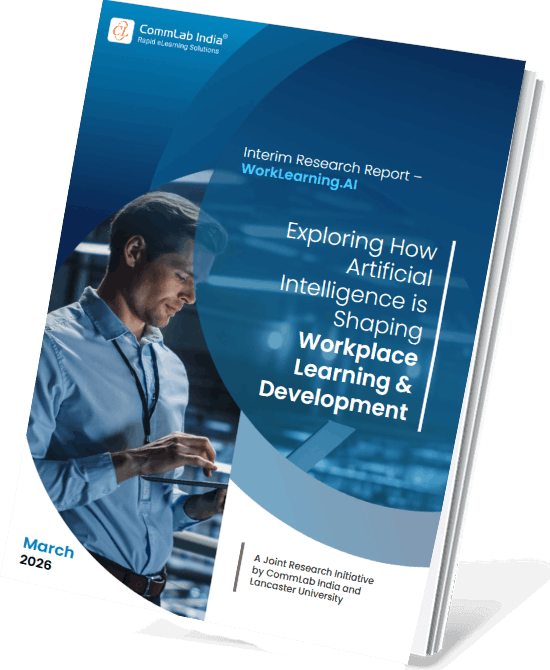
WorkLearning.AI Interim Research Report
A Joint Research Initiative by Lancaster University, UK and CommLab India