Most corporate training still behaves as if learners are empty vessels waiting to be filled. Content is uploaded, slides are narrated, quizzes are appended at the end, and completion reports are celebrated as success. Yet people return to their desks and work exactly as they did before.
The disconnect is not usually a lack of topics or technology. It is a failure to design for how adults actually learn.
Adult learning principles give learning and development teams a practical lens to correct this. They describe what adults need in order to pay attention, stay motivated, and transfer learning into performance. When these principles are treated as a strategic design framework, training stops being an event and becomes a driver of capability.
Within the first few hundred words, it is important to be precise:
Adult learning principles are the foundational conditions that must be present for adults to engage with, internalize, and apply new knowledge and skills.
They reflect how adults see themselves, how they process information, and how they relate new ideas to existing experience. When training is built around these principles, it feels relevant, respectful, and worth the learner’s time.
This article explores how to use adult learning principles to redesign corporate training and eLearning from content delivery to capability building. It focuses on application, not theory recitation, and connects design choices directly to business outcomes.
Download eBook: An L&D Manager’s Implementation Guide
Table of Contents
- Understanding Adult Learning in The Context of Work
- What are the Core Drivers of Adult Learning?
- Reframing Corporate Training Through an Adult Learning Lens
- Translating Adult Learning Principles Into eLearning Design
- Applying Adult Learning Principles Across The Learning Journey
- Measuring The Impact Of Adult Learning Principles
- FAQ
Understanding Adult Learning in The Context of Work
Adult learning theory is often introduced with academic terminology, but its implications are straightforward for corporate environments.
Employees arrive with existing identities, responsibilities, and pressures. They do not attend training to explore possibilities in the abstract. They attend because something is expected of them: a new system, a changed regulation, a revised performance standard, a role transition.
Adult learning principles recognize that:
- Time is limited and constantly traded against other priorities
- Experience already shapes how people interpret new input
- Motivation is linked to perceived usefulness and control
- Learning that does not connect to current or near future work will be ignored or quickly forgotten
In other words, training built for adults must be negotiated, not imposed. It needs to answer three questions very quickly:
- Why should I care about this right now
- How will this help me do my work better or more safely
- How much control do I have over what and how I learn
If those questions remain unanswered, no amount of animation, quizzes, or storytelling will rescue the experience.
What are the Core Drivers of Adult Learning?
Rather than memorizing lists of principles, it is more useful to focus on the underlying drivers that shape adult learning behavior. The following forces consistently determine whether adults lean into or disengage from learning.
1. Autonomy And Relevance
Adults expect to be treated as self-directing. They are more likely to engage deeply when they feel:
- They have a choice in how they navigate content
- The topics clearly intersect with their current role or career path
- Their time is being respected
Design implication: training must signal relevance early and give learners a degree of control. This can take the form of role based pathways, optional deep dives, or scenario choices that mirror daily decisions.
2. Experience As a Strategic Asset
Adults do not arrive as blank slates. They bring years of practice, stories, and mental models. Training that ignores this feels patronizing.
Design implication: learning experiences should invite learners to connect new ideas to prior experience. Case analysis, reflection prompts, and before-after comparisons help learners reframe existing knowledge rather than discard it.
3. Purpose, Goals, and Outcomes
Adults want to understand what success looks like. Vague promises of “improved skills” are not enough.
Design implication: make outcomes concrete. Replace generic objectives with statements like:
- “You will be able to conduct a 15 minute safety briefing that surfaces hidden risks and secures commitment.”
- “You will be able to configure the new CRM pipeline so that no qualified lead is lost between marketing and sales.”
Clear outcomes give learners a mental target and help managers reinforce the right behaviors back on the job.
4. Application and Practice
Adults evaluate training by its usefulness. If they cannot see how to apply it, they will not invest effort in retention.
Design implication: prioritize practice over exposition. Scenarios, simulations, job specific exercises, and guided walkthroughs create the bridge between concept and action. Explanations should support the activity, not the other way around.
5. Social Learning and Peer Insight
Adults learn a great deal from peers who share their constraints. Hearing how others solve similar problems is often more persuasive than formal instruction.
Design implication: integrate structured discussions, peer feedback, and collaborative problem solving into programs. In digital environments, this can mean social forums, cohort challenges, or shared reflections that build a sense of community.
6. Respect, Safety, and Trust
Adults will not share doubts, admit gaps, or experiment with new behaviors if they feel they are being judged or monitored for compliance alone.
Design implication: create psychological safety in both physical and virtual environments. Set norms that normalize questions, frame mistakes as learning data, and ensure assessments are used to support development, not only evaluation.
These drivers are not abstract ideals. They are practical levers that L&D teams can pull when designing any learning experience, regardless of modality.

An L&D Manager's Guide to Successful Planning & Implementation.
Learn:
- What Challenges do L&D Managers Face?
- How to Align Business and Project?
- How to be a Learning Consultancy?
- DOWNLOAD NOW!
Reframing Corporate Training Through an Adult Learning Lens
Once adult learning principles are understood as drivers, they can be used to reframe how training is conceived.
Instead of asking, “What do we need people to know” L&D teams begin asking, “What decisions, behaviors, and conversations need to change, and what experiences will make that change plausible for busy adults”
This shift has several implications.
First, training stops being a one time event and becomes a journey. Adults rarely change behavior after a single exposure. They need repeated encounters with ideas, opportunities to practice, feedback, and reminders in the flow of work.
Second, content volume is no longer a proxy for value. In many organizations, training has been judged by the richness of slides or the number of topics covered. Adult learning principles point in the opposite direction: less content, more application.
Third, managers become critical partners. Because adults care about relevance and application, their direct supervisors strongly influence whether they prioritize learning. Programs designed with managers in mind, including pre and post training touchpoints, feel more anchored in reality.
When adult learning principles drive strategy, corporate training moves from “information broadcast” to “performance enablement”.
Translating Adult Learning Principles Into eLearning Design
Digital learning is often where adult learning principles are most at risk. It is easy to convert slides into modules and assume that interactivity equals clicking. Applying adult learning principles requires more intentional design.
Structuring Digital Learning Journeys
Adults rarely consume long blocks of content in one sitting. Attention is fragmented, and work interruptions are constant.
- Break content into purposeful segments that each solve a clearly defined problem or answer a specific question.
- Use signposting to show learners where they are in the journey and what is coming next.
- Allow flexible pathways when possible, so learners in different roles or regions can prioritize what matters most.
The goal is not simply shorter modules but coherent micro journeys that collectively build capability.
Designing Activities That Reflect Real Work
Adults engage more deeply when activities look and feel like the situations they encounter daily.
Instead of asking them to recall definitions, immerse them in decisions:
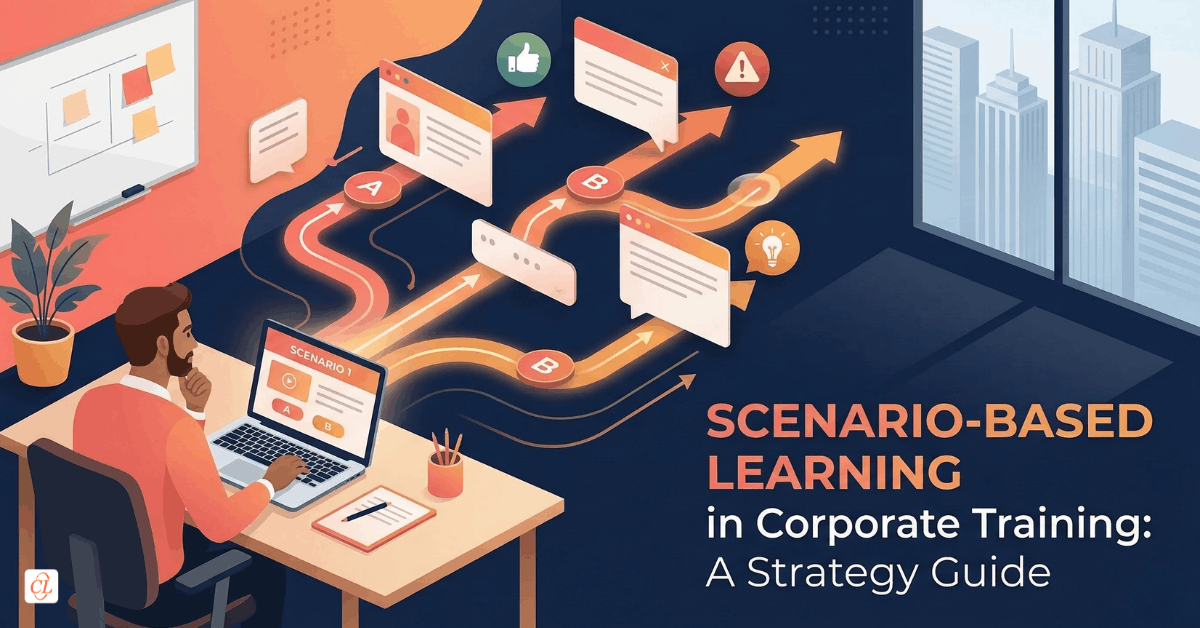
- Present a realistic conversation with a customer or colleague and ask them to choose a response.
- Show a dashboard or system screenshot and ask them to interpret patterns or take next steps.
- Provide a short case that mirrors a typical incident and guide them through the analysis.
The closer the scenario is to real work, the more adults will test and refine their assumptions rather than guess what the “training answer” might be.
Feedback, Reflection, And Self Direction
Adults appreciate feedback that is specific, respectful, and actionable.
- Replace generic “correct” or “incorrect” messages with explanations that connect choices to consequences.
- Encourage self reflection after key interactions. Ask learners what they would do differently next time and why.
- Provide optional resources so motivated learners can pursue deeper mastery without forcing everyone through the same material.
When eLearning supports reflection and self direction, it becomes a partner in ongoing development rather than a hurdle to clear.
Applying Adult Learning Principles Across the Learning Journey
Adult learning principles are not limited to the core module or classroom event. They should guide the entire end to end experience.
Before The Program
Adults are more receptive when they know what is coming and why it matters.
- Communicate the purpose of the program in plain language that links to current business priorities.
- Share a short diagnostic or reflection prompt that helps learners notice their own gaps or opportunities.
- Equip managers with a simple conversation guide to position the learning as support, not an obligation.
This pre work builds curiosity and primes experience, which are both core to adult learning.
During The Experience
Whether live, virtual, or self paced, the main learning experience should:
- Alternate between input and application so learners do not sit in long passive stretches.
- Surface the experience in the room. Ask for stories, examples, and workarounds rather than only presenting best practice.
- Acknowledge constraints openly. Adults respect facilitators who address real pressures instead of describing idealized situations.
These design choices signal respect and encourage learners to bring their full context into the discussion.
After The Program
Learning is fragile immediately after a program. Without reinforcement, most of it dissipates.
- Provide simple job aids that learners can use in the flow of work, such as checklists, conversation prompts, or diagnostic questions.
- Schedule short nudges or micro lessons that reconnect learners to key ideas in the weeks following the program.
- Encourage managers to revisit commitments made during training and ask what support is needed to sustain new behaviors.
This follow through reflects the principle of application and demonstrates that the organization values change, not just attendance.
Measuring The Impact Of Adult Learning Principles
Measurement is often limited to completion rates and satisfaction scores. Adult learning principles invite a broader, more meaningful view.
Consider three levels of measurement:
- Engagement Quality
Look beyond logins and time spent. Are learners returning to optional resources Are they participating in discussions Are they completing scenario branches and practice activities - Behavioral Indicators
Define what visible behaviors should shift if learning is effective. This might be the quality of customer conversations, adherence to safety protocols, or the way managers conduct feedback sessions. - Business Outcomes
Where possible, connect adult learning based programs to performance indicators, such as reduced error rates, increased conversion, faster onboarding, or fewer compliance incidents.
Adult learning principles are working when learners voluntarily reference training in their decisions, ask for more practice opportunities, and managers report observable change.
FAQ
1. What are adult learning principles in simple terms?
A. Adult learning principles describe what adults need in order to engage with and apply new knowledge. They emphasize relevance to current work, respect for existing experience, practical application, autonomy in learning, and a safe environment for questions and experimentation.
2. Why are adult learning principles important in corporate training?
A. In organizations, employees balance learning with heavy workloads. Adult learning principles help designers create programs that feel worth the time, connect directly to real tasks, and support behavior change rather than simply transmitting information.
3. How do adult learning principles change eLearning design?
A. They shift digital learning from linear content presentation to interactive journeys. Instead of long slide narrations, eLearning focuses on realistic scenarios, problem solving, reflection, and optional deep dives that align with learner needs and roles.
4. Can adult learning principles be applied to mandatory compliance training?
A. Yes. Even when training is mandatory, you can design experiences that mirror real compliance risks, show realistic consequences, invite reflection on past incidents, and provide tools that help employees apply the rules correctly in daily decisions.
5. What role do managers play in adult learning?
A. Managers strongly influence whether adults prioritize training and sustain new behaviors. When managers frame learning as support for performance, discuss application, and provide ongoing feedback, adult learning principles are reinforced instead of undermined.
6. How do you measure whether adult learning principles are working?
A. Look for behavioral and outcome signals. Are conversations with customers improving Are errors decreasing Are learners using tools or frameworks introduced in training These indicators show that adults are not just completing modules but changing how they work.
7. Are adult learning principles different in virtual and classroom settings?
A. The principles are the same, but their expression varies. In virtual settings, autonomy and relevance rely on flexible pathways and well designed interaction, while psychological safety depends on norms for participation and feedback in digital spaces.
Conclusion
Adult learning principles are sometimes treated as a theoretical backdrop, mentioned in design documents and forgotten in execution. In reality, they are a powerful practical framework for redesigning how organizations build capability.
When training respects autonomy, honors experience, connects directly to work, and provides meaningful practice, adults respond. They experiment with new behaviors, share insights with peers, and carry ideas back into daily decisions.
For learning and development leaders, adult learning principles are not a checklist. They are a design philosophy that influences strategy, governance, and stakeholder alignment.
- Program portfolios should be audited for relevance and application, not just coverage of topics.
- Vendor and tool decisions should be evaluated against their ability to support experiential, scenario based learning rather than only content hosting.
- Manager enablement becomes central, because they play a critical role in signaling relevance and supporting application on the job.
- Stakeholder conversations shift from “How many employees completed the module” to “What decisions or behaviors will look different in six months”
Adopting adult learning principles at a strategic level helps L&D teams move from order takers to partners in capability building.