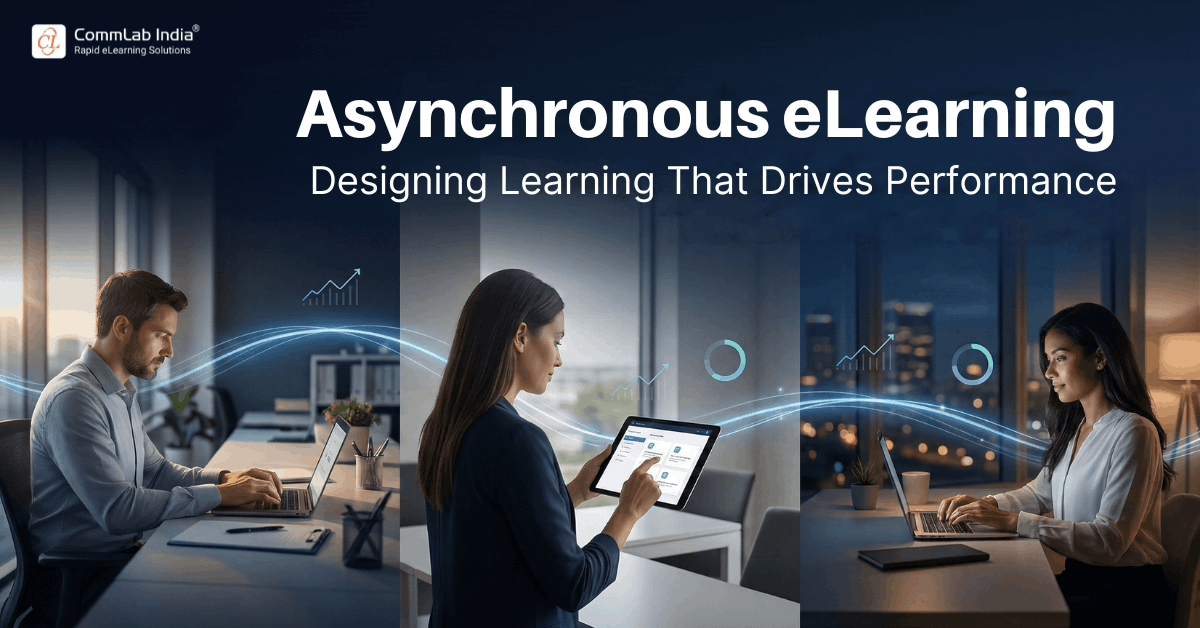
Enterprise learning has outgrown the classroom.
Distributed teams, hybrid schedules, and accelerating skill demands have made calendar-based training increasingly impractical. Coordinating live sessions across time zones is costly. Pulling employees into scheduled workshops disrupts operations. Even well-executed virtual sessions struggle to scale consistently.
In response, many organizations have turned to asynchronous eLearning. Yet too often, this shift is treated as a logistical adjustment rather than a strategic redesign. Courses become recorded slide decks. Completion rates replace competency metrics. Flexibility is achieved, but impact remains uneven.
Asynchronous learning is not simply “self-paced training.” It is a structural rethinking of how knowledge is delivered, reinforced, and translated into performance. When designed intentionally, it becomes one of the most powerful scalability engines in the enterprise learning ecosystem.
This article examines how to move beyond convenience-driven design and build asynchronous learning experiences that are measurable, engaging, and aligned with business outcomes.
Download Play Book: 25 Years of Insights for L&D Leaders
Table of Contents
- Reframing Asynchronous Learning Beyond “Self-Paced”
- Asynchronous and Synchronous: Strategic Complements, Not Competitors
- The Enterprise Imperative for Asynchronous Learning
- Designing High-Impact Asynchronous Courses
- Avoiding the Hidden Pitfalls of Self-Paced Learning
- Measuring Effectiveness in an Asynchronous Model
- When Asynchronous Learning Is Not Enough
- Strategic Implementation Roadmap
- FAQs
Reframing Asynchronous Learning Beyond “Self-Paced”
Asynchronous eLearning refers to instructional experiences that learners can access independently, without the need for real-time interaction with instructors or peers. Content, assessments, and interactions occur on demand rather than on schedule.
While the definition appears simple, its implications are significant.
In enterprise environments, asynchronous learning shifts control from facilitator-led pacing to learner-managed progression. That shift demands stronger instructional architecture. Without a live instructor to clarify concepts, regulate tempo, or stimulate discussion, the course design must carry the entire cognitive and motivational load.
When designed well, asynchronous learning achieves four strategic advantages:
- Global scalability across time zones
- Standardized messaging for compliance and policy
- Operational efficiency through reduced scheduling friction
- Repeatable, measurable delivery of core knowledge
When designed poorly, it becomes passive content consumption with limited behavioral impact.
The difference lies not in format, but in design maturity.
Asynchronous and Synchronous: Strategic Complements, Not Competitors
Organizations often debate asynchronous versus synchronous learning as though one must replace the other. In practice, they serve distinct instructional purposes.
Synchronous learning excels in real-time dialogue, collaborative problem solving, and live coaching. It is particularly valuable when emotional nuance, group dynamics, or immediate feedback are central to skill development.
Asynchronous learning, by contrast, offers flexibility, scalability, and consistency. It is particularly effective for foundational knowledge transfer, regulatory training, and standardized onboarding programs.
| Dimension | Synchronous Learning | Asynchronous Learning |
| Core Strength | Real-time engagement | On-demand flexibility |
| Interaction Style | Live discussion and dialogue | Self-paced progression |
| Clarification | Immediate instructor feedback | Learner-controlled review and revisit |
| Social Element | Strong peer interaction and energy | Independent learning experience |
| Facilitation | Facilitator-driven structure and momentum | Design-driven structure and autonomy |
| Scalability | Limited by scheduling and facilitator availability | Highly scalable across time zones |
| Scheduling | Requires coordinated timing | No scheduling constraints |
| Depth of Learning | Dynamic through live exchange | Reflective and self-directed depth |
The strategic decision is not about preference. It is about alignment.
When the objective is to build baseline understanding across a global workforce, asynchronous delivery often provides the most efficient solution. When the goal is to refine interpersonal negotiation skills, synchronous components may be indispensable.
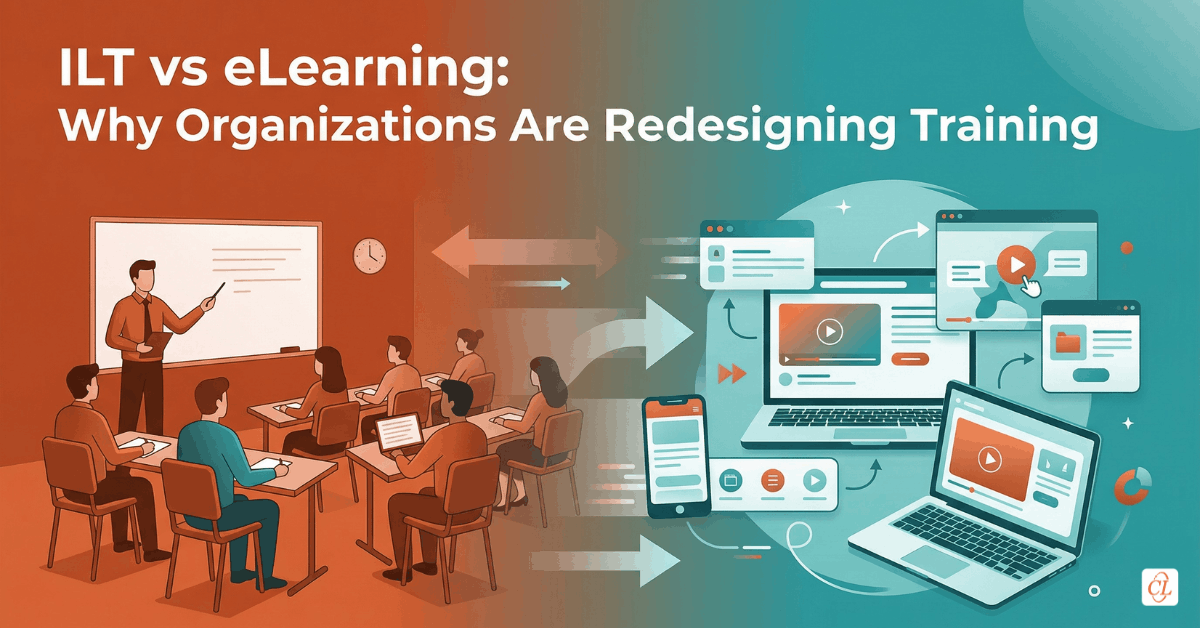
Mature learning strategies integrate both modalities intentionally. They use asynchronous learning to establish shared knowledge foundations and synchronous sessions to deepen practice where human interaction adds distinct value.
The Enterprise Imperative for Asynchronous Learning
The growing reliance on asynchronous models is not accidental. It is driven by structural business realities.
Asynchronous models address several persistent enterprise challenges.
- Global Workforce Distribution: When teams operate across regions, coordinating live sessions becomes logistically expensive.
- Operational Disruption: Pulling employees into scheduled sessions disrupts productivity.
- Scalability Requirements: Instructor-led programs scale linearly.
- Consistency and Compliance: Self-paced digital modules ensure standardized messaging, especially critical in regulated environments.
- Budget Optimization: Travel, facilitation, and venue costs are reduced significantly.
Asynchronous learning addresses these challenges directly. Once developed, a digital course can be deployed to thousands of employees without incremental facilitation costs. Standardized modules reduce variation in messaging. On-demand access allows employees to integrate learning into workflow gaps rather than rearranging schedules.
Yet scalability alone does not guarantee effectiveness. Without engagement, reinforcement, and performance alignment, asynchronous learning risks becoming an administrative exercise rather than a strategic lever.
The enterprise opportunity lies in designing asynchronous programs that balance flexibility with rigor.
Designing High-Impact Asynchronous Courses
The most common failure in asynchronous learning is passivity. Uploading narrated slides and labeling them as digital training does not constitute instructional design.
Uploading slides with narration is not instructional design. Effective asynchronous learning requires deliberate architecture.
A. Define Outcome Before Format
Start with performance outcomes:
- What should learners be able to do?
- What decisions must they make differently?
- What errors must decrease?
Without clear outcomes, asynchronous learning drifts into content consumption.

Learning Evolved: 25 Years of Insights for Modern L&D Leaders
Get ready to:
- Benchmark your eLearning journey
- Start with what’s working for top enterprise L&D teams
- Explore self-assessments, planners, and other tools
- Much More
B. Structure for Cognitive Flow
Self-paced learning requires stronger structural clarity than live sessions.
Each module should include:
- Clear objective statement
- Concept explanation
- Real-world application example
- Interactive checkpoint
- Reflection or reinforcement
Learners need internal pacing cues. Without them, cognitive overload increases.
C. Design Micro-Progression
Long modules reduce completion rates.
Break content into smaller, logically sequenced segments:
- 5–10 minute learning blocks
- Scenario-based segments
- Decision-driven interactions
Shorter units improve focus and give learners psychological momentum.
D. Build Meaningful Interactivity
Asynchronous does not mean static.
Use:
- Scenario branching
- Knowledge checks
- Drag-and-drop applications
- Decision simulations
- Realistic case dilemmas
Interactivity should test application, not recall.
E. Reinforce Through Spaced Learning
Without scheduled reinforcement, retention declines.
Add:
- Follow-up microlearning
- Scenario refreshers
- Performance support assets
- Job aids
- Reflective prompts
Asynchronous learning must extend beyond course completion.
Avoiding the Hidden Pitfalls of Self-Paced Learning
While asynchronous learning offers flexibility, it introduces specific risks that must be mitigated strategically.
| Risk in Asynchronous Learning | Why It Happens | Mitigation Strategies |
|
Low Completion Rates |
Autonomy without accountability reduces engagement and follow-through. |
|
| Passive Consumption | Minimal interaction encourages multitasking and surface-level attention. |
|
| Isolation | Limited peer interaction can reduce motivation and sense of shared learning. |
|
| Cognitive Overload | Learners cannot rely on facilitator pacing and may struggle with content flow. |
|
These limitations do not invalidate asynchronous models. They underscore the need for deliberate design governance.
Measuring Effectiveness in an Asynchronous Model
In many organizations, asynchronous learning is evaluated primarily by completion metrics. This approach provides administrative visibility but limited strategic insight.
True effectiveness requires measuring behavioral and performance outcomes.
Assessment design is a starting point. Are knowledge checks testing memorization, or do they simulate real-world decision-making? Application-based assessments yield deeper insight into readiness.
Behavioral indicators provide stronger evidence. Has compliance adherence improved? Have customer service errors decreased? Has time-to-competency shortened for new hires?
Learning analytics can reveal friction points within modules, identifying where learners disengage or struggle. Continuous optimization based on data ensures that asynchronous programs evolve alongside business needs.
Measurement must extend from the learning management system into operational performance.
When Asynchronous Learning Is Not Enough
Despite its advantages, asynchronous learning is not universally sufficient.
Complex interpersonal skills, high-stakes negotiation, and emotionally nuanced leadership development often benefit from real-time facilitation. Immediate feedback and collaborative exploration can accelerate mastery in ways that static modules cannot replicate.
In these scenarios, asynchronous learning can serve as a foundational layer, delivering core knowledge before live practice sessions. This blended approach optimizes both scalability and depth.
Strategic integration, rather than modality loyalty, produces the strongest outcomes.
Strategic Implementation Roadmap
Transitioning to asynchronous learning at scale is not a content conversion exercise. It is an operational redesign. Organizations that succeed treat it as a phased transformation rather than a one-time rollout.
Phase 1: Audit Existing Training
The first step is diagnostic, not creative.
Before building anything new, learning leaders must evaluate the current portfolio and identify which programs are best suited for asynchronous delivery. Strong candidates typically share specific characteristics: they are knowledge-heavy, compliance-driven, globally distributed, or frequently repeated across cohorts.
Knowledge-heavy programs that focus on policies, systems, product information, or foundational concepts often translate well into structured digital modules. Compliance training, where consistency and documentation matter, is particularly well suited to asynchronous delivery. Programs delivered repeatedly to multiple regions or business units also offer strong return on redesign investment.
This audit should go beyond content type. It should assess performance impact, audience size, delivery frequency, and operational burden. The goal is to prioritize programs where asynchronous redesign will produce both efficiency gains and measurable learning improvement.
Without this disciplined front-end analysis, organizations risk digitizing low-value training instead of modernizing high-impact programs.
Phase 2: Redesign for Engagement
Once priority programs are identified, redesign must focus on experience, not format.
Converting slide decks into eLearning modules is insufficient. Content-heavy sessions need to be restructured around decision-making and application. Scenario-driven modules help learners apply concepts in context rather than passively absorb information.
Shorter learning blocks improve focus and retention. Breaking long workshops into structured digital segments creates cognitive momentum and reduces fatigue. Each segment should move from concept to application, ensuring learners actively process information.
Assessments must also evolve. Instead of relying solely on recall-based quizzes, organizations should integrate application-based assessments that simulate workplace decisions. This shift transforms evaluation from knowledge verification into performance rehearsal.
Engagement in asynchronous learning is not accidental. It is engineered.
Phase 3: Build a Reinforcement Layer
Completion is not competence.
One of the most common failures in asynchronous initiatives is assuming that course completion equates to capability. Without reinforcement, retention declines and behavior remains unchanged.
A structured reinforcement layer extends learning beyond the initial module. Microlearning follow-ups delivered weeks after completion can refresh key concepts. Job aids and performance support tools embed guidance directly into workflow. Refresher quizzes can surface weak areas before errors occur.
Performance dashboards provide visibility into engagement patterns and knowledge gaps, enabling targeted reinforcement rather than generic reminders.
Reinforcement should be planned during design, not appended after launch. It transforms asynchronous learning from a single event into an ongoing performance system.
Phase 4: Align with Managers
Manager involvement is often the decisive factor in learning transfer.
Asynchronous learning increases learner autonomy, but autonomy without leadership support reduces accountability. Managers should not simply receive completion reports. They should understand the objectives of the training and be equipped to reinforce application.
Encouraging managers to discuss key takeaways during team meetings, observe behavior changes, and connect learning to performance goals strengthens transfer. Monitoring completion is necessary, but reinforcing relevance is more important.
When managers actively support asynchronous learning, it shifts from a compliance requirement to a performance expectation.
Phase 5: Optimize Based on Data
Scaling asynchronous learning does not end at deployment. It requires continuous refinement.
Data provides insight into friction points. Drop-off trends reveal where learners disengage. Assessment performance highlights misunderstood concepts. Time spent per module may indicate cognitive overload or insufficient challenge.
Analyzing these metrics allows organizations to improve clarity, adjust pacing, refine scenarios, and strengthen reinforcement strategies. Over time, iterative optimization enhances both engagement and impact.
Organizations that treat asynchronous learning as a living system rather than a static library achieve stronger long-term results.
A strategic implementation roadmap ensures that asynchronous learning evolves from isolated digital courses into an integrated capability-building architecture. With disciplined auditing, intentional redesign, reinforcement planning, managerial alignment, and data-driven refinement, organizations can scale learning without sacrificing depth or effectiveness.
Frequently Asked Questions
1. What is asynchronous eLearning?
A. Asynchronous eLearning allows learners to access training content independently without real-time instructor involvement. It provides flexibility while maintaining structured learning objectives and assessments.
2. What are the primary benefits for enterprises?
A. Asynchronous learning enables global scalability, cost efficiency, consistent compliance delivery, and minimal operational disruption while allowing employees to learn at their own pace.
3. What are its main limitations?
A. Potential challenges include reduced accountability, limited real-time interaction, and lower engagement if poorly designed. These risks can be mitigated through interactive design and reinforcement strategies.
4. How can organizations increase engagement in asynchronous courses?
A. Scenario-based learning, application-driven assessments, microlearning segmentation, and structured reflection prompts significantly improve learner engagement and retention.
5. When should synchronous learning be used instead?
A. Synchronous learning is particularly valuable for collaborative exercises, emotionally nuanced discussions, and skills requiring immediate feedback or group dynamics.
Conclusion
Asynchronous eLearning represents more than a scheduling solution. It is a structural response to the realities of modern enterprise work.
When thoughtfully designed, it delivers scalable capability development without sacrificing engagement or rigor. When treated as a shortcut, it becomes digital content storage with limited behavioral impact.
The future of enterprise learning will not be defined by modality alone. It will be defined by intentional design, strategic alignment, and measurable performance outcomes.
Asynchronous learning, when executed with discipline and insight, stands at the center of that evolution.